Ancient DNA recovered from a tooth in South Africa dating to around 50,000 years represents the oldest genetic material yet retrieved from sub-Saharan Africa. The findings demonstrate that valuable ancient DNA can survive in warmer climates and suggest that fossil-rich sites across the region may hold far greater genetic potential than previously believed.
For decades, ancient DNA research has largely focused on cold regions, where freezing temperatures slow the breakdown of genetic material. That has left many of Africa’s fossil-rich archaeological sites underexplored, despite their importance for understanding the continent’s past.
New research now challenges that long-standing assumption. By successfully extracting ancient DNA from fossils collected at multiple sites along South Africa’s southern coast, researchers have shown that genetic material can survive for tens of thousands of years even in environments traditionally considered unfavorable for preservation.
The study, published in Quaternary Science Reviews, provides evidence that paleogenetic research in warmer climates can be far more productive than previously expected.
Testing DNA Preservation Across South Africa’s Fossil Record
Rather than focusing on a single specimen, the researchers examined fossils spanning a wide range of ages and locations. Their goal was to determine whether recoverable DNA could be found in ancient animal remains preserved under different environmental conditions.
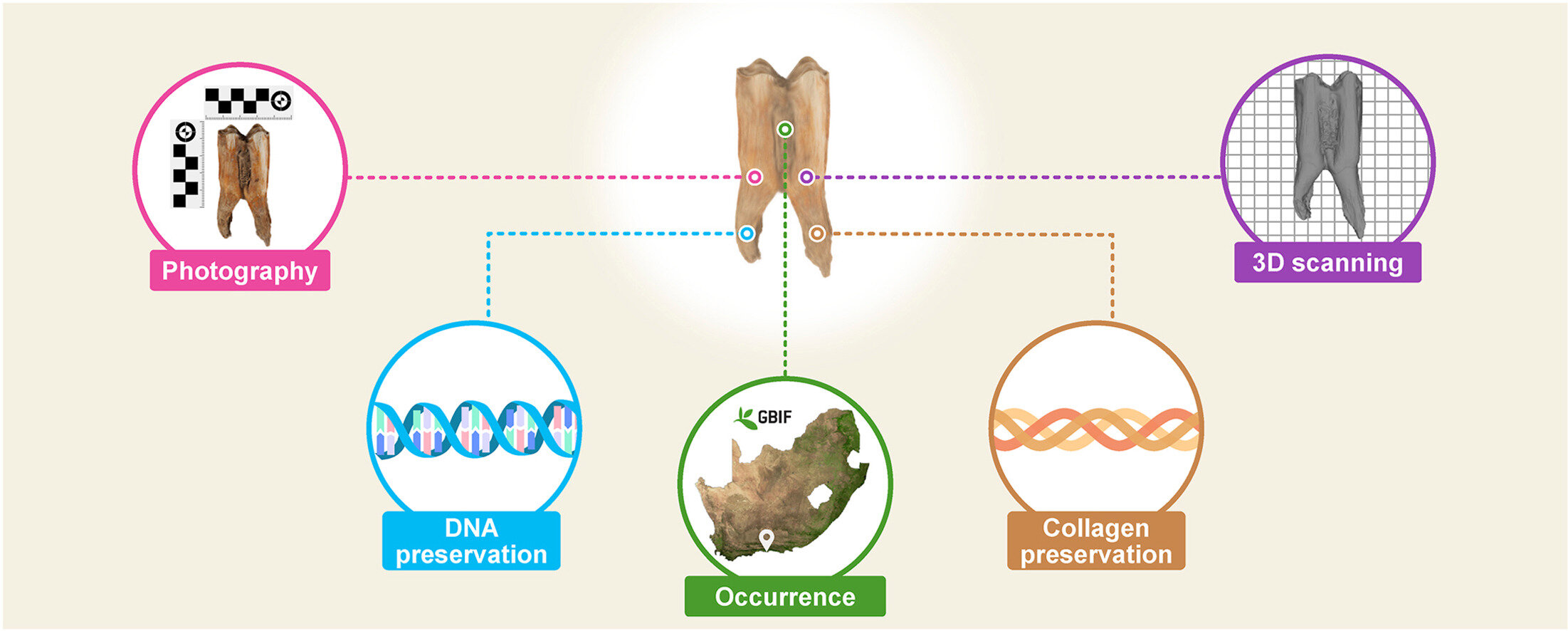
The team analyzed 320 fossil teeth and bones from six species of wild bovids—the mammal family that includes antelope and buffalo. These remains covered roughly the past 110,000 years and came from six cave and rock shelter sites along South Africa’s southern coastline.
From that larger collection, 144 specimens were selected for ancient DNA screening.
To maximize their chances of recovering degraded genetic material, the researchers compared two laboratory techniques. One targeted traditional double-stranded DNA, while the other focused on single-stranded DNA, a method designed to recover extremely small, damaged DNA fragments that conventional approaches often fail to detect.
Because the single-stranded technique effectively separates damaged DNA into recoverable fragments, it proved particularly well suited for ancient specimens that had undergone thousands of years of natural degradation.
Single-Stranded DNA Method Delivered Far Better Results
The study achieved a surprisingly high recovery rate.
Ancient DNA was successfully extracted from 65 of the 144 specimens, representing a 45% success rate.
The single-stranded method consistently outperformed the traditional approach. According to the researchers, it recovered up to 6.7 times more animal DNA than the double-stranded technique.
Those results suggest that methodological advances can substantially improve DNA recovery from fossils preserved outside the cold environments that have historically dominated ancient DNA research.
Instead of confirming expectations of poor preservation, the findings indicate that at least some fossils from South Africa retain enough surviving genetic material for meaningful analysis.
Oldest Ancient DNA Yet Retrieved From Sub-Saharan Africa
Among the successful samples, one stands out for its age.
Researchers recovered DNA from a tooth estimated to be about 50,000 years old, making it the oldest ancient DNA yet obtained from sub-Saharan Africa.
Most of the successful DNA recoveries came from the more recent Holocene period. Before this study, the oldest genome recovered from a wild South African animal belonged to an extinct blue antelope that lived approximately 9,300 years ago.
The new research extends that timeline substantially.
In addition to the oldest specimen, the researchers recovered DNA from four much older fossils, including three teeth from the extinct long-horned buffalo and one tooth from a mountain reedbuck, dating between roughly 12,000 and 50,000 years ago.
These older recoveries demonstrate that DNA preservation in South Africa extends well beyond the youngest archaeological deposits previously thought most likely to yield usable genetic material.
Challenging Assumptions About Warm-Climate DNA Preservation
The findings carry implications beyond the individual fossils themselves.
Ancient DNA studies have often concentrated on colder parts of the world because low temperatures slow the chemical processes that damage DNA after death. Warmer climates, by contrast, have generally been viewed as poor candidates for preserving ancient genetic material over long periods.
The South African results show that this assumption does not always hold.
As the researchers write in their paper, “We show that paleogenetic studies on fauna at lower latitudes are possible.“
That conclusion suggests that other fossil collections from similar environments may also preserve recoverable DNA, opening opportunities to investigate ancient animal populations that have remained genetically inaccessible.
Guidance for Future Research
Although the study demonstrated that much older specimens can preserve DNA, the researchers also identified where future work may be most productive.
Based on their results, they recommend prioritizing Holocene specimens, which consistently produced the highest rates of successful DNA recovery.
As the authors note, “Targeting Holocene specimens will provide the best chance of success.“
Even so, the recovery of DNA from fossils dating back as far as 50,000 years shows that older material should not automatically be ruled out. The study demonstrates that careful sample selection combined with sensitive laboratory methods can reveal ancient genetic information from fossils preserved in environments once considered unlikely to yield such evidence.
Together, these findings broaden the possibilities for future paleogenetic research in sub-Saharan Africa and show that the region’s fossil record may contain far more recoverable genetic history than previously recognized.