The newly identified marsupial Miyumba chrisdickmani pushes the confirmed fossil history of the Dasyuridae family back to the Early Miocene, revealing the oldest known true member of the group that today includes quolls, dunnarts, antechinuses, and the Tasmanian devil. The remarkably preserved fossils also led researchers to identify a new dental feature that helps define the family, offering fresh insight into how Australia’s iconic small carnivorous marsupials evolved.
Australia’s living predatory marsupials belong to the family Dasyuridae, a remarkably diverse group that ranges from tiny insect-hunting dunnarts weighing only a few grams to the much larger Tasmanian devil. Despite their modern success, their early evolutionary history has remained surprisingly mysterious.
For decades, paleontologists had found fossils resembling early dasyurids, but none could be confidently placed within the family. Many of those fossils were eventually reassigned to entirely different branches of marsupial evolution after closer study. As a result, confirmed members of Dasyuridae were absent from the fossil record before the Pliocene, leaving a gap of millions of years between evolutionary estimates and fossil evidence.
The newly described species, Miyumba chrisdickmani, changes that picture dramatically.
Recovered from the Early Miocene deposits of the Riversleigh World Heritage Area in northwestern Queensland, the fossils show that true dasyurids were already present about 18.24 million years ago, making the species the oldest confirmed representative of the family.
Fossils from multiple jaws revealed a previously unknown animal
Rather than relying on a single specimen, the researchers studied a series of fossilized lower jaws collected from several Early Miocene fossil sites at Riversleigh. Together, these specimens preserved much of the lower dentition, allowing scientists to reconstruct the animal’s anatomy with unusual confidence.
The fossils were examined using high-resolution micro-computed tomography (micro-CT) scanning, enabling researchers to visualize tiny anatomical details hidden inside the rock and digitally reconstruct the jaws and teeth.
The team carefully measured every preserved tooth and compared the new species with a broad range of living and extinct marsupials. Those comparisons included modern dasyurids, extinct thylacinids, malleodectids, myrmecobiids, keeunamorphians, and several other fossil marsupial groups whose relationships have long been debated.
The combination of dental characteristics proved unlike any previously known species, leading the researchers to establish both a new genus and a new species: Miyumba chrisdickmani.
The genus name comes from the Waanyi word “Miyumba,” referring to the country where Riversleigh is located, while the species honors Professor Chris Dickman for his major contributions to the study of Australian marsupials.
An ancient marsupial that looked surprisingly modern
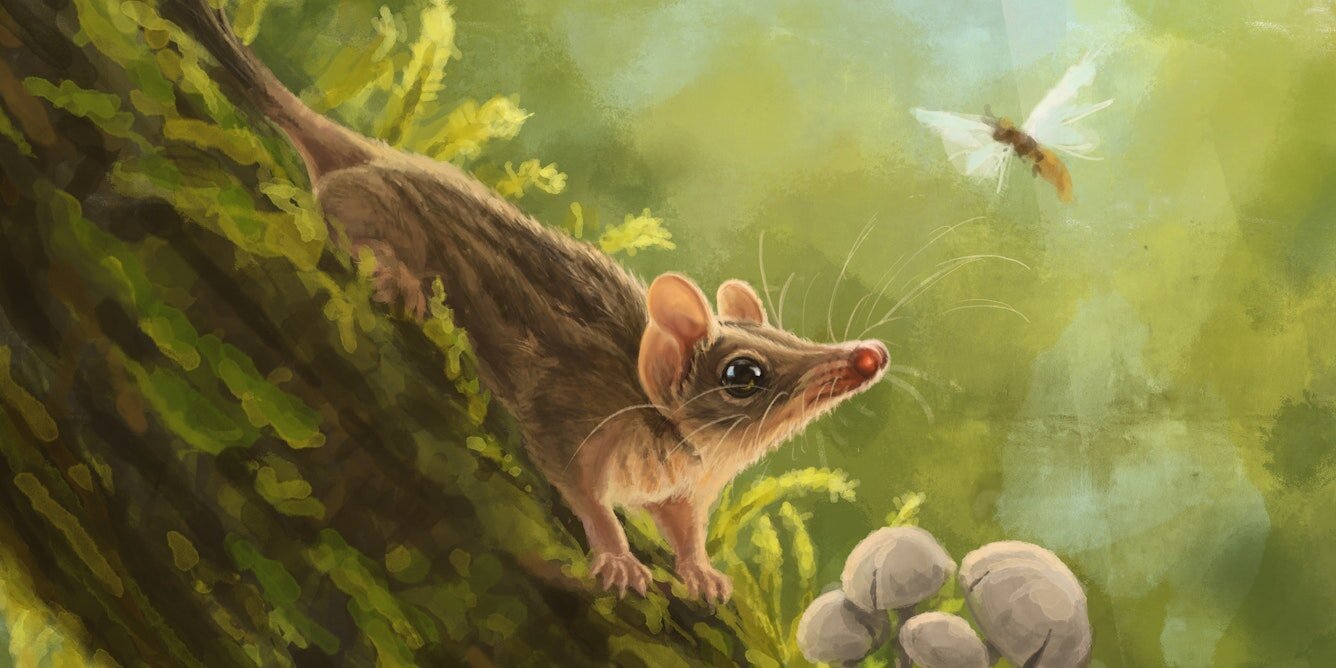
Although Miyumba chrisdickmani lived nearly 18 million years ago, its estimated size would not have looked unusual among Australia’s living small carnivorous marsupials.
Using established body-mass equations based on tooth measurements, the researchers estimated the animal weighed between 23.3 and 33.5 grams depending on the specimen. That places it close to living Antechinus species and several modern Sminthopsis relatives.
The teeth reveal an animal adapted for catching and eating small prey. Like modern dasyurids, it possessed sharp, slicing molars designed for processing insects and other small animals. Yet it also retained several primitive dental traits that later disappeared in more specialized descendants.
This blend of ancient and modern characteristics makes the species especially valuable because it appears to capture an early stage in dasyurid evolution.
A new clue hidden in the teeth
One of the study’s most important contributions extends beyond describing a new species.
The researchers identified what they consider a previously unrecognized dental synapomorphy—a shared anatomical feature that unites all members of Dasyuridae.
Finding such defining characteristics has been a longstanding challenge because the family previously lacked reliable dental features that could consistently distinguish it from closely related extinct marsupials.
The team also introduced several additional dental characters into their evolutionary dataset, allowing finer distinctions among fossil species whose relationships have remained uncertain.
These new characters improve researchers’ ability to identify fragmentary fossils, which often consist only of isolated teeth or jaw fragments.
Testing where the new species fits
The team did not rely on appearance alone.
Instead, they incorporated the new species into two separate evolutionary analyses. One used a large morphological dataset of skeletal and dental features analyzed with maximum parsimony methods. The second combined anatomical evidence with genetic information from living marsupials in a Bayesian total-evidence analysis.
Both approaches independently reached the same broad conclusion.
They consistently placed Miyumba chrisdickmani as the sister lineage to every other known dasyurid, meaning it represents the earliest-diverging branch currently recognized within the family.
That position suggests the species preserves an exceptionally primitive stage in dasyurid evolution, close to the family’s origin.
The analyses also clarified the positions of several other puzzling fossil marsupials.
The tiny Mayigriphus orbus was recovered either as a member of the dasyurid subfamily Sminthopsinae or as the second-most primitive dasyurid after Miyumba chrisdickmani, depending on the analytical method.
Meanwhile, Joculusium muizoni, previously considered one of the most primitive dasyuromorphians, fell outside Dasyuridae, forming a sister lineage rather than belonging within the family itself.
The analyses also supported placing Urrayira whitei within the living genus Planigale, while Antechinus yuna and Antechinus yammal were recovered as members of Antechinus.
What the fossils suggest about ancient rainforests
The study’s conclusions reach beyond anatomy.
The researchers note that Miyumba chrisdickmani shares notable similarities with living dasyurids found in New Guinea. That resemblance raises the possibility that some modern New Guinean rainforest marsupials may represent descendants of lineages whose deeper origins trace back to the lush Miocene rainforests once covering Riversleigh.
If that interpretation is correct, the new fossil could represent another surviving branch of rainforest-adapted marsupials whose evolutionary roots extend far deeper into Australia’s past than previously demonstrated.
A clearer—but still incomplete—picture
Although the fossils substantially improve understanding of early dasyurid evolution, the picture remains incomplete.
The new species is currently known only from lower jaw material and teeth, leaving many aspects of its anatomy unknown. Because of this limited preservation, the researchers could score only a fraction of the anatomical characters used in their evolutionary analyses.
Future discoveries of skulls, upper teeth, or postcranial bones could test whether the species truly occupies the deepest branch of the dasyurid family tree and provide a more complete understanding of how the earliest members of Australia’s dominant predatory marsupial family evolved.
For now, Miyumba chrisdickmani fills one of the most persistent gaps in Australia’s fossil record, extending the confirmed history of Dasyuridae into the Early Miocene and providing the strongest fossil evidence yet for the earliest known stage in the evolution of one of the continent’s most successful groups of marsupial predators.