Extreme droughts that coincided with the Late Bronze Age collapse were likely not isolated climate accidents but the result of multiple long-term and short-term climate processes lining up at the same time. A new modeling study suggests that gradual drying across the Eastern Mediterranean, combined with naturally occurring variability in the Atlantic Ocean, created severe water shortages capable of pushing an already vulnerable region beyond critical environmental thresholds.
For decades, archaeologists and climate scientists have debated whether drought played a meaningful role in the widespread societal upheaval that swept across the Eastern Mediterranean between roughly 1300 and 900 BCE. During this period, several powerful civilizations—including the Mycenaeans in Greece and the Hittite Empire in Anatolia—experienced political fragmentation, population decline, and economic disruption.
The new research argues that the climate story was more complex than a single drought. Instead, the region experienced thousands of years of gradual environmental change before a series of exceptionally severe dry periods emerged.
Using a fully transient Holocene climate simulation that spans the past 8,000 years, the researchers reconstructed how rainfall, temperature, soil moisture, vegetation, and large-scale ocean-atmosphere circulation evolved across the Eastern Mediterranean. Rather than attempting to reproduce individual historical years, the model was designed to reveal the physical processes that naturally generate long-term climate variability.
The simulation successfully reproduced the broad drying trend identified by numerous paleoclimate records while also generating major drought episodes comparable in timing to those documented in geological evidence.
Drying unfolded differently across the region
The model showed that the Eastern Mediterranean did not become uniformly drier.
Rainfall gradually declined across much of the region, but cooling temperatures altered how that decline affected local environments. Cooler conditions reduced potential evapotranspiration, meaning less water evaporated from soils and vegetation.
As a result, parts of the Balkans and Anatolia actually experienced improved effective moisture despite receiving less rainfall. Lower evaporative demand helped offset declining precipitation.
The Levant, however, followed a different path.
There, rainfall declined while temperatures changed very little, leaving evaporative demand largely unchanged. The region therefore remained persistently dry throughout the simulation, maintaining much lower moisture availability than areas farther north.
The findings suggest that ancient communities across the Eastern Mediterranean were not all exposed to the same environmental pressures. Instead, neighboring regions experienced very different combinations of rainfall loss, cooling, and water availability.
Several ancient megadroughts emerged from the simulation
Beyond the long-term drying trend, the model identified three major intervals of prolonged drought centered around 4000–3500 BCE, 2600–2100 BCE, and 1400–900 BCE.
The last of these overlaps closely with the period associated with the Late Bronze Age collapse.
During this interval, rainfall decreased across much of the Eastern Mediterranean while temperatures and atmospheric water demand combined to produce exceptionally low effective moisture.
The strongest moisture deficits reached roughly 10 to 12 millimeters per month below average in parts of the Balkans and Anatolia, accompanied by marked declines in the region’s aridity index. Conditions later recovered, but only after centuries of severe hydroclimatic stress.
Importantly, the researchers found that these droughts did not simply represent an intensification of the long-term drying trend. Instead, they reflected the interaction of multiple climate processes operating over different timescales.
The Atlantic Ocean played a surprisingly important role
The study points to the Atlantic Ocean as a key driver of these extreme drought episodes.
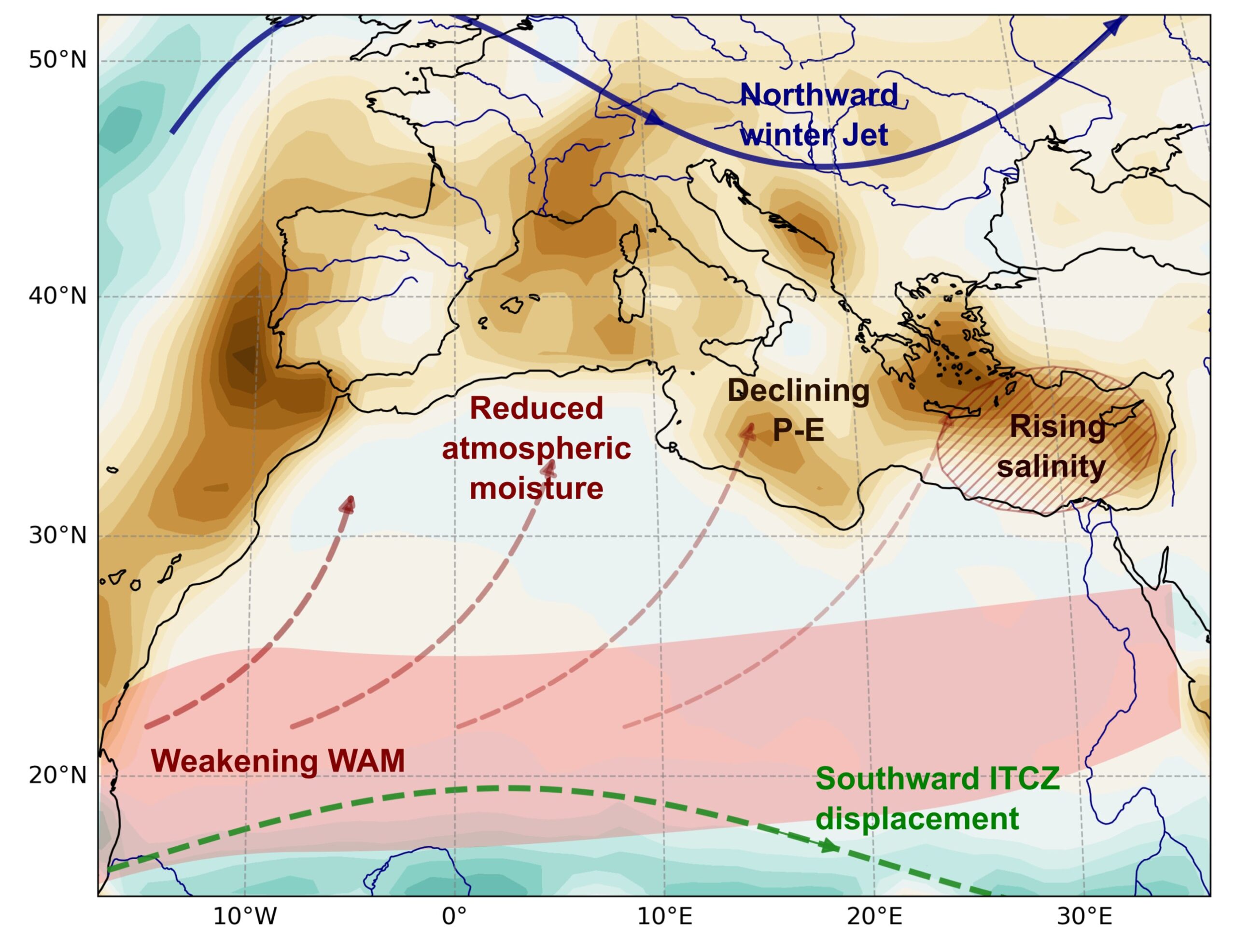
Over thousands of years, changes in Earth’s orbit gradually reduced Northern Hemisphere summer sunlight. That weakened major monsoon systems, shifted the Intertropical Convergence Zone southward, and reduced the amount of moisture transported toward the Mediterranean.
This slow background drying altered the region’s average climate.
At shorter timescales, however, internal variability within the Atlantic became increasingly important.
The model indicates that fluctuations in the Atlantic Meridional Overturning Circulation (AMOC), North Atlantic sea surface temperatures, and the North Atlantic Oscillation (NAO) affected Mediterranean temperatures, atmospheric moisture, and rainfall.
Rather than acting independently, these climate patterns occasionally entered dry phases simultaneously.
When long-term orbital drying, multicentennial Mediterranean temperature changes, and centennial Atlantic variability aligned, their combined influence produced droughts far more severe than any single process could generate alone.
Wavelet analysis performed in the study showed that the major droughts emerged when these different modes synchronized, amplifying regional drying through what the researchers describe as constructive interference across multiple timescales.
Geological evidence broadly supports the model
To test the realism of the simulation, the researchers compared it with numerous independent paleoclimate records collected across the Balkans, Anatolia, and the Levant.
These included cave formations, lake sediments, marine deposits, and pollen records.
Overall, the simulated drought intervals corresponded well with evidence for reduced moisture recorded in these proxies.
The strongest agreement appeared during the Late Bronze Age drought, when multiple independent records indicated sustained dry conditions across much of the Eastern Mediterranean.
The earlier 4.2-kiloyear event, another well-known period of abrupt climate change, also appeared in both the simulation and proxy evidence, although its regional expression was more variable.
The comparison suggests that the model captures not only long-term climate evolution but also the timing and relative magnitude of major hydroclimatic disruptions documented in geological archives.
Ancient ecosystems responded in unexpected ways
The study also reconstructed how vegetation changed during these climate shifts.
Despite decreasing rainfall, forests expanded across much of the Balkans and Turkey over the long term.
Cooling reduced evaporative demand enough to improve overall moisture efficiency, allowing woody vegetation to spread even as precipitation slowly declined.
Turkey proved especially sensitive because it lies near an ecological threshold separating steppe from woodland. Relatively small improvements in effective moisture triggered substantial forest expansion.
The Levant behaved differently.
Its vegetation remained closely tied to rainfall because the region stayed below the moisture threshold needed for widespread woodland growth. Grass-dominated landscapes persisted throughout the simulation with little long-term ecological change.
These contrasting responses illustrate that rainfall alone cannot explain how ecosystems respond to climate change. Temperature, evaporation, and regional ecological thresholds can be equally important.
Climate alone cannot explain the collapse
Although the findings provide a physical mechanism linking climate variability with the environmental conditions surrounding the Late Bronze Age collapse, the researchers do not argue that drought alone caused societal breakdown.
Instead, they suggest that internally generated Atlantic climate variability acted upon an already drying background climate, pushing regional water availability across critical thresholds.
Such environmental stress would likely have intensified food insecurity and placed additional pressure on societies already facing political, economic, and social challenges.
The study therefore presents climate as one component of a much broader system rather than a single explanation for the collapse of ancient civilizations.
What the findings could mean for the future
The researchers also see modern relevance in these ancient climate dynamics.
Today’s Mediterranean is already warming rapidly under human-driven climate change, while climate projections suggest the AMOC could weaken during the coming centuries.
Their results indicate that future drought risk may depend not only on gradual warming but also on how internal Atlantic climate variability interacts with that changing background state.
The authors caution, however, that their simulation did not include time-varying volcanic eruptions, meaning it cannot reproduce the exact timing of historical drought events. Because internal climate variability develops freely within the model, individual drought years should not be interpreted as direct reconstructions of the past.
Instead, the study offers a process-based explanation showing how natural Atlantic variability, operating across multiple timescales, can combine with long-term climate trends to produce prolonged regional droughts capable of reshaping both landscapes and the societies that depend on them.
Publication details
Katherine Power, Holocene ocean-atmosphere coupling and Mediterranean sensitivity to Atlantic circulation: Lessons from the Late Bronze Age collapse, Science Advances (2026). DOI: 10.1126/sciadv.aed5439. www.science.org/doi/10.1126/sciadv.aed5439