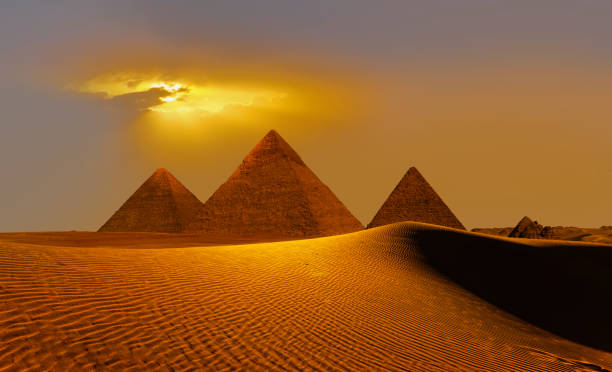
Across the golden sands of the Giza Plateau, the colossal forms of the pyramids rise against the Egyptian sky, silent yet overwhelming. For more than four thousand years, they have watched empires bloom and fade, religions shift, languages evolve, and technologies leap from bronze tools to space telescopes. They have inspired awe, speculation, and sometimes wild imagination. Why were they built? What purpose demanded such staggering labor, precision, and ambition?
The pyramids of ancient Egypt, especially the Great Pyramid built for Pharaoh Khufu during the Fourth Dynasty of the Old Kingdom, are among the most studied monuments in human history. Archaeology, geology, engineering analysis, inscriptions, and comparative studies of ancient culture provide a scientifically grounded picture of their purpose. They were not alien beacons, mystical power plants, or secret astronomical machines. They were products of a sophisticated civilization expressing political authority, religious belief, technological mastery, and cosmic vision.
Understanding why the pyramids were built requires stepping into the worldview of ancient Egypt. It means recognizing that architecture, religion, kingship, astronomy, economics, and society were deeply intertwined. The pyramids were not just stone structures. They were statements about life, death, divinity, and eternity.
What follows are nine scientifically supported reasons that explain why the pyramids were built, drawn from archaeological evidence, ancient texts, and careful historical study.
1. Royal Tombs for Divine Kings
The primary and most firmly established reason the pyramids were built was to serve as tombs for pharaohs. Archaeological evidence overwhelmingly supports this conclusion. The pyramids at Giza were constructed for Khufu, Khafre, and Menkaure, rulers of the Fourth Dynasty. Their names are found in inscriptions inside the monuments, including quarry marks left by work crews.
In ancient Egyptian belief, the pharaoh was not merely a political leader. He was considered divine or semi-divine, a mediator between gods and humanity. Upon death, the king was believed to join the gods in the afterlife. His physical body needed preservation through mummification, and his burial place had to be secure, monumental, and eternal.
Earlier Egyptian rulers were buried in mastabas, flat-roofed rectangular tombs. Over time, these evolved into stepped pyramids, such as the Step Pyramid of Djoser at Saqqara, and eventually into smooth-sided pyramids. This architectural progression is visible in the archaeological record and demonstrates a clear development in royal burial design.
Inside the pyramids are burial chambers, sarcophagi, and internal passageways. Surrounding them are mortuary temples and smaller pyramids for queens. These features align with known Egyptian funerary practices. The pyramids were not isolated monuments; they were central components of elaborate royal funerary complexes.
2. Ensuring the Pharaoh’s Journey to the Afterlife
In ancient Egyptian religion, death was not an end but a transition. The soul, or “ka” and “ba,” required ritual support to navigate the afterlife. The pyramid functioned as a spiritual launch platform for this cosmic journey.
The shape of the pyramid itself may have symbolic significance. Its sloping sides resemble rays of the sun. The sun god Ra played a central role in Egyptian belief, particularly during the Old Kingdom. The king was closely associated with Ra and was believed to ascend to the sky after death to join the solar cycle.
Texts found in later pyramids, known as Pyramid Texts, contain spells and instructions intended to help the deceased king rise to the heavens. Though these texts appear after the Giza pyramids, they reflect beliefs that were already forming during the Fourth Dynasty. The architecture aligns with these cosmological ideas.
The orientation of the pyramids is also striking. The Great Pyramid of Khufu is aligned with remarkable precision to the cardinal directions—north, south, east, and west. Such alignment reflects careful astronomical observation and supports the idea that the pyramid was meant to connect the earthly king with the cosmic order.
3. Demonstrating Political Power and Central Authority
The construction of the pyramids required immense organization, planning, and resources. Contrary to outdated myths, they were not built by enslaved masses but by skilled laborers, artisans, engineers, and seasonal workers supported by the state.
Excavations near the Giza Plateau have uncovered workers’ villages, bakeries, breweries, and administrative buildings. These discoveries reveal a highly organized workforce. Feeding, housing, and coordinating thousands of workers demanded a powerful and centralized government.
The pyramids thus served as visible proof of the pharaoh’s authority. Only a ruler with vast control over agricultural surplus, labor, and materials could undertake such a project. The Nile’s annual flooding created predictable agricultural cycles, allowing labor to be mobilized during off-seasons.
In this sense, the pyramids were political statements. They demonstrated that the pharaoh maintained ma’at, the concept of cosmic order and harmony. A stable kingdom capable of constructing such monuments was evidence of divine favor and effective rule.
4. Reinforcing Religious Ideology
Religion in ancient Egypt permeated every aspect of life. The pyramids were not isolated tombs but centers of ritual activity. Mortuary temples attached to the pyramids were sites where priests performed daily offerings to sustain the deceased king’s spirit.
These rituals were essential. Egyptians believed that without offerings and remembrance, the dead could suffer in the afterlife. The pyramid complex functioned as a perpetual religious institution, supported by endowments of land and resources.
The very act of building such a monument reinforced belief in the divine nature of kingship. The king’s transformation into an eternal being was dramatized through architecture. The pyramid, visible for miles across the desert, constantly reminded the population of the ruler’s sacred role.
This religious function was not symbolic in a modern metaphorical sense. For ancient Egyptians, it was literal. The pyramid was a necessary mechanism in the spiritual machinery of the universe.
5. Creating an Eternal Monument in Stone
The Egyptians were deeply concerned with permanence. While ordinary houses were made of mudbrick, royal monuments were constructed from stone. Stone signified durability and eternity.
The desert plateau west of the Nile was chosen intentionally. The west was associated with the setting sun and the realm of the dead. Building the pyramids in stone on the western bank aligned with religious symbolism and practical preservation. The dry desert environment also helped protect structures from flooding.
The scale and durability of the pyramids reflect a desire to defy time. The Great Pyramid originally stood about 146 meters tall and remained the tallest human-made structure for nearly four thousand years. Its massive limestone blocks, some weighing several tons, were precisely fitted.
In choosing stone and monumental scale, the builders aimed to ensure that the king’s name and legacy would endure forever. In many ways, they succeeded.
6. Showcasing Technological and Engineering Mastery
The pyramids represent extraordinary achievements in ancient engineering. Quarrying, transporting, and placing millions of stone blocks required advanced planning and skilled craftsmanship.
Archaeological studies of quarries near Giza show how limestone was extracted. Copper tools, stone hammers, sledges, and ramps were used. Recent research suggests that water may have been poured on sand to reduce friction when moving heavy loads.
The precision of construction is remarkable. The base of the Great Pyramid is nearly perfectly square, and its sides are aligned with astonishing accuracy. This precision was achieved without modern instruments, relying instead on careful observation of stars and the Sun.
Building the pyramids allowed the Egyptian state to refine logistical systems, measurement techniques, and construction methods. These skills influenced later monumental projects, including temples and obelisks.
The pyramids were not built for experimentation, but the process itself drove technological development.
7. Anchoring the Cosmic Order
Ancient Egyptians believed in ma’at, the principle of balance and order that governed both society and the cosmos. The pharaoh was responsible for upholding ma’at. The pyramid symbolized stability, balance, and geometric perfection.
Its four triangular faces converge at a single point, reflecting unity and harmony. Its orientation to the cardinal directions connects it to the Earth’s structure. Some scholars argue that the alignment with certain circumpolar stars, which never set, symbolized eternity.
By constructing a monument aligned with cosmic patterns, the Egyptians were embedding their ruler into the fabric of the universe. The pyramid was both earthly and celestial. It stood as a fixed point in a changing world.
The very act of monumental construction may have been viewed as restoring order against chaos. In this worldview, architecture was not separate from cosmology. It was cosmology made visible.
8. Stimulating Economic Organization and Social Cohesion
Large-scale construction projects can unify societies. The pyramids required coordinated effort across regions. Stone came from different quarries. Food was supplied from agricultural centers. Craftspeople contributed specialized skills.
This mobilization strengthened economic networks and reinforced administrative systems. Taxes in the form of grain and labor supported the project. Skilled workers gained status and training.
Excavations of workers’ settlements reveal evidence of adequate nutrition and medical care. This suggests that pyramid builders were valued members of society rather than disposable laborers.
In building the pyramids, Egypt was not merely constructing tombs. It was exercising and refining the mechanisms of state organization. The project fostered a shared sense of participation in something grand and meaningful.
9. Preserving the Pharaoh’s Legacy and Name
For ancient Egyptians, being remembered was a form of immortality. Names were carved into stone to ensure they would endure. The pyramid guaranteed that the king’s name would be associated with a permanent monument.
The Giza pyramids remain synonymous with Khufu, Khafre, and Menkaure. Even today, their names are spoken because of these structures. In Egyptian belief, the erasure of a name could threaten the deceased’s existence in the afterlife.
Thus, the pyramid served as a safeguard against oblivion. It was a physical anchor for memory. It proclaimed the achievements and divine status of the ruler to future generations.
Ironically, while the pyramids were built to secure eternal life in a spiritual sense, they also secured historical immortality.
The Human Story Behind the Stones
When we strip away fantasy and sensationalism, what remains is perhaps more powerful. The pyramids were built by human beings—organized, intelligent, deeply religious, and ambitious. They lived in a world where the line between heaven and earth was thin, where kings were divine, and where architecture was theology carved in stone.
Scientific investigation does not diminish the wonder of the pyramids. It enhances it. Knowing how precisely they were aligned, how carefully their blocks were cut, how thoughtfully their complexes were designed reveals not mystery but mastery.
The pyramids were built because ancient Egyptians believed profoundly in the afterlife, in divine kingship, in cosmic order, and in permanence. They were built because a centralized state could command resources and labor. They were built because technology had advanced to make such ambition possible. They were built because human beings seek meaning beyond their mortal span.
Standing before the pyramids today, one feels both small and connected. Small in the presence of ancient ambition, connected through shared humanity. The builders are long gone, yet their work endures. Their reasons, grounded in religion, politics, astronomy, engineering, and social organization, form a coherent and scientifically supported explanation.
The pyramids were not accidents. They were deliberate expressions of a civilization’s deepest convictions. And in their towering silence, they continue to whisper the story of why they were built: to bridge earth and sky, life and death, memory and eternity.