Space is not silent darkness. It is alive with glowing clouds of gas and dust—vast stellar nurseries and celestial graveyards where stars are born and die in spectacular fashion. Some of these nebulae shine with colors so surreal and shapes so uncanny that they seem less like natural objects and more like apparitions drifting through the void. Their twisted filaments resemble skeletal hands. Their glowing cavities look like hollow eyes. Their expanding shells resemble cosmic screams frozen in time.
Yet these ghostly visions are not supernatural. They are governed by physics—by gravity, nuclear fusion, shock waves, and radiation. They are real structures shaped by the lives and deaths of stars. When telescopes such as the Hubble Space Telescope and the James Webb Space Telescope capture them in extraordinary detail, we see something deeply unsettling: beauty born from violence, light emerging from destruction.
Below are seven nebulae whose shapes evoke horror-movie imagery—yet whose true stories are even more powerful than fiction.
1. The Helix Nebula
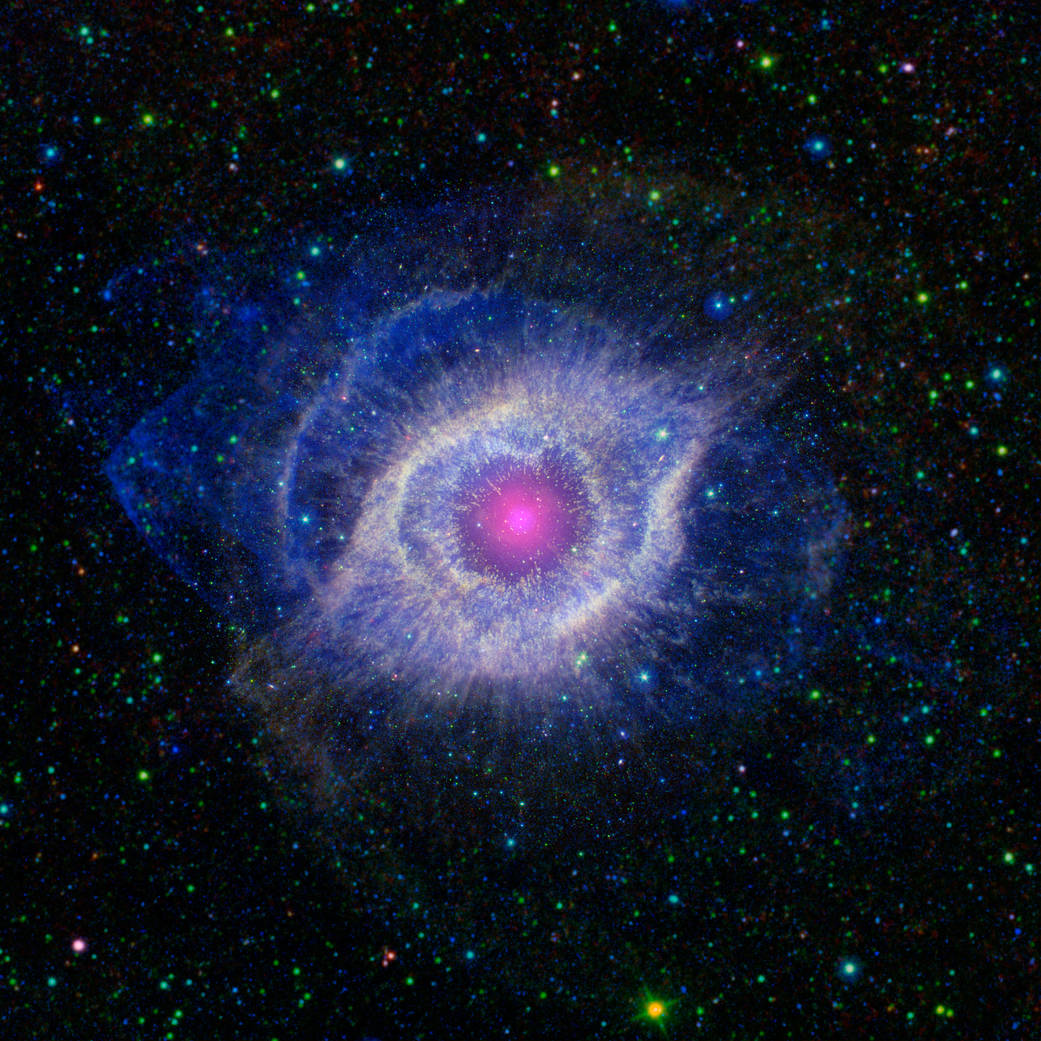
Floating roughly 650 light-years away in the constellation Aquarius is the eerie and unforgettable Helix Nebula. Often called the “Eye of God,” it appears like a gigantic cosmic iris staring directly into the darkness of space.
At first glance, it resembles an enormous, glowing eyeball suspended in blackness. A bright central star forms the pupil. Surrounding it is a ring of luminous gas forming the iris, tinged with blues, greens, and reds depending on the chemical elements present. Filamentary structures radiate outward like veins.
But what we are seeing is not an eye. It is a planetary nebula—the remains of a dying star similar in mass to our Sun. When such stars exhaust the hydrogen fuel in their cores, they expand into red giants. Eventually, they shed their outer layers into space. The hot core left behind becomes a white dwarf, emitting intense ultraviolet radiation that causes the expelled gas to glow.
The Helix Nebula’s intricate knots and comet-like structures are clumps of dense gas being eroded by radiation. Each knot is a small, sculpted fragment of stellar material, illuminated and stripped by powerful stellar winds.
The horror-movie resemblance comes from symmetry and perspective. We see a circular structure from Earth’s vantage point, giving it the illusion of an eye. But in reality, it is likely more complex—a three-dimensional shell expanding outward over tens of thousands of years.
The Helix Nebula is a reminder of the Sun’s distant future. Billions of years from now, our own star may create a similar glowing halo before fading into a white dwarf. The eye staring back at us may be a glimpse of our destiny.
2. The Ghost Nebula
Drifting through the constellation Cepheus lies the ethereal Sh2-136, commonly known as the Ghost Nebula. In visible light, it looks exactly as its nickname suggests—a pale, translucent figure with a flowing cloak and faint, hollowed features.
Unlike planetary nebulae, the Ghost Nebula is a reflection nebula. It does not glow primarily from ionized gas. Instead, it reflects the light of nearby young stars embedded within it. Dust particles scatter starlight, especially shorter blue wavelengths, giving the nebula its ghostly hue.
The shape that appears so haunting is the result of turbulence within the interstellar medium. Stellar winds and radiation pressure carve cavities and sculpt wispy tendrils of gas and dust. As stars form within the cloud, they push material outward, creating cavities that resemble eyes and mouths when viewed from Earth.
In reality, the nebula spans several light-years. The “face” we perceive is a projection effect—our brains instinctively finding patterns in randomness. This psychological phenomenon, known as pareidolia, explains why we see faces in clouds or on the Moon’s surface.
But even knowing this, the Ghost Nebula remains unsettling. It appears fragile and luminous, like something drifting between life and death. And in a sense, it is—representing both the birthplace of stars and the remnants of molecular clouds slowly dispersing into space.
3. The Skull and Crossbones Nebula
In the constellation Puppis, about 1,600 light-years away, lies the ominous NGC 246, often nicknamed the Skull and Crossbones Nebula. Its structure resembles a skull floating in darkness, complete with hollow eye sockets and a faint, skeletal grin.
Like the Helix Nebula, NGC 246 is a planetary nebula—the expanding outer layers of a dying star. At its center is a white dwarf, the exposed core of the once-sunlike star. Ultraviolet radiation from this hot remnant excites surrounding gas, causing it to glow.
The eerie skull-like appearance arises from irregular density patterns in the expanding gas. Regions where material is thinner allow us to see deeper into the nebula, forming dark cavities that resemble eye sockets. Denser regions glow more brightly, outlining shapes that our pattern-seeking minds interpret as bone.
This nebula is scientifically significant as part of a multiple-star system. The central white dwarf is accompanied by stellar companions, and the gravitational interactions may have influenced the nebula’s asymmetric shape.
The Skull and Crossbones Nebula is a reminder that stars, like living organisms, have life cycles. They are born, they evolve, and they die. What appears as a cosmic skeleton is actually a moment in stellar transformation—a phase lasting perhaps tens of thousands of years before the gas disperses completely.
4. The Witch Head Nebula
Stretching across nearly 50 light-years in the constellation Eridanus is the haunting IC 2118, commonly known as the Witch Head Nebula. In long-exposure photographs, it appears as the profile of a witch, complete with pointed nose and flowing hair.
This nebula is illuminated primarily by the bright star Rigel, one of the most luminous stars in the night sky. Rigel’s intense blue light reflects off dust grains in the nebula, giving it a bluish glow.
The Witch Head Nebula is not glowing from internal processes but from reflected starlight. It is part of a larger complex of molecular clouds and star-forming regions. Within its dusty folds, new stars may be forming, though they are obscured from direct view in visible light.
Its witch-like appearance is a trick of perspective. The nebula’s elongated shape and curved ridges happen to align in a way that resembles a human profile. But the underlying processes are physical: gravity pulling gas together, radiation sculpting surfaces, turbulence shaping clouds over millions of years.
Even so, the image is striking. It feels deliberate, as though the universe briefly shaped dust into a figure from folklore. It is a reminder that nature often creates forms that resonate deeply with human imagination.
5. The Soul Nebula
The vast and complex IC 1848, commonly called the Soul Nebula, lies about 7,500 light-years away in the constellation Cassiopeia. It forms a pair with its neighbor, the Heart Nebula.
The Soul Nebula glows red due to ionized hydrogen gas energized by massive young stars embedded within it. Ultraviolet radiation strips electrons from hydrogen atoms; when the electrons recombine, they emit characteristic red light known as H-alpha emission.
Within the nebula are clusters of hot, newly formed stars. Their radiation and stellar winds carve out cavities and pillars in the surrounding gas. Dark dust lanes snake across glowing regions, creating contrasts that appear almost spectral.
Some regions resemble hollowed skulls or drifting spirits. Long, finger-like pillars stretch outward like skeletal hands reaching into space. These structures form when denser clumps of gas resist erosion longer than their surroundings, leaving behind elongated shapes as radiation strips away less dense material.
The Soul Nebula is not a remnant of death but a nursery of creation. Yet its appearance feels haunted—like a phantom emerging from cosmic fog. It embodies the paradox of the universe: creation and destruction intertwined.
6. The Tarantula Nebula
Located in the Large Magellanic Cloud, a satellite galaxy of the Milky Way, the immense Tarantula Nebula is one of the most active star-forming regions in our galactic neighborhood. Its tangled filaments resemble the legs of a monstrous spider stretching across space.
The Tarantula Nebula spans over 1,000 light-years and contains some of the most massive stars known. At its center lies the star cluster R136, home to stars dozens of times more massive than the Sun.
The intense radiation and stellar winds from these massive stars create shock fronts, compressing nearby gas and triggering further star formation. Supernova explosions add additional energy, carving cavities and driving turbulence.
The nebula’s spider-like appearance arises from filamentary gas shaped by interacting shock waves and gravity. Dust lanes weave between glowing regions, creating contrast and giving the illusion of spindly limbs.
While it may look like a cosmic predator, the Tarantula Nebula is a cradle of life on stellar scales. It demonstrates how massive stars influence their environments, seeding galaxies with heavier elements forged in their cores.
7. The Boogeyman Nebula
Hidden in visible light but revealed dramatically in infrared observations is the eerie Lynds 1544, often nicknamed the Boogeyman Nebula. In infrared images, it resembles a looming, shadowy figure.
Lynds 1544 is a dense dark nebula—a molecular cloud core where gravity is slowly pulling material inward. These regions are cold, with temperatures only a few degrees above absolute zero. Dust within the cloud blocks visible light from background stars, creating dark silhouettes against brighter fields.
Infrared observations penetrate the dust, revealing internal structures. The “boogeyman” shape is a result of dense gas clumps and asymmetrical collapse regions.
Within such clouds, new stars may eventually form as gravity overcomes internal pressure. The shadowy figure is not a monster but a stellar embryo—matter gathering quietly before ignition.
Dark nebulae are scientifically crucial for understanding the earliest stages of star formation. Their shapes are determined by turbulence, magnetic fields, and gravitational instability.
Yet when seen in processed astronomical images, the Boogeyman Nebula looks like something lurking in cosmic darkness—a reminder that even star birth can appear ominous.
When Science Meets Imagination
Why do so many nebulae look like ghosts, skulls, witches, or monsters? The answer lies in human psychology as much as astrophysics.
Our brains evolved to detect patterns, especially faces. This ability helped early humans identify threats and social partners. When we look at random structures in clouds of gas light-years wide, our minds impose familiarity.
But beyond pareidolia, there is genuine drama in these objects. Nebulae are shaped by explosive supernovae, by stellar winds traveling millions of kilometers per hour, by radiation powerful enough to strip electrons from atoms.
They are scenes of transformation. They are cosmic autopsies and cosmic maternity wards. They glow because atoms are energized. They expand because gravity and pressure battle endlessly.
Their horror-movie resemblance is accidental. Their true story is scientific—and even more astonishing.
The Beauty in the Darkness
Each of these ghostly nebulae tells a chapter in the life cycle of stars. Massive stars explode and scatter heavy elements into space. Sun-like stars shed their outer layers in planetary nebulae. Cold molecular clouds collapse to form new stellar systems.
The universe recycles itself endlessly.
What looks like a skull is a dying star enriching space with carbon and oxygen. What looks like a witch is dust reflecting the light of a luminous giant. What looks like a phantom is hydrogen glowing under ultraviolet radiation.
These are not omens. They are processes governed by physics—gravity, thermodynamics, quantum mechanics, and electromagnetism working together on cosmic scales.
And yet, there is something profoundly moving about their appearance. They remind us that the universe is not sterile or mechanical in appearance. It is expressive, dynamic, and occasionally unsettling.
When we gaze at these nebulae, we are looking at structures larger than our solar system, shaped over thousands or millions of years. We are seeing time made visible.
The horror lies not in monsters, but in scale. In realizing how small we are. In recognizing that stars die violently. In understanding that our Sun will one day create its own glowing shell before fading away.
But within that darkness lies wonder. Within that apparent dread lies creation.
The universe does not intend to frighten us. It simply exists in forms so vast and powerful that our imaginations struggle to contain them.
And perhaps that is the most haunting truth of all.