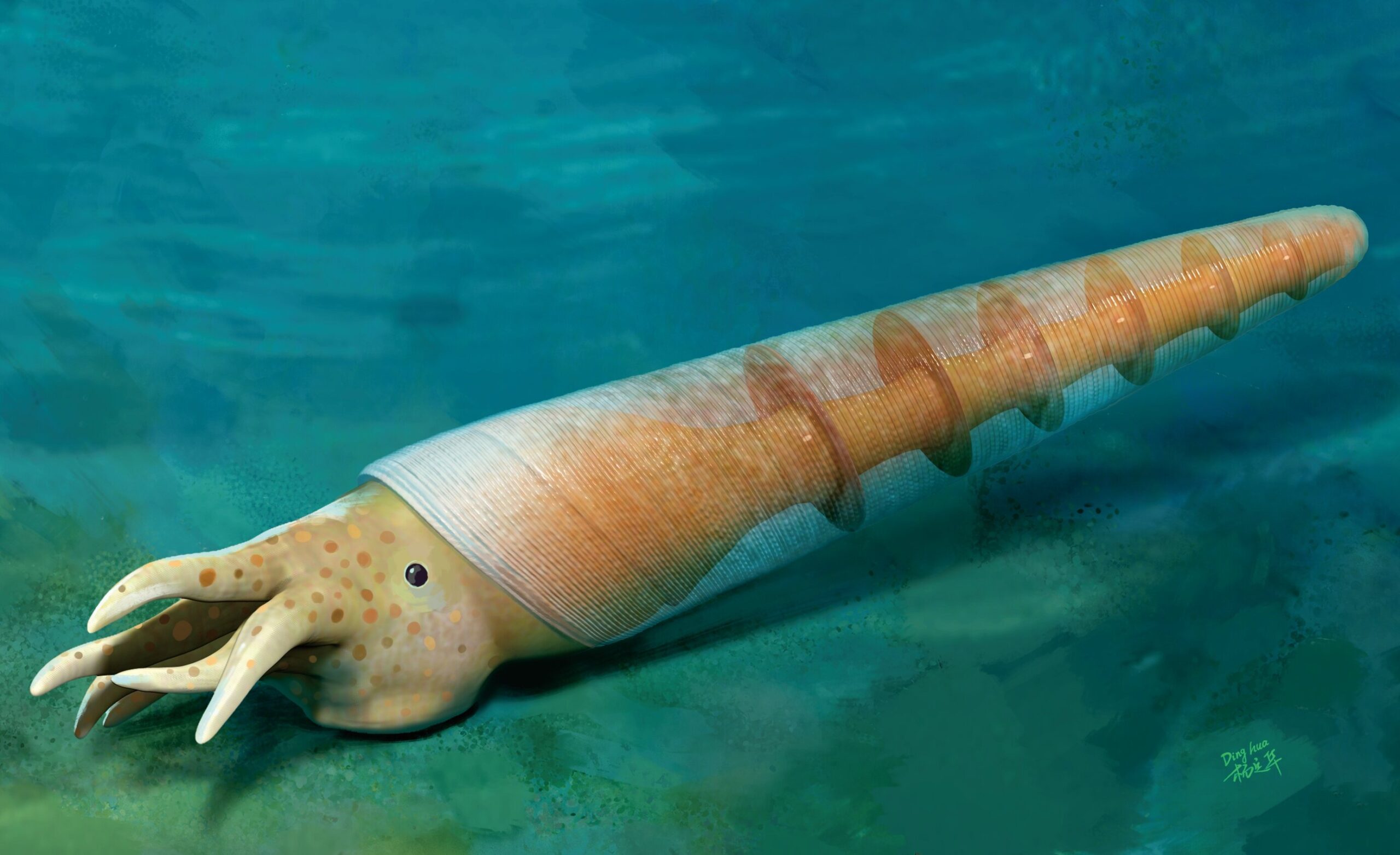
For hundreds of millions of years, cephalopods have depended on specialized shell structures to control their position in the water. A tiny fossil from South China is now offering an unusually early glimpse of how one of those defining features may have first emerged, helping bridge a gap that has long complicated efforts to trace the group’s earliest history.
Living and extinct cephalopods—including octopuses, squids, cuttlefish, nautiluses, and ammonites—have all faced the challenge of buoyancy. In ancient forms with external shells, that ability depended on internal structures such as chambers, septa, septal necks, and especially the siphuncle, a tube running through shell chambers that could contain water or gas to regulate buoyancy.
The siphuncle is considered one of the defining evolutionary innovations that separates cephalopods from other mollusks. Even so, its early evolution has remained difficult to reconstruct because the fossil record contains a significant gap.
An international team of researchers now reports what it identifies as the earliest known siphuncle-bearing cephalopod, a new fossil species named Eoceras shaanxiense. The fossils were recovered from the approximately 520-million-year-old Shuijingtuo Formation in South China.
Searching for fossils older than the earliest accepted cephalopod
The search was driven by a mismatch between fossil evidence and evolutionary estimates.
The earliest widely accepted cephalopod, Plectronoceras cambria, dates to the late Cambrian. That places it roughly 30 million years younger than the divergence time for cephalopods estimated by molecular clocks during the Cambrian explosion in the early Cambrian. Because of that difference, researchers have been seeking older fossil evidence, particularly from early Cambrian rocks.
One promising source has been the abundant “small shelly fossils” found worldwide in early Cambrian deposits. These microscopic fossils include a wide variety of mollusks and closely related groups, making them a potential place to search for the earliest cephalopods.
Working with small shelly fossils from the Shuijingtuo Formation, the researchers identified 32 specimens of E. shaanxiense, which they concluded represent an early cephalopod.
To study the fossils, the team used scanning electron microscopy and micro-computed tomography. Because the specimens had been preserved through different types of phosphatization, these imaging methods allowed the researchers to reconstruct both the external shape and the internal anatomy of the new species.
A simple tube that may mark an early stage of cephalopod evolution
The fossils measure only millimeters in size. They possess an orthoconic shell, an oblique apertural margin, multiple septa, and a segmented tube positioned along the ventral side of the shell that appears to connect the septa through tiny canals.
After comparing these internal features with those of recognized siphuncle-bearing cephalopods, the researchers concluded that the segmented tube is a siphuncle. If that interpretation is correct, Eoceras represents the earliest known example of a cephalopod with this defining structure.
The researchers argue that the species occupies an intermediate evolutionary position between earlier chambered-shell organisms and later cephalopods equipped with more advanced buoyancy systems.
Based on that interpretation, they propose a general pathway for early cephalopod evolution. In this scenario, the earliest cephalopods first evolved from an ancestor with an orthoconic shell containing multiple septa. A sealed, segmented siphuncle then evolved within that shell, followed later by the development of a true siphuncle with septal necks and connecting rings.
Questions that the fossil cannot yet answer
Although Eoceras appears to preserve an early buoyancy-regulating system, the researchers describe it as primitive and simple. They suggest that the animal probably lived a mostly benthic lifestyle.
The fossil also leaves important uncertainties unresolved. It lacks features found in later cephalopods, and its soft-body anatomy remains unknown.
Because of those limitations, the researchers say additional Cambrian fossil discoveries will be necessary to clarify the earliest stages of cephalopod evolution and to better understand how the distinctive shell architecture of the group first developed.
Publication details
Junfeng Guo, Earliest siphuncle-bearing cephalopod from the early Cambrian, Nature (2026). DOI: 10.1038/s41586-026-10868-y. www.nature.com/articles/s41586-026-10868-y