Long before humans shaped the planet with cities, stories, and science, Earth belonged to creatures so strange they feel almost imaginary. These beings walked, swam, and flew through worlds utterly different from ours—alien landscapes shaped by shifting continents, unfamiliar climates, and evolutionary experiments that would never be repeated. Some ruled the land, others dominated the seas or skies, and all of them were masters of their time.
They were not primitive mistakes leading inevitably to humans. They were highly successful life forms, perfectly adapted to their environments, reigning for millions of years—far longer than humans have existed so far. Their rise and fall tell a powerful story about evolution, survival, and the fragility of dominance.
Here are five strange species that once ruled the Earth long before humans appeared, and the astonishing worlds they commanded.
1. Tiktaalik – The Creature That Bridged Water and Land
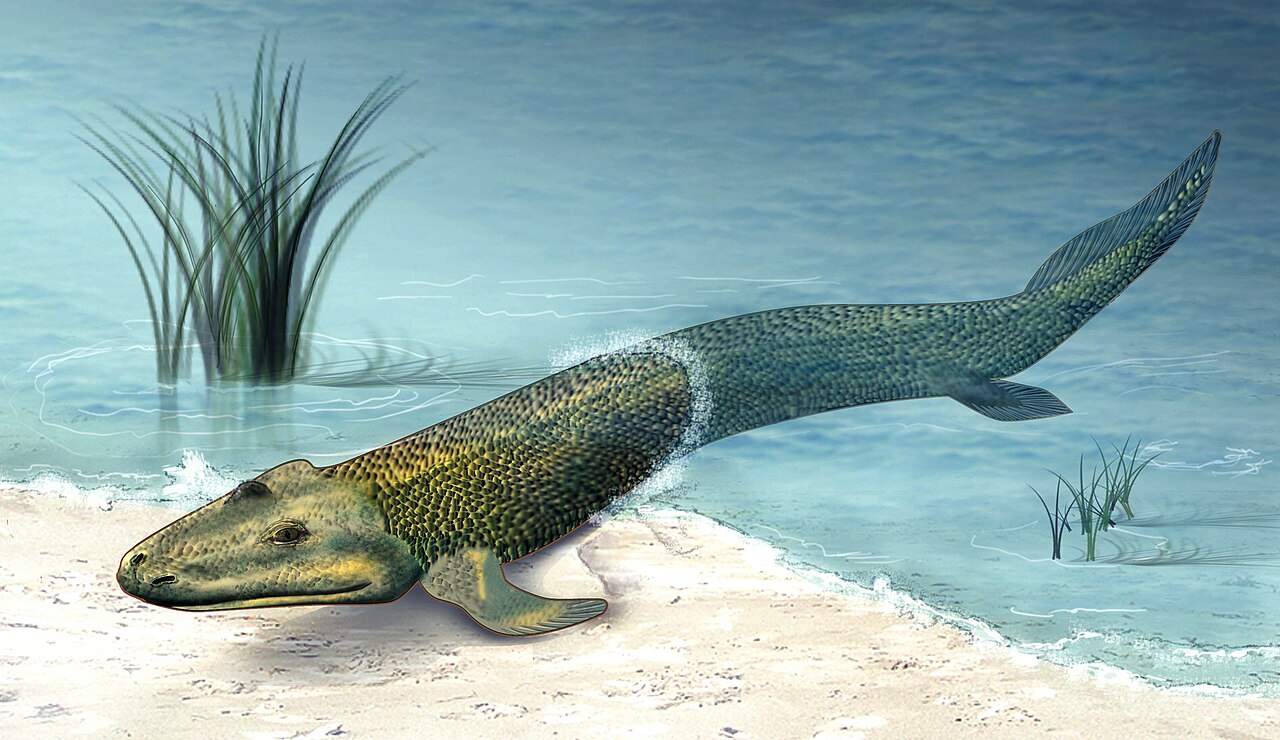
Around 375 million years ago, the Earth was a world of shallow seas, swampy coastlines, and sparse plant life creeping onto land. In this in-between world lived Tiktaalik, a creature that looks today like a biological puzzle assembled from different eras of life.
Tiktaalik was not a fish as we usually imagine one, nor was it a true land animal. It possessed scales and fins, yet those fins contained bones arranged in a way strikingly similar to arms, wrists, and shoulders. It had a flat head, eyes positioned on top, and a neck—something fish lack but land animals need. It could push itself up in shallow water, lifting its body and turning its head independently.
This strange anatomy made Tiktaalik a ruler of the ecological frontier. It thrived in environments where water met land, exploiting food sources that purely aquatic animals couldn’t reach and escaping predators that were bound to deeper water. It could lurk like a crocodile in murky shallows, ambushing prey, while also navigating oxygen-poor waters using primitive lungs.
Tiktaalik’s dominance was not about size or strength, but versatility. It represented one of evolution’s most radical experiments: the transition from water to land. While Tiktaalik itself did not give rise directly to humans, it belonged to the lineage that eventually produced all land vertebrates, including amphibians, reptiles, mammals, and ultimately us.
In its time, Tiktaalik ruled a world on the edge of transformation, embodying the moment when life first dared to crawl out of the water and rewrite the future of Earth.
2. Arthropleura – The Giant Millipede of Ancient Forests
If you walked through a forest 300 million years ago during the Carboniferous Period, you might have encountered something truly nightmarish: Arthropleura, a millipede-like arthropod stretching over eight feet long. This creature was not a predator with sharp teeth or venom, yet its sheer size made it one of the most dominant animals on land at the time.
Arthropleura lived in a world unlike anything we know today. The atmosphere contained significantly higher oxygen levels than now, allowing arthropods—creatures that breathe through tiny tubes rather than lungs—to grow to enormous sizes. Dense forests of giant ferns and towering club mosses covered the land, creating humid environments perfect for massive invertebrates.
Despite its terrifying appearance, Arthropleura was likely a herbivore or detritivore, feeding on decaying plant matter. It moved slowly but deliberately, protected by a segmented armored body that few predators could penetrate. At a time when vertebrate land predators were still relatively small and rare, Arthropleura had little to fear.
Its dominance came from being nearly untouchable. There were few animals capable of challenging such a massive, armored creature. It roamed forest floors as an uncontested giant, shaping ecosystems through its feeding habits and sheer presence.
When oxygen levels dropped and climates changed, Arthropleura vanished. Its extinction reminds us that dominance is often tied to environmental conditions. Remove the oxygen-rich air, and even giants fall.
3. Dunkleosteus – The Armored Terror of Ancient Seas
Long before sharks became the rulers of the ocean, the seas were dominated by Dunkleosteus, a monstrous armored fish that lived around 360 million years ago. Measuring up to 30 feet in length and weighing several tons, Dunkleosteus was one of the most powerful predators ever to exist.
Its most striking feature was its armor. Thick bony plates covered its head and upper body, forming a living tank. Instead of teeth, Dunkleosteus had razor-sharp bony blades that acted like self-sharpening shears. With an incredibly fast jaw snap, it could slice through prey—or even other armored fish—with terrifying efficiency.
Dunkleosteus ruled ancient oceans through brute force and engineering perfection. Its bite was among the strongest ever recorded in any animal, capable of crushing bone and armor alike. It fed on large fish, smaller armored creatures, and possibly even members of its own species.
In its time, Dunkleosteus had no equal. Sharks existed, but they were smaller, softer, and far less dominant. The seas belonged to this armored king.
Yet even Dunkleosteus could not escape extinction. As ecosystems shifted and new predators emerged, its heavily armored design became a disadvantage. Flexibility and speed eventually replaced brute armor as the key to survival in the oceans.
Dunkleosteus reminds us that being the strongest does not guarantee permanence. Evolution favors adaptability over raw power.
4. Quetzalcoatlus – The Giant of the Skies
When we imagine prehistoric skies, we often think of birds or small flying reptiles. But during the late Cretaceous Period, the air itself was ruled by giants. Among them, Quetzalcoatlus stands as one of the largest flying animals ever to exist.
With a wingspan comparable to a small airplane—up to 35 feet—Quetzalcoatlus was a pterosaur, not a dinosaur. Its body was relatively lightweight, supported by hollow bones and massive wing membranes stretched over elongated fingers. On the ground, it stood as tall as a giraffe, moving on four limbs in a surprisingly efficient way.
Quetzalcoatlus likely lived far inland, stalking prey across open plains rather than fishing like seabirds. It may have hunted small animals, scavenged carcasses, or plucked prey from the ground with its long, spear-like beak. Taking flight required a powerful launch, but once airborne, it could soar vast distances with minimal effort.
In a world without humans, birds, or large aerial predators, Quetzalcoatlus ruled the skies uncontested. Its size alone deterred most threats, and its ability to fly gave it access to resources no land animal could reach.
The extinction event that ended the age of dinosaurs also ended the reign of the giant pterosaurs. After they vanished, the skies were never ruled by creatures of such immense size again.
Quetzalcoatlus stands as a reminder that Earth once supported forms of life that stretch the limits of imagination, reshaping our sense of what is biologically possible.
5. Smilodon – The Saber-Toothed Icon of Ice Age Power
Closer to our own time, but still long before civilization, the world belonged to predators of immense power and precision. Among them, Smilodon—the famous saber-toothed cat—stands as an icon of Ice Age dominance.
Smilodon was not simply a lion with long teeth. It was built differently, with a stocky, muscular body, powerful forelimbs, and a jaw capable of opening extraordinarily wide. Its saber-like canine teeth could reach up to seven inches long, designed not for chewing but for delivering precise, fatal bites.
Smilodon lived in a world filled with massive prey: mammoths, giant ground sloths, bison, and other megafauna. Its hunting strategy relied on ambush rather than endurance. Using its strength, it would wrestle prey to the ground and deliver a killing bite to soft tissue, avoiding bone that could shatter its fragile teeth.
For hundreds of thousands of years, Smilodon was among the top predators of the Americas. It shaped ecosystems, controlled herbivore populations, and ruled through a balance of power and precision.
Its extinction likely came from a combination of climate change and the arrival of humans. As large prey declined and new competitors emerged, even this perfectly adapted hunter could not survive.
Smilodon’s fall marks a turning point. It was among the last great predators to rule before humans began reshaping ecosystems on a global scale.
The Rise and Fall of Earth’s Forgotten Rulers
These five strange species ruled Earth not because they were stepping stones toward humans, but because they were masters of their own worlds. Each one dominated its era through unique adaptations perfectly suited to the conditions of the time.
Their stories reveal a sobering truth: dominance is temporary. Environments change. Oxygen levels shift. Climates transform. Asteroids fall. And no matter how powerful a species becomes, extinction is always possible.
Humans often see themselves as the final chapter, but evolution has no end point. The reigns of Tiktaalik, Arthropleura, Dunkleosteus, Quetzalcoatlus, and Smilodon remind us that Earth has belonged to many rulers before us—and will likely belong to others after.
To study these ancient giants is not just to marvel at the past, but to understand the fragile nature of power, survival, and life itself. We are not separate from this story. We are part of it—one strange species among many, living in a moment that, one day, will also become ancient history.