On a clear, moonless night, the stars appear calm, steady, and timeless. For thousands of years, people looked at them as fixed points of light decorating the heavens. They inspired myths, guided sailors across oceans, and became symbols of permanence in an ever-changing world.
Modern astronomy has completely transformed that picture.
Today, astronomers know that stars are dynamic, evolving objects. They are born inside enormous clouds of gas and dust, spend millions or billions of years fusing hydrogen into helium, and eventually die in spectacular ways. Some explode as supernovae. Others collapse into neutron stars or black holes. Many host planets, while others travel through space at incredible speeds.
Yet not all stars fit neatly into these well-understood categories.
Some blink unpredictably. Others are impossibly old or unimaginably large. Some appear to have survived explosions that should have destroyed them. Others pulse with extraordinary precision or vanish behind mysterious clouds of dust. A few are so unusual that astronomers are still debating exactly what they are seeing.
These stars are not mysterious because they defy the laws of physics. Rather, they challenge scientists to refine those laws and improve our understanding of stellar evolution. Every unusual star represents an opportunity to learn something new about the universe.
Here are twelve of the most mysterious stars ever discovered.
1. Tabby’s Star (KIC 8462852)
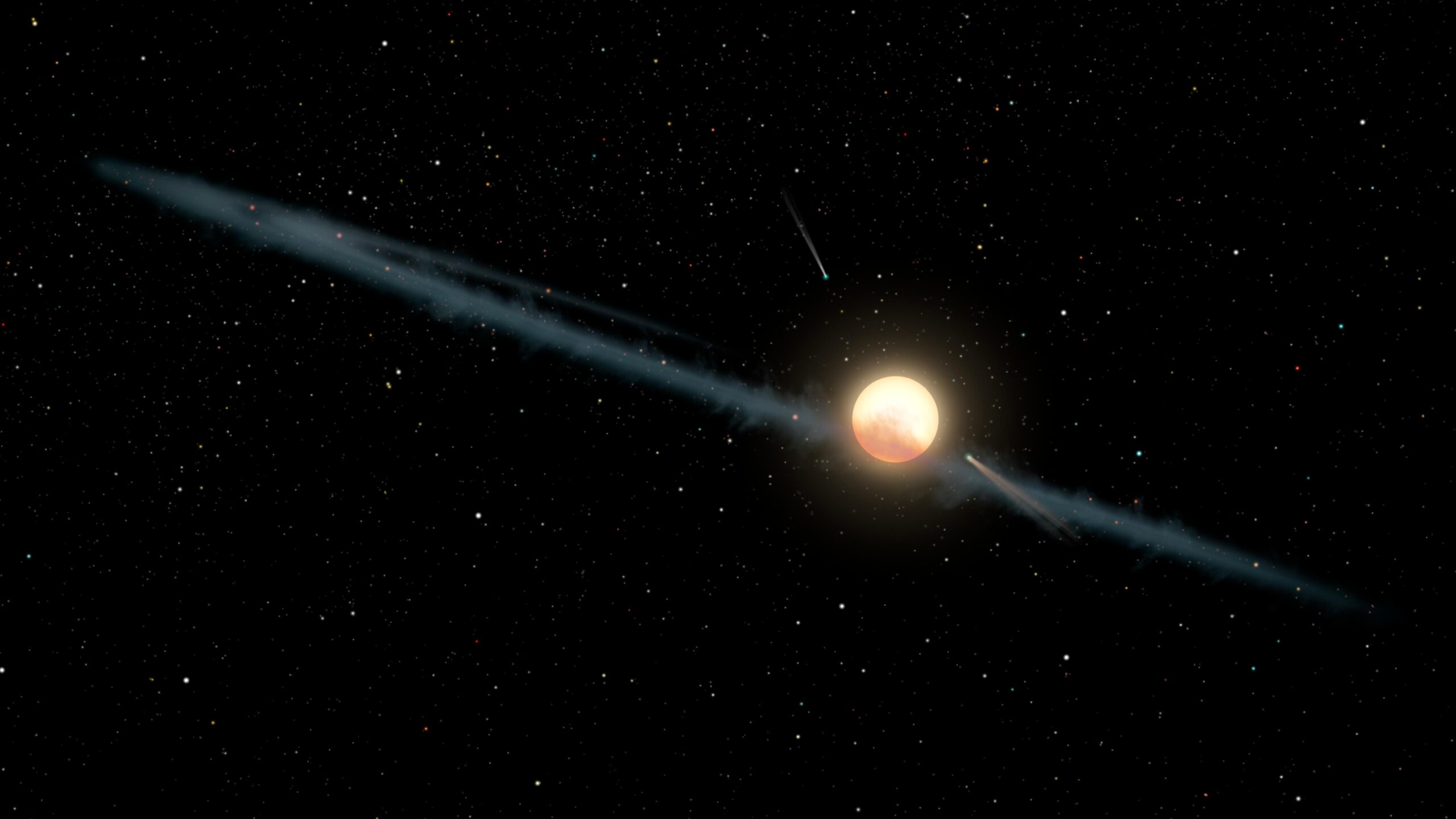
Few stars have generated as much excitement and speculation as Tabby’s Star, officially known as KIC 8462852.
Located about 1,470 light-years from Earth in the constellation Cygnus, the star first attracted attention during observations by NASA’s Kepler Space Telescope.
Astronomers expected to see the regular, shallow dips in brightness that occur when a planet passes in front of its host star. Instead, they found something astonishing.
The star’s brightness dropped irregularly, sometimes by more than 20 percent.
This is far deeper than the dimming caused by an ordinary planet.
Even stranger, the dips were neither periodic nor predictable.
At first, researchers considered many possibilities. Perhaps a swarm of comets was passing in front of the star. Maybe enormous clouds of dust orbited nearby. Some scientists even suggested collisions between planets or fragmented celestial bodies.
The mystery became famous after speculative discussions proposed an entirely different possibility: a gigantic artificial structure built by an advanced civilization.
Although this “alien megastructure” idea captured public imagination, subsequent observations strongly favor natural explanations involving fine dust particles.
Still, the exact origin of the unusual dimming remains uncertain.
Tabby’s Star reminds astronomers that nature often produces phenomena far stranger than expected.
2. Betelgeuse
The bright reddish star Betelgeuse dominates the shoulder of the constellation Orion.
It is one of the largest stars visible to the naked eye.
If placed at the center of our Solar System, its outer atmosphere would extend beyond the orbit of Mars and perhaps even approach Jupiter, depending on how its changing size is measured.
Betelgeuse is a red supergiant nearing the end of its life.
Astronomers have long known that such stars vary naturally in brightness.
However, in late 2019 and early 2020, Betelgeuse surprised the world.
Its brightness suddenly dropped by roughly two-thirds.
Many wondered whether the star was about to explode as a supernova.
Instead, detailed observations revealed a more subtle explanation.
Researchers concluded that Betelgeuse ejected an enormous cloud of gas. As this material cooled, dust condensed and temporarily blocked part of the star’s light from Earth’s perspective.
The event demonstrated that giant stars can undergo dramatic episodes of mass loss.
Even so, Betelgeuse remains mysterious.
Its interior is unstable.
Its surface constantly changes.
Astronomers know it will eventually explode as a supernova—but no one knows whether that will happen tomorrow or 100,000 years from now.
3. R136a1
Deep within the Tarantula Nebula in the Large Magellanic Cloud lies one of the most extreme stars ever discovered.
Known as R136a1, it is the most massive star currently known.
Its estimated mass at birth exceeded 250 times that of the Sun.
For decades, theoretical models suggested that stars above about 150 solar masses should not exist because intense radiation pressure would halt further growth.
R136a1 challenged those expectations.
Its immense energy output is almost beyond comprehension.
The star shines with millions of times the Sun’s luminosity.
It loses mass through incredibly powerful stellar winds, ejecting enormous amounts of material into surrounding space.
Astronomers continue investigating how such gigantic stars form.
Did R136a1 grow through ordinary gas accretion?
Did multiple stars merge?
Are current models incomplete?
The answers remain uncertain.
4. HD 140283 (The Methuselah Star)
Some stars are mysterious because they seem impossibly old.
HD 140283, often called the Methuselah Star, is one of them.
Located about 190 light-years away, it belongs to one of the oldest stellar populations in the Milky Way.
Early measurements suggested an age slightly older than the universe itself.
Of course, this could not actually be true.
The apparent contradiction forced astronomers to reexamine both stellar evolution models and observational uncertainties.
Improved measurements have refined the star’s estimated age to approximately 12 to 13 billion years, making it consistent with the universe’s age of about 13.8 billion years.
Even so, HD 140283 remains extraordinarily ancient.
It formed when the universe contained very few heavy elements.
Studying it provides a rare glimpse into the earliest generations of stars that emerged after the Big Bang.
5. Eta Carinae
Some stars live violent lives.
Eta Carinae is among the most unstable stars ever observed.
It is actually a binary system containing two extremely massive stars locked in a highly eccentric orbit.
During the nineteenth century, Eta Carinae underwent what astronomers call the Great Eruption.
For several decades, it briefly became the second-brightest star in Earth’s night sky without actually exploding.
Instead, it expelled enormous quantities of matter.
The expanding debris now forms the spectacular Homunculus Nebula.
Researchers still debate what triggered the eruption.
Possible explanations include violent interactions between the two stars, internal instabilities, or processes not yet fully understood.
Eventually, one or both stars are expected to end their lives in catastrophic supernova explosions.
6. PSR B1257+12
Most mysterious stars are unusual because of their physical behavior.
This one changed astronomy for another reason.
PSR B1257+12 is a pulsar—a rapidly rotating neutron star left behind after a massive star exploded.
In 1992, astronomers discovered something extraordinary.
Planets orbited this dead star.
These became the first confirmed exoplanets ever detected.
The discovery overturned long-held assumptions.
How could planets survive a supernova explosion?
Did they survive?
Or did entirely new planets form afterward from remaining debris?
Researchers continue studying such systems to understand planetary formation under extreme conditions.
7. VY Canis Majoris
Among the largest known stars in the universe is VY Canis Majoris.
This enormous red hypergiant is so large that if it replaced our Sun, its outer atmosphere would extend beyond the orbit of Jupiter.
Yet despite decades of study, astronomers still debate its precise size.
Unlike solid objects, giant stars possess extended atmospheres without sharply defined boundaries.
Powerful stellar winds constantly eject gas into surrounding space.
The star experiences intense instability, producing irregular brightness changes and enormous mass loss.
Eventually, it will likely explode as a supernova, enriching the galaxy with heavy elements forged inside its core.
8. WR 104
At first glance, WR 104 appears beautiful.
Detailed infrared images reveal a stunning spiral pattern surrounding the star.
This remarkable structure forms because WR 104 is actually a binary system.
A Wolf-Rayet star and a massive companion orbit each other.
Powerful stellar winds collide, creating dust that flows outward in a rotating spiral.
The system also attracted attention because early studies suggested its rotational axis might point roughly toward Earth.
If true, a future gamma-ray burst associated with its eventual explosion could theoretically be directed in our direction.
Fortunately, more recent observations indicate that the alignment is probably less direct than initially feared.
Nevertheless, WR 104 remains one of the most visually extraordinary stellar systems known.
9. Vega
Today, Vega serves as one of the brightest stars in Earth’s night sky.
It has also played an important historical role.
About 12,000 years ago, Vega—not Polaris—was Earth’s northern pole star due to the slow wobble of Earth’s rotational axis.
Modern observations reveal another mystery.
Vega rotates incredibly rapidly.
Its equator spins at nearly 90 percent of the speed required for the star to begin breaking apart.
As a result, centrifugal force causes the star to bulge outward.
Its equatorial diameter is significantly larger than its polar diameter.
This rapid rotation also creates major temperature differences across its surface.
Studying Vega has helped astronomers understand how rotation influences stellar structure and evolution.
10. Sirius A and Sirius B
The brightest star visible from Earth is actually a binary system.
Sirius A shines brilliantly in the constellation Canis Major.
Its faint companion, Sirius B, is one of the nearest known white dwarfs.
When Sirius B was first detected in the nineteenth century, astronomers found its properties astonishing.
Despite being roughly similar in size to Earth, it contains nearly the Sun’s entire mass.
This means its density is extraordinary.
A teaspoon of white dwarf material would weigh many tons on Earth.
The discovery helped confirm theoretical predictions about degenerate matter—an exotic state governed by quantum mechanics.
Even today, Sirius B remains one of the best laboratories for studying stellar remnants.
11. UY Scuti
For many years, UY Scuti was considered one of the largest stars known.
Its estimated radius is so enormous that if placed at the center of our Solar System, it would engulf the orbit of Jupiter.
Determining its exact size, however, has proven surprisingly difficult.
Its atmosphere extends gradually into surrounding space rather than ending abruptly.
Distance measurements also affect size estimates.
As observational techniques improve, astronomers continue refining its dimensions.
Whether or not it remains the absolute largest known star, UY Scuti illustrates the incredible diversity of stellar evolution.
Some stars grow to sizes almost impossible to imagine before finally collapsing.
12. The Sun
It may seem surprising to include our own Sun among the universe’s most mysterious stars.
After all, it is by far the best-studied star in existence.
Yet many important questions remain unanswered.
Astronomers still seek to fully understand the mechanisms driving the Sun’s magnetic cycle.
The origin of the solar dynamo remains an active area of research.
Scientists continue investigating why the Sun’s outer atmosphere—the corona—is millions of degrees hotter than its visible surface.
This “coronal heating problem” remains one of solar physics’ greatest mysteries.
Researchers also study unpredictable solar flares and coronal mass ejections that can disrupt satellites, electrical grids, and communication systems on Earth.
The better we understand our own star, the better we understand stars throughout the universe.
Why Mysterious Stars Matter
These stars are more than astronomical curiosities.
Each one represents a natural laboratory operating under conditions impossible to reproduce on Earth.
By studying them, astronomers test theories of gravity, nuclear fusion, plasma physics, quantum mechanics, and stellar evolution.
Unexpected observations often lead to major scientific breakthroughs.
When stars behave differently from predictions, scientists do not discard physics.
Instead, they refine models, gather more observations, and deepen understanding.
History has shown repeatedly that today’s mystery often becomes tomorrow’s discovery.
The Future of Stellar Exploration
Powerful observatories are transforming stellar astronomy.
The James Webb Space Telescope observes stars through infrared wavelengths capable of penetrating dust clouds.
The Gaia spacecraft continues measuring the positions and motions of more than a billion stars with unprecedented precision.
Ground-based telescopes equipped with adaptive optics produce images once thought impossible.
Future facilities such as the Extremely Large Telescope and the Vera C. Rubin Observatory will reveal countless new variable stars, stellar explosions, and rare objects.
Artificial intelligence is also becoming an essential tool.
Machine-learning algorithms now analyze enormous datasets, identifying unusual stars that human observers might never notice.
The next great stellar mystery may already exist within data waiting to be recognized.
The Universe’s Most Beautiful Questions
Stars are often described as simple spheres of glowing gas powered by nuclear fusion.
In reality, they are among the most complex objects in the universe.
They pulsate, erupt, collapse, rotate, merge, explode, and reshape entire galaxies through the heavy elements they create. Every mysterious star reminds us that the cosmos is still full of unanswered questions.
Perhaps somewhere in a distant galaxy, an even stranger star is shining at this very moment—a star unlike anything astronomers have ever imagined. Its light may already be racing toward Earth, carrying the next great discovery across millions of years of space, waiting for humanity to finally notice its remarkable story.