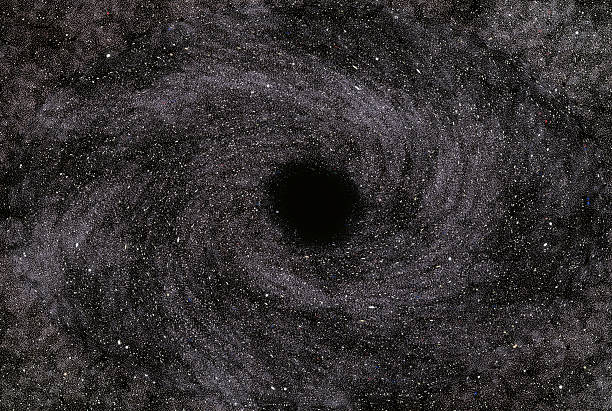
There is something profoundly unsettling about black holes. They are not monsters in the mythological sense, yet they behave like cosmic predators. They do not roar or hunt, yet they devour. They do not glow like stars, yet they dominate entire galaxies. Born from the collapse of massive stars and lurking at the centers of galaxies, black holes are regions of space where gravity becomes so intense that nothing—not even light—can escape.
The idea alone is enough to unsettle the imagination. A place where the familiar rules of reality seem to bend. A boundary beyond which information may be lost forever. A cosmic abyss from which there is no return.
Black holes are predicted by Albert Einstein’s theory of general relativity, and over the past century, they have moved from theoretical curiosities to observed astrophysical objects. We have detected their gravitational influence, captured images of their shadows, and measured the ripples they send across spacetime when they collide.
Yet the more we learn, the more unsettling they become.
Below are ten scientifically accurate, deeply terrifying facts about black holes—facts that reveal just how strange, extreme, and unsettling our universe truly is.
1. A Black Hole Is Not a Hole—It Is a Region Where Reality Collapses
The name “black hole” is misleading. It is not a tunnel, not a cosmic vacuum cleaner, not a doorway to somewhere else. It is a region of spacetime where gravity becomes so strong that escape is impossible.
At its core lies what physics calls a singularity—a point where matter is crushed to an infinitely small size and density becomes infinite, at least according to current theory. General relativity predicts this singularity forms when a massive star exhausts its nuclear fuel and collapses under its own gravity. There is no known force capable of halting the collapse once it passes a critical threshold.
Imagine compressing the mass of the Sun into a sphere only a few kilometers across. The gravitational field becomes so extreme that spacetime itself curves inward without limit. The singularity is not just dense—it represents a breakdown of our current understanding of physics. The equations cease to make meaningful predictions.
What makes this terrifying is not merely the collapse of matter. It is the collapse of predictability. The singularity is a place where our known laws of nature stop functioning. We do not know what truly happens there. The universe, in that region, becomes unknowable.
2. The Event Horizon Is a One-Way Boundary with No Warning
Surrounding every black hole is the event horizon—the point of no return. Cross this boundary, and escape becomes impossible. There is no physical wall, no sudden jolt, no flashing sign announcing your doom.
From your perspective, drifting toward a black hole, you might not even notice when you pass the event horizon, especially if the black hole is massive. Gravity would feel intense but not necessarily destructive at that exact boundary. The horror lies in its invisibility.
Once inside, every possible path forward in spacetime leads inward, toward the singularity. Even light, traveling at the fastest speed in the universe, cannot climb back out. All future directions point toward destruction.
From the outside, however, something even stranger happens. An observer watching you fall would see you appear to slow down as you approach the event horizon. Your image would become increasingly redshifted, fading and stretching, until you seem frozen at the edge. Time itself appears to slow to a halt.
The event horizon represents a cosmic prison gate. Cross it, and causality itself rearranges so that escape is not just difficult—it is physically forbidden.
3. Time Near a Black Hole Slows to a Crawl
Gravity affects time. This is not poetic metaphor—it is measurable physics. According to general relativity, the stronger the gravitational field, the slower time flows relative to regions with weaker gravity.
Near a black hole, this effect becomes extreme.
If you were to orbit close to a black hole without falling in, your clock would tick much more slowly compared to someone far away. Hours for you might correspond to years for them. The closer you approach the event horizon, the more dramatic the difference becomes.
This is not science fiction speculation. Time dilation has been experimentally confirmed around Earth, though the effect here is tiny. Near a black hole, it becomes enormous.
Imagine hovering just outside the event horizon of a supermassive black hole. You might experience a few hours while thousands of years pass in the wider universe. Civilizations could rise and fall. Stars could be born and die. Entire galactic structures could shift—while you remain suspended in a warped bubble of slowed time.
Black holes do not just distort space. They fracture our intuitive sense of time itself.
4. You Would Be Stretched into Spaghetti Before You Died
One of the most horrifying fates near a black hole is something physicists casually call spaghettification. The name sounds playful, but the process is lethal.
Gravity decreases with distance. If your feet are closer to a black hole than your head, the gravitational pull on your feet will be significantly stronger. This difference in force is known as tidal gravity.
Near a stellar-mass black hole, tidal forces become extreme well before you reach the event horizon. Your body would be stretched lengthwise and compressed sideways. The force difference between head and feet would increase rapidly, tearing you apart at the molecular level.
Your atoms would be pulled into a long, thin stream. Bones would not matter. Tissue would not matter. Even molecules would eventually be torn apart.
For supermassive black holes, tidal forces at the event horizon can be weaker, meaning you might cross the horizon intact—but the stretching would become fatal as you approach the singularity.
In either case, the outcome is inescapable. The closer you get, the more gravity transforms you from a solid object into a shredded filament of matter.
5. Black Holes Can Swallow Entire Stars
Black holes do not constantly roam the universe consuming everything in sight. Objects must venture close enough to be captured. But when a star strays too near, the results are catastrophic.
If a star passes within a certain distance of a black hole, tidal forces can rip it apart in what astronomers call a tidal disruption event. The star is stretched, torn, and shredded. Some of its material is flung outward into space, while the rest spirals inward, forming a glowing accretion disk around the black hole.
As matter accelerates and heats up in this disk, it emits enormous amounts of radiation, sometimes briefly outshining entire galaxies. For a short time, the black hole announces its feast to the universe.
These events have been observed in distant galaxies. They are not theoretical fantasies. They are violent realities.
The idea that a star—a colossal sphere of nuclear fusion millions of kilometers wide—can be torn apart like a fragile object underscores the sheer power of black hole gravity.
6. Supermassive Black Holes Lurk at the Centers of Galaxies
Nearly every large galaxy we observe appears to host a supermassive black hole at its center. These black holes can contain millions or billions of times the mass of the Sun.
Our own Milky Way galaxy contains one called Sagittarius A*, with a mass of about four million Suns. It sits approximately 26,000 light-years away from Earth. It is currently relatively quiet, but its gravitational influence governs the orbits of stars near the galactic core.
In other galaxies, supermassive black holes actively consume matter, powering quasars—some of the brightest objects in the universe.
The unsettling truth is that black holes are not rare cosmic accidents. They are fundamental components of galactic structure. Entire star systems orbit around them, bound by their gravitational dominance.
The night sky feels serene. Yet at the heart of our galaxy lies a dark gravitational anchor, silently shaping the motion of billions of stars.
7. Colliding Black Holes Shake the Fabric of Spacetime
When two black holes orbit each other and eventually merge, they release energy in the form of gravitational waves—ripples in spacetime itself.
These waves were first directly detected in 2015 by the LIGO observatory, confirming a prediction made by Einstein a century earlier. The collision of two black holes billions of light-years away produced a measurable stretching and squeezing of space on Earth.
The energy released during such mergers can briefly exceed the combined light output of all stars in the observable universe—except it is emitted not as light, but as distortions in spacetime.
Imagine two invisible titans spiraling toward each other in darkness, accelerating, warping space around them, then merging into a single larger black hole in a final explosive surge of gravitational energy.
Spacetime itself shudders when black holes collide. The universe trembles.
8. Information May Be Lost Forever Inside Them
One of the deepest mysteries in physics is the black hole information paradox. Quantum mechanics states that information about a physical system cannot be destroyed. Yet when matter falls into a black hole, it seems that all information about its detailed structure disappears beyond the event horizon.
Stephen Hawking showed that black holes are not entirely black—they emit radiation due to quantum effects near the event horizon. Over immense timescales, they can evaporate.
But if a black hole eventually disappears, what happens to the information about everything that fell inside? Is it destroyed? Does it escape in some encoded form within Hawking radiation? Does it remain stored in a yet-unknown way?
Physicists do not yet have a complete answer.
The terrifying aspect here is philosophical as much as physical. If information can truly vanish, then the universe allows irreversible erasure at a fundamental level. If it cannot, then our understanding of spacetime must be incomplete.
Black holes force us to confront the limits of our theories.
9. Black Holes Slowly Evaporate Over Time
It sounds impossible, but black holes are not eternal.
Due to quantum effects at the event horizon, black holes emit what is known as Hawking radiation. This radiation arises from particle-antiparticle processes in the quantum vacuum near the horizon. Over time, this radiation causes black holes to lose mass.
For stellar-mass or supermassive black holes, the evaporation timescale is far longer than the current age of the universe—trillions upon trillions of years. But in principle, if left alone long enough, a black hole will shrink and eventually disappear in a final burst of radiation.
This means that even the most extreme gravitational prisons are temporary.
The universe will not always contain stars. It will not always contain galaxies. And in the unimaginably distant future, even black holes—the ultimate symbols of permanence—will fade.
The terror here lies in cosmic loneliness. A universe where black holes slowly evaporate into darkness is a universe entering its final chapter.
10. We Still Do Not Fully Understand Them
Perhaps the most unsettling fact of all is that black holes sit at the intersection of two great theories—general relativity and quantum mechanics—that do not yet fully agree.
General relativity describes gravity and large-scale structure. Quantum mechanics governs the behavior of particles and fields at microscopic scales. Both are extraordinarily successful within their domains. Yet when applied together to black holes, contradictions arise.
We do not yet have a complete theory of quantum gravity. We do not fully understand what happens at the singularity. We do not know how information is preserved or transformed. We do not know whether spacetime itself breaks down at some deeper level.
Black holes are laboratories for the unknown.
They are not merely astrophysical objects. They are boundary markers of human knowledge. They show us where our theories fail and where new physics must emerge.
The Abyss That Teaches Us
Black holes are terrifying because they challenge everything we take for granted. They distort time. They bend space. They shred matter. They swallow light. They threaten the permanence of information. They warp the very fabric of the cosmos.
And yet, they are also profoundly beautiful.
They demonstrate the predictive power of general relativity. They confirm the reality of gravitational waves. They reveal quantum effects in extreme environments. They anchor galaxies and shape cosmic evolution.
The darkness at their centers is not merely absence. It is mystery.
When you look up at the night sky, remember that somewhere out there, stars are being torn apart, spacetime is being twisted, and black holes are merging in silent violence. The universe is not calm. It is dynamic, extreme, and awe-inspiring.
Black holes may keep you up at night. But they also remind us that we live in a universe far stranger—and far more magnificent—than imagination alone could ever invent.