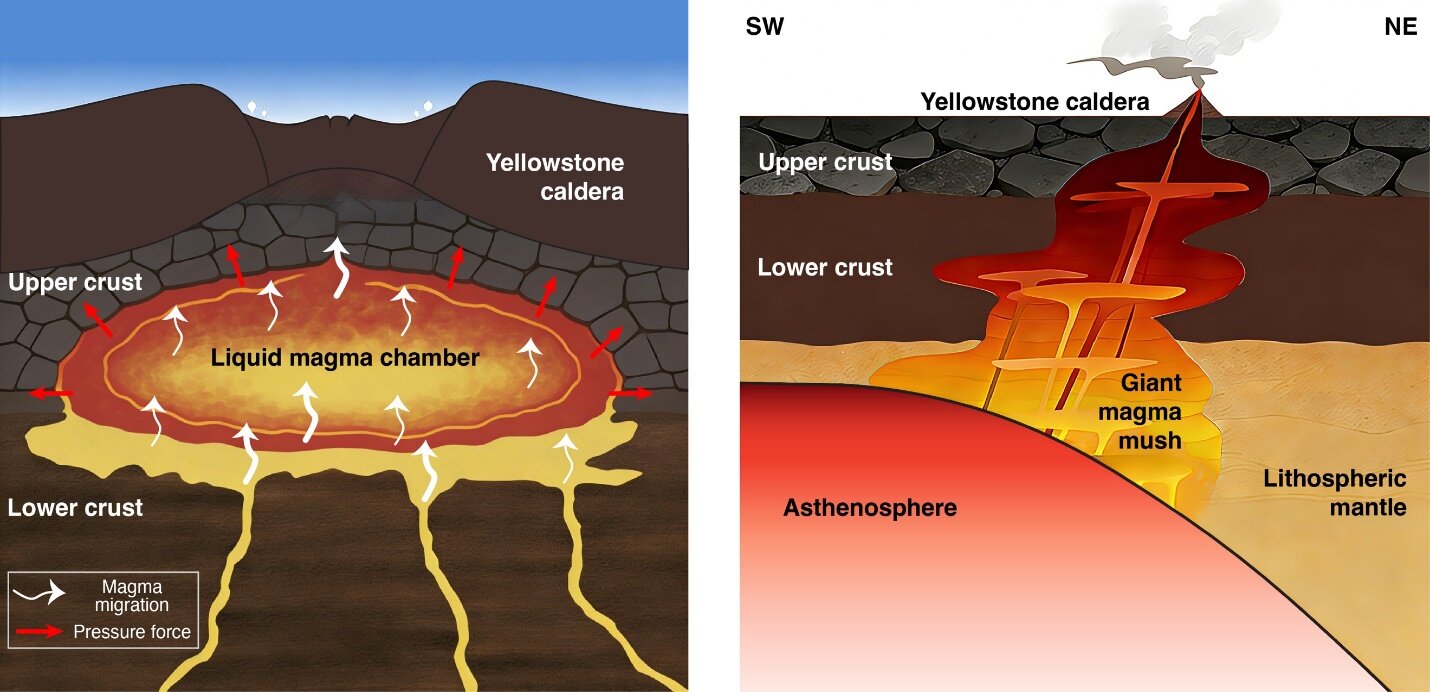
The giants of the volcanic world do not behave like the volcanoes we think we know. When we imagine a volcano, we often picture a singular, cone-shaped mountain with a subterranean “tank” of liquid fire sitting directly beneath it, waiting to boil over. But for the supervolcanoes—monsters capable of ejecting more than 1,000 cubic kilometers of magma, rock, and ash in a single “supereruption”—the reality is far more ghost-like and expansive. For years, scientists operated under the traditional hypothesis that these titans hosted massive, liquid-dominated magma chambers within the crust. They believed that as low-density magma filled these pockets, the pressure would eventually cause the crust to fail and collapse. Yet, as our tools for peerng into the Earth have improved, a mystery emerged: those giant, liquid-filled tanks simply weren’t there. Instead, evidence began to point toward something more complex: a magma mush.
The Ghostly Architecture of a Sleeping Giant
Rather than a simple pool of liquid, the plumbing of a supervolcano appears to be a vast, diffuse network of partially molten rock that stretches through nearly the entire lithosphere—the cold, rigid outer shell of our planet that includes both the crust and the uppermost mantle. This magma mush is not a rushing river of fire; it is a sticky, highly viscous soup of crystals and melt. In fact, this mush is so thick that its viscosity is several orders of magnitude higher than that of pure liquid magma. This discovery turned the old scientific models on their heads. If the material is so thick and spread out, the old “buoyancy-driven” theories of how eruptions are triggered no longer seem to fit. To solve this puzzle, a research team from the Institute of Geology and Geophysics of the Chinese Academy of Sciences (IGGCAS) turned their attention to the most famous natural laboratory on Earth: Yellowstone.
A Hidden Gale Beneath the Continent
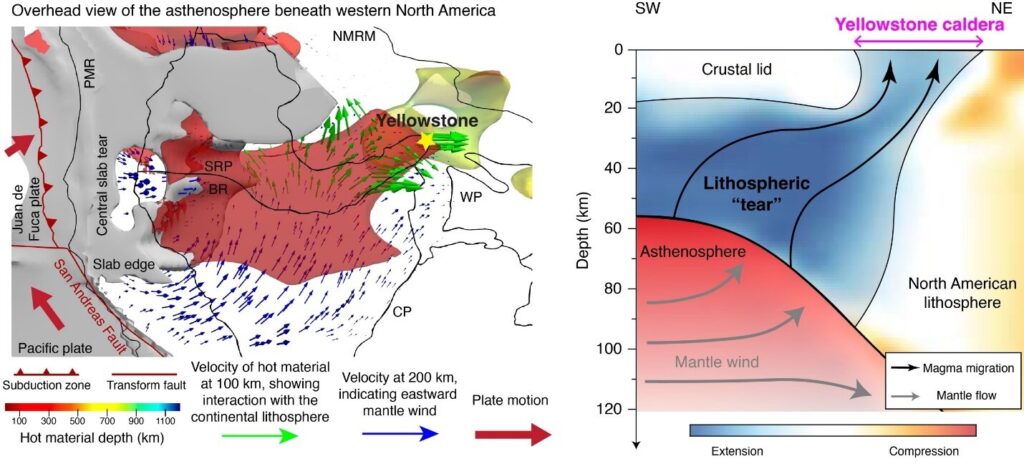
Yellowstone has long been the primary test case for understanding supervolcano behavior, having unleashed two massive supereruptions in the last 2.1 million years. While researchers knew that a southwest-dipping system of magma mush existed deep beneath the park, the “engine” driving that system remained a subject of intense debate. For a long time, the leading theory was that a deep mantle plume—a vertical column of heat rising all the way from the core-mantle boundary—was responsible. However, the new three-dimensional geodynamic model developed by the IGGCAS team suggests a different, more horizontal story. They discovered that the heat source isn’t rising straight up from the deep core; instead, it is being carried by an eastward mantle wind.
This is not a wind of air, but a broad, slow-moving horizontal flow of hot rock within the asthenosphere, the ductile layer just beneath the rigid lithosphere. This “wind” is fueled by the ancient subduction of the Farallon Plate, whose remnants now lie deep under central and eastern North America. As this mantle wind pushes hot material toward the Yellowstone region, it encounters the thick “roots” of the North American continent. When this buoyant material is pulled downward beneath the heavy lithosphere, it undergoes vertical extension. This stretching causes decompression melting, a process where rock melts simply because the pressure on it has been reduced, even without adding more heat. This provides the primary source of melt for the supervolcano, originating not from the deep core, but from the shallow mantle just below the Earth’s outer shell.
The Great Continental Tear
As this mantle wind blows eastward, it does more than just melt rock; it physically reshapes the underside of the continent. The new model reveals a violent tug-of-war taking place miles beneath our feet. The eastward-moving mantle flow exerts a powerful horizontal push against the thick lithospheric root to the east of Yellowstone. Simultaneously, the more buoyant sections of the lithosphere to the west create a counteracting force. These two opposing powers essentially tear the continental lithosphere apart. This geological “rip” creates a southwest-dipping, channel-like conduit.
This conduit acts as a highway for the ascending melt. Because of this structural tear, the magma has a specific path to follow as it rises, cools, and evolves into the thick magma mush that scientists observe today. The model explains why the Yellowstone system is tilted the way it is and how it has managed to stay active for so long. It suggests that the traditional “magma chamber”—the liquid-rich pool we usually associate with volcanoes—is actually a transient feature. It only appears briefly, in a geological sense, right before an eruption occurs. The rest of the time, the supervolcano exists as this long-lived, stable system of mush, held in place by the constant flow of the mantle wind and the structural damage it causes to the plate above it.
Why Mapping the Invisible Matters
Understanding these subsurface dynamics is not merely an exercise in curiosity; it is a fundamental shift in how we assess the risks of the world’s most hazardous geological events. By linking the deep flow of the mantle to the specific way magma accumulates in the lithosphere, researchers now have a comprehensive framework to explain how supervolcanoes are born and sustained. These eruptions have the power to alter the global climate and disrupt human society on a scale that dwarfs any modern weather event. By identifying the physical mechanism of the mantle wind and the lithospheric tear, scientists can better understand the long-term evolution of these systems. This research provides a vital map of the “invisible” forces shaping our world, moving us away from outdated “tank” models and toward a more accurate, dynamic view of how the Earth breathes and occasionally, violently, exhales.
Study Details
Zebin Cao et al, Tectonic origin of Yellowstone’s translithospheric magma plumbing system, Science (2026). DOI: 10.1126/science.ady2027