The Minoan civilization was a Bronze Age society that flourished on the island of Crete in the eastern Mediterranean, becoming one of the earliest complex civilizations in Europe. From roughly 3000 to 1450 BCE, Minoan communities developed large palace complexes, extensive maritime trade networks, distinctive art, specialized crafts, and administrative systems that helped organize life across the island. Their influence extended throughout the Aegean Sea, connecting Crete with mainland Greece, Egypt, and the wider eastern Mediterranean.
The Minoans are best known for monumental centers such as Knossos, elaborate wall paintings, and architecture that differed in important ways from the fortified citadels of contemporary mainland societies. Their palaces were not simply royal residences. They appear to have served as centers for administration, storage, craft production, religious activity, and the redistribution of resources.
Despite their importance, many aspects of Minoan life remain uncertain. Their written language, known as Linear A, has not been deciphered, leaving historians without direct access to most of their administrative records or literature. Much of what is known comes from archaeology: buildings, pottery, tools, burials, paintings, and the remains of trade goods.
Understanding the Minoans reveals how geography, maritime connections, agricultural production, and institutional organization helped create one of Europe’s earliest sophisticated societies.
Where and when did the Minoan civilization develop?
The Minoan civilization developed on Crete, the largest Greek island, located south of the Aegean Sea and within reach of both the Greek mainland and the eastern Mediterranean. Its position helped shape its economic and cultural development.
Crete’s landscape includes fertile plains, sheltered coastal areas, mountain valleys, and natural harbors. These environments supported agriculture, animal husbandry, fishing, and maritime exchange. Although the island’s mountainous interior sometimes limited communication between settlements, its coastline provided access to sea routes linking different parts of the Mediterranean.
People had inhabited Crete for thousands of years before the emergence of Minoan palaces. During the third millennium BCE, communities grew more complex, craft production expanded, and contacts with neighboring regions increased. These developments created conditions for larger political and economic institutions.
The Minoan civilization is conventionally divided into broad chronological phases based on changes in pottery, architecture, and other archaeological evidence. The early phases preceded the great palaces, while the Middle Bronze Age saw the emergence of major palace centers. Later, these centers were rebuilt and expanded before many were damaged or abandoned.
These divisions are useful for understanding long-term change, but they do not represent a single, uniform political history. Different parts of Crete developed at different rates, and the island’s communities did not necessarily share one government throughout the entire Minoan period.
The term Minoan itself is modern. Archaeologists adopted it from Minos, a legendary king associated with Crete in ancient Greek mythology. There is no certainty that the people of Bronze Age Crete used this name for themselves.
Why were the Minoan palaces so important?
The palace complexes are the most distinctive feature of Minoan civilization. Major examples include Knossos, Phaistos, Malia, and Zakros. These large architectural centers contained courtyards, storage rooms, workshops, corridors, stairways, and spaces that may have been used for ceremonies and gatherings.
The buildings were often complex rather than symmetrical. Multiple wings surrounded central courtyards, and successive construction phases produced interconnected spaces that could be difficult to navigate. Light wells, open courts, and carefully designed circulation routes helped bring light and air into parts of the structures.
The palaces were not identical, and their precise functions remain debated. Nevertheless, their size and organization indicate that they were important institutions within their surrounding communities.
Large storage areas contained substantial ceramic vessels, sometimes called pithoi, that could hold agricultural products such as grain, oil, and wine. These facilities suggest that palace authorities collected, stored, managed, or redistributed food and other goods. Such activities could help support workers, craft specialists, religious ceremonies, and administrative operations.
The palaces also contained evidence of specialized production. Artisans manufactured pottery, metal objects, textiles, and other goods, while administrative areas included clay tablets and sealings associated with recordkeeping. These finds indicate that palace centers coordinated activities extending beyond the immediate needs of a single household.
However, archaeologists cannot establish that every palace performed exactly the same role or that all goods passed through a centralized bureaucracy. Some production and exchange took place outside palace institutions, and the relationship between palaces and nearby settlements likely varied.
The scale of these complexes demonstrates that Minoan society could mobilize labor, obtain materials, and maintain institutions over extended periods. It does not, by itself, prove that Crete was ruled by a single king or centralized state.
How did the Minoan economy work?
Agriculture formed the foundation of the Minoan economy. Communities cultivated crops such as wheat and barley, produced olives and grapes, and raised animals including sheep, goats, cattle, and pigs. Fishing and other coastal activities supplemented food supplies.
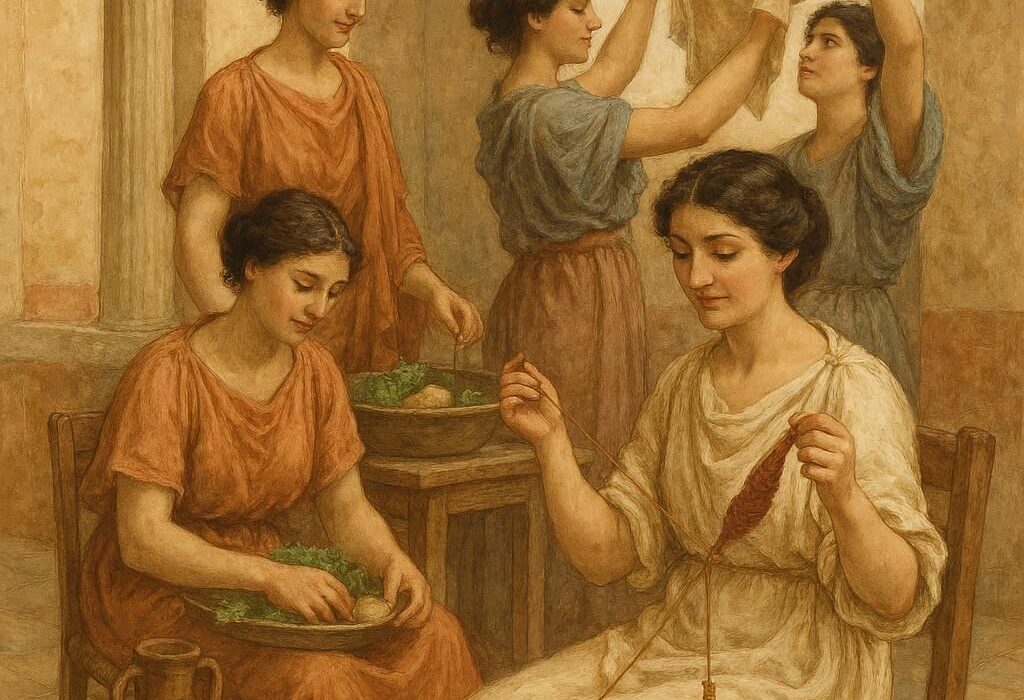
Olive oil and wine were particularly important products because they could be stored, transported, and exchanged. Sheep also supplied wool, a valuable raw material for textile production. Textiles were labor-intensive goods, and their production may have supported both household economies and larger institutions.
Agricultural production depended on local environmental conditions, seasonal rainfall, and the availability of cultivable land. Crete’s varied terrain meant that different communities had access to different resources. Trade and exchange could help compensate for local shortages and connect agricultural producers with craft specialists.
Palace storage facilities provide evidence of organized resource management. Collecting agricultural surpluses allowed institutions to maintain supplies beyond the immediate harvest. Such reserves could support people engaged in activities that did not directly produce food, including administrators, builders, and artisans.
The scale and precise organization of this system remain uncertain. Storage capacity does not automatically reveal who owned the stored goods, who controlled distribution, or whether contributions were collected as taxes, rents, offerings, or other obligations.
Minoan craftspeople also produced sophisticated objects from clay, stone, ivory, and metal. Potters developed distinctive decorative styles, while metalworkers fashioned tools, weapons, vessels, and ornaments. The quality of these goods indicates specialized skills and access to raw materials, some of which came from outside Crete.
This combination of farming, storage, specialized production, and exchange provided the economic foundation for the Minoan palace culture.
How did maritime trade shape Minoan society?
The sea was central to Minoan life. Crete’s location made it a natural participant in exchange networks linking the Aegean islands, mainland Greece, Anatolia, Cyprus, the Levant, and Egypt.
Archaeological finds demonstrate contact between Minoan Crete and these regions. Minoan pottery has been found beyond the island, while imported materials and objects show that Cretan communities obtained goods from abroad. These exchanges moved more than physical products: they also transmitted artistic techniques, technologies, religious practices, and ideas.
Copper was essential for producing bronze, the metal alloy that gives the Bronze Age its name. Crete did not possess all the raw materials needed for its metalworking industries in sufficient quantities, making external connections important. Tin, another component of bronze, was especially dependent on long-distance supply networks.
Other traded materials included ivory and precious or semi-precious stones. Their presence in Minoan contexts reflects access to resources that were not readily available on the island.
Minoan pottery provides especially useful evidence for exchange. Its distribution helps archaeologists identify connections between Crete and distant communities. However, finding a Cretan vessel abroad does not necessarily mean that a Minoan merchant carried it directly to its destination. Goods could pass through several intermediaries, and objects could travel as gifts, diplomatic offerings, or personal possessions.
Minoan ships probably supported the movement of agricultural products, crafted goods, and raw materials, although the precise organization of maritime commerce is not fully understood.
For a long time, scholars described the Minoans as a peaceful maritime civilization whose power rested primarily on trade rather than warfare. Their art does contain fewer prominent scenes of large-scale combat than the art of some contemporary societies, and many Minoan settlements lacked the massive defensive walls found at certain mainland centers.
Yet this evidence does not establish that Minoan society was peaceful in every respect. Weapons, fortifications in some locations, and other archaeological evidence complicate an entirely pacifist interpretation. Maritime activity could have supported commerce, diplomacy, migration, and military power simultaneously.
The strongest conclusion is that sea connections gave Minoan communities access to resources and ideas that helped sustain their complex society.
What did Minoan art and architecture reveal about their world?
Minoan art is among the most recognizable aspects of Bronze Age archaeology. Wall paintings, pottery, carved seals, figurines, and decorated objects depict animals, plants, human activities, and scenes that may have had religious or ceremonial significance.
Many wall paintings use energetic lines, flowing forms, and vivid colors. Figures appear in gardens, processions, landscapes, and ritual settings. Bulls, dolphins, birds, and other animals feature prominently in the surviving imagery.
These paintings provide clues about the environments and activities that mattered to Minoan communities. At the same time, they should not be treated as straightforward documentary records. Artists selected and stylized their subjects, and the symbolic meanings of many images remain uncertain.
One of the best-known motifs is bull-leaping, in which figures appear to vault over or interact acrobatically with a bull. The images may represent a ritual performance, a ceremonial spectacle, or an idealized activity. Their exact meaning and the practical details of the depicted action remain debated.
Bulls also appear in other contexts, including architectural decoration and objects associated with religious practice. Their repeated presence suggests cultural importance, although it does not establish a single, universally shared meaning.
Minoan architecture offers another perspective on social life. Large courtyards could accommodate gatherings, while elaborate stairways, painted rooms, and carefully arranged spaces created environments for public and restricted activities. The arrangement of buildings may have helped distinguish different social roles and forms of access.
Pottery styles changed over time, reflecting developments in artistic conventions, manufacturing techniques, and regional preferences. Some vessels featured naturalistic marine designs, while others used geometric patterns or more stylized motifs.
These objects are valuable because they survive in greater numbers than textiles, wooden furniture, and many other everyday materials. As a result, the archaeological record may overrepresent durable, decorated goods compared with the ordinary objects most people used.
Minoan art demonstrates the presence of skilled craftspeople and established artistic traditions. It also reveals that visual culture played an important role in expressing identity, status, and possibly religious beliefs.
What did the Minoans believe?
Religion appears to have been woven into many aspects of Minoan life. Archaeological evidence includes figurines, decorated vessels, sacred-looking architectural spaces, ritual objects, and images associated with animals and natural settings.
Some of the most familiar finds are female figurines holding snakes, often called snake goddesses. Their interpretation is uncertain. They may represent deities, ritual participants, or figures with another symbolic role. The label commonly applied to them should not be mistaken for a confirmed ancient identity.
Minoan religious activity appears to have taken place in several settings, including palace complexes, caves, mountain locations, and smaller shrines. This distribution suggests that sacred practices were not confined to a single type of building.
Mountains and caves may have held particular significance because of their natural features and distinctive settings. Archaeologists have found offerings and other objects at some such locations, indicating repeated ceremonial activity.
Animals, especially bulls, recur in Minoan religious or ritual imagery. Double axes, horns-of-consecration motifs, and other objects also appear in contexts interpreted as sacred. However, the precise beliefs associated with these symbols remain uncertain.
Some scholars have emphasized the prominence of female figures in Minoan imagery and proposed that goddesses played a major role in the religious system. Although female representations are important, surviving images do not provide enough evidence to reconstruct the entire pantheon or establish the exact relationship between male and female deities.
The absence of deciphered Minoan religious texts makes interpretation especially difficult. Archaeologists must infer meaning from the placement of objects, repeated patterns, iconography, and comparisons with neighboring societies. Such comparisons can be useful, but similarities do not prove that different cultures held identical beliefs.
Minoan religion is therefore best understood as a set of practices and symbols whose broad importance is evident, even though many specific meanings remain unknown.
What languages did the Minoans speak and write?
The Minoans used more than one writing system during their history. The most important early script associated with their civilization is known as Cretan Hieroglyphic, followed by Linear A, which was used extensively for administrative records during the palace period.
Neither script has been deciphered with sufficient confidence to allow scholars to read Minoan documents as they would read a known ancient language. Linear A remains particularly important because its surviving inscriptions provide direct evidence that Minoan institutions maintained written records.
The tablets and other inscribed objects were often made of clay. Many appear to record commodities, quantities, personnel, or administrative transactions. Their repetitive formats suggest practical recordkeeping rather than extended literary writing, although the surviving material cannot tell us everything the writing system was used for.
Linear A should not be confused with Linear B, a related script used later to write an early form of Greek. Linear B was deciphered in the twentieth century, revealing records associated with the Mycenaean civilization of mainland Greece and its influence on Crete.
The relationship between the two scripts is important. Linear B adapted elements of the earlier writing system but represented Greek, whereas Linear A remains unreadable. The fact that one script can be deciphered does not mean that the other must encode the same language.
The language written in Linear A is often called Minoan as a convenient label, but its linguistic identity is unresolved. Scholars cannot confidently determine its full grammatical structure, vocabulary, or relationship to known language families.
This uncertainty limits what can be said about Minoan political institutions, personal names, religious concepts, and historical events. Archaeology can reveal that records were kept and goods were managed, but it cannot reliably reconstruct the exact language of the people who created those records.
The surviving evidence also does not establish how widely literacy extended beyond palace administrators and other specialists. Written records demonstrate administrative expertise, not universal literacy.
How was Minoan society organized?
The palace complexes and their contents indicate that Minoan society included people with different occupations, responsibilities, and levels of access to resources. Farmers, herders, craftspeople, sailors, administrators, and religious specialists likely contributed to the broader economic system.
The construction and maintenance of large buildings required coordinated labor. Producing decorated pottery and metal objects demanded specialized knowledge, while managing stored agricultural goods and maintaining written records required administrative skills.
These activities suggest social differentiation, meaning that people occupied different positions within the community and did not all have equal access to wealth or authority.
The distribution of elaborate objects, large buildings, and specialized production provides evidence of unequal resources. However, archaeologists cannot determine the exact boundaries between social classes or reconstruct a complete hierarchy from these finds alone.
The political organization of Crete is similarly uncertain. The major palaces may have governed surrounding territories, competed with one another, or operated within a more interconnected system. Their architectural similarities suggest shared traditions, but they do not prove that a single ruler controlled the entire island.
Knossos eventually became especially influential, yet the extent and timing of its political dominance remain subjects of debate. The relationship between palace authorities and local communities may also have changed over time.
Women appear prominently in some Minoan artworks, including ceremonial scenes and representations of richly dressed figures. These images have encouraged arguments that women held substantial religious or political authority. However, artistic prominence does not automatically reveal actual legal rights, inheritance practices, or political power.
Burials and grave goods offer additional evidence about social differences, but burial customs do not provide a complete picture of everyday life. Some objects may have expressed family identity or ritual obligations rather than individual wealth alone.
The most defensible interpretation is that Minoan Crete supported a complex society with specialized labor, institutional centers, and social distinctions. The exact political system and the distribution of authority remain unresolved.
How did the Minoan civilization influence mainland Greece?
Minoan influence extended beyond Crete, especially into the Aegean islands and parts of mainland Greece. Trade, travel, migration, and contact between elites helped spread artistic styles, technologies, and cultural practices.
The Mycenaean civilization, which developed on mainland Greece during the later Bronze Age, maintained important connections with Crete. Mycenaean sites contain objects and artistic traditions that reflect Minoan influence, although mainland communities adapted these elements to their own circumstances.
Minoan-style pottery and other goods circulated beyond Crete, while features of Minoan art and architecture appeared in settings connected with the wider Aegean world. These exchanges show that cultural influence did not require direct political control. Communities could adopt foreign designs and practices through trade, imitation, and personal contact.
The relationship between Minoans and Mycenaeans became particularly important during the later Bronze Age. Mycenaean Greek speakers eventually used Linear B to maintain administrative records on Crete, indicating that Greek-speaking authorities operated at Knossos during a later phase of the island’s history.
This development is one reason historians distinguish the earlier Minoan palace culture from the later Mycenaean administrative presence. Although the two civilizations interacted closely, they were not identical.
The Minoan contribution to Aegean civilization was therefore substantial, but it should not be understood as a simple process in which one culture replaced another overnight. Cultural influence, political authority, and population movement could occur at different times and in different places.
What caused the decline of the Minoan civilization?
The decline of Minoan palace culture was not a single event with one universally accepted explanation. Archaeological evidence points to a sequence of destruction, rebuilding, political change, and eventual loss of the institutions that had organized much of Cretan society.
A major event in this history was the eruption of the Thera volcano, on the island now known as Santorini, north of Crete. The eruption occurred during the second millennium BCE, although its exact date remains debated.
The eruption was enormous by human historical standards. It produced widespread volcanic deposits and dramatically altered Thera’s landscape. It also generated hazards that may have affected parts of the surrounding Aegean region, including ashfall and tsunamis.
The extent of the eruption’s direct impact on Crete is uncertain. Coastal settlements may have been vulnerable to tsunami damage, and environmental disruption could have affected maritime activity. However, the eruption cannot simply be treated as the immediate cause of the destruction of every Minoan palace.
Evidence indicates that major palace centers on Crete continued to function after the eruption. Some experienced later destruction, meaning that the decline of the palace system unfolded over an extended period rather than ending everywhere at once.
Internal political tensions, competition between regional centers, disruptions to trade, earthquakes, and other environmental pressures have all been considered as possible contributors to the changes. These explanations are not mutually exclusive, and their relative importance may have varied across the island.
Around the later fifteenth century BCE, many major Minoan palace centers had been destroyed or abandoned, while Knossos continued to operate for a time under conditions associated with Mycenaean influence. The evidence from this period points to a significant shift in political authority and administrative practice.
Mycenaean expansion or intervention is often regarded as an important part of this transition. The appearance of Linear B records at Knossos supports the conclusion that Greek-speaking administrators exercised authority there during a later phase. Nevertheless, the exact process by which control changed hands remains uncertain.
The archaeological record does not justify a simple narrative in which a single invasion destroyed an otherwise stable civilization. Environmental disasters, political developments, and economic changes may have interacted, weakening institutions that had previously coordinated production and exchange.
The Minoan civilization did not disappear in the sense that Crete became uninhabited or lost all of its earlier cultural traditions. People continued living on the island, and aspects of Minoan material culture persisted even as political institutions and administrative systems changed.
How do archaeologists reconstruct Minoan history?
Because Minoan writing remains undeciphered, archaeology is essential for reconstructing the civilization’s development. Researchers study buildings, artifacts, environmental evidence, burials, and settlement patterns to determine how people lived and how their society changed.
Stratigraphy, the study of layers of soil and archaeological deposits, helps establish the sequence of events at a site. Objects found in the same layer can provide clues about which activities occurred together, while layers above and below them help establish relative chronology.
Radiocarbon dating provides estimates of the age of organic materials, such as charcoal or seeds. The method measures the decay of radioactive carbon and compares the results with calibration data to estimate when the organism died. Because radiocarbon measurements have uncertainties and require calibration, archaeologists often combine them with other dating methods and archaeological evidence.
Dendrochronology, which uses tree-ring patterns, can sometimes provide highly precise dates when suitable wood survives and can be matched to established regional sequences. Volcanic deposits and other geological evidence can also help researchers correlate events across different sites.
Pottery is another essential tool. Styles and manufacturing techniques changed over time, allowing archaeologists to compare objects from different locations and establish broad chronological relationships. These comparisons are particularly valuable when written historical records are unavailable.
Researchers also examine animal bones, plant remains, pollen, and other environmental evidence. Such materials can reveal which crops were cultivated, what animals people raised, how landscapes changed, and whether environmental pressures affected local communities.
Scientific analyses of metals, stone, and ceramics can help identify where materials originated and how they were processed. Chemical and mineralogical characteristics may connect an object to a particular source, although such conclusions depend on the quality of reference data and the uniqueness of the material’s composition.
No single type of evidence answers every historical question. A destroyed building might indicate an earthquake, deliberate attack, or another event, and distinguishing among these possibilities requires multiple lines of evidence. Likewise, the presence of imported pottery demonstrates contact but does not necessarily reveal who arranged the exchange or how it was organized.
The most reliable accounts of Minoan history emerge when independent forms of evidence support the same interpretation. Where the evidence remains incomplete, archaeologists must distinguish what they can establish from what they can only propose.
Why does the Minoan civilization matter today?
The Minoan civilization provides an important example of how complex societies developed in prehistoric Europe. Its palaces, administrative systems, specialized crafts, and maritime networks demonstrate that sophisticated institutions emerged in the Aegean long before the classical Greek city-states.
Its history also illustrates the importance of geography. Crete’s position created opportunities for exchange, while its agricultural resources supported growing communities. Maritime connections provided access to materials and ideas that could not be obtained locally, helping sustain specialized production and monumental architecture.
At the same time, the Minoan experience shows why cultural complexity should not be reduced to a single measure of progress. Large buildings, elaborate art, and long-distance trade reveal organizational capabilities, but they do not tell us everything about ordinary people’s lives, political freedom, social inequality, or the distribution of wealth.
The civilization’s decline offers another lasting lesson. Societies depend on networks of production, exchange, administration, and political cooperation. Disruptions to these systems can produce consequences that extend beyond the immediate damage caused by a disaster. In the Minoan case, however, the relative importance of environmental shocks, political competition, and Mycenaean expansion remains uncertain.
Finally, Minoan history highlights the limits of historical knowledge. Archaeologists can reconstruct many aspects of the civilization with considerable confidence, yet its undeciphered writing leaves major questions unanswered. The people who built the palaces and created their art remain partly inaccessible through their own words.
The Minoans were neither simply a precursor to classical Greece nor a mysterious civilization defined by its disappearance. They developed a distinctive Bronze Age culture whose economic networks, architectural achievements, artistic traditions, and administrative institutions helped shape the wider Aegean world. Their legacy lies not only in the remarkable objects and buildings they left behind, but also in the evidence they provide about how early European societies organized resources, connected distant communities, and adapted to changing political and environmental conditions.