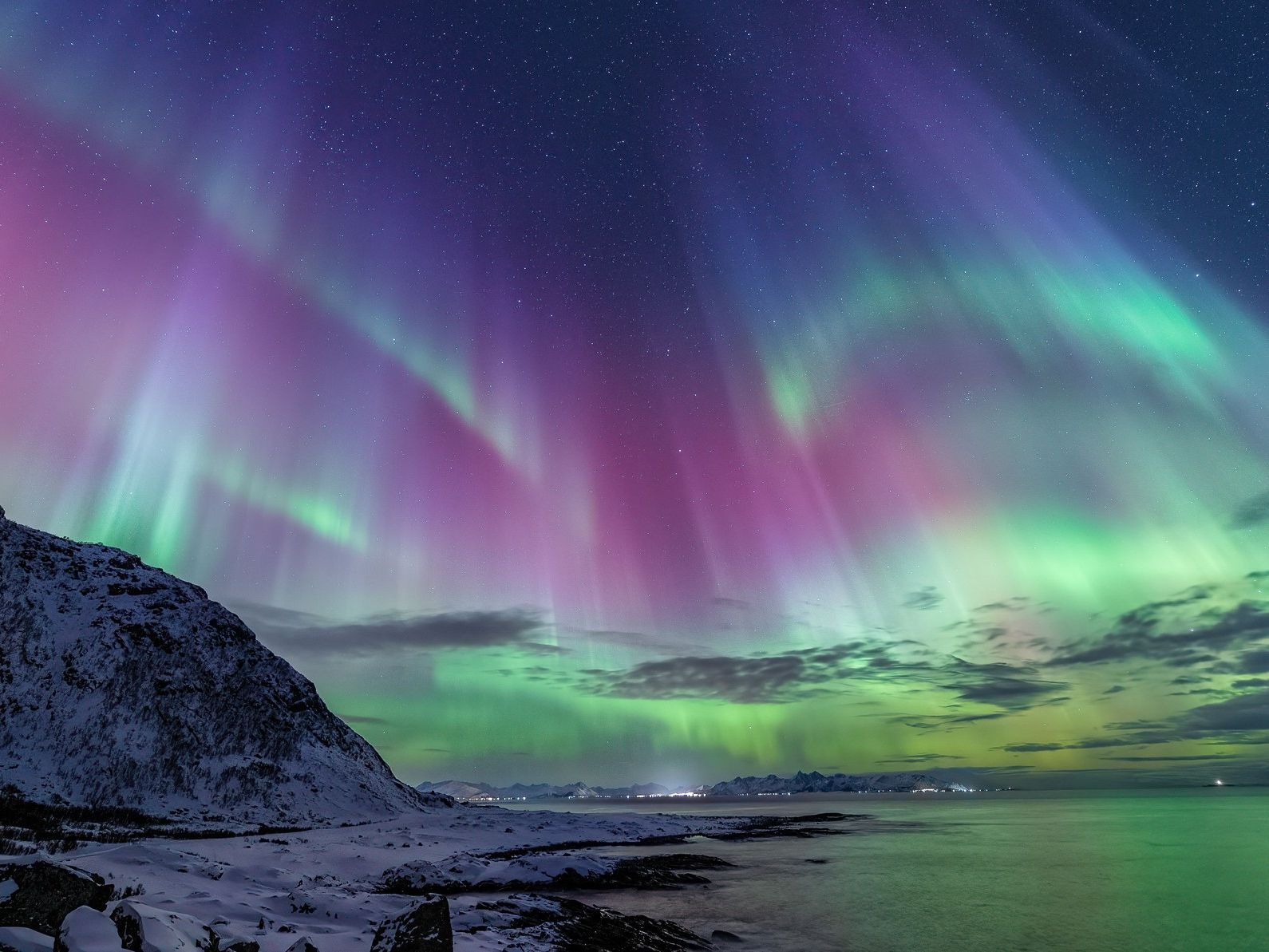
The aurora borealis, commonly called the northern lights, is a natural light display produced when energetic particles from space interact with Earth’s upper atmosphere. The result can be a shifting curtain, arc, or band of light that appears in colors such as green, red, purple, blue, and pink.
Although the aurora can look almost otherworldly, its basic cause is straightforward: the Sun supplies the particles and energy, Earth’s magnetic field guides them, and atmospheric gases produce the light.
Understanding how those three pieces interact explains why the aurora occurs mainly near the poles, why it changes shape, and why its colors vary.
What causes the aurora borealis?
The immediate source of most auroras is the Sun. The Sun continuously releases a stream of electrically charged particles called the solar wind. These particles are primarily electrons and protons moving outward through space.
Earth is protected from much of this particle flow by its magnetosphere, the region of space dominated by Earth’s magnetic field. The magnetic field deflects most of the solar wind around the planet rather than allowing it to strike the atmosphere directly.
But the magnetosphere is not an impenetrable shield. Solar-wind energy can interact with Earth’s magnetic field and become stored in the magnetosphere. During periods of increased solar activity, particularly when disturbances in the solar wind strongly affect Earth’s magnetic environment, that stored energy can be released.
Some charged particles are accelerated toward Earth along magnetic field lines. Near the planet’s polar regions, these field lines connect the magnetosphere with the upper atmosphere. The particles can therefore travel downward and collide with atoms and molecules high above Earth’s surface.
Those collisions create the visible aurora.
Why do the northern lights happen near the North Pole?
Earth’s magnetic field has a distinctive geometry. Magnetic field lines extend outward from the polar regions and curve through space around the planet. Charged particles tend to follow these field lines, so particles entering the upper atmosphere are concentrated into broad regions around the magnetic poles.
The aurora therefore commonly appears in an oval-shaped zone known as the auroral oval. It surrounds the magnetic pole rather than forming a simple circle around the geographic North Pole.
This distinction matters because the geographic poles and magnetic poles are not in exactly the same locations. The auroral oval can also expand toward lower latitudes when geomagnetic activity becomes strong. That is why an aurora that is normally confined to far northern regions can sometimes be visible much farther south.
The corresponding phenomenon in the Southern Hemisphere is called the aurora australis, or southern lights.
How does the aurora make light?
The light comes from Earth’s atmosphere.
When energetic electrons enter the upper atmosphere, they collide with atmospheric atoms and molecules. The collisions can transfer energy to those particles, putting them into excited states.
An excited atom or molecule does not remain that way indefinitely. It eventually releases some of its excess energy, often as a particle of light called a photon. The wavelength of that emitted light determines its color.
Two atmospheric gases are especially important to the visible aurora: oxygen and nitrogen.
Oxygen can produce the familiar green glow and, under different conditions, red light. Nitrogen and nitrogen molecules can contribute blue, purple, and reddish colors. The precise appearance depends on factors including the energy of the incoming particles, the atmospheric composition, and the altitude at which the collisions occur.
Why is the aurora usually green?
Green is the color most strongly associated with the northern lights because excited oxygen atoms commonly emit green light at altitudes where auroras occur.
The green emission is produced by a particular transition in oxygen atoms. Importantly, this emission is relatively long-lived compared with many other atmospheric light emissions. At sufficiently high altitude, an excited oxygen atom has enough time to emit its photon before another collision interrupts the process.
Red auroral light can also come from oxygen, but it is generally produced higher in the atmosphere, where the lower density gives excited oxygen atoms more opportunity to emit red photons.
Blue and purple hues are more closely associated with nitrogen emissions and can become especially noticeable along the lower edges of some auroral displays.
Why does the aurora move and change shape?
The aurora is not a stationary cloud or object. Its changing appearance reflects changes in the flow of charged particles and in Earth’s magnetic environment.
The incoming particles interact with Earth’s magnetic field and can be accelerated, redistributed, and directed along different field lines. As those processes change, the regions of the upper atmosphere receiving energetic particles also change.
That produces the aurora’s characteristic motion: arcs can brighten, curtains can ripple, and bands can stretch across much of the sky. During particularly active displays, the aurora may appear to move rapidly, with structures forming and fading over relatively short periods.
The patterns are also shaped by Earth’s magnetic field. What looks from the ground like a three-dimensional curtain of light is the visible result of energetic particle precipitation occurring across an enormous region of the upper atmosphere.
What role does the Sun play?
Not all solar activity produces equally strong auroras.
The solar wind varies in speed, density, temperature, and magnetic-field properties. The Sun also produces eruptions that can send especially large amounts of plasma and magnetic energy into space. When such disturbances reach Earth, they can cause significant changes in the magnetosphere.
One particularly important type of disturbance is a coronal mass ejection, or CME. A CME is a large eruption of magnetized plasma from the Sun. If its magnetic structure and trajectory are favorable for interacting strongly with Earth’s magnetosphere, it can trigger a geomagnetic storm.
During a geomagnetic storm, the auroral oval can expand and the aurora can become visible at considerably lower latitudes than usual.
The Sun therefore does not simply “shine” the aurora into existence. Instead, solar activity changes the conditions in near-Earth space, which can alter how much energy reaches Earth’s upper atmosphere.
Is the aurora caused by solar flares?
Solar flares and auroras are related to solar activity, but they are not the same phenomenon.
A solar flare is a sudden release of energy from the Sun that produces intense electromagnetic radiation. A coronal mass ejection, by contrast, involves the expulsion of a large quantity of magnetized plasma.
Both can occur during periods of heightened solar activity, but they affect Earth in different ways. Auroras are primarily associated with energetic particles entering the atmosphere and with disturbances in Earth’s magnetosphere. A CME can be particularly important because its interaction with Earth’s magnetic field can drive the geomagnetic activity that intensifies auroras.
So seeing an aurora does not mean that a solar flare itself is illuminating the sky.
How high above Earth does the aurora occur?
Auroras occur in the upper atmosphere, far above the altitude at which commercial aircraft normally fly.
The visible emissions occur at different altitudes depending on the atmospheric gas involved and the energy of the particles producing them. Green oxygen emissions commonly occur at roughly 100 kilometers or more above Earth’s surface, while some red emissions can originate at substantially greater altitudes.
Because the atmosphere becomes extremely thin at these heights, particles can travel farther between collisions than they would near the surface. That low density is essential to the production of some auroral colors: excited atoms have a better chance of releasing light before colliding with another atmospheric particle.
The aurora is therefore not a weather phenomenon in the ordinary sense. It takes place in the upper atmosphere and is driven by processes connecting Earth’s atmosphere, magnetic field, and the space environment around the planet.
Why can auroras be different colors?
Auroral color depends mainly on which atmospheric particles are emitting the light, how much energy they receive, and the altitude where the emissions occur.
Oxygen is responsible for prominent green and red emissions. Nitrogen contributes blue and purple tones. A single display can contain several colors because energetic particles can penetrate to different depths and excite different atmospheric species.
The human eye also affects how auroras appear. A faint aurora may look mostly gray or white to the eye because human night vision is relatively poor at detecting color. A brighter aurora can reveal much stronger greens, reds, purples, and other hues.
Cameras can make auroras appear more colorful than they look to the unaided eye because camera sensors can collect light over longer exposures.
Why are some auroras faint while others are spectacular?
The brightness of an aurora depends largely on how much energy is being deposited into the upper atmosphere by energetic particles.
When particle precipitation is weak, the resulting light may be subtle and difficult to see, especially in areas affected by artificial light. Stronger geomagnetic activity can produce brighter and more extensive auroral structures.
Location matters, too. Even a strong aurora can be difficult to see from a city because light pollution overwhelms faint natural light in the night sky. Dark skies make a major difference.
Weather is another practical limitation. Clouds below the aurora can block the view even when auroral activity overhead is strong.
Can the northern lights be seen from the United States?
Yes. Alaska is the U.S. state most strongly associated with aurora viewing because much of it lies beneath or near the auroral oval. The phenomenon can also be visible from parts of the northern continental United States.
During stronger geomagnetic storms, the auroral oval can expand far enough south for displays to be seen across portions of the Lower 48. How far south the aurora becomes visible depends on the strength and structure of the geomagnetic disturbance.
For someone trying to observe an aurora, three conditions are especially helpful: a sufficiently active aurora, a dark location with an unobstructed view of the sky, and clear weather.
The best viewing time is generally during the nighttime hours, when the sky is dark enough for the relatively faint auroral light to stand out.
Are the northern lights dangerous?
The aurora itself is not dangerous to people watching it from the ground. The light is produced high in the atmosphere, and the energetic particles responsible for it do not reach the surface in a way that poses a direct threat to ordinary observers.
The space-weather events that produce strong auroras can, however, affect technology. Significant geomagnetic storms can disturb Earth’s ionosphere and magnetosphere, potentially interfering with radio communication, navigation systems, satellites, and electrical infrastructure.
These technological effects are a separate issue from the visible light itself. The aurora is the atmospheric manifestation of a much larger interaction between solar activity and Earth’s magnetic environment.
Why do the northern lights matter to science?
Auroras provide a visible window into processes that are otherwise difficult to observe.
Scientists study them to understand how energy moves from the solar wind into Earth’s magnetosphere and upper atmosphere. Auroral observations can reveal information about charged particles, magnetic fields, and interactions between the Sun and Earth.
This broader field is known as space weather. Just as ordinary weather describes changing conditions in Earth’s atmosphere, space weather describes changing conditions in the space environment around Earth, particularly those influenced by solar activity.
The aurora is therefore more than a beautiful atmospheric display. It is one visible consequence of a continuous physical connection between the Sun and Earth.
The aurora is a solar-Earth interaction made visible
The northern lights begin with activity on the Sun, but the final glow is produced by Earth’s own atmosphere. Solar-wind particles and solar eruptions influence Earth’s magnetic environment; the magnetic field directs energetic particles toward the polar atmosphere; and collisions there excite oxygen and nitrogen, which release that energy as visible light.
That chain of events—Sun, solar wind, magnetosphere, charged particles, atmosphere, and light—is what produces the aurora borealis.
The result is one of the clearest examples of space physics becoming visible from the ground: a phenomenon governed by invisible magnetic fields and microscopic atomic processes that ultimately paints changing light across the night sky.