Spacetime is the four-dimensional framework that combines the three dimensions of space with the dimension of time. It describes not only where events happen but also when they happen, providing the foundation for understanding motion, gravity, and the structure of the universe. According to Albert Einstein’s theory of relativity, space and time are not separate, universal backgrounds. They are interconnected aspects of a single physical reality, and measurements of distance and duration can depend on an observer’s motion and gravitational environment.
This idea goes far beyond a change in terminology. It explains why two observers moving relative to each other can disagree about how much time has passed or how far apart two events are, while still agreeing on the underlying laws of physics. It also reveals that gravity is not simply a force pulling objects through otherwise empty space. In Einstein’s general theory of relativity, gravity arises from the curvature of spacetime itself.
Understanding spacetime helps explain everything from the behavior of satellites and the accuracy of GPS navigation to the evolution of stars, the existence of black holes, and the large-scale history of the universe. It also exposes one of modern physics’ deepest unresolved problems: how to reconcile the structure of spacetime with quantum mechanics, the theory governing matter and energy at the smallest scales.
What the four dimensions of spacetime mean
To understand spacetime, begin with the difference between space and time as we experience them.
Space describes the positions and distances between objects. In ordinary life, locating an object requires three coordinates: one for left and right, one for forward and backward, and one for up and down. These correspond to the three familiar spatial dimensions.
Time describes when something happens. A location alone cannot fully specify an event because different events can occur at the same place. A traffic light might turn green at noon and red a minute later. To distinguish those occurrences, we need a time coordinate in addition to the three spatial coordinates.
An event in physics is something that happens at a particular place and at a particular time. A ball striking the ground, a star emitting light, and a spacecraft passing a planet are all events. To specify any one of them completely, we need four coordinates: three describing its location and one describing its time.
Together, these coordinates form spacetime.
The four dimensions are not four spatial directions. The first three describe positions in space, while the fourth describes time. Time also differs fundamentally from space in the way it enters the equations of relativity, so it cannot simply be treated as another direction that we can move through at will.
A useful analogy is a map paired with a schedule. A map tells you where a train station is, while a schedule tells you when a train arrives. Combining the two allows you to identify a particular arrival. Spacetime unites these kinds of information into a single framework.
However, spacetime is more than a convenient system for recording coordinates. Its geometry determines which events can influence one another, how clocks measure elapsed time, how objects move under gravity, and how light travels. The relationship between space and time is a physical feature of the universe, not merely a bookkeeping choice.
Why space and time cannot be understood separately
Before Einstein developed his theories, Isaac Newton’s mechanics treated space and time as independent backgrounds. Space provided a fixed arena in which objects moved, while time flowed uniformly for everyone, everywhere. Within the everyday conditions of Newtonian physics, this picture works remarkably well.
Newtonian mechanics remains an excellent approximation for ordinary speeds, weak gravitational fields, and many engineering applications. But experiments involving light and the development of electromagnetic theory exposed a problem with the idea that time must pass identically for all observers.
The central breakthrough of special relativity, published by Einstein in 1905, was that the laws of physics are the same for all observers moving at constant velocity relative to one another, and that the speed of light in a vacuum is the same for all such observers, regardless of the motion of the light source or observer.
These principles have consequences that contradict everyday intuition. Space and time measurements cannot both remain independent and absolute while preserving the same speed of light for every inertial observer. Instead, observers in relative motion can measure different distances and durations, and they can disagree about whether two separated events occurred at the same time.
What remains consistent is the underlying spacetime relationship between events. Different observers may assign different spatial and temporal coordinates to an event, but they agree on the structure of physical laws and on certain quantities that combine space and time.
This relationship is expressed mathematically through spacetime geometry. In particular, the interval between two events in flat spacetime combines their spatial separation with their temporal separation in a way that remains invariant between inertial observers. The interval is not simply an ordinary distance in four dimensions because time enters with a different sign from space.
This distinction matters. If time behaved exactly like another spatial dimension, the universe would have a very different causal structure. Relativity instead establishes a relationship between space and time that preserves a universal speed limit for the transmission of information and physical influence.
How relativity changes our understanding of time
One of the most surprising consequences of spacetime is that elapsed time is not universal. Different observers can measure different amounts of time between events, even when their clocks are functioning correctly.
This effect is called time dilation. It occurs in two important circumstances: when observers move relative to each other and when they experience different gravitational conditions.
In special relativity, a clock moving relative to an observer is measured to tick more slowly than a clock at rest in that observer’s frame, assuming the clocks are compared under the appropriate conditions. The effect becomes increasingly significant as the relative speed approaches the speed of light.
For example, imagine two highly accurate clocks. One remains on Earth while the other travels aboard a spacecraft at an extremely high speed and later returns. When the clocks are reunited, they can show different elapsed times. The traveling clock may have recorded less time than the clock that remained on Earth.
This is not merely an illusion caused by signals taking time to travel between the clocks. When the clocks meet again, the difference can be measured directly. Each clock records the time along its own path through spacetime, a quantity known as proper time.
The familiar example of twins, one traveling through space at high speed and the other staying on Earth, illustrates this effect. The traveling twin can return younger than the twin who remained behind. The result does not mean that the traveler experiences time as unusually slow in their own immediate surroundings. Their clock and bodily processes proceed normally from their perspective. The age difference becomes apparent when the two are brought together and their elapsed times are compared.
The gravitational version of time dilation follows from general relativity. A clock closer to a massive body, such as Earth, generally ticks more slowly relative to a clock farther away in a weaker gravitational field, when the clocks are compared using the appropriate reference conditions.
These effects are small in many everyday situations, but they are real and measurable. Precision clocks flown on aircraft, atomic clocks at different elevations, and clocks in satellite systems all demonstrate that motion and gravity affect elapsed time.
The practical lesson is that time is not a single universal clock governing the entire cosmos. Each clock measures time along its own trajectory through spacetime, and the relationship between those measurements depends on motion and gravity.
Why simultaneity depends on the observer
Another important consequence of relativity is that observers can disagree about whether two spatially separated events happened at the same time.
In everyday experience, simultaneity seems straightforward. If two distant lights flash at once, we tend to assume that they did so at the same moment, regardless of who observes them. But establishing whether distant events are simultaneous requires a method of synchronizing clocks and accounting for the time light takes to travel.
Special relativity shows that observers moving relative to each other can disagree about the timing of separated events even when they account correctly for signal travel. This is called the relativity of simultaneity.
Imagine two lightning strikes hitting opposite ends of a moving train. An observer standing beside the tracks may judge the strikes to have occurred simultaneously. An observer moving with the train can reach a different conclusion because the two observers use different reference frames to describe the events.
Neither observer necessarily made a mistake. They are assigning time coordinates according to different but physically valid frames of reference.
This does not mean that every event is subjective or that reality changes according to someone’s beliefs. The events themselves occur, and the laws of physics constrain how different observers can describe them. What is not universal is the division of spacetime into a single set of simultaneous moments extending across space.
This insight challenges the idea of a universal present shared by the entire universe. There is no observer-independent definition of simultaneity for all distant events in special relativity. Although people can share a practical sense of the present in everyday circumstances, that approximation does not extend unchanged to every scale and relative motion.
The speed of light and the structure of spacetime
The speed of light in a vacuum is approximately 300,000 kilometers per second, or about 186,000 miles per second. In relativity, this speed plays a fundamental role because it sets the maximum speed at which information or causal influence can propagate through spacetime.
Light does not need to travel at this speed in every material. It can move more slowly through glass, water, or other substances because of its interactions with matter. The invariant speed in relativity refers specifically to light in a vacuum and to the limiting speed for the propagation of causal signals.
This limit determines how events are connected.
Suppose a star explodes many light-years away. Its light cannot reach Earth instantaneously, so we observe the explosion only after the light has crossed the intervening distance. Until information about the explosion can reach us, we cannot receive a signal telling us that it occurred.
The same principle applies to all causal influence. An event cannot affect another event outside its future light cone, the region of spacetime that can be reached from the first event by a signal traveling at or below the speed of light.
A light cone is a geometric way to represent the possible paths of light and the limits on cause and effect. At any event, light can travel outward in different spatial directions, defining the boundary between events that can be causally connected and events that cannot.
Events inside the future light cone can potentially be influenced by the original event. Events inside the past light cone can potentially have influenced it. Events outside these regions are separated in a way that prevents a light-speed-or-slower signal from connecting them.
This structure explains why relativity does not permit ordinary faster-than-light communication. It also clarifies why different observers may disagree about the time ordering of some distant events without disagreeing about cause and effect. If two events can causally influence each other, their temporal order is constrained to remain consistent across inertial reference frames.
Spacetime therefore does more than combine position and time. It defines the boundaries of possible communication and the physical order of cause and effect.
How gravity curves spacetime
Special relativity describes spacetime in the absence of gravity in its simplest form. Einstein’s general theory of relativity, published in 1915, extends the framework to include gravity by treating spacetime as a dynamic geometry.
In Newtonian physics, gravity is a force that attracts objects with mass toward one another. This description remains useful in many circumstances, but general relativity provides a deeper account of how gravity operates.
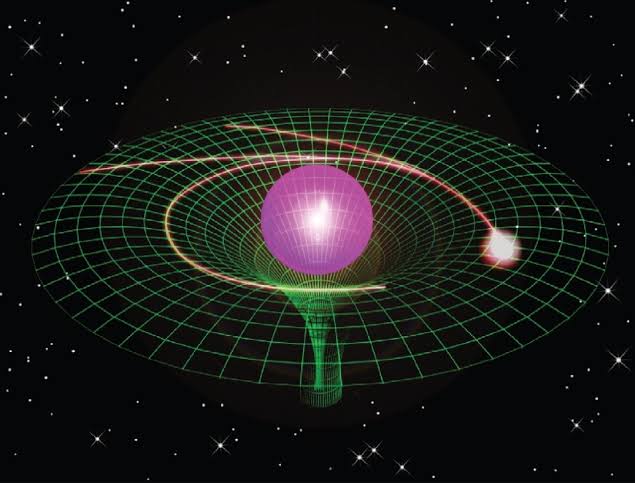
According to general relativity, matter and energy influence the geometry of spacetime, while that geometry guides the motion of matter and light. Massive objects such as planets and stars change the relationships between distances, times, and possible paths through their surroundings.
Objects moving under gravity can then follow paths called geodesics, which are the closest equivalents to straight lines in curved geometry. In curved spacetime, a geodesic need not look straight when viewed on an ordinary map or represented in a simple three-dimensional picture.
Earth orbits the Sun because the Sun changes the geometry of the surrounding spacetime, and Earth follows a path consistent with that geometry. In the general relativistic description, Earth is not simply being pulled through a fixed background by an invisible Newtonian force. Its motion reflects the curved spacetime around the Sun.
A common analogy compares spacetime to a stretched rubber sheet with a heavy ball placed on it. The ball creates a depression, and smaller objects roll along altered paths. This can help illustrate how the presence of mass changes geometry, but it has important limitations. A rubber sheet is a two-dimensional surface embedded in three-dimensional space, and its deformation depends on Earth’s gravity. Spacetime curvature does not require an external space into which spacetime bends, and gravity in general relativity is not simply a dent in a material sheet.
The analogy also fails to capture the role of time. In many gravitational situations, the curvature involving the time dimension is especially important in explaining the motion of objects. A complete description requires the geometry of all four spacetime dimensions, not just a curved spatial surface.
General relativity describes the relationship between spacetime curvature and the distribution of matter and energy through field equations. These equations determine how geometry responds to physical conditions and how that geometry affects motion.
Gravity, in this account, is not merely a property of objects. It is also a feature of the structure of spacetime.
How scientists know that spacetime is physically real
Spacetime is a mathematical framework, but its predictions are not confined to abstract equations. Many of its consequences have been tested through experiments and astronomical observations.
One of the earliest major tests of general relativity concerned the orbit of Mercury. Mercury’s elliptical orbit gradually rotates, a phenomenon called the precession of its perihelion. Newtonian calculations explain most of this motion, but they leave a small discrepancy. General relativity accounts for the additional precession through the curvature of spacetime near the Sun.
Another major prediction is the bending of light by gravity. Light passing near a massive object follows the geometry of the surrounding spacetime, causing its path to appear deflected. This effect has been measured around the Sun and is also observed on much larger scales through gravitational lensing, in which galaxies and clusters of galaxies distort the images of objects behind them.
General relativity also predicts gravitational waves: disturbances in spacetime geometry that propagate outward from accelerating masses under the right conditions. Such waves are produced by events including the mergers of black holes and neutron stars. Their direct detection has provided evidence that spacetime can carry propagating disturbances, much as electromagnetic fields can carry light.
Time dilation has also been confirmed through precision measurements. Atomic clocks flown on aircraft or placed at different altitudes record time differences consistent with relativity when the effects of motion and gravity are accounted for.
Satellite navigation offers a particularly practical example. GPS satellites carry precise clocks and move at high speeds relative to observers on Earth’s surface while operating in a weaker gravitational field than clocks at sea level. Special relativity predicts that their motion makes their clocks run slower relative to Earth-based clocks, while general relativity predicts that the weaker gravitational field makes them run faster. The gravitational effect is larger than the motion-related effect, so the two corrections do not cancel.
The combined difference is roughly 38 microseconds per day for GPS satellite clocks relative to clocks on the ground. That amount may sound negligible, but timing errors accumulate into substantial positioning errors if left uncorrected. Satellite navigation systems must account for relativistic effects to maintain accurate results.
These tests do not prove every possible implication of general relativity under every imaginable condition. They establish that the theory successfully describes a broad range of observed phenomena. Scientists continue testing its predictions, particularly in extreme gravitational environments where new physics might become detectable.
What happens to spacetime near black holes
Black holes provide some of the most extreme environments in which to study spacetime. They form when enough mass is compressed into a sufficiently small region that an event horizon develops.
An event horizon is a boundary beyond which no signal can escape to distant observers, not even light. It is not a solid surface. Rather, it marks a limit on which future-directed paths can reach the outside universe.
In the simplest description of a nonrotating black hole, the event horizon surrounds a region where spacetime is curved so strongly that all possible future paths for light and matter point inward once the horizon has been crossed. An object falling through the horizon does not necessarily encounter a material barrier at that boundary. What happens locally depends on the black hole’s properties and the environment.
To a distant observer using suitable coordinates, signals from an object approaching the horizon become increasingly delayed and redshifted, meaning their light shifts toward longer wavelengths. In practice, the signals become too faint and stretched out to observe. The falling object, meanwhile, can cross the horizon in a finite amount of its own proper time.
These descriptions are not contradictory. They reflect the distinction between the time measured along the falling object’s path and the coordinate system used to describe events from far away.
Black holes also reveal a limitation of current physical theories. General relativity predicts that under idealized conditions, gravitational collapse can lead to a singularity, where quantities describing curvature become unbounded and the classical equations cease to provide a complete physical description.
A singularity should not automatically be understood as a confirmed physical point of infinite density. It is more accurately a sign that the classical theory has reached the limits of its applicability. Scientists expect that a more complete account of gravity, incorporating quantum physics, will be needed to describe what happens in such extreme conditions.
Black holes therefore illustrate both the extraordinary explanatory power of spacetime geometry and the limits of current knowledge.
How the universe expands through spacetime
Spacetime is also central to modern cosmology, the scientific study of the origin, evolution, and large-scale structure of the universe.
Observations show that, on sufficiently large scales, distant galaxies are generally moving away from one another in a pattern consistent with the expansion of the universe. The standard cosmological description interprets this as an expansion of space itself rather than as galaxies flying outward from one special center through a fixed, preexisting void.
A useful analogy is the surface of an expanding balloon. Dots drawn on its surface move farther apart as the balloon inflates, even if the dots themselves do not crawl across the surface. Similarly, the large-scale distances between galaxies can increase because the spatial geometry of the universe evolves.
The analogy has limits. The universe is not known to be the surface of a balloon, and its expansion does not require an external space into which it grows. The balloon’s center is also not a model for a special central point in the universe. In the standard cosmological model, expansion occurs throughout space on large scales.
General relativity allows spacetime geometry to change over time. When applied to the universe as a whole, its equations describe how the cosmic scale factor, a measure of how large distances between freely moving galaxies become over time, evolves according to the universe’s contents and geometry.
Observations of galaxy distances, the cosmic microwave background, and the abundance of light elements support the broad picture that the observable universe evolved from an early hot, dense state. The cosmic microwave background is the radiation released when the early universe cooled enough for light to travel freely over long distances. Today, it is observed as microwave radiation arriving from all directions.
The expansion of the universe is not the same as the ordinary expansion of matter into an empty surrounding region. Rather, it describes changes in the large-scale relationships between locations within spacetime. Individual galaxies, stars, planets, and other bound systems do not generally expand along with the universe because local forces and gravitational binding prevent them from following the overall cosmic expansion in that simple way.
The observed expansion is accelerating in the current era, according to measurements interpreted within the standard cosmological model. The cause is commonly described using the term dark energy, which refers to whatever drives the accelerated expansion in that model. A cosmological constant, representing a constant energy density associated with space, is the simplest explanation consistent with many observations, but the fundamental nature of dark energy remains unresolved.
Cosmology demonstrates that spacetime is not necessarily static. Its geometry can evolve, carrying the history of the universe in the changing relationships between distances, times, and the distribution of matter and energy.
What the fourth dimension does—and does not—mean
The phrase “fourth dimension” can suggest that time is a hidden spatial direction or that the universe contains an additional realm beyond ordinary experience. Neither interpretation is required by relativity.
Time is the fourth coordinate used to describe events, but it differs from spatial dimensions in several fundamental respects. We can choose to move left or right, up or down, and forward or backward, but we cannot freely choose to move backward through time in the same way. Our experience of time is also linked to causality, thermodynamics, and the physical processes that allow memories and records to form.
The equations of relativity do not, by themselves, establish that past, present, and future exist in precisely the same sense. One interpretation of spacetime, often called the block universe view, treats events throughout spacetime as parts of a four-dimensional structure rather than as a universe in which only the present is real. This interpretation is associated with the geometry of relativity, but the philosophical implications of the theory remain debated.
It is important to distinguish the experimentally tested predictions of relativity from broader claims about the nature of existence. The theory provides a precise account of measurements, causal relationships, and gravitational phenomena. It does not settle every philosophical question about the passage of time, consciousness, or whether the future is predetermined.
Nor does describing spacetime as four-dimensional imply that humans can directly perceive all four dimensions at once. Our brains construct a practical understanding of three-dimensional surroundings and track change over time. Physics extends that everyday understanding with a mathematical framework capable of describing phenomena beyond ordinary human experience.
The fourth dimension is therefore not a mysterious place hidden behind the visible universe. It is an essential part of the structure needed to describe when events occur and how physical processes unfold.
The relationship between spacetime and quantum physics
Despite the success of relativity, spacetime is not yet understood in a way that unifies all known fundamental physics.
Quantum mechanics describes matter and energy at small scales using concepts such as quantum states, superposition, and uncertainty. A quantum state is a mathematical description of the possible outcomes of measurements on a system. Superposition means that a quantum system can be described as a combination of possible states, while uncertainty places fundamental limits on how precisely certain pairs of physical quantities can be specified simultaneously.
In ordinary quantum mechanics and quantum field theory, spacetime often provides the framework in which quantum systems and fields evolve. General relativity, by contrast, treats spacetime geometry as a physical entity that responds dynamically to matter and energy.
The difficulty emerges when gravity must be treated quantum mechanically or when both quantum effects and strong spacetime curvature become essential. In general relativity, geometry is dynamic. In conventional formulations of quantum field theory, fields are often described on a specified spacetime background. Reconciling these approaches in a fully consistent theory remains a major challenge.
Physicists have developed approaches to quantum gravity, including string theory and loop quantum gravity, but no complete theory has yet been experimentally established as the correct description of spacetime at the deepest level. Some approaches suggest that spacetime may have a more fundamental structure from which familiar geometry emerges. Others investigate ways of quantizing gravitational fields or describing geometry using new mathematical objects.
These possibilities remain active areas of research rather than confirmed descriptions of reality. There is not yet a settled experimental answer to whether spacetime is fundamentally continuous, whether it has discrete features at extremely small scales, or whether it emerges from more basic physical relationships.
Quantum entanglement, in which the states of separated quantum systems exhibit correlations that cannot be explained by ordinary classical models, has also inspired research into possible connections between quantum information and spacetime geometry. Some theoretical proposals suggest that patterns of entanglement may be related to the structure of spacetime in certain settings. These ideas are important research directions, but they do not establish that all spacetime is made of entanglement or that entanglement can transmit messages faster than light.
The challenge is not simply to add quantum effects to the existing picture. A complete theory must explain how quantum behavior and gravitational geometry fit together while reproducing the successful predictions of both quantum physics and general relativity in the situations where those theories already work.
Why understanding spacetime matters
Spacetime provides a unified way to understand physical events, from the motion of everyday objects to the behavior of the universe as a whole. It explains why measurements of time and distance depend on motion, why gravity affects both light and clocks, and why the large-scale geometry of the universe can change as the cosmos evolves.
Its implications are practical as well as theoretical. Satellite navigation relies on relativistic timing corrections. Astronomers use gravitational lensing to study distant galaxies and otherwise difficult-to-observe matter. Gravitational-wave detectors measure tiny distortions associated with distant cosmic events. Observations of the cosmic microwave background and the expansion of the universe help scientists reconstruct the history of the cosmos.
At the same time, spacetime remains a subject of open questions. General relativity has passed demanding tests, but its classical description becomes incomplete under conditions where quantum gravity is expected to matter. The nature of cosmic acceleration is not fully understood, and the ultimate status of space and time in a more fundamental theory remains unknown.
The most important insight is that space and time are not merely separate containers for the universe’s contents. They form an interconnected structure that helps determine how events relate to one another, how objects move, how gravity works, and which physical influences can travel from one event to the next.
Spacetime is both a powerful scientific description of the universe and a continuing frontier of fundamental physics. Its four dimensions give scientists a framework for explaining much of the observable cosmos, while the unanswered questions surrounding its deepest structure point toward discoveries still to come.