Few inventions in human history have carried as much power, fear, and controversy as nuclear weapons. They represent one of the most profound scientific achievements ever made and, at the same time, one of the most terrifying capabilities humanity has created. A nuclear weapon is not simply a larger version of a conventional bomb. It operates on entirely different principles, drawing its explosive force from the very structure of matter itself.
To understand nuclear weapons is to explore the deepest levels of physics, the intense pressures of global conflict, and the complex moral dilemmas faced by nations and scientists alike. These weapons are the product of discoveries about the atomic nucleus—discoveries that revealed that matter contains enormous stores of energy locked within its smallest components. When that energy is suddenly released, the result is an explosion far more powerful than any chemical reaction could ever produce.
Nuclear weapons have reshaped international politics, military strategy, and public consciousness. Since their creation in the twentieth century, they have stood as symbols of both ultimate destruction and uneasy deterrence. Their existence has forced humanity to confront a sobering truth: our scientific knowledge has reached a point where civilization itself could be threatened by the misuse of that knowledge.
Understanding nuclear weapons requires exploring their scientific foundations, the historical circumstances that led to their creation, and the global impact they continue to have on politics, security, and human thought.
The Atomic Foundations of Nuclear Energy
At the heart of every nuclear weapon lies the atom. Atoms are the fundamental building blocks of matter, forming everything from the air we breathe to the stars scattered across the universe. Each atom consists of a central nucleus surrounded by electrons. The nucleus itself contains protons and neutrons, tightly bound together by powerful forces.
For centuries, scientists believed that atoms were indivisible units of matter. This idea began to change in the late nineteenth and early twentieth centuries as physicists discovered that atoms had internal structure. Electrons were identified as tiny negatively charged particles orbiting the nucleus, and later research revealed that the nucleus itself was composed of even smaller components.
What made these discoveries extraordinary was the realization that the atomic nucleus contains enormous amounts of energy. This energy arises from the strong nuclear force, which binds protons and neutrons together. Under normal circumstances, this energy remains locked inside the nucleus, invisible and inaccessible.
However, under certain conditions, the nucleus can split apart or combine with other nuclei. When these processes occur, a small portion of mass is converted into energy. According to one of the most famous principles of physics, even a tiny amount of mass can produce tremendous energy when converted.
Nuclear weapons exploit this principle. By triggering reactions within atomic nuclei, they release energy millions of times greater than the energy produced by chemical explosives.
Nuclear Fission: Splitting the Atom
The first mechanism used to create nuclear weapons is known as nuclear fission. Fission occurs when the nucleus of a heavy atom splits into two or more smaller nuclei.
Certain elements are particularly susceptible to this process. When their nuclei absorb a neutron, they become unstable and divide into smaller fragments. In the process, they release additional neutrons along with a tremendous amount of energy.
The released neutrons can then strike other nuclei, causing them to split as well. This creates a chain reaction in which one fission event triggers many more.
If this chain reaction occurs slowly and under controlled conditions, it can produce energy for electricity generation in nuclear power plants. But if the reaction occurs extremely rapidly and without control, the result is a massive explosion.
In a nuclear weapon, the goal is to create an uncontrolled chain reaction that unfolds within a fraction of a second. The energy released during this reaction produces intense heat, light, radiation, and a powerful shockwave capable of devastating entire cities.
The energy from a fission explosion is so immense because it originates from changes within atomic nuclei rather than chemical bonds. Chemical reactions involve rearranging electrons, while nuclear reactions involve altering the nucleus itself. The difference in energy scales is staggering.
Nuclear Fusion: The Power of the Stars
While fission splits heavy atoms, nuclear fusion combines light atoms to form heavier ones. Fusion is the process that powers stars, including the Sun.
In the extreme temperatures and pressures found inside stars, hydrogen nuclei collide and merge to form helium. During this process, some of the mass of the original particles is converted into energy. This energy radiates outward as sunlight and heat.
Fusion reactions release even more energy than fission reactions. However, they require extremely high temperatures to occur, often millions of degrees.
Modern nuclear weapons sometimes combine both fission and fusion processes. A fission reaction can be used to create the temperatures and pressures necessary to trigger fusion. The result is a weapon with explosive power far greater than that of a fission-only device.
Fusion-based weapons are often called thermonuclear weapons because of the extreme heat involved in initiating the reaction.
The Scientific Discoveries That Made Nuclear Weapons Possible
The creation of nuclear weapons was not the result of a single discovery. It emerged from decades of scientific exploration into the nature of atoms and radiation.
At the end of the nineteenth century, scientists discovered that certain materials emitted mysterious forms of radiation. These emissions suggested that atoms were not entirely stable and that energy could emerge from within them.
Further research into atomic structure revealed the existence of the nucleus and the particles it contained. Experiments showed that nuclear reactions could release energy far beyond what was possible through chemical processes.
One of the most important breakthroughs came when scientists discovered nuclear fission in the late 1930s. Researchers observed that bombarding heavy elements with neutrons could cause the nucleus to split and release additional neutrons.
This discovery revealed the possibility of a chain reaction capable of producing immense energy.
Physicists quickly realized that such reactions might be harnessed to create powerful weapons. The timing of this discovery was significant because it occurred during a period of rising global tensions that would soon lead to war.
The Urgency of War and the Birth of the Atomic Bomb
When the Second World War erupted, scientists and political leaders feared that nuclear weapons might be developed by rival nations. This fear accelerated research into atomic energy and weapons.
Large-scale scientific efforts were launched to explore the possibility of building a nuclear bomb. These programs brought together physicists, engineers, chemists, and military planners in an unprecedented collaboration.
The challenge was enormous. Researchers had to determine how to produce sufficient quantities of fissile material, design mechanisms to trigger a chain reaction, and develop methods to assemble the components rapidly enough to produce an explosion.
Two main fissile materials became central to early nuclear weapons. These materials possessed properties that allowed them to sustain a rapid chain reaction when arranged under the right conditions.
The scientific and engineering challenges required innovative solutions. New industrial processes were developed to produce and separate the necessary materials. Entire facilities were constructed to carry out this work.
The race to build the first nuclear weapon became one of the most ambitious scientific and technological projects ever undertaken.
The First Nuclear Explosion
The first successful test of a nuclear weapon marked a turning point in human history. For the first time, humanity had unleashed energy directly from atomic nuclei in a weapon.
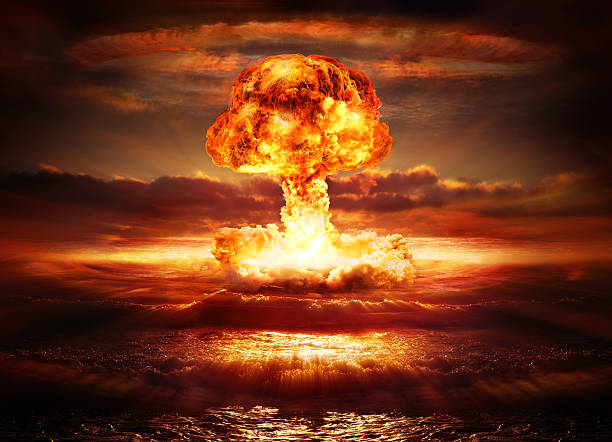
The explosion produced a brilliant flash of light, followed by a towering cloud rising into the sky. Observers described the event as both awe-inspiring and deeply unsettling.
The immense power released during the explosion confirmed that nuclear weapons were not theoretical possibilities but devastating realities.
This moment demonstrated that scientific knowledge had reached a level where humanity possessed the capability to reshape the world—both creatively and destructively.
The Effects of a Nuclear Explosion
A nuclear explosion produces several destructive effects simultaneously. The most immediate effect is an intense flash of light and heat generated by the release of enormous energy.
Temperatures near the center of the explosion can reach millions of degrees, comparable to the conditions found inside stars. This heat can ignite fires across vast areas and cause severe burns to people miles away.
A powerful blast wave follows the flash. This shockwave travels outward at high speed, crushing buildings, overturning vehicles, and causing widespread destruction.
Another major effect is radiation. Nuclear explosions release both immediate radiation and long-term radioactive fallout. Radiation can cause severe illness, damage biological tissues, and increase the risk of long-term health problems.
The combined effects of heat, blast, and radiation make nuclear weapons uniquely destructive.
Entire urban areas can be devastated within seconds, and the environmental consequences can persist long after the initial explosion.
The Global Spread of Nuclear Weapons
After the first nuclear weapons were developed, other nations began pursuing similar technologies. The strategic importance of these weapons made them central to international power dynamics.
Countries invested heavily in nuclear research programs, developing their own arsenals and delivery systems.
As nuclear weapons spread, concerns about global security intensified. The possibility of nuclear conflict between powerful nations created a new kind of geopolitical tension.
Military strategies began to revolve around the concept of deterrence—the idea that the possession of nuclear weapons could prevent war by making the consequences of conflict too devastating to contemplate.
This doctrine influenced international relations throughout the latter half of the twentieth century.
The Cold War and the Nuclear Arms Race
The decades following the Second World War saw an intense rivalry between major world powers. Nuclear weapons became central to this competition.
Both sides developed increasingly powerful weapons and delivery systems capable of reaching targets across the globe.
Missiles capable of traveling vast distances were created, along with submarines and aircraft designed to carry nuclear payloads.
The number of nuclear warheads grew dramatically as nations sought to maintain strategic advantages.
This arms race created widespread fear that a nuclear conflict could destroy civilization. At the same time, the principle of mutual deterrence arguably prevented direct large-scale war between nuclear-armed powers.
The Cold War era demonstrated both the terrifying potential of nuclear weapons and the complex role they play in global politics.
Nuclear Weapons and International Control
As the destructive potential of nuclear weapons became widely understood, international efforts emerged to limit their spread and reduce the risk of nuclear war.
Treaties and agreements were negotiated to control nuclear testing, regulate the proliferation of nuclear weapons, and encourage disarmament.
These agreements aimed to reduce tensions and prevent additional nations from acquiring nuclear capabilities.
Although progress has been made in limiting nuclear arsenals, the issue remains one of the most challenging challenges in international diplomacy.
Balancing national security concerns with the goal of global safety continues to shape discussions about nuclear policy.
The Ethical Dilemma of Nuclear Weapons
Nuclear weapons raise profound ethical questions about the relationship between science, technology, and human responsibility.
The same scientific discoveries that led to nuclear weapons have also produced beneficial technologies, including nuclear power generation and medical treatments.
Yet the destructive potential of nuclear weapons forces humanity to confront difficult moral choices.
Scientists involved in early nuclear research grappled with the implications of their work. Some believed that the weapons were necessary to end war or deter aggression. Others feared the long-term consequences of introducing such destructive technology into the world.
These debates continue today, as societies consider how scientific knowledge should be used and what limits should be placed on powerful technologies.
The Continuing Presence of Nuclear Weapons
Even decades after their creation, nuclear weapons remain part of the global security landscape.
Many nations maintain nuclear arsenals, and ongoing debates focus on modernization, deterrence strategies, and arms control agreements.
Advances in technology have also introduced new challenges, including missile defense systems, cyber threats, and emerging military technologies.
The continued existence of nuclear weapons means that discussions about their role, risks, and regulation remain highly relevant.
Scientists, policymakers, and citizens alike must consider how to manage these powerful technologies responsibly.
Nuclear Weapons and the Future of Humanity
The story of nuclear weapons is ultimately a story about the power of knowledge.
Human curiosity led scientists to explore the structure of atoms and the forces that govern them. These discoveries revealed a universe filled with extraordinary energy and complexity.
But knowledge alone does not determine how technology is used. Human decisions, values, and institutions shape the outcomes.
Nuclear weapons remind us that scientific progress carries both opportunities and responsibilities. The same understanding that allows us to harness atomic energy can also threaten the survival of entire civilizations if used carelessly.
The future of nuclear weapons will depend on international cooperation, responsible governance, and continued efforts to reduce the risks associated with these technologies.
Humanity now possesses the ability to release the energy of the stars within a single explosion. Whether that power is ultimately controlled, reduced, or eliminated will shape the course of history for generations to come.
In the end, the question surrounding nuclear weapons is not only scientific or political. It is deeply human. It asks whether our wisdom can grow as quickly as our knowledge, and whether our collective choices will ensure that the power unlocked from the atom serves life rather than destruction.