A black hole is a region of space where gravity is so strong that nothing—not even light—can escape once it crosses a boundary called the event horizon. Black holes are among the most extreme objects predicted by modern physics. They can form when massive stars collapse, influence the motion of stars and gas in their surroundings, and release enormous amounts of energy from matter falling toward them.
Despite their name, black holes are not empty holes in space. They are concentrations of mass that profoundly distort the surrounding space and time. Their defining feature is not simply their immense gravitational pull but the existence of an event horizon: a boundary beyond which every possible path into the future leads farther inward.
Scientists have developed a detailed understanding of how black holes form, how they affect their surroundings, and what happens to matter and light near them. Observations of stars orbiting invisible massive objects, gravitational waves from black hole mergers, and images of glowing gas around black holes have provided compelling evidence that these extraordinary objects exist.
However, what happens deep inside a black hole remains one of the most challenging questions in physics. General relativity, Albert Einstein’s theory of gravity, describes much of what scientists expect, but its predictions become incomplete under the extreme conditions near the center.
What makes a black hole different from other objects?
Gravity is the attractive force associated with mass and energy. Every object with mass produces gravity, including planets, stars, and even people. The more mass an object contains, the stronger its gravitational influence generally becomes. The distance from the object’s center also matters.
On Earth, gravity keeps people on the ground and holds the atmosphere around the planet. A spacecraft can escape Earth’s gravitational influence if it reaches a sufficiently high speed and follows an appropriate trajectory.
A black hole is different because its mass is compressed into an extraordinarily small region. When enough mass is concentrated within a sufficiently small radius, the resulting gravitational conditions create an event horizon. Inside this boundary, escaping is no longer physically possible.
This does not mean that a black hole has an infinitely powerful gravitational field everywhere around it. At a sufficient distance, its gravitational influence can be similar to that of any other object with the same mass.
For example, imagine replacing the Sun with a black hole containing exactly the same mass. Earth would continue orbiting at approximately the same distance, assuming the replacement happened without disrupting the solar system in other ways. The planet would not suddenly be pulled into the black hole.
The major difference would be the absence of sunlight and the extreme concentration of the Sun’s mass. The black hole’s event horizon would be tiny compared with the Sun’s present size, but its gravitational influence at Earth’s orbital distance would remain essentially unchanged.
This illustrates an important principle: black holes are not cosmic vacuum cleaners. They do not automatically pull in everything nearby. Objects can orbit them, just as planets orbit stars, provided their trajectories and distances allow stable motion.
How black holes form
Black holes can develop through several processes, but the best-understood pathway involves the collapse of a massive star at the end of its life.
Stars produce energy through nuclear fusion in their interiors. During fusion, lighter atomic nuclei combine to form heavier nuclei, releasing energy. This energy moves outward and helps support the star against the inward pull of its own gravity.
For much of a star’s life, gravity and internal pressure maintain a delicate balance. Gravity tries to compress the star, while pressure generated by the hot interior pushes outward.
Eventually, a massive star exhausts the nuclear fuel needed to sustain its structure. The details depend on the star’s mass, composition, and evolutionary history, but the loss of sufficient internal support can trigger a catastrophic collapse.
In a sufficiently massive stellar core, gravity overwhelms the forces resisting compression. The core contracts rapidly, and its density increases dramatically.
Many massive stars undergo a supernova, an enormous explosion associated with the collapse of their cores. The outer layers can be expelled into space, enriching the surrounding environment with elements produced during the star’s lifetime and final stages.
However, a supernova does not always leave behind a black hole. If the remaining core is sufficiently massive, it may continue collapsing beyond the point at which a neutron star can remain stable. The result can be a stellar-mass black hole.
A neutron star is an extremely dense remnant in which much of the matter consists of neutrons. It is supported partly by quantum-mechanical effects, including neutron degeneracy pressure, which arises from the fact that identical fermions cannot occupy the same quantum state.
If the collapsing core exceeds the maximum mass that these supporting mechanisms can sustain, collapse continues. A black hole forms when an event horizon develops.
The precise mass limits and evolutionary pathways depend on complex stellar physics. Some black holes may also form through direct collapse, in which a massive stellar core collapses without producing a conventional, bright supernova.
Other ways black holes can form
Not all black holes originate from individual massive stars. Astronomers have identified several populations that differ enormously in mass, and scientists investigate different formation mechanisms to explain them.
Stellar-mass black holes typically contain several to many times the mass of the Sun. They form primarily through the collapse of massive stellar cores, although their subsequent growth and interactions can change their masses.
Supermassive black holes contain millions or billions of solar masses. They are found at the centers of many large galaxies, including the Milky Way. Their origins remain an active research topic.
One possibility is that some began as the remnants of early massive stars. These initial black holes could have grown by absorbing gas, merging with other black holes, and interacting with their surroundings over billions of years.
Another possibility involves the direct collapse of enormous gas clouds in the early universe. Under certain conditions, a cloud could form a massive black hole seed without first developing into ordinary stars.
These mechanisms are not necessarily mutually exclusive. Different supermassive black holes may have formed through different combinations of processes.
Intermediate-mass black holes, with masses between those of stellar-mass and supermassive black holes, are another important subject of investigation. Evidence for some candidates exists, but this population is less well established than the stellar-mass and supermassive populations.
Scientists also consider the possibility of primordial black holes. These hypothetical objects could have formed from unusually dense regions of matter in the very early universe, rather than from collapsing stars. Their existence has not been confirmed.
Understanding the event horizon
The event horizon is the defining boundary of a black hole. It marks the point beyond which no signal or object can escape to distant observers.
The term horizon is appropriate because it resembles the horizon on Earth: beyond it, certain information cannot reach an observer. However, unlike an ordinary horizon, the event horizon is not simply a limit of visibility caused by distance or atmospheric conditions. It is a fundamental boundary in the structure of spacetime.
Spacetime combines the three dimensions of space with time into a single four-dimensional framework. According to general relativity, mass and energy curve spacetime, and this curvature influences how objects and light move.
A black hole creates such an extreme curvature that, inside its event horizon, all possible future-directed paths lead toward the interior. Even a beam of light traveling outward cannot escape.
This is why the escape of light is impossible. It is not because light slows down or loses its energy until it stops moving. Light continues traveling locally at the speed of light, but the geometry of spacetime prevents it from reaching the outside universe.
For a simple, nonrotating black hole, the event horizon has a characteristic radius called the Schwarzschild radius. This radius depends on the black hole’s mass: greater mass produces a larger event horizon.
The Schwarzschild radius is not a solid surface. An astronaut falling through the event horizon of a sufficiently large black hole might not experience anything unusual at the exact moment of crossing, although the surrounding gravitational environment could become increasingly dangerous.
The event horizon is also not necessarily the location of the strongest gravitational effects. It is the boundary beyond which escape becomes impossible, not a physical shell or wall.
What happens to matter near a black hole?
Matter approaching a black hole does not necessarily fall directly into it. Depending on its motion, it may orbit the black hole, become part of a disk, or be redirected by gravitational interactions.
Gas and dust that gradually lose orbital energy can spiral inward and form an accretion disk. An accretion disk is a rotating structure of material surrounding a central object.
As matter in the disk moves through different orbits, it interacts with neighboring material. Friction-like processes, turbulence, and magnetic forces transport angular momentum outward, allowing some gas to move inward.
The gas becomes extremely hot as gravitational energy is converted into heat. In some systems, the disk reaches temperatures high enough to emit intense radiation, including X-rays.
This radiation can make black holes detectable even though the black holes themselves do not emit light from inside their event horizons.
Not all the material in an accretion disk eventually enters the black hole. Magnetic fields and other processes can help drive powerful outflows, including jets that travel away from the central region at speeds approaching the speed of light.
These jets can extend far beyond the immediate surroundings of a black hole and influence the evolution of their host galaxies.
The energy powering these phenomena comes largely from the gravitational energy released as matter moves inward. For rapidly rotating black holes, some energy can also be extracted from the black hole’s rotation through interactions with magnetic fields and surrounding plasma.
An important distinction is that the black hole itself does not need to consume everything nearby to produce powerful radiation. Much of the visible activity comes from material outside the event horizon.
What would happen to an object falling into a black hole?
The experience of falling toward a black hole depends on its mass, rotation, and the object’s trajectory.
As an object approaches a black hole, the gravitational attraction increases. If the object falls headfirst toward the black hole, the gravitational pull on its nearer end becomes stronger than the pull on its farther end.
This difference is called a tidal force. It can stretch the object along the direction of the gravitational field while compressing it in other directions.
For a human body, the resulting deformation could become fatal. Scientists often describe this process as spaghettification because an object can be stretched into a long, thin shape.
The severity of tidal forces depends strongly on the black hole’s mass.
Near a relatively small black hole, tidal forces at the event horizon can be enormous. An astronaut approaching such an object would likely be destroyed before reaching the boundary.
A supermassive black hole can have much weaker tidal forces at its event horizon because its event horizon is much larger. An astronaut might cross the boundary without immediately noticing a dramatic physical change, assuming the surrounding environment were sufficiently quiet and other hazards were absent.
However, crossing the event horizon would still be irreversible. No signal sent from inside could reach the distant outside universe.
The astronaut would continue inward and eventually encounter extreme tidal forces or other conditions that make survival impossible according to classical general relativity.
The exact experience would depend on the black hole’s properties and the astronaut’s motion. It is therefore misleading to imagine that every black hole would immediately crush anything crossing its event horizon.
Why does time behave differently near a black hole?
One of the most remarkable predictions of general relativity is that gravity affects the passage of time.
This phenomenon is called gravitational time dilation. A clock closer to a massive object runs more slowly relative to a clock farther away, when the clocks are compared using an appropriate distant reference.
Near a black hole, the effect can become extreme.
Imagine an astronaut falling toward a black hole while another observer watches from a safe distance. The astronaut’s own clock would continue ticking normally from their perspective. They would not feel their time slowing down simply because they were approaching the event horizon.
However, the distant observer would receive signals from the astronaut that become increasingly delayed and gravitationally redshifted. Gravitational redshift means that light escaping from a strong gravitational field loses energy relative to a distant observer, causing its frequency to decrease and its wavelength to increase.
In the idealized description of a nonrotating black hole, signals from the falling astronaut become progressively fainter and more redshifted as the astronaut approaches the event horizon. The distant observer never receives a final signal showing the actual crossing.
This does not mean the astronaut remains suspended at the horizon in their own experience. They cross it in a finite amount of their own proper time, which is the time measured by a clock traveling with them.
The apparent difference arises because observers in different gravitational conditions do not necessarily agree on elapsed time or on how distant events are coordinated.
This distinction is essential for understanding black holes. The event horizon is not a place where time simply stops for everyone. The behavior depends on the observer and how measurements are made.
What happens inside a black hole?
The interior of a black hole is where the predictions of general relativity become especially difficult to interpret.
For a sufficiently simple black hole, classical general relativity predicts that matter continues inward after crossing the event horizon. In the case of an idealized, nonrotating black hole, it eventually reaches a central singularity.
A singularity is a mathematical feature where quantities describing spacetime curvature become infinite in the classical theory. It signals that the theory has reached a limit where its predictions can no longer provide a complete physical description.
It is important not to think of a singularity as an ordinary physical object with a known structure. Scientists do not have a confirmed understanding of what actually exists at the center of a black hole.
General relativity describes gravity on large scales extremely well, while quantum mechanics describes the behavior of matter and energy at very small scales. Near a predicted singularity, both sets of principles may become essential.
However, scientists do not yet have a complete, experimentally confirmed theory of quantum gravity that successfully combines them under such extreme conditions.
Several theoretical approaches attempt to address this problem, but none has established a definitive account of the black hole interior.
Rotation complicates the picture further. Real black holes are expected to rotate because the stars or other material from which they form generally possess angular momentum.
The simplest mathematical descriptions of rotating black holes predict an interior structure different from that of nonrotating black holes. However, the stability and physical significance of some features in these idealized solutions remain uncertain under realistic conditions.
Consequently, statements about exactly what a person would encounter at the deepest interior of a real black hole must be treated cautiously. The event horizon and many external properties are well understood, but the central region remains beyond the reach of established, experimentally verified physics.
Can anything escape a black hole?
Once matter or light crosses the event horizon, classical general relativity says it cannot escape to the outside universe.
However, this does not mean black holes are completely invisible or that nothing can escape their surrounding environments.
Radiation from hot gas outside the event horizon can be extremely bright. Magnetic fields can help launch jets from regions surrounding a black hole. These processes occur outside the boundary and do not violate the principle that nothing can escape from within it.
There is also a more subtle phenomenon known as Hawking radiation.
In the 1970s, physicist Stephen Hawking showed that quantum field theory applied to curved spacetime predicts that black holes should emit thermal radiation.
The popular explanation involves particle-antiparticle pairs appearing near the event horizon, with one particle falling in while the other escapes. Although this picture can provide an introductory analogy, it is not a complete description of the underlying physics.
More accurately, Hawking radiation arises from how quantum fields behave in curved spacetime and how different observers describe particle states. It does not require ordinary particles to emerge from inside the event horizon.
The radiation carries energy away from the black hole. As a result, the black hole gradually loses mass.
For astrophysical black holes, Hawking radiation is predicted to be extraordinarily weak. The larger the black hole, the lower its Hawking temperature. A black hole with a mass comparable to the Sun would have a temperature far below that of the cosmic microwave background, the faint radiation left over from the early universe.
Consequently, scientists have not directly detected Hawking radiation from an astrophysical black hole.
The phenomenon remains an important theoretical prediction because it connects gravity, quantum physics, and thermodynamics.
The black hole information paradox
Hawking radiation raises a profound question about information.
In quantum mechanics, the evolution of an isolated physical system is expected to preserve information about its quantum state. This principle is associated with unitary evolution.
However, Hawking’s original semiclassical calculation suggested that black holes emit thermal radiation that appears not to preserve the detailed information about the matter that formed the black hole.
If a black hole eventually evaporates completely and leaves only featureless thermal radiation, it seems that information about its original contents could be lost.
This apparent conflict is known as the black hole information paradox.
It is not simply a question of whether matter disappears. The deeper issue is whether the fundamental information describing a physical system can be destroyed during black hole formation and evaporation.
Many theoretical developments suggest that information may be preserved in the complete quantum description of black hole evaporation. Research involving quantum gravity, black hole entropy, holography, and the structure of Hawking radiation has produced important insights.
Nevertheless, explaining precisely how information is encoded in the outgoing radiation remains a challenging subject in theoretical physics.
The paradox matters because resolving it could reveal how gravity and quantum mechanics fit together at a fundamental level.
How scientists detect and study black holes
Black holes cannot be observed directly through ordinary light emitted from inside their event horizons. Instead, astronomers study their effects on surrounding matter, nearby objects, and spacetime itself.
One powerful method involves observing the motion of stars near an invisible massive object.
At the center of the Milky Way, astronomers have tracked stars orbiting a compact source known as Sagittarius A*. Their orbital paths reveal that an enormous amount of mass is concentrated within a relatively small region.
The most convincing explanation is a supermassive black hole containing approximately four million times the mass of the Sun.
Another method involves studying X-ray emissions from binary systems. A binary system consists of two objects orbiting a common center of mass.
When one object is a black hole and the other is a star, gas can flow from the star toward the black hole. The gas heats up as it spirals inward, producing X-rays that telescopes can detect.
Astronomers can also identify black hole candidates by measuring the motion of the visible companion and estimating the mass of the unseen object.
Gravitational waves provide another extraordinary way to study black holes.
Gravitational waves are disturbances in spacetime produced by accelerating masses. When two black holes orbit each other, they lose orbital energy through gravitational-wave emission. Their orbit gradually shrinks, causing them to spiral together and eventually merge.
The resulting disturbance travels outward through the universe at the speed of light.
In 2015, the Laser Interferometer Gravitational-Wave Observatory, known as LIGO, made the first direct detection of gravitational waves from a merging pair of black holes.
This discovery opened an entirely new way to investigate the universe. By analyzing gravitational-wave signals, scientists can estimate the masses, spins, and distances of merging black holes.
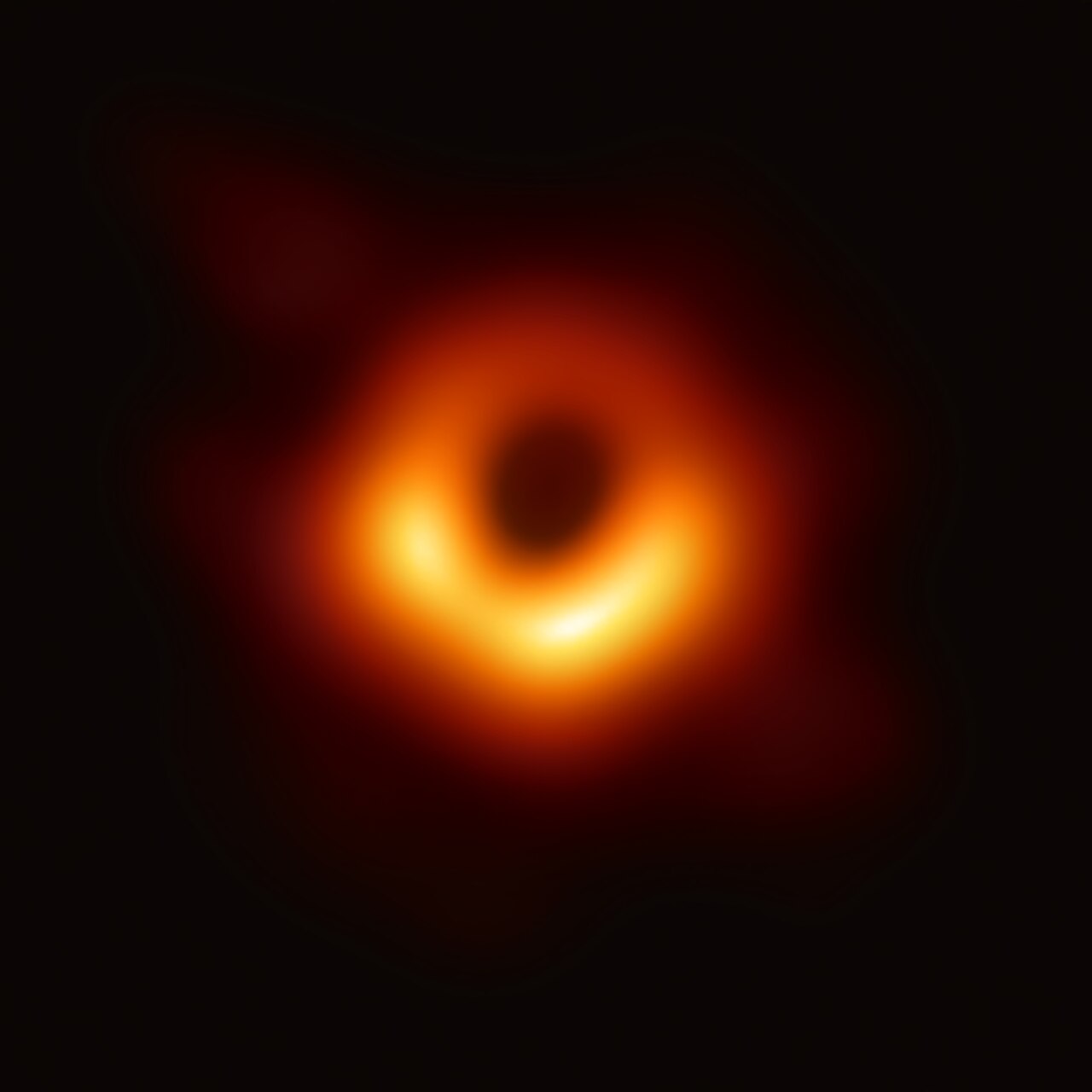
Astronomers have also obtained images of the bright regions surrounding black holes using the Event Horizon Telescope, a global network of radio observatories working together as an Earth-sized virtual telescope.
In 2019, the collaboration released the first image of the shadow of the supermassive black hole in the galaxy Messier 87. In 2022, it released an image of Sagittarius A* at the center of the Milky Way.
These images do not show the event horizon as a directly photographed surface. Instead, they reveal the dark central region against the emission from hot gas surrounding the black hole. The appearance is shaped by the black hole’s gravity, which bends light and changes the paths along which radiation reaches observers.
Together, these methods allow scientists to investigate black holes through their gravitational influence, electromagnetic emissions, and effects on spacetime.
How black holes influence galaxies and the universe
Black holes can have effects far beyond their immediate surroundings.
Supermassive black holes occupy the centers of many galaxies. When large quantities of gas fall toward them, the resulting accretion disks can become extraordinarily luminous.
Such systems are sometimes classified as active galactic nuclei. Their brightest examples include quasars, which can outshine the combined starlight of their host galaxies.
The energy released by accretion can heat surrounding gas, produce powerful jets, and drive large-scale outflows.
These processes can affect how gas moves through a galaxy and how easily new stars form. For example, heating or expelling gas can reduce the supply of material available for star formation.
This influence is often called feedback. It is an important part of modern models of galaxy evolution.
However, a supermassive black hole does not simply control every aspect of its host galaxy. The relationship between black hole growth and galaxy development involves many interacting processes, including gravity, gas dynamics, star formation, magnetic fields, and feedback.
Black holes also contribute to the evolution of galaxies through mergers. When galaxies collide and eventually combine, their central black holes may form a gravitationally bound pair. Over time, such pairs can lose energy and merge, producing gravitational waves.
These processes connect black hole physics with the large-scale structure and history of the universe.
What scientists still do not know
Although black holes are now supported by multiple independent lines of observational evidence, several fundamental questions remain unresolved.
Scientists do not yet know exactly what happens at the center of a black hole. Classical general relativity predicts singularities under certain conditions, but a complete physical description likely requires quantum gravity.
The origin of the earliest supermassive black holes is another major puzzle. Some enormous black holes already existed when the universe was relatively young. Explaining how their initial seeds formed and grew so rapidly is an active area of research.
The nature of Hawking radiation and the final stages of black hole evaporation also remain unconfirmed observationally. The evaporation of an astrophysical black hole would take an extraordinarily long time, making direct tests difficult.
Researchers are also investigating the detailed structure of black hole interiors, the preservation of quantum information, and the relationship between black holes and the fundamental properties of spacetime.
These uncertainties do not undermine what scientists have established. General relativity successfully predicts many observable properties of black holes, and astronomical measurements repeatedly confirm those predictions.
Instead, black holes reveal where current scientific theories meet their limits. They provide natural environments in which gravity, quantum mechanics, thermodynamics, and cosmology intersect.
A black hole is therefore more than an object that traps light. It is a powerful demonstration of how mass shapes spacetime, how extreme gravity changes the behavior of matter and time, and how much remains to be discovered about the fundamental laws governing the universe.