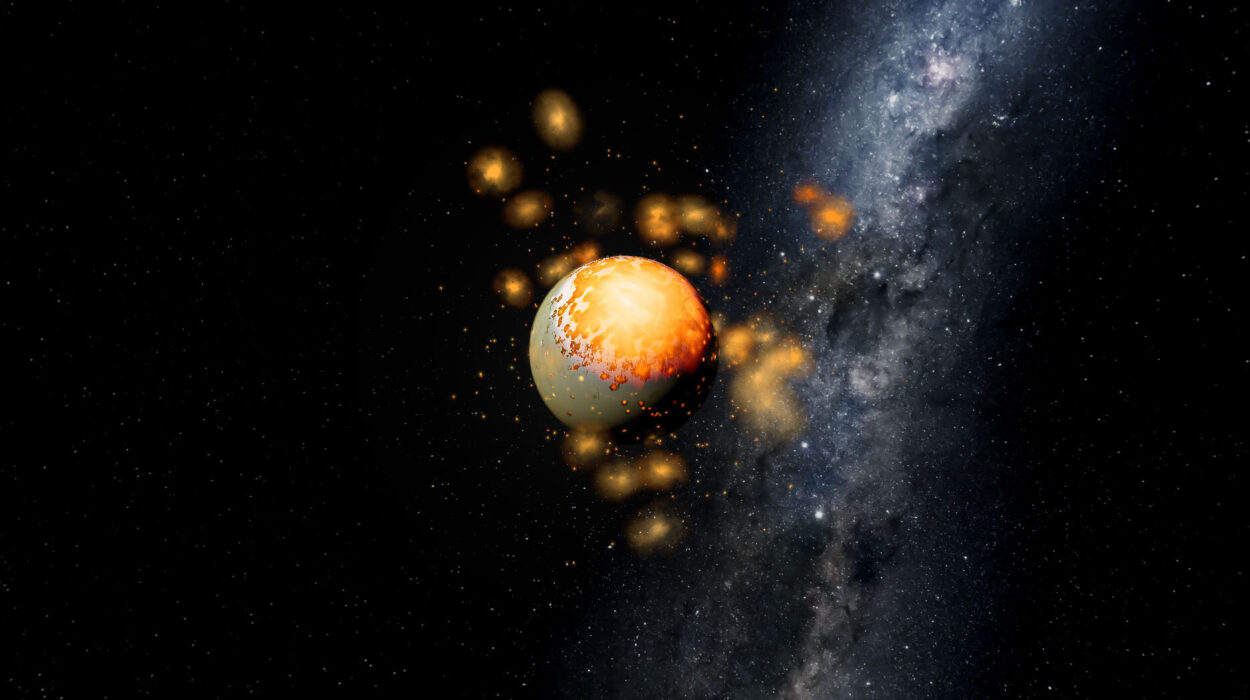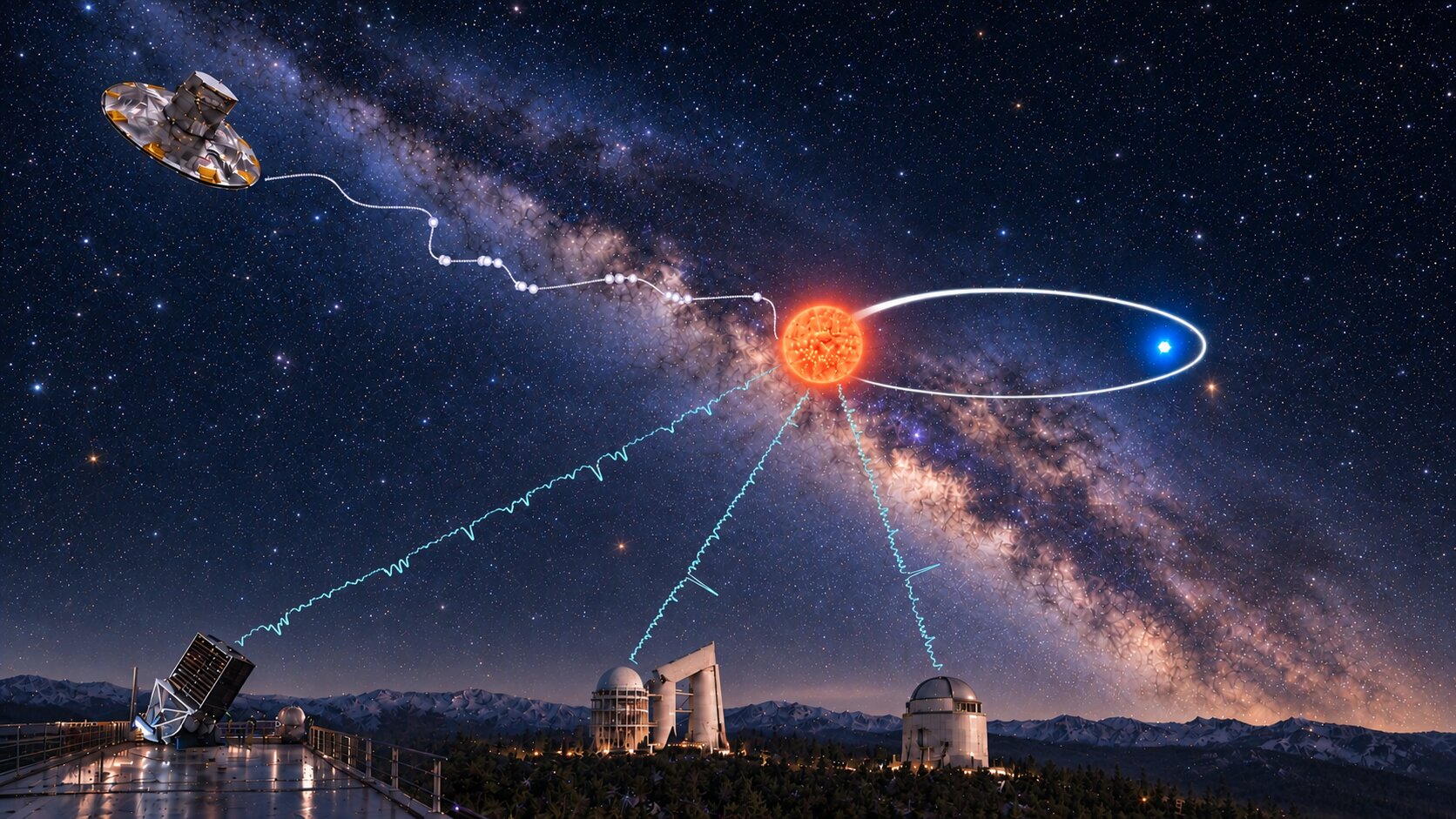
An unseen object orbiting a red giant star may be an unusually massive neutron star, potentially weighing 2.2 times as much as the Sun. Its estimated mass places it near the poorly understood boundary between neutron stars and black holes, while its unusually wide, nearly circular orbit presents a puzzle that existing computer simulations have struggled to explain.
The binary system, named J0008+0128, was identified by astronomers analyzing observations from the Large Sky Area MultiObject Fiber Spectroscopic Telescope (LAMOST) and the Apache Point Observatory Galactic Evolution Experiment (APOGEE).
The companion cannot be seen directly. Instead, astronomers inferred its presence from the gravitational influence it exerts on the visible red giant. By studying the star’s motion, the team estimated the companion’s mass and reconstructed important features of the pair’s orbit.
The results point to an object that does not fit comfortably into the usual picture of how neutron stars and their binary systems form.
An object in the neutron star–black hole mass gap
Neutron stars form when massive stars exhaust their nuclear fuel and explode, leaving behind extremely dense remnants. Despite typically containing about 1.4 times the mass of the Sun, these objects are only about 20 kilometers (12 miles) across.
Black holes are generally more massive. Stellar-mass black holes typically weigh at least five times as much as the Sun, leaving a puzzling gap between the heaviest known neutron stars and the lightest known black holes.
This apparent gap, spanning roughly 2.5 to 5 solar masses, remains an important unanswered question in astronomy.
The dividing line is not simply a matter of observation. A neutron star’s maximum possible mass depends on how matter behaves under the enormous pressures inside it. Scientists still do not fully understand the physical relationship between pressure and density under these extreme conditions.
Finding unusually massive neutron stars could help narrow down the maximum mass these objects can support before collapsing into black holes.
That makes J0008+0128 particularly interesting. The researchers estimate that its unseen companion has a mass between 1.8 and 2.8 times that of the Sun, with a best estimate of 2.2 solar masses.
Although the uncertainty means its precise position relative to the proposed mass boundary is not established, the upper end of the estimate extends into the neutron star–black hole gap.
Its orbit is harder to explain than its mass
The companion’s estimated mass is only part of the puzzle. Its orbital behavior also stands out.
The two objects take approximately 3.3 years to complete one orbit. Their relatively wide separation is unusual for a system containing a potentially very massive neutron star. More surprising, however, is that their orbit is nearly circular.
Astronomers also found no evidence of light coming from another ordinary star, making a conventional stellar companion unlikely.
A neutron star is therefore the leading explanation, but its presence raises questions about how the system evolved.
Many massive neutron stars in binary systems are thought to have gained additional mass by pulling material away from a companion star. This process, known as mass transfer, can make a neutron star substantially heavier.
However, the wide separation in J0008+0128 makes significant mass transfer from the red giant less likely. The researchers also found none of the usual signs that such a process had occurred.
The combination of a potentially heavy neutron star, a wide orbit and very little orbital eccentricity (the measure of how stretched an orbit is) is difficult to reconcile with familiar explanations of binary evolution.
Hundreds of thousands of simulations failed to reproduce it
To investigate how the system might have formed, the research team ran approximately 300,000 computer simulations using POSYDON, a framework for modeling the evolution of isolated binary star systems.
None reproduced the observed combination of masses and orbital characteristics.
That does not establish that the system could not have formed through ordinary stellar evolution. Instead, it suggests that producing a system like J0008+0128 may require an unusual combination of circumstances.
The study authors write, “The scarcity of J0008+0128–like systems is unlikely to be driven solely by limited POSYDON sampling, and instead points to a strong evolutionary bias within isolated binary evolution. Nonetheless, the formation of such a system is not precluded in principle and may require a combination of extreme but physically plausible parameters, such as an unusually efficient common envelope (CE) ejection during the evolution of the [neutron star] progenitor, a high [neutron star] birth mass, and minimal supernova kick.”
A common-envelope phase occurs when two stars become engulfed in a shared envelope of gas during their evolution. How efficiently that envelope is expelled can influence the eventual separation of the surviving objects.
A supernova kick, meanwhile, is the sudden change in a compact object’s motion caused by an asymmetric stellar explosion. A relatively small kick could help explain why a binary system retains a nearly circular orbit after a supernova.
These processes offer possible explanations, but the simulations did not establish which, if any, actually occurred in J0008+0128.
A neutron star is the leading explanation, but not the only one
The researchers considered several alternatives to a single massive neutron star.
One possibility is that the system contains three objects rather than two. The unseen companion could actually consist of two closely orbiting, lower-mass neutron stars whose combined gravitational influence resembles that of a single heavier object.
Another proposed configuration involves a neutron star, a white dwarf and the visible red giant. The system could also have originated as a triple system in which two smaller compact objects eventually merged.
A very low-mass black hole is another possibility, although no black hole this small has been identified so far.
The researchers also point to Gaia NS1, another neutron star candidate with an estimated mass of about 1.9 solar masses and an orbital period of roughly two years. J0008+0128 appears more extreme, but the comparison shows that astronomers have begun identifying other systems that may contain unusually massive neutron stars.
For now, the available evidence favors a neutron star as the unseen companion, but its true nature remains uncertain. Additional observations will be needed to distinguish between the competing explanations and establish its mass more precisely.
The study authors write, “The wide, low-eccentricity orbit is difficult to explain through standard binary evolution channels, pointing to the need for improved theoretical models to account for such systems.”
The research was published in Science Advances.