In most of the world we know, electricity comes with a cost. As it flows, it heats. As it moves, it wastes. Even in our most advanced electronics, some of that precious energy dissolves into warmth, a quiet tax on every signal we send and every computation we perform.
Now, a team of researchers in the United States has revealed something astonishing: a device in which electricity travels along its edges without losing energy to heat. No dissipation. No burn. Just motion.
Described in Nature Physics, the breakthrough was led by Xiaodong Xu at the University of Washington. What they have built is the first demonstration of a dissipationless fractional Chern insulator, a long-sought state of matter that many physicists have imagined but never fully realized. And in its strange, precise behavior lies a promise for future quantum technologies.
To understand why this is so extraordinary, we have to travel into the strange landscape where electrons stop behaving like individuals and begin acting as something far more collective.
When Electrons March in Quantized Steps
The story begins with the quantum Hall effect, a phenomenon that appears only under extreme conditions. When electrons are trapped inside a two-dimensional material, cooled to incredibly low temperatures, and subjected to strong magnetic fields, something remarkable happens.
As electrical current flows, a voltage appears across the material at right angles to that flow. That part is familiar from the classical Hall effect. But here’s the twist: instead of changing smoothly, the voltage increases in discrete, perfectly measured steps. It becomes quantized.
Under even more extreme conditions, the physics deepens. The system can enter what is called the fractional quantum Hall (FQH) effect. In this regime, electrons no longer behave as independent particles. They move collectively, as if bound together in a coordinated dance. The voltage steps now correspond not to whole units of electron charge, but to fractions of it.
Fractional charge. Collective motion. Exotic behavior. These are not just curiosities. They are precisely the kinds of phenomena that make physicists dream about robust platforms for quantum technologies.
But all of this required one demanding ingredient: a powerful magnetic field.
The Strange Dream of Zero Magnetic Field
For years, researchers wondered whether a similar fractional behavior could emerge without an external magnetic field at all. Could matter organize itself into a state that mimics the fractional quantum Hall effect—yet at zero magnetic field?
That hypothetical state became known as the fractional Chern insulator (FCI). If realized, it would exhibit the defining signature called the fractional quantum anomalous Hall (FQAH) effect.
More than a decade after the idea was proposed, Xu’s group achieved a milestone. In 2023, they demonstrated the FQAH effect experimentally for the first time. Their device was built from two layers of molybdenum ditelluride, stacked and twisted at a carefully chosen angle. That twist turned out to be crucial.
The initial discovery was thrilling. The Hall resistance was quantized at the expected value, a clear fingerprint of fractional behavior without an external magnetic field.
But something wasn’t right.
The Imperfection That Wouldn’t Vanish
In a perfect fractional Hall state, something very specific should happen. The longitudinal resistance—the resistance along the direction of current—should vanish. That disappearance would signal that electrical energy is flowing without dissipation.
Instead, the researchers found that the longitudinal resistance remained appreciable. Energy was still being lost as heat. The state was fractional, yes—but not yet dissipationless.
That lingering resistance was more than an inconvenience. It was a sign that the material wasn’t clean enough. Somewhere inside, imperfections were scattering charges, interrupting the delicate collective motion.
If they wanted to achieve truly dissipationless edge conduction, they would need to refine the material itself.
Growing Better Crystals, Twisting with Greater Precision
The team attacked the problem from two directions.
First, they improved the quality of the underlying crystals. Xu’s colleague Jiun-Haw Chu and their joint postdoc Chaowei Hu discovered that a method called horizontal flux growth dramatically enhanced crystal quality. Compared with the crystals used in the original 2023 study, the new approach increased charge-carrier mobility by more than an order of magnitude.
That leap in mobility meant electrons could move more freely, with fewer disruptions from defects.
Second, Xu’s student Heonjoon Park and collaborators refined the fabrication process itself, reducing twist-angle disorder between the two layers. In a system where the twist angle defines the physics, even tiny variations can undermine performance. Sharpening that alignment was essential.
With cleaner crystals and tighter control over the twist, the stage was set for a second attempt.
The Moment the Resistance Fell Silent
The breakthrough came when the system was tuned to a state corresponding to two-thirds filling of the electronic band.
In that configuration, something extraordinary happened. The unwanted longitudinal resistance nearly vanished.
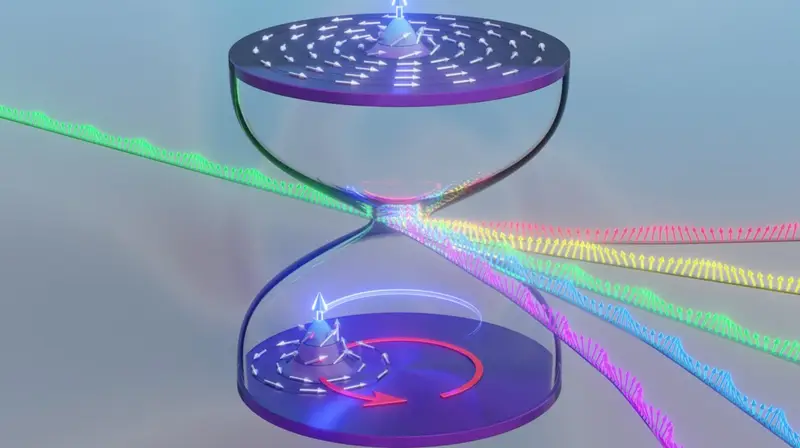
Electricity now flowed along the edges with essentially no loss to heat. The researchers had realized the first dissipationless fractional Chern insulator.
This wasn’t merely an incremental improvement. It was the missing piece. For the first time, a fractional Chern insulator demonstrated the hallmark behavior physicists had been seeking: edge conduction that does not dissipate energy.
Along the edges of the device, electrical current moved with almost perfect efficiency, shielded from the scattering and heating that plague ordinary conductors.
But in the process of cleaning up the device, the team uncovered another mystery.
A Puzzling Energy Gap
The improved devices allowed the researchers to examine something called the thermal activation gap. This gap represents the energy difference between the system’s ground state and its lowest excited states.
If the gap is too small, heat can excite electrons into bulk states, allowing them to compete with the edge states and degrade performance. A robust gap is therefore essential for stability.
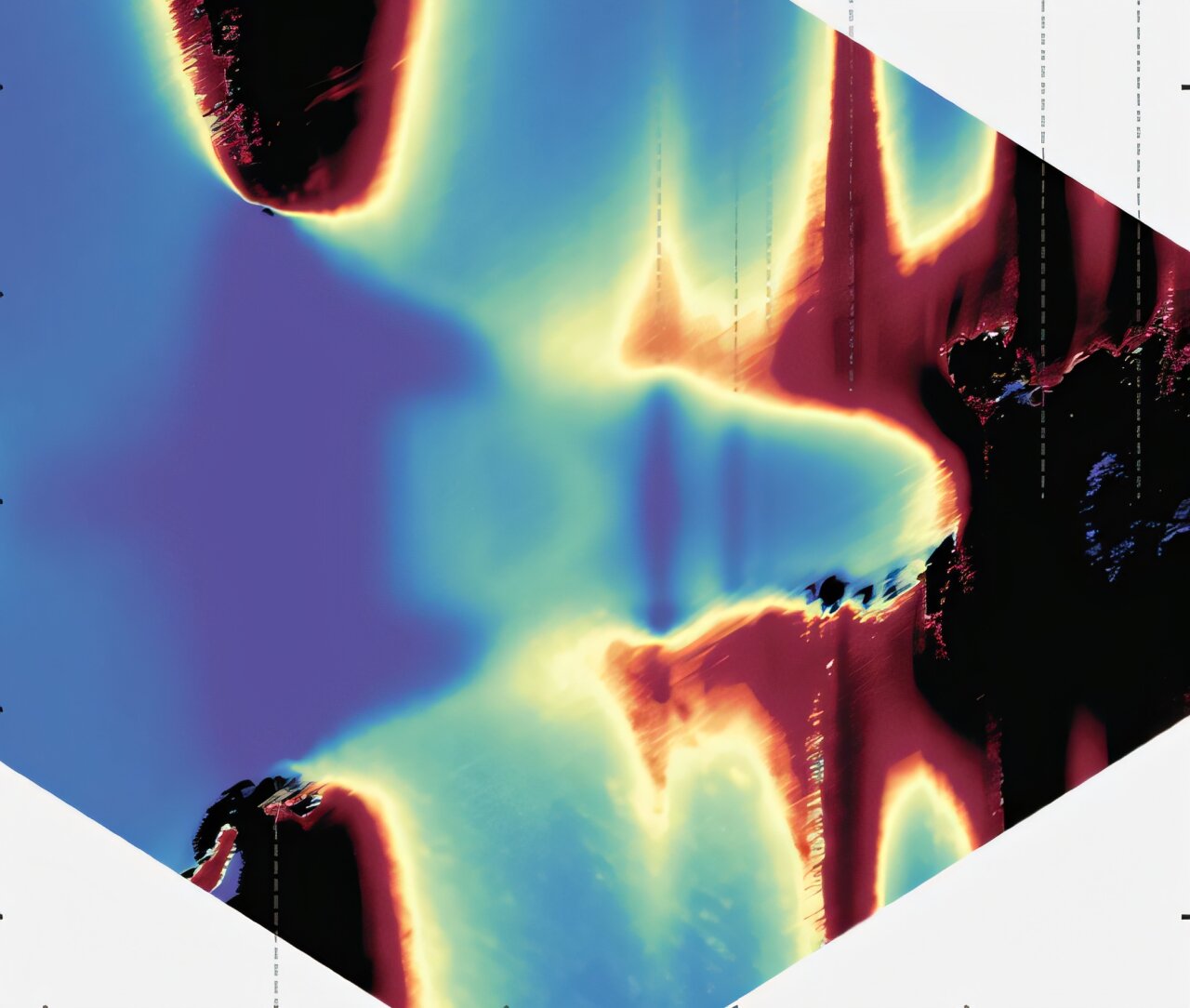
Here, the team encountered an unexpected trend. As the magnetic field increased, the thermal activation gap of the fractional state rapidly decreased, then plateaued above a certain field strength.
This behavior was surprising.
In conventional FQH states, a magnetic field is not only required to form the state—it typically strengthens it. Increasing the magnetic field enhances the energy gap.
But in the FQAH system, the opposite trend emerged. Adding magnetic field suppressed the gap before it leveled off.
The team’s theoretical analysis suggests that this unusual behavior arises from competition between different low-energy excitations tied to electron spin and charge. Each type requires a different amount of energy to activate. In this delicate balance, changing the magnetic field shifts the competition in unexpected ways.
Even as one mystery was solved, another opened.
Why This Matters for the Future of Quantum Technology
At first glance, this research may seem esoteric—an intricate dance of electrons in twisted layers at ultralow temperatures. But its significance runs deeper.
The realization of a dissipationless FCI demonstrates that fractional quantum behavior can exist without relying on strong magnetic fields, and that it can be engineered and improved through careful materials design. It shows that edge conduction with almost no energy loss is not just a theoretical fantasy, but an achievable state of matter.
For emerging quantum technologies, stability and precision are everything. Systems built on collective, fractionalized states of electrons offer pathways toward devices that are both robust and fundamentally new in their capabilities. The cleaner and more controllable these materials become, the more viable they are as platforms for future quantum applications.
Xu draws inspiration from history. Over the past forty years, the quantum Hall community has repeatedly pushed boundaries simply by improving sample quality. Each refinement has led to new discoveries.
Now, with this new platform in hand, progress may come even faster.
A current that does not heat. Edges that conduct without loss. Fractional charges moving in collective harmony at zero magnetic field. What once seemed like a theoretical curiosity is becoming a laboratory reality.
And if history is any guide, this is not the end of the story—but the beginning of a new chapter in our understanding of matter itself.
Study Details
Heonjoon Park et al, Observation of dissipationless fractional Chern insulator, Nature Physics (2026). DOI: 10.1038/s41567-025-03167-2