Around 6,000 years ago, as farming spread across Denmark, a hunter-gatherer living on the island of Sejerø began eating more food from the land while continuing to depend on the sea. Chemical evidence from his exceptionally well-preserved skeleton suggests that he lived through the transition from hunting and gathering to agriculture, adapting to the arrival of farming communities without abandoning his ancestral way of life.
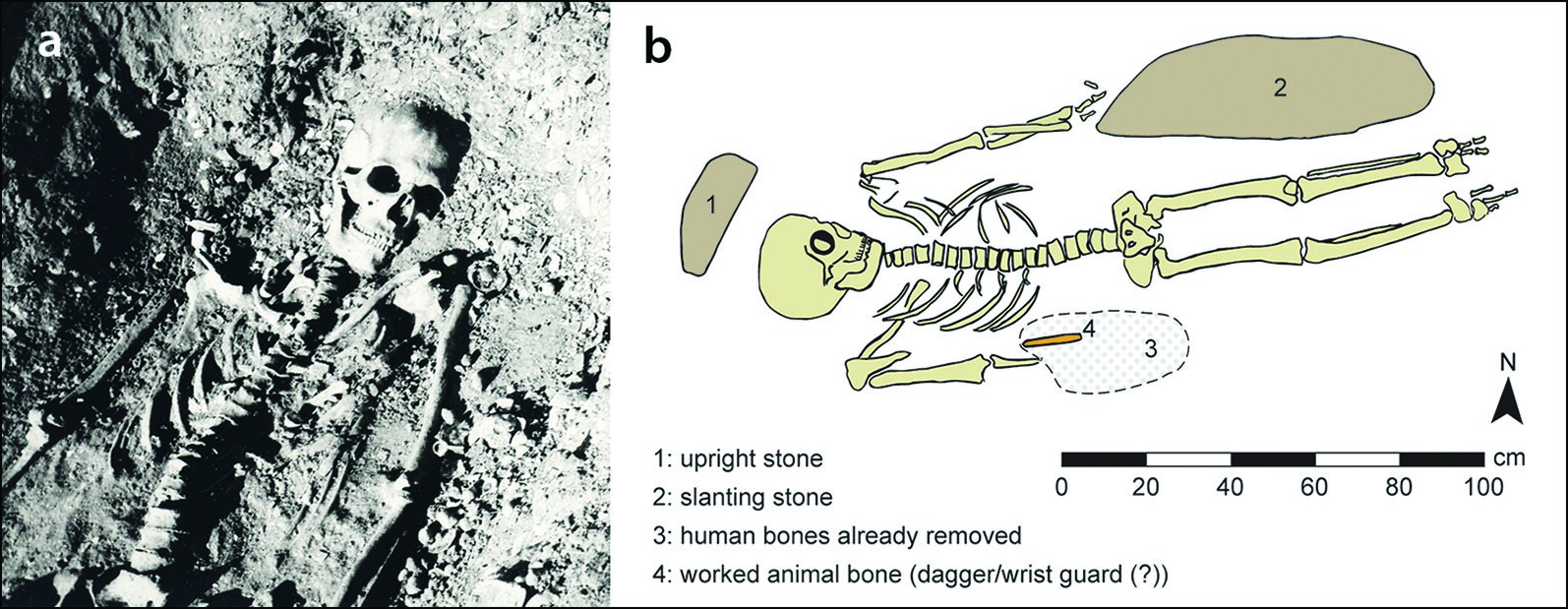
Known as Rødhals Man, the individual was biologically male and about 40 years old when he died. He was buried in a shell midden, a site containing discarded shells and other remains of food consumption, on the Danish island.
His ancestors had lived as hunter-gatherers, relying on fishing, hunting marine mammals and collecting resources such as shellfish. But the world around them was changing. Neolithic farmers were moving north from the south, bringing a different way of producing food and organizing daily life.
Archaeological evidence suggests that hunter-gatherers disappeared abruptly from the record around the time the first farmers arrived. What happened to the people who lived through this transition, however, has been much harder to establish.
Rødhals Man’s remains offer an unusual opportunity to investigate that question through the life of a single individual.
His ancestry remained that of the original hunter-gatherers
The research team combined radiocarbon dating, ancient DNA and isotope analysis to investigate when Rødhals Man lived, where his ancestry came from and how his diet changed during his lifetime.
Radiocarbon dating placed him after farming had already reached the nearby island of Zealand, around 3900 B.C. Yet analysis of his ancient DNA showed that his ancestry was entirely indigenous, matching the genetic profile associated with European Western Hunter-Gatherers.
This distinction is important. Although farming communities had established themselves in the surrounding region, Rødhals Man was not genetically descended from the incoming farmers. He belonged to the population that had traditionally inhabited the area.
His diet, however, tells a more complicated story.
Chemical evidence reveals a changing diet
Researchers examined isotopes preserved in his skeleton to reconstruct the kinds of food he consumed at different stages of his life.
Isotopes are different forms of the same chemical element. Their proportions in human bones and teeth can reflect the foods a person ate, allowing scientists to investigate aspects of ancient diets that are not always visible in archaeological remains.
The analysis showed that Rødhals Man relied much more heavily on marine foods during childhood. Fishing and other resources from the surrounding waters were central to the traditional hunter-gatherer lifestyle of Sejerø.
But his diet changed as he grew older.
During adolescence and adulthood, he consumed significantly more food from terrestrial sources, suggesting a greater reliance on resources obtained from the land. He never completely abandoned marine foods, but the balance of his diet shifted substantially.
Compared with other hunter-gatherers, he ate considerably more terrestrial food. His burial also shared more similarities with those of Early Neolithic farmers than with burials associated with Late Mesolithic hunter-gatherers.
Taken together, these findings suggest that he regularly interacted with farming communities and adopted at least some aspects of their way of life.
The researchers interpret the dietary changes as evidence that Rødhals Man belonged to the first generation of hunter-gatherers on Sejerø to experience life alongside incoming farmers.
However, the evidence does not establish exactly how he obtained terrestrial foods, whether through exchange, direct participation in farming or other forms of interaction. Nor does it reveal the precise nature of his relationships with the newcomers.
Adaptation without abandoning an ancestral way of life
The transition from foraging to farming was one of the most significant changes in human prehistory. But it did not necessarily mean that established communities immediately abandoned their traditional practices when agricultural populations arrived.
Rødhals Man’s remains suggest a more gradual and selective response. His diet changed, and aspects of his burial were more closely associated with Neolithic practices, yet his continued consumption of marine resources indicates that the sea remained an important part of his life.
“Foragers seemed to have disappeared abruptly from the archaeological record just as the first farmers arrived,” says Dr. Anders Fischer from the University of Gothenburg, lead author of the research published in Antiquity. “What was it like to live through such a momentous, irreversible transition, seeing the archipelago where for centuries your ancestors had lived by fishing transformed by the arrival of a new group of people?”
The researchers also raise questions about the choices facing hunter-gatherers as farming communities expanded. Engaging with newcomers might have offered opportunities, but it could also have involved risks. Remaining separate might have carried its own costs.
“Was this a threat or an opportunity? What were the risks of engaging with the incomers, and the opportunity costs of not doing so? Was there any realistic alternative?” asks co-author Dr. John Meadows from the Leibniz Center for Archaeology.
Rødhals Man’s changing diet cannot answer all these questions. It does, however, provide evidence that at least one indigenous hunter-gatherer adapted to the changing circumstances while retaining important elements of his traditional lifestyle.
The researchers caution that his experience represents just one person and one generation. It cannot establish how other hunter-gatherers responded or whether his descendants followed a similar path.
“It is only one person’s story, and only one generation,” states Fischer, “but the behavioral insights now accessible through a combination of ancient DNA, high-resolution sampling, and multi-isotope ecology give us hope that we will eventually understand the choices, or fate, of any children and grandchildren of Rødhals Man.”
The survival of his complete skeleton makes it possible to connect genetic ancestry, dietary changes and burial practices in a way that is rarely achievable for prehistoric individuals.
“Rødhals Man is an incredibly rare find, the complete skeleton of someone who was an eyewitness to one of the most fundamental transformations in prehistory, the transition from foraging to farming,” Meadows concludes. “He did not fully embrace the farmers’ lifestyle, or run away from them, but adopted some components of farmer culture while maintaining the way of life of his indigenous ancestors.”
The findings were published in Antiquity.