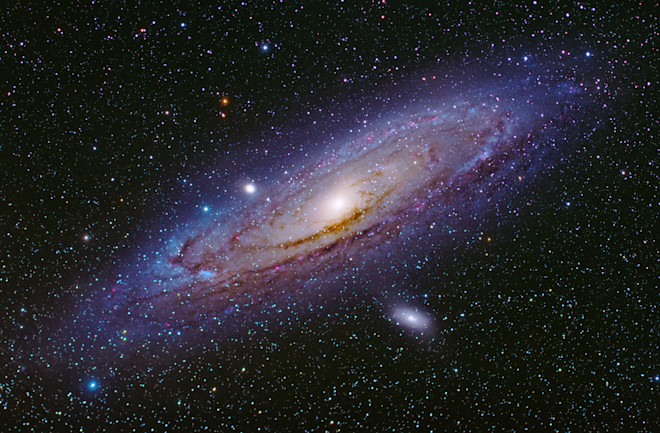
Look up at the night sky on a dark, clear night, far away from bright city lights, and you may see a faint, glowing band stretching across the sky.
That soft river of light is the Milky Way.
It may look like a thin, cloudy stripe, but you are actually looking into the vast galaxy that we call home. The Milky Way contains enormous numbers of stars, along with planets, clouds of gas and dust, star clusters, mysterious dark matter, and at its center, a supermassive black hole.
And somewhere inside this enormous cosmic system is a small yellow star called the Sun.
Around that star is a small planet called Earth.
And on that planet, you are reading about the galaxy you live in.
The Milky Way is so large that light, the fastest thing we know of in the universe, takes roughly 100,000 years to travel from one side of its stellar disk to the other. Yet, on the scale of the observable universe, our entire galaxy is only one galaxy among hundreds of billions or possibly more.
So, what exactly is the Milky Way, where are we inside it, how did it form, and what will happen to it in the future?
Let us take a journey through our cosmic home.
What Is the Milky Way?
The Milky Way is a galaxy, a huge gravitationally bound system containing stars, stellar remnants, gas, dust, planets, and a large amount of invisible dark matter.
Our Solar System is part of this galaxy.
The Milky Way is not simply a group of stars floating randomly through space. Gravity holds its major components together. Stars orbit the center of the galaxy, while gas and dust move through its structure and can eventually form new stars.
From the outside, the Milky Way would appear as a large, flattened disk with a bright central region and spiral arms extending outward. It also has a much more extended, roughly spherical halo surrounding the disk.
However, there is one small problem with taking a perfect photograph of the Milky Way from outside.
We cannot.
No spacecraft has traveled far enough away to photograph our entire galaxy from the outside. Every picture showing the complete Milky Way from an external viewpoint is therefore an artistic visualization based on astronomical observations.
Astronomers understand the Milky Way by studying it from within and comparing its structure with observations of other galaxies.
It is a little like trying to understand the shape of a forest while standing somewhere deep among the trees.
Why Is It Called the Milky Way?
The name comes from the pale, milky appearance of the bright band visible in a dark night sky.
For thousands of years, people around the world looked upward and wondered what this strange glowing path could be.
The ancient Greeks connected it with mythology and called it galaxias kyklos, meaning “milky circle.” The word galaxy itself ultimately comes from this Greek word.
But the Milky Way is not made of milk, clouds, or cosmic fog.
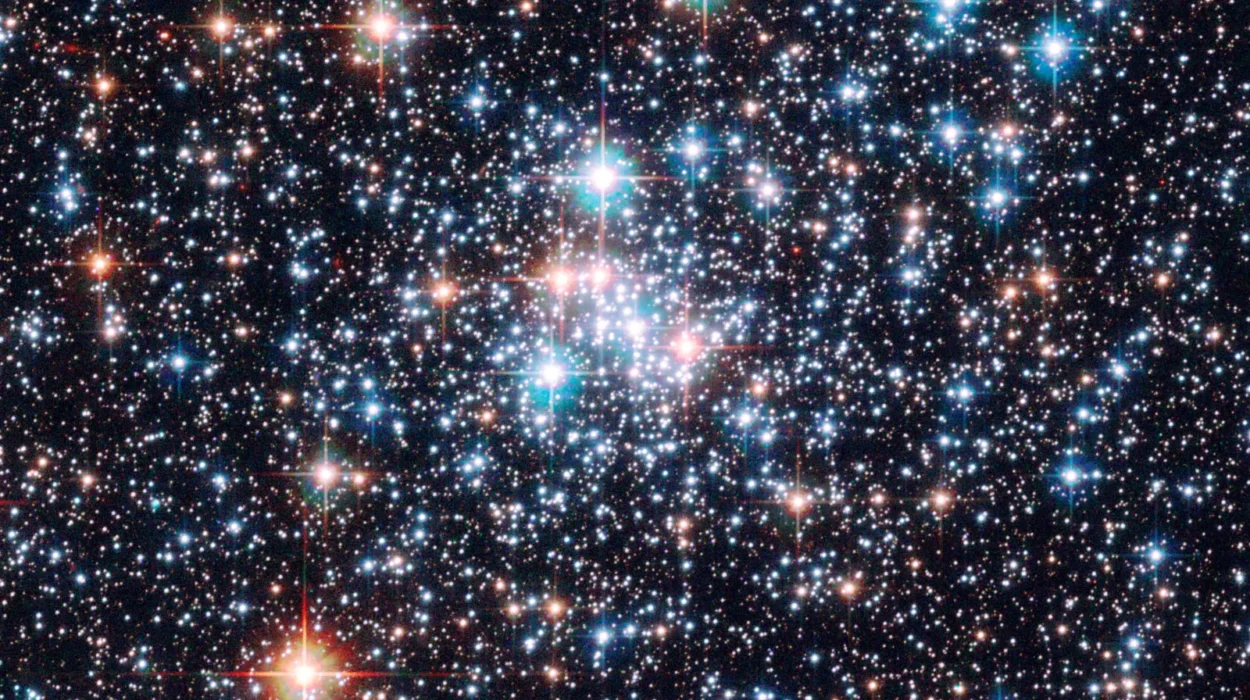
The glowing band is produced mainly by the combined light of enormous numbers of distant stars. Because these stars are so far away and so densely packed along our line of sight, our eyes cannot easily separate them individually.
Together, they create a soft glow.
In other words, when you see the Milky Way as a bright band in the sky, you are looking through the crowded plane of our galaxy.
What Type of Galaxy Is the Milky Way?
The Milky Way is classified as a barred spiral galaxy.
A spiral galaxy has a rotating disk containing stars, gas, and dust, with spiral arms extending outward from the central region.
The word barred refers to a long, bar-shaped structure of stars that extends across the galaxy’s central region.
The Milky Way has several large-scale components. There is a relatively thin disk where many of its stars, gas clouds, and young stellar populations are found. A thicker disk extends above and below the thin disk. At the center is a dense bulge containing the galactic bar, while a much larger halo surrounds the galaxy.
The spiral arms are not solid structures like the arms of a giant cosmic pinwheel.
Stars move into and out of spiral arms as they orbit the galactic center. The arms are regions where stars, gas, and other material are concentrated.
The Milky Way is a dynamic galaxy, constantly moving and changing.
How Big Is the Milky Way?
The Milky Way is enormous, although measuring its exact size is not as simple as using a very large cosmic ruler.
The visible stellar disk is commonly described as being roughly 100,000 light-years across, though the galaxy’s outer structure and extended components reach much farther.
A light-year is the distance light travels in one year. Light moves through empty space at about 300,000 kilometers per second, so one light-year is about 9.46 trillion kilometers.
That means a distance of 100,000 light-years is truly difficult to imagine.
Suppose you could travel at the speed of light, which humans cannot currently do. Even then, crossing the Milky Way’s disk would take about 100,000 years.
A spacecraft traveling at the speeds we currently achieve would take vastly longer.
The Milky Way is not something you could cross on a weekend.
Or on several million weekends.
How Many Stars Are in the Milky Way?
Astronomers estimate that the Milky Way contains hundreds of billions of stars.
The exact number is difficult to determine because we live inside the galaxy, and enormous clouds of interstellar dust block our view of many regions.
Not every star is equally bright. Small, faint stars are especially difficult to count across the entire galaxy.
The Milky Way also contains many objects that do not shine like ordinary stars. These include planets, brown dwarfs, stellar remnants, clouds of gas and dust, black holes, neutron stars, and other objects.
So when you look up at the night sky, remember that the stars visible to your naked eyes represent only a tiny fraction of the Milky Way’s stellar population.
Our galaxy is far more crowded than the night sky makes it appear.
Where Is Earth in the Milky Way?
The Solar System is located in the Milky Way’s disk, far from the crowded central region.
We are about 26,000 light-years from the galactic center, although the exact value depends somewhat on the measurement method.
The Sun is located in a smaller spiral feature often called the Orion Spur or Orion Arm, situated between larger spiral arms.
This is our cosmic neighborhood.
The Solar System does not sit still inside the Milky Way. The Sun, along with Earth and the other planets, orbits the center of the galaxy.
The Sun travels around the Milky Way at roughly 220 kilometers per second, although its exact orbital motion is more complicated than a perfectly simple circular path.
At this speed, you might expect the journey to be quick.
But space is enormous.
One complete orbit around the galactic center takes the Sun roughly 225 to 250 million years.
This is sometimes called a galactic year.
So, during the time dinosaurs appeared and disappeared, the Solar System completed only about one orbit around the center of the Milky Way.
You are moving through the galaxy right now, even while sitting completely still.
What Is at the Center of the Milky Way?
At the center of the Milky Way lies a remarkable object called Sagittarius A*, usually pronounced “Sagittarius A-star.”
Sagittarius A* is associated with a supermassive black hole.
Its mass is about 4 million times the mass of the Sun.
That sounds terrifyingly close when you hear that it is at the center of our galaxy.
Fortunately, it is about 26,000 light-years away.
The black hole does not act like a giant cosmic vacuum cleaner that pulls the entire galaxy inward.
Objects can orbit a black hole just as planets orbit a star if they are far enough away and have the appropriate motion. The enormous size of the Milky Way means that the stars in the galaxy follow orbits determined by the combined gravitational influence of the galaxy’s matter, not simply by the central black hole.
Astronomers have observed stars moving rapidly around the region near Sagittarius A*. These observations provided strong evidence for the presence of a supermassive black hole there.
In 2022, the Event Horizon Telescope collaboration released the first image of the shadow of the supermassive black hole at the center of the Milky Way.
That image gave humanity a remarkable view of the environment around the black hole at the heart of our own galaxy.
The Milky Way Is Full of Gas and Dust
Space may look empty, but much of the Milky Way contains thin clouds of gas and tiny particles of dust.
These materials are collectively known as the interstellar medium.
The gas is made mostly of hydrogen and helium, the two most abundant chemical elements in the universe.
Interstellar clouds can become regions where new stars form.
Gravity can pull parts of a cold, dense cloud together. As material collapses, it can form a growing young star surrounded by gas and dust.
The Milky Way is therefore not only filled with old stars.
It is also a place where new stars continue to be born.
Some of the most beautiful objects seen by telescopes are nebulae, enormous clouds of gas and dust associated with star formation or the remains of dying stars.
These colorful images may look like cosmic paintings, but they represent real physical processes happening across vast distances.
How Does a Star Form in the Milky Way?
A star begins inside a cloud of gas and dust.
Under the right conditions, gravity can cause part of the cloud to collapse. As more material gathers, the central region becomes denser and hotter.
Eventually, if the growing object becomes hot and dense enough, nuclear fusion begins in its core.
Fusion releases enormous amounts of energy.
The object has now become a star.
The Sun formed through this general process about 4.6 billion years ago.
The material that created the Solar System was enriched with elements produced by earlier generations of stars.
In a very real sense, the Milky Way has been recycling matter for billions of years.
Stars are born, evolve, and eventually return some material to space. That material can later become part of new stars, planets, or other objects.
The galaxy is not a frozen collection of objects.
It is a constantly changing ecosystem of matter and energy.
How Old Is the Milky Way?
The Milky Way began forming very early in the history of the universe.
The oldest stars associated with our galaxy are more than 13 billion years old, although the Milky Way did not suddenly appear in its present form on a single day.
Galaxies grow over time.
The early Milky Way formed through the accumulation of gas and the merging of smaller galaxies. Over billions of years, gravity helped shape it into the large galaxy we know today.
And this process did not simply stop.
The Milky Way has continued to interact with and absorb smaller galaxies.
Evidence of these past events can still be found in the motions and chemical compositions of stars.
Some stars in the Milky Way may have originated in smaller galaxies that were later pulled apart and absorbed by our own.
Galaxies, it turns out, can have complicated family histories.
The Milky Way Has Been Growing for Billions of Years
Our galaxy is surrounded by smaller satellite galaxies.
Some of these galaxies orbit the Milky Way and are gravitationally influenced by it.
Over cosmic time, interactions between galaxies can distort their shapes and redistribute their stars and gas.
The Milky Way itself has a long history of mergers.
When galaxies merge, individual stars usually do not collide directly because the distances between stars are enormous. Instead, gravity changes their motions, while gas clouds can interact and sometimes trigger new bursts of star formation.
The result can gradually change the structure of the larger galaxy.
The Milky Way we see today is partly the product of billions of years of cosmic growth.
What Are the Spiral Arms of the Milky Way?
The Milky Way’s spiral arms are among its most famous features.
They contain concentrations of stars, gas, and dust and are important regions for star formation.
Young, massive, bright stars can make parts of spiral arms especially visible.
But the spiral arms are not permanent collections of the same stars traveling together forever.
The galaxy rotates, and stars move through its large-scale structure.
The exact nature and behavior of spiral structure in galaxies is complex, and astronomers continue to study how these patterns form and evolve.
From far away, however, the result is beautiful.
A vast rotating disk marked by graceful spiral patterns.
From inside the Milky Way, we cannot simply look up and see the entire pattern.
We are inside the pattern.
What Is the Galactic Halo?
Surrounding the main disk of the Milky Way is a large, roughly spherical region known as the galactic halo.
The halo contains stars, ancient star clusters called globular clusters, and a vast amount of dark matter.
Some of the Milky Way’s oldest stars can be found in the halo.
Globular clusters are especially fascinating. They contain enormous numbers of stars packed together by gravity and can be billions of years old.
The halo also helps reveal that the visible part of the Milky Way is only part of the story.
Much of the galaxy’s mass is believed to exist as dark matter, a form of matter that does not emit or absorb light in the same way as ordinary matter.
We cannot see dark matter directly with ordinary telescopes.
But astronomers can study its gravitational effects.
The Mysterious Dark Matter Around the Milky Way
When astronomers study how stars and gas move around galaxies, they find evidence that there is more mass present than can be explained by visible stars, gas, and dust alone.
This unseen mass is called dark matter.
Dark matter is believed to form a large halo around the Milky Way.
Although scientists have strong evidence that dark matter exists because of its gravitational effects, its exact physical nature remains unknown.
That means one of the biggest mysteries in modern science is literally surrounding our galaxy.
You cannot see it.
You cannot photograph it directly.
But gravity suggests that something is there.
That is both slightly spooky and extremely exciting.
The Milky Way Is Moving
The Milky Way is not floating motionlessly through space.
Our galaxy moves as part of a larger collection of galaxies known as the Local Group.
The Local Group contains the Milky Way, the Andromeda Galaxy, the Triangulum Galaxy, and many smaller galaxies.
These galaxies are gravitationally connected.
The Milky Way and the Andromeda Galaxy are the two largest members of the Local Group.
They are also moving toward each other.
This does not mean the galaxies are about to crash into each other tomorrow.
The timescale is measured in billions of years.
And when large galaxies interact, the event is very different from two solid objects smashing together.
Galaxies are mostly empty space.
Their gravitational structures can change dramatically, while individual stars usually pass enormous distances from one another.
Will the Milky Way Collide with Andromeda?
The Milky Way and the Andromeda Galaxy are expected to undergo a major interaction in the distant future.
Current measurements show that Andromeda is approaching the Milky Way, although the exact long-term details of their interaction depend on their motions and the gravitational influence of other galaxies.
Over billions of years, their encounter could dramatically reshape both galaxies.
Their stars are unlikely to collide directly in large numbers because stars are separated by enormous distances.
Instead, gravity will alter the orbits of stars and redistribute gas.
Eventually, the galaxies may merge into a larger galaxy.
By that time, Earth itself may be a very different place—if it still exists as a planet around the Sun.
The future of the Milky Way is written on a timescale so enormous that the entire history of human civilization is only a tiny moment by comparison.
Can We See the Milky Way from Earth?
Yes, but the answer depends on where you are.
The Milky Way is visible from Earth as a broad band of light under sufficiently dark skies.
Unfortunately, light pollution from cities and towns makes the Milky Way difficult or impossible to see in many populated areas.
The Moon can also brighten the night sky and make faint details harder to observe.
The best views usually come from locations far from artificial lights on clear, dark nights.
What you see depends on Earth’s location, the time of year, and the direction you are looking.
When you see the Milky Way, you are not looking at an object outside our galaxy.
You are looking through part of the galaxy from the inside.
The stars appear to form a band because the Milky Way is a flattened disk, and our Solar System is located within that disk.
When we look along the plane of the disk, we see many more distant stars in the same general direction.
Why Can’t We See All the Stars in the Milky Way?
There are several reasons.
First, many stars are simply too far away or too faint to be seen without a telescope.
Second, clouds of interstellar dust block visible light from stars behind them.
Third, Earth’s atmosphere and light pollution make faint objects more difficult to observe.
Even on the clearest night, your eyes can see only a small fraction of the stars in the Milky Way.
But telescopes can reveal an astonishingly crowded universe.
Point a telescope toward a region that looks dark to your eyes, and you may discover that it is filled with stars.
The darkness was not necessarily empty.
Your eyes simply could not detect what was there.
How Fast Does the Milky Way Rotate?
The Milky Way rotates, but different parts of the galaxy do not all move in the same simple way.
Stars orbit the galactic center under the influence of the galaxy’s overall gravitational field.
The Sun moves around the center at roughly 220 kilometers per second.
At this speed, the Solar System takes approximately 225 to 250 million years to complete one orbit.
Think about that for a moment.
The last time the Sun was approximately in its current galactic location, dinosaurs had not yet appeared in their familiar forms, and the continents were arranged very differently.
Human beings have existed for only a tiny fraction of a single galactic orbit.
The Milky Way moves on a clock far larger than anything in everyday human life.
How Many Planets Are in the Milky Way?
Astronomers have discovered thousands of exoplanets, planets orbiting stars other than the Sun.
Observations suggest that planets are common in our galaxy.
Because the Milky Way contains hundreds of billions of stars, the total number of planets may also be enormous, likely numbering in the hundreds of billions or more.
However, the exact number remains uncertain.
Not every planet is easy to detect. Smaller planets and planets far from their stars can be especially difficult to find.
There may also be planets drifting through space without orbiting a star, known as rogue planets.
The Milky Way may therefore contain an astonishing variety of worlds.
Rocky worlds.
Gas giants.
Ice-covered planets.
Extremely hot planets.
Planets orbiting two stars.
Perhaps worlds unlike anything we have imagined.
Our Solar System may be only one planetary neighborhood in a galaxy full of them.
Could There Be Life Elsewhere in the Milky Way?
This is one of the most fascinating questions in science.
We know that life exists on at least one planet: Earth.
We also know that the Milky Way contains an enormous number of stars and planets.
Some planets may have conditions that are suitable for certain forms of life.
But we do not yet have confirmed evidence of life beyond Earth.
Scientists continue searching for potentially habitable environments within our Solar System and for signs of life on worlds orbiting other stars.
The Milky Way is so vast that the possibility of other life is scientifically interesting.
But possibility is not the same as evidence.
Until reliable evidence is found, we cannot say whether Earth is the only place in the Milky Way where life exists.
For now, the answer remains one of humanity’s greatest cosmic mysteries.
The Milky Way Has a Magnetic Environment
The Milky Way also contains magnetic fields.
These fields are much weaker than the magnetic field you might notice around an everyday refrigerator magnet, but on galactic scales they can influence charged particles and the movement of interstellar gas.
Magnetic fields are part of the complex environment in which stars and planets exist.
They can play important roles in processes involving gas clouds and star formation.
The Milky Way is therefore not simply a collection of stars held together by gravity.
It is a complex system involving gravity, gas, radiation, magnetic fields, and many other physical processes.
The Milky Way Is Full of Stellar Birth and Death
Stars do not live forever.
Their lives depend largely on their mass.
A star like the Sun shines for billions of years by fusing hydrogen into helium in its core.
More massive stars use their nuclear fuel more quickly and can end their lives in spectacular explosions called supernovae.
These events can release enormous amounts of energy and scatter newly formed elements into space.
The material produced and released by generations of stars can later become part of new stars and planets.
Many of the elements in your body, including carbon and oxygen, were produced through processes connected to the lives and deaths of earlier stars.
So when people say that we are made from “star stuff,” the statement is not merely poetic.
The chemistry of the universe truly connects us to ancient stars.
The Milky Way Is Not Alone
For most of human history, people did not know whether the Milky Way was the entire universe.
The answer was hidden in plain sight.
Those faint, fuzzy patches visible through early telescopes were eventually recognized as other galaxies far beyond the Milky Way.
One of the most important realizations in modern astronomy was that our galaxy is not the entire universe.
The Milky Way is one galaxy among an enormous cosmic population.
Some galaxies are smaller.
Some are larger.
Some are spiral-shaped.
Others are elliptical or irregular.
The universe is filled with galaxies, each containing its own collection of stars and other matter.
Suddenly, humanity’s cosmic address became much larger.
Earth is part of the Solar System.
The Solar System is part of the Milky Way.
The Milky Way is part of the Local Group.
The Local Group belongs to an even larger cosmic environment.
And all of this exists within an expanding universe.
How Do Scientists Study the Milky Way?
Studying our own galaxy is challenging because we are inside it.
Astronomers use many different kinds of observations to understand its structure.
Visible-light telescopes show stars and glowing gas, but interstellar dust can block visible light.
Infrared observations can reveal regions hidden behind some of that dust.
Radio telescopes can study certain kinds of gas, including hydrogen distributed throughout the galaxy.
Space-based observatories can observe the Milky Way without looking through Earth’s atmosphere.
Astronomers also measure the distances and motions of enormous numbers of stars.
By combining these observations, they can build increasingly detailed maps of our galaxy.
It is a remarkable achievement.
We are creatures living inside a galaxy, using tiny instruments on one small planet to map a structure tens of thousands of light-years across.
What Is the Future of the Milky Way?
The Milky Way will continue to change.
Stars will continue to form, although the rate of star formation can change over time.
Existing stars will evolve and eventually die.
Smaller galaxies may continue to interact with the Milky Way.
And billions of years from now, the Milky Way is expected to undergo a major interaction with Andromeda.
On even longer timescales, the galaxy’s supply of gas for forming new stars will gradually change, and the stellar population will evolve.
The universe itself will also continue to expand.
The Milky Way has existed for more than 13 billion years, and its future stretches far beyond the timescale of human civilization.
We are living during only one brief chapter of its history.
Why Is the Milky Way So Special?
Scientifically, the Milky Way is not known to be uniquely special among galaxies.
There may be many galaxies with broadly similar properties elsewhere in the universe.
But to us, it is special for one very obvious reason.
It is home.
Every person who has ever lived, every animal, every forest, every ocean, every city, every invention, and every story in human history exists within this galaxy.
The Milky Way is not merely something we see in astronomy photographs.
We are inside it.
We move with it.
The Sun orbits within it.
Every night sky you have ever seen is part of it.
Even when the Milky Way is hidden by clouds, daylight, or city lights, you are still traveling through this enormous galaxy.
You have never been outside it.
Our Place in the Milky Way
It is easy to feel small when thinking about the Milky Way.
And, physically speaking, we are small.
Earth is a tiny planet orbiting one ordinary star among hundreds of billions of stars.
The Solar System occupies a small region of one galaxy among countless galaxies in the observable universe.
But there is another way to look at it.
We are small enough to live on one planet, yet capable of understanding objects thousands or millions of light-years away.
We have learned that the faint band across the night sky is not a cloud.
It is our galaxy.
We have measured the movements of stars around a supermassive black hole we cannot see directly.
We have mapped regions of a structure too large for any human being to visit.
The universe is enormous.
But the human ability to ask questions about it is extraordinary.
The Milky Way Is Our Cosmic Home
The Milky Way Galaxy is a vast, ancient, and constantly changing system of stars, gas, dust, planets, dark matter, and much more.
It is roughly 100,000 light-years across in its visible stellar disk and contains hundreds of billions of stars. Near its center lies the supermassive black hole Sagittarius A*, while the Solar System travels through the galaxy far from that crowded central region.
The Milky Way was shaped by billions of years of star formation, gravitational interactions, and mergers with smaller galaxies. It continues to change today and will continue changing for billions of years to come.
When you look up at a dark night sky and see that faint river of light, you are seeing something extraordinary.
You are looking into the galaxy that contains your Sun.
Your planet.
And you.
The Milky Way is unimaginably large, yet it is also the place we call home.
And perhaps the most amazing part is this: after billions of years of cosmic history, a small species on one small planet has become curious enough to look up at its own galaxy and ask a simple question.
What is out there?