At 7 kelvin, electrons moving through Co₁/₄TaSe₂ show a striking pattern: bands with opposite spin separate in some directions through momentum space, become degenerate in others, and even reverse their dominant spin character as momentum changes. The pattern disappears when the material is heated above 178 kelvin, tying the unusual electronic structure directly to its antiferromagnetic order.
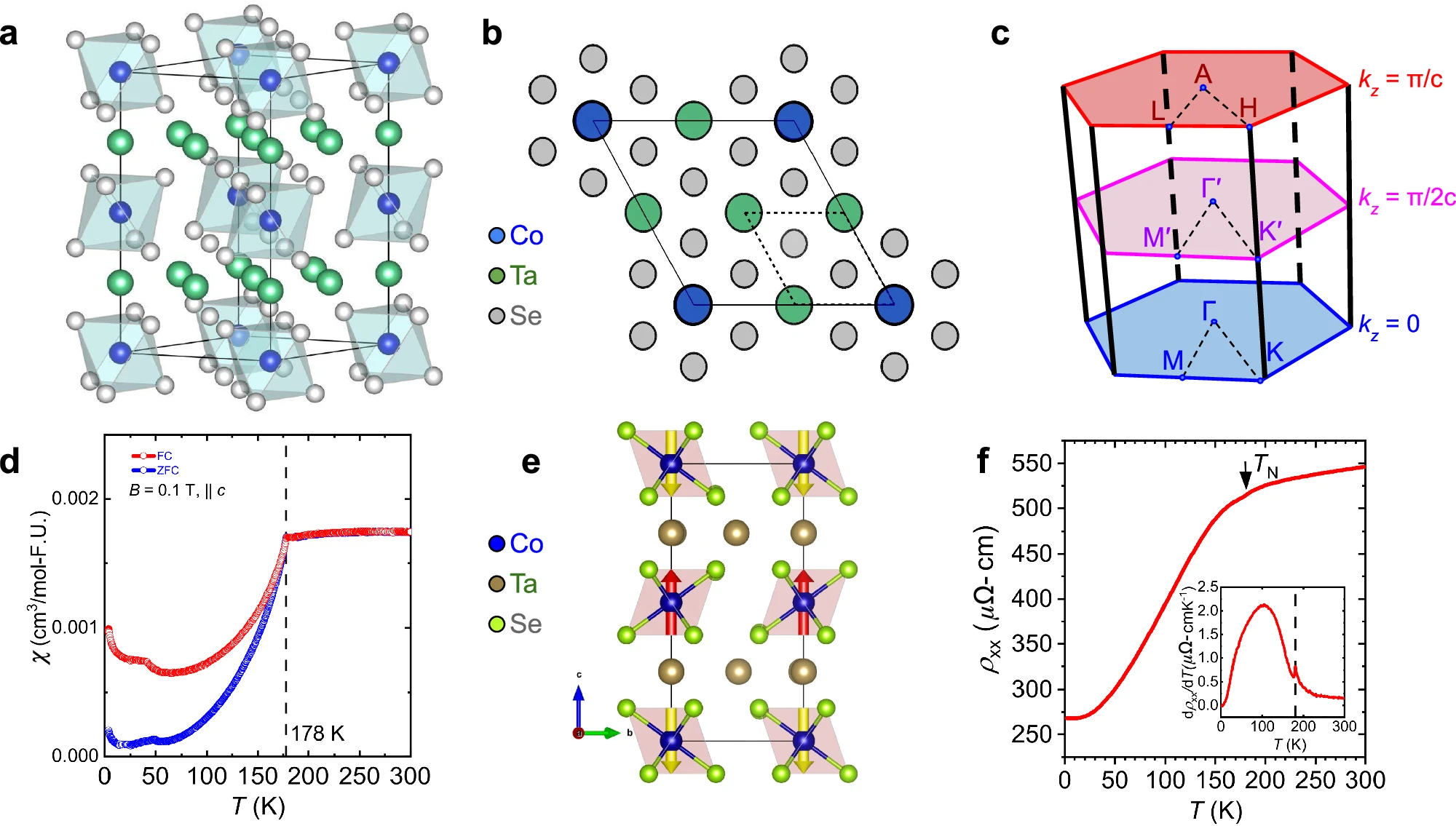
Co₁/₄TaSe₂ is built from layers of tantalum and selenium with cobalt atoms inserted between them. The cobalt atoms double the material’s unit cell within the plane, producing a hexagonal crystal structure while preserving the parent compound’s space group, P6₃/mmc.
The material becomes antiferromagnetic below a Néel temperature of 178 K. In this type-A antiferromagnetic arrangement, cobalt moments point along the crystal’s c-axis, align ferromagnetically within each plane and point oppositely in neighboring planes. Magnetic susceptibility shows a sharp transition at 178 K, and heat-capacity measurements provide an additional anomaly at the same temperature.
That magnetic arrangement has an important symmetry difference from a conventional compensated antiferromagnet. The opposite cobalt spins are not related simply by a translation or inversion operation. Instead, the magnetic structure contains a mirror plane that connects the two cobalt sites. According to the authors’ symmetry analysis, this allows the material to belong to a class known as altermagnets.
Altermagnets have no net magnetization, as in antiferromagnets, but their electronic bands can nevertheless become spin-split. The splitting is not uniform across momentum space. Instead, crystal symmetry can force the spin splitting to alternate in a characteristic pattern, while certain directions remain spin-degenerate.
The calculations for Co₁/₄TaSe₂ predict precisely such a pattern. The authors describe it as g-wave altermagnetism, in which the spin splitting changes sign and vanishes along symmetry-protected directions.
The cobalt moments are not completely localized
The magnetic behavior of Co₁/₄TaSe₂ also points to an unusual mixture of localized and itinerant magnetism.
Previous neutron-scattering measurements reported a cobalt magnetic moment of about 1.35 μB, substantially below the 3 μB expected for an ideal high-spin d⁷ cobalt configuration. The authors’ DFT calculations place most of the magnetic moment on cobalt, with only about 10% of opposite-sign magnetization generated in the TaSe₂ layers. They interpret the reduced cobalt moment as evidence that cobalt also forms an itinerant electronic band rather than behaving as a completely localized magnetic ion.
Transport measurements provide another indication that cobalt electrons participate in the electronic states carrying current. The material behaves metallically, with resistivity increasing as temperature rises. The temperature dependence of the resistivity changes substantially around the Néel transition, and the calculations indicate that roughly one-quarter of the total electronic density of states at the Fermi level comes from cobalt.
The authors therefore propose an intermediate picture in which the cobalt moments have both localized and itinerant character. They suggest that partial localization can support magnetic coupling to itinerant electrons, while the itinerant component participates directly in the electronic reconstruction associated with magnetic ordering. This is an interpretation of the combined measurements and calculations rather than a directly measured separation of the magnetic system into two independent components.
ARPES exposes the spin splitting
To look directly at the electronic structure, the researchers used angle-resolved photoemission spectroscopy, or ARPES, together with first-principles DFT calculations.
ARPES measures how electrons are distributed in energy and momentum. That makes it possible to map the Fermi surface, the set of electronic states at the energy where electrical conduction occurs, and to compare the measured bands with calculated spin-resolved bands.
The measurements were first performed at 7 K, well below the 178 K magnetic transition. Using 55-eV photons, the researchers probed a region of momentum space corresponding approximately to the kᶻ = π/2c plane, where the calculations predicted the strongest altermagnetic splitting.
The measured Fermi surface contained several distinct features, including a small electron-like pocket around Γ′, petal-shaped pockets along the Γ′–K′ direction and dog-bone-shaped pockets around M′. When the calculated spin-up and spin-down Fermi surfaces were placed over the experimental data, their separation followed a six-fold pattern expected for g-wave altermagnetism.
The contrast between different directions was particularly important. Along Γ′–K′, the opposite-spin Fermi surfaces remained degenerate. As the measurement direction rotated away from Γ′–K′ toward Γ′–M′, the separation increased. The clearest splitting appeared around the dog-bone-shaped pocket along Γ′–M′.
The same behavior appeared in the electronic band dispersion. Calculations showed spin-degenerate bands along the measured high-symmetry directions except along Γ′–M′, where opposite-spin bands separated. The two Fermi-level crossings associated with the dog-bone pocket were separated in momentum by about 0.01 Å⁻¹.
The experiment also revealed how strongly the apparent splitting depended on the out-of-plane momentum. Reducing the photon energy from 55 eV to 51 and then 48 eV moved the measurement away from the kᶻ = π/2c plane toward kᶻ ≈ 0, and the separation of the spectral features decreased.
At 48 eV, corresponding approximately to kᶻ ≈ 0, the researchers observed a single-peaked momentum-distribution curve along Γ–M rather than the split structure seen at 55 eV. This momentum dependence is consistent with the symmetry of the calculated altermagnetic bands.
The split bands carry opposite spin
The clearest test came from spin-resolved ARPES.
The researchers focused on three points across the dog-bone pocket along Γ′–M′, at momenta of 0.35, 0.38 and 0.41 Å⁻¹. At one side of the pocket, the spin-down spectral peak was shifted closer to the Fermi energy than the spin-up peak. Moving toward the middle, the two features moved closer together. On the opposite side, their relative positions reversed, with the spin-up component moving toward the Fermi energy while the spin-down component shifted toward higher binding energy.
In other words, the dominant spin character changed as the measurement moved across the pocket. That reversal is one of the characteristic signatures expected from the momentum-dependent spin texture of an altermagnet.
The measured out-of-plane spin polarization also changed sign. Across the dog-bone band, the reported polarization varied from approximately −13% to +13%.
The researchers then followed the spin polarization along a curved path from the Γ′–M′ direction toward Γ′–K′. The polarization steadily decreased as the path approached Γ′–K′, where the crystal symmetry requires spin degeneracy.
Together, these spin-resolved measurements provide direct evidence that the split electronic states are associated with alternating spin polarization rather than simply being two unrelated spectral features. Their evolution also matches the spin texture calculated with DFT.
Heating through 178 kelvin changes the bands
The connection to magnetism becomes clearer when the material is heated.
At 7 K, below the Néel temperature, the ARPES spectrum contains the split dog-bone bands and the small hole-like pocket around Γ′. At 200 K, above the 178 K magnetic transition, the Fermi-surface features broaden and several of the low-temperature structures change substantially.
The petal-shaped spectral intensity along Γ′–K′ becomes much weaker, although the underlying band remains detectable in dispersion measurements. The small hole-like pocket around Γ′ also loses spectral intensity at the Fermi energy, consistent with a shift of the pocket away from the Fermi level.
Most importantly, the two-peaked structure associated with the altermagnetic splitting along Γ′–M′ is replaced above the transition by a narrower band crossing the Fermi energy. The authors interpret this as the suppression of the altermagnetic splitting when the ordered magnetic state disappears.
The temperature evolution was not limited to a comparison between two temperatures. Measurements at 20 K, 80 K and 200 K showed that the low-temperature electronic features persisted at 20 and 80 K but disappeared at 200 K. When the temperature was cycled back down, the low-temperature features returned.
Momentum-distribution curves provided a more detailed comparison. The positions of the peaks changed little between 7 and 200 K, with the temperature-dependent shifts comparable to or smaller than the experimental resolution. Their intensities, however, changed noticeably.
The innermost peaks became weaker at 200 K across the measured binding energies, consistent with thermal broadening. Other peaks retained similar intensity between −100 meV and the Fermi energy but became suppressed farther below the Fermi level, between −200 and −100 meV. The authors suggest that this behavior may reflect the closing of small band gaps associated with altermagnetism as the temperature rises.
The temperature-dependent changes therefore extend beyond the disappearance of the spin splitting itself. The electronic structure is reconstructed more broadly around the magnetic transition, including changes in spectral weight and the small Γ′ pocket.
The authors note that some of the reduced spectral intensity may also arise from changes in photoemission matrix elements as the orbital composition changes with magnetic order. They therefore do not attribute every intensity change uniquely to the magnetic transition.
A magnetic structure with a six-fold electronic signature
The combined measurements and calculations point to a specific relationship between crystal symmetry, magnetic order and electronic bands.
The two cobalt sites are related by mirror symmetry, while a general momentum does not retain the usual Kramers degeneracy. At the same time, the hexagonal symmetry forces spin-degenerate nodal planes in specific regions of momentum space, including the Γ–K–H–A plane and the kᶻ = 0 and kᶻ = π/c planes.
Between those symmetry-protected regions, the electronic bands can split according to the g-wave pattern. The ARPES measurements reproduce this structure: the splitting is strongest along Γ′–M′, disappears along Γ′–K′ and vanishes when the measurement is moved toward the appropriate kᶻ plane.
The authors describe Co₁/₄TaSe₂ as a layered van der Waals material with this g-wave altermagnetic electronic structure. Its magnetic transition, momentum-dependent spin splitting, spin-polarization reversal and temperature-dependent band reconstruction are all observed within the same material and are consistent with the DFT calculations.
Linking localized moments to itinerant electrons
The researchers use these observations to propose a picture that combines two aspects of the material’s magnetism.
They suggest that partially localized cobalt moments can interact with itinerant electrons through RKKY-mediated coupling, while the itinerant electronic component contributes directly to momentum-dependent changes in the bands. In this interpretation, magnetic ordering produces hybridization features below the Néel temperature, while the itinerant component helps produce momentum-selective gaps and redistribution of spectral weight near the Fermi level.
The absence of strong precursor fluctuations above the Néel temperature is also noted. The authors interpret this as evidence that the electronic reconstruction becomes operative primarily once static magnetic order is established.
This proposed mechanism is based on the combined magnetic, transport, ARPES and DFT results. The experiments directly establish the magnetic transition and the associated electronic-structure changes, while the localized-itinerant picture is the authors’ interpretation of how those observations fit together.
The crystals were grown by chemical vapor transport using iodine. The researchers first prepared a polycrystalline precursor from cobalt, tantalum and selenium, then carried out a second high-temperature transport process that produced well-faceted, plate-like single crystals.
High-resolution ARPES measurements were performed at the Stanford Synchrotron Radiation Lightsource. The samples were cleaved at 7 K under ultrahigh vacuum, with energy and angular resolutions of 20 meV and 0.1°, respectively. Spin-resolved ARPES was performed at the Advanced Light Source using a spin detector, with energy and angular resolutions of 40 meV and 0.5°. The DFT calculations used the VASP plane-wave framework, the PBE generalized-gradient approximation, a 600-eV energy cutoff and a 9 × 9 × 4 momentum-space sampling grid.
Taken together, the measurements provide evidence for a g-wave spin-split electronic structure in Co₁/₄TaSe₂ that is tied to its antiferromagnetic order. The spin splitting appears in the low-temperature electronic structure, follows the momentum dependence expected from the crystal symmetry, reverses its spin character across the dog-bone pocket, and disappears above the 178 K magnetic transition. The broader band reconstruction across the same transition also indicates that magnetic ordering affects electronic states beyond the immediate spin-split bands.
The study was published in Nature Communications.