For nearly 80 years, physicists have used Richard Feynman’s path integral idea to calculate how quantum particles move between two points. Now, a team in China has directly tested the underlying idea in the laboratory, using single particles of light and measurements of more than 1.4 million possible paths.
In 1948, Feynman proposed a way to describe the motion of a quantum particle that differs sharply from the everyday picture of an object following one route.
In his path integral approach, every possible path between two points contributes to the final result. Those contributions combine to produce the outcome observed in an experiment.
Feynman also proposed that the possible paths have equal likelihood, with their differences coming from the phase of their quantum wave functions. Physicists have relied on these ideas in quantum calculations for decades, but they had not been directly confirmed experimentally.
Shi-Liang Zhu of South China Normal University in Guangzhou, China, and his colleagues set out to test them using single photons.
Measuring paths without directly following them
A photon cannot simply be watched as it travels along a particular path without disturbing its behavior. Instead, the researchers measured a quantity called probability amplitude.
Probability amplitude describes how likely a quantum particle is to follow a particular route while also accounting for information about the size and timing of its quantum wave.
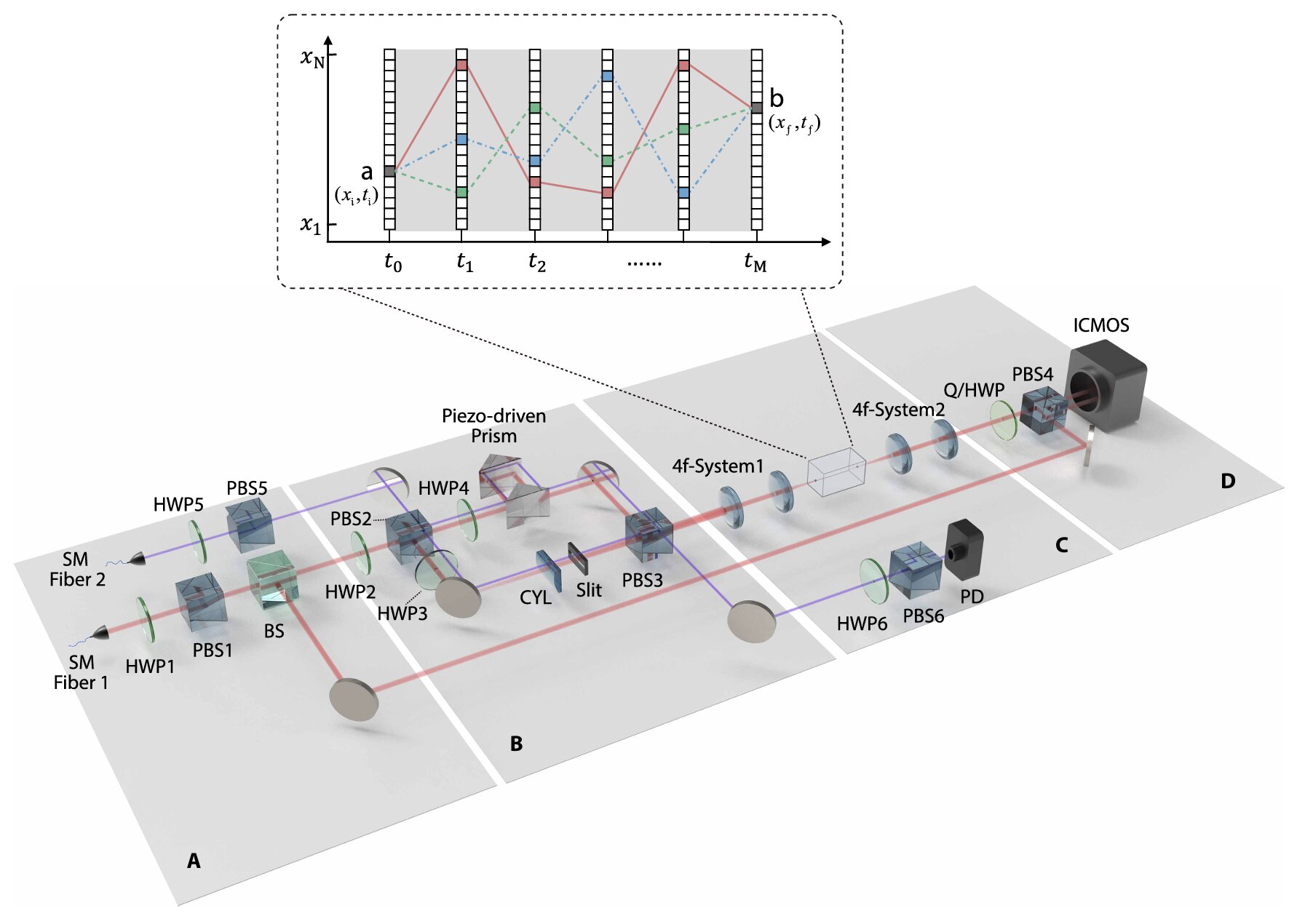
The team sent single photons through an arrangement containing mirrors, lenses and crystals. By measuring changes in the photons’ properties, the researchers reconstructed the amplitudes associated with 1,419,857 possible paths.
That created a demanding measurement problem. Small errors could accumulate across such a large number of paths and undermine the comparison with Feynman’s predictions. The researchers therefore refined the measurement process so the resulting data could be combined with enough fidelity for the test.
The measured results matched the prediction
The measurements closely followed the behavior predicted by Feynman’s approach.
The observed probabilities resulted from combining contributions from all the paths. The paths had equal strength, while their phases were determined by the particle’s classical trajectory.
The experiment therefore provided a direct laboratory test of assumptions that had been used in quantum calculations for decades.
The researchers hope the same measurement technique can be adapted to other physical systems. One possibility they identify is testing how quantum paths combine when photons travel through materials rather than empty space.
The study was published in Science Advances.