On January 14, 2025, something subtle yet profound washed across Earth. It passed through buildings, bodies, oceans, and mountains without leaving a mark, unnoticed by human senses. But deep inside exquisitely sensitive instruments in the United States, the universe rang like a struck bell. This ripple in space and time was named GW250114, and to scientists who listen for such things, it sounded astonishingly clear.
Gravitational waves are whispers from violent cosmic events, distortions in space-time set off when massive objects move and collide. Since the first detection a decade earlier, researchers have been tuning their instruments, learning how to hear these whispers more sharply. With GW250114, they heard something close to perfection: the cleanest gravitational wave signal ever captured from a binary black hole merger.
For physicists, clarity matters. A clear signal is not just easier to admire; it is an opportunity to test the deepest rules governing reality itself.
A Familiar Song, Heard With New Ears
To Keefe Mitman, a physicist at Cornell University and a NASA Hubble Postdoctoral Fellow, the wave felt strangely familiar. In its essence, GW250114 closely resembled GW150914, the first gravitational wave ever detected ten years earlier. The difference was not in the cosmic event itself, but in how sharply humanity could now perceive it.
Over the past decade, the detectors operated by the Laser Interferometer Gravitational-Wave Observatories, along with partners in the Virgo Collaboration in Italy and the KAGRA Collaboration in Japan, have become dramatically more precise. What once arrived as a faint cosmic murmur now came through with remarkable definition.
Mitman is a co-author of the analysis published in Physical Review Letters, a paper titled “Black Hole Spectroscopy and Tests of General Relativity with GW250114.” The work represents decades of collaboration, with Cornell researchers playing key roles since the project’s earliest days in the 1990s. This wave was not just another detection. It was a milestone.
The Moment Two Black Holes Became One
The story behind GW250114 begins far from Earth, where two black holes spiraled toward each other and merged in a cataclysmic collision. As they combined, they shook the fabric of space-time itself. That shaking traveled outward at the speed of gravity, eventually brushing past Earth and through the waiting detectors.
The signal was officially announced by the LIGO-VIRGO-KAGRA team in September 2025. What followed was careful listening, analysis, and interpretation. The wave carried information not only about the collision but about the nature of gravity itself.
According to general relativity, Albert Einstein’s century-old theory of gravity, black hole mergers should behave in very specific ways. The ringing aftermath of a collision, known as the “ringdown,” should produce tones with precisely defined properties. If reality follows Einstein’s rules, those tones should tell a consistent story.
The Bell That Tested Einstein
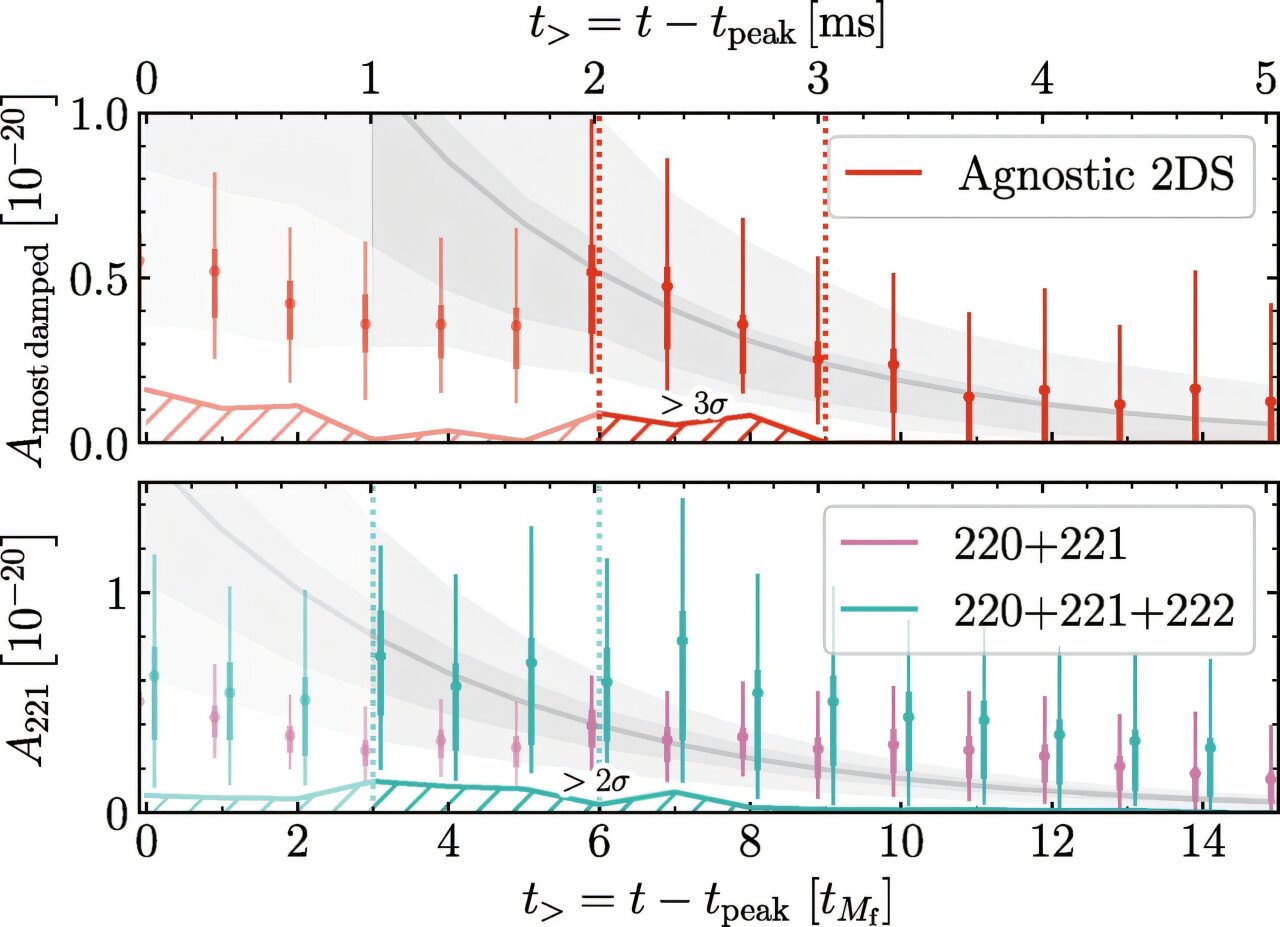
When two black holes merge, the newly formed black hole does not settle quietly. It rings, much like a struck bell. This ringing produces distinct tones described by two key properties: an oscillatory frequency and a damping time, which describes how quickly the tone fades.
Einstein’s theory makes a powerful prediction here. If you can measure one of these tones, you can calculate the mass and spin of the final black hole. But if you can measure two or more tones, each tone independently reveals those same properties. Under general relativity, all of those measurements should agree.
This is where GW250114 shines. Its signal was clear enough for researchers to measure two tones directly and place constraints on a third. Each tone told the same story. The mass and spin inferred from one matched the others precisely, just as Einstein’s equations predicted.
In that agreement lies both confirmation and tension. The theory passed the test, but the test itself hints at how it might one day fail.
Listening for What Shouldn’t Be There
Physicists are not satisfied when a theory simply works. In fact, they expect general relativity to be incomplete. As powerful as it is, it does not explain everything gravity appears to do in the universe. It struggles with phenomena tied to dark energy and dark matter, and it refuses to align cleanly with the rules of quantum mechanics, the framework used to describe the smallest scales of reality.
This incompatibility is a known paradox. Gravity governs the large-scale structure of the cosmos, while quantum mechanics rules the microscopic realm. Yet the universe contains places, such as black holes, where both should matter at once. Somewhere, physicists believe, Einstein’s classical description must give way.
Gravitational waves may be the place where that transition reveals itself.
If future signals contain tones that disagree, if different measurements point to different masses or spins, it would be a sign that something beyond general relativity is at work. That disagreement would not be a failure. It would be a discovery.
The Silence That Would Have Changed Everything
Mitman and his collaborators are open about what they hoped might happen. If the tones from GW250114 had failed to align, physicists would have been forced into deep and difficult questions. Why did gravity behave differently? What new rules were shaping the collision? What theory could replace or extend Einstein’s?
That silence of disagreement did not arrive this time. The tones harmonized. The equations held. But the possibility remains alive, hanging in the data of future waves still traveling toward Earth.
The researchers believe that not all binary black hole collisions will conform so neatly. Somewhere out there, a merger may carry the fingerprints of new physics, deviations imprinted by a deeper theory of gravity yet to be understood.
Traces of a Quantum Universe
One of the most tantalizing possibilities is that gravitational waves could carry signatures of quantum gravity, the long-sought framework that would unify gravity with quantum mechanics. Such signatures would not appear as dramatic explosions or obvious anomalies. They would be subtle, hiding in the fine structure of the waveforms themselves.
Physicists suspect that at extreme energies and densities, Einstein’s smooth description of space-time begins to crack. Tiny deviations from classical predictions could reveal how gravity behaves at the quantum level. These deviations, if they exist, may be written into the ringing tones of merging black holes.
The hope is simple and profound. By listening carefully enough, humanity may one day hear the sound of a deeper truth.
Why This Moment Matters
GW250114 matters not because it overturned physics, but because it sharpened the tools needed to eventually do so. It demonstrates how far gravitational wave astronomy has come in just ten years. It shows that detectors are now precise enough to perform what amounts to spectroscopy on black holes, teasing out multiple tones from a single cosmic event.
Each such detection tightens the constraints on our understanding of gravity. Each confirmation of general relativity narrows the space where new theories must live. And each future deviation, should it appear, will point the way forward.
This research matters because it transforms black holes from distant mysteries into laboratories. It turns the universe itself into an experiment, one that runs continuously and sends its results across space-time to Earth. By listening, physicists are not just confirming what Einstein got right. They are patiently waiting for the moment when the universe tells them what comes next.
In the quiet after the bell fades, the promise remains. Somewhere in the cosmic noise, the next wave is already on its way.
Study Details
Anonymous, Black hole spectroscopy and tests of general relativity with GW250114, Physical Review Letters (2025). DOI: 10.1103/6c61-fm1n