Stopping at exactly the right moment may depend on a finely balanced partnership between two groups of brain cells. Researchers found that specialized neurons deep within the brain work in opposite yet complementary ways to guide movement while tracking progress toward a goal, offering fresh insight into how complex actions are organized and potentially paving the way for a better understanding of neurological disorders.
Everyday life depends on more than simply moving. Whether unlocking a door, typing a password, or reaching for an object, the brain must coordinate precise movements while continuously monitoring progress toward a desired outcome. Scientists have long known that the basal ganglia (BG) play a central role in controlling voluntary movement, but exactly how this brain network organizes sequences of goal-directed actions has remained unclear.
Now, researchers at Duke University School of Medicine and Duke University have uncovered new evidence that specific groups of neurons within the basal ganglia work together to both steer movement and keep track of how close an animal is to achieving its objective. Their findings, published in Nature Neuroscience, reveal a coordinated system that integrates physical movement with action counting.
A New Way to Study Goal-Directed Behavior
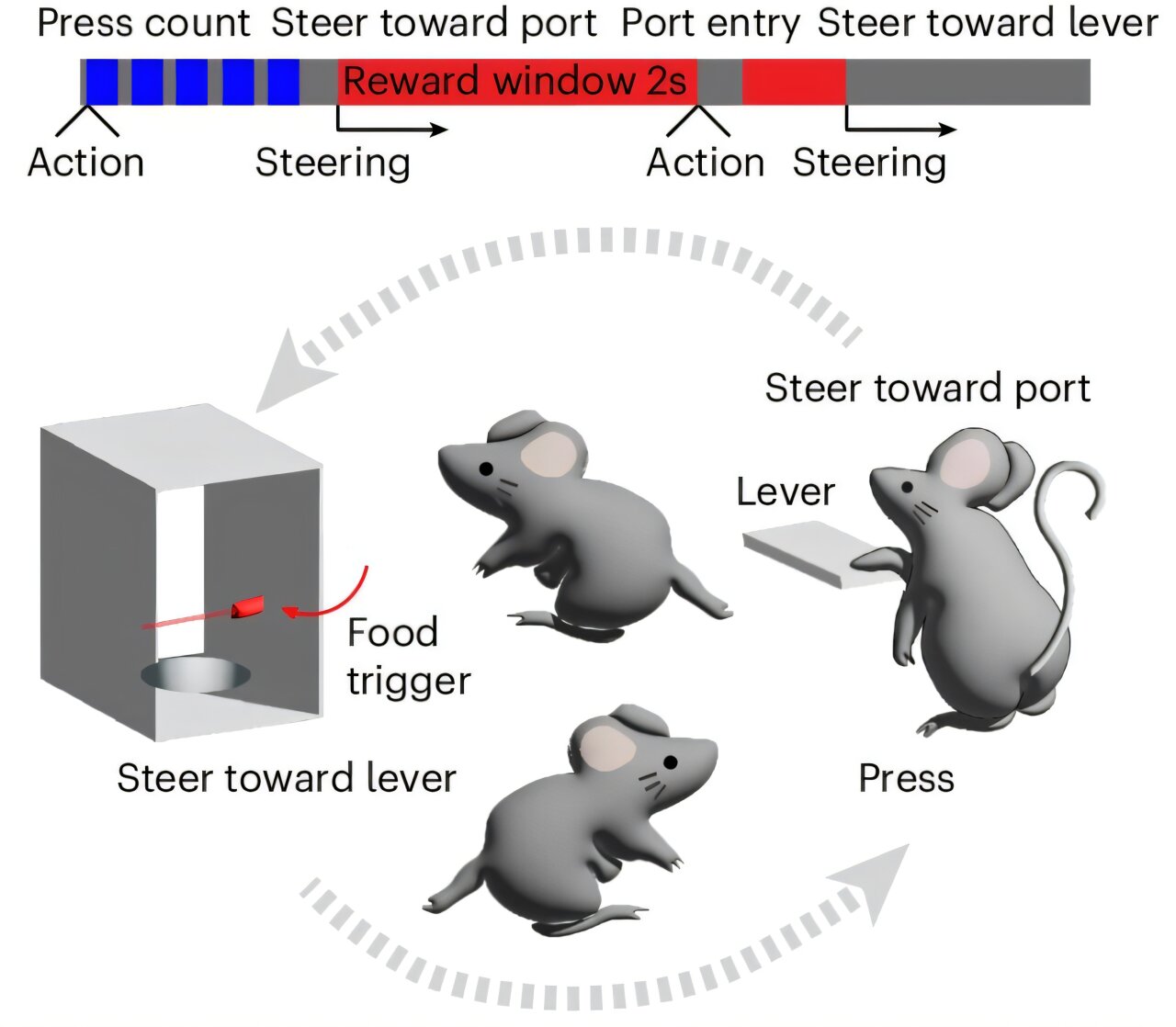
To better understand how the brain manages complex action sequences, the researchers designed an entirely new behavioral task for mice.
The experiment required each mouse to press a tiny lever a specific number of times before earning a food reward. This setup allowed the researchers to monitor not only the animals’ movements but also their progress toward completing the required sequence of lever presses.
By separating movement from goal tracking, the task provided an opportunity to examine how the brain manages both processes simultaneously.
While the mice performed the task, the researchers carefully recorded their behavior and manipulated the activity of specific neurons in the brain using optogenetics, an experimental technique that enables scientists to control genetically modified cells with light.
Two Neuron Types With Opposing Roles
The investigation focused on two major neuron populations located in the striatum, the primary input region of the basal ganglia.
These neurons are known as direct-pathway spiny projection neurons (dSPNs) and indirect-pathway spiny projection neurons (iSPNs).
Rather than performing the same function, the two cell types appeared to have opposite effects on behavior.
When researchers activated dSPNs, the mice continued pressing the lever for longer periods, effectively extending their action sequences.
In contrast, activating iSPNs caused the mice to stop pressing the lever too early, ending the sequence before completing the required number of presses needed to receive the reward.
The results suggest that these two neuron populations function as complementary controllers, each influencing behavior in a different direction.
The Brain Tracks Progress Toward a Goal
The team also examined how these neurons behaved naturally during the task using calcium imaging, a technique that reveals patterns of activity within living neurons.
Their observations showed that both dSPNs and iSPNs reflected progress toward a goal, but in distinct ways.
The researchers identified activity patterns that gradually increased or decreased as the mice moved closer to completing both their physical movement and their numerical target—the required number of lever presses.
Importantly, the difference in activity between the two neuron populations became greater as the animals approached their spatial and counting goals.
According to the researchers, these findings indicate that the basal ganglia operate as a push-pull controller, integrating both movement and action counting to guide behavior toward successful goal completion.
Rather than simply triggering movement, the brain appears to continuously monitor where an individual is within an action sequence and adjust behavior accordingly.
More Than Movement Control
Previous research had already established that the basal ganglia are essential for selecting, initiating, and controlling voluntary movements.
The new findings expand that understanding by showing that this brain network also keeps track of how many actions remain before a goal is reached.
This suggests that the basal ganglia contribute not only to the mechanics of movement but also to organizing the sequence of actions needed to accomplish complex tasks.
The discovery provides a more complete picture of how the brain coordinates behavior from beginning to end.
What the Findings Could Mean
Although the experiments were conducted in mice, the researchers say the results could eventually improve understanding of neurological conditions marked by problems with movement control or planning goal-directed action sequences if similar mechanisms are confirmed in humans.
Because the study identifies specific neuron populations involved in monitoring progress and controlling action sequences, it offers a clearer framework for investigating the neural basis of disorders that affect these abilities.
The researchers emphasize that further work will be needed to determine whether the same mechanisms operate in the human brain.
Why This Matters
Goal-directed behavior is fundamental to nearly everything humans do, from simple daily routines to complex tasks requiring careful planning and coordination. This study provides new insight into how the basal ganglia integrate movement with action counting by revealing complementary roles for dSPNs and iSPNs. By showing that these neurons not only steer movement but also track progress toward a goal, the research advances scientists’ understanding of the brain’s internal control systems and lays the groundwork for future investigations into neurological disorders that disrupt movement planning and goal-directed behavior.