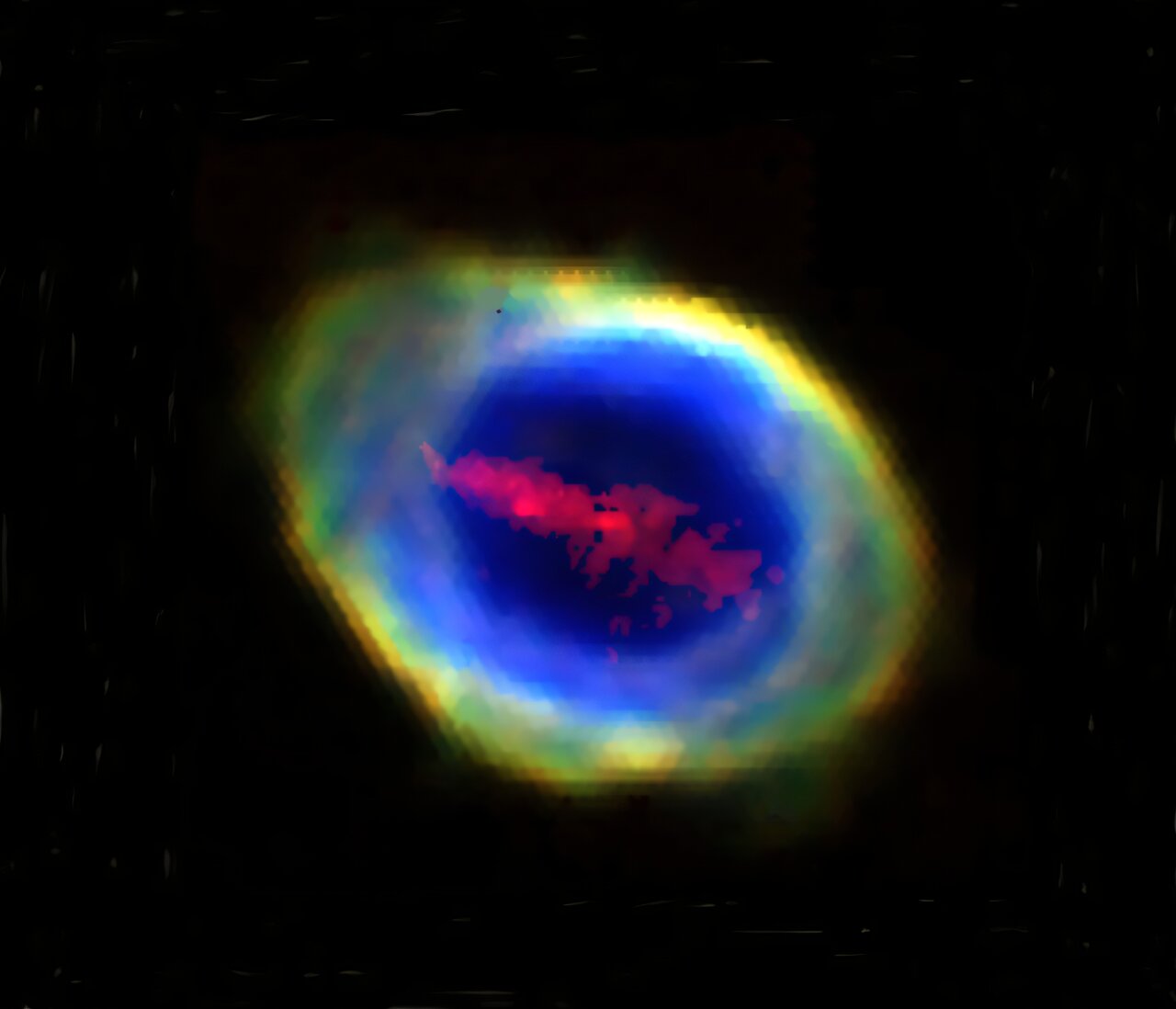
For centuries, the Ring Nebula has felt reassuringly known. Hanging in the northern constellation of Lyra, it has been sketched, photographed, and admired since Charles Messier first recorded it in 1779. Its glowing oval shell, cast off by a dying star, has become one of the most recognizable sights in the night sky, especially in modern images captured at infrared wavelengths by the James Webb Space Telescope. Yet even objects we think we understand can still surprise us. Deep inside this famous nebula, astronomers have now found something entirely unexpected: a hidden bar-shaped cloud of iron.
This newly discovered structure sits quietly within the nebula’s inner region, unseen until now. Its presence reshapes the story of the Ring Nebula and reminds scientists that the universe still holds secrets, even in places we thought we knew by heart.
Seeing the Ring Nebula in a New Way
The discovery was made by a European research team led by astronomers at University College London and Cardiff University, using a powerful new instrument called the WHT Enhanced Area Velocity Explorer, known as WEAVE. Installed on the 4.2-meter William Herschel Telescope, WEAVE allowed the team to observe the nebula not just as a glowing image, but as a detailed map of light and chemistry.
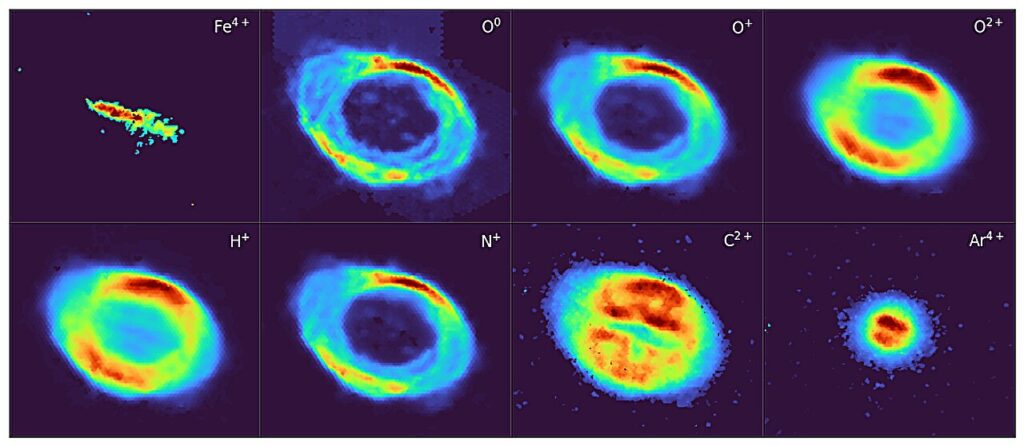
At the heart of this capability is the Large Integral Field Unit, or LIFU, a bundle of hundreds of optical fibers. These fibers collect light from every point across the entire face of the Ring Nebula at once. Instead of capturing a single combined signal, the instrument separates light into its component wavelengths, producing a spectrum at each location. This makes it possible to examine the nebula’s chemical composition in extraordinary detail.
Dr. Roger Wesson, the study’s lead author, described how transformative this approach has been. He explained that although the Ring Nebula has been studied with many telescopes and instruments, WEAVE made it possible to observe it in a completely new way. By obtaining a continuous spectrum across the whole nebula, the team could create images at any wavelength and determine what elements were present at every position.
As the researchers processed the data and scrolled through the resulting images, something unexpected emerged with striking clarity. Right in the middle of the familiar ring was a previously unknown structure: a distinct bar of ionized iron atoms.
The Shape, Size, and Weight of a Cosmic Bar
The iron cloud is not subtle. It stretches across the nebula in a narrow strip that fits neatly inside the inner layer of the elliptical ring. Its shape is so well defined that the researchers describe it as a bar, or strip, rather than a diffuse cloud.
The scale of this structure is immense. Its length is roughly 500 times the size of Pluto’s orbit around the Sun, a distance so vast that it defies everyday intuition. Even more striking is its mass. The total amount of iron contained in this bar is comparable to the mass of Mars. This is not a trace signal or a minor feature. It is a dominant structure hiding in plain sight within one of the sky’s most beloved nebulae.
Despite its size and weight, the bar had remained invisible until now. Traditional observations could not isolate it from the surrounding glow. Only by mapping the nebula’s light wavelength by wavelength did the iron reveal itself.
A Star’s Final Act, Written in Gas and Light
The Ring Nebula itself is the result of a star reaching the end of its nuclear fuel-burning life. As the star exhausted its fuel, it expelled its outer layers into space, creating a colorful shell of gas that continues to expand outward. This process is not unique. Astronomers expect that our own Sun will shed its outer layers in a similar way a few billion years from now.
What makes the new discovery so intriguing is how it fits into this familiar story. The presence of such a concentrated bar of iron was not predicted. Its location, shape, and composition suggest that something unusual happened during, or possibly even before, the nebula was ejected.
This raises a profound question. How did this iron bar form?
Two Ideas, Both Equally Astonishing
At the moment, the researchers can only outline possible explanations. One idea is that the iron bar reveals a previously unknown detail about how the dying star expelled its material. The process of shedding outer layers may have been more complex and structured than scientists realized, leaving behind this iron-rich feature as a kind of fossil record of the star’s final stages.
The second idea is even more dramatic. The iron bar could be an arc of plasma created by the vaporization of a rocky planet. In this scenario, a planet orbiting the star may have been caught up in the star’s earlier expansion. As the star grew and heated its surroundings, the planet could have been destroyed, its rocky material torn apart and ionized, leaving behind a bar-shaped trail of iron.
Right now, there is not enough information to know which explanation is correct.
Professor Janet Drew, a co-author on the study, emphasized how much remains unknown. She explained that the team needs to determine whether other chemical elements exist alongside the iron. Finding additional elements would point toward the correct class of models and help explain the bar’s origin. Without that information, an important piece of the puzzle is still missing.
Returning to the Nebula for Answers
The mystery has already set the stage for future research. The team plans to conduct follow-up observations using WEAVE’s LIFU at higher spectral resolution. These sharper measurements will allow them to examine the iron bar in greater detail and search for the presence of other elements.
This work is part of a much larger effort. Over the next five years, WEAVE will carry out eight surveys, observing targets that range from nearby white dwarfs to extremely distant galaxies. One of these efforts, the Stellar, Circumstellar and Interstellar Physics survey led by Professor Drew, will examine many more ionized nebulae across the northern Milky Way.
Dr. Wesson believes it would be surprising if the iron bar in the Ring Nebula were truly unique. As more nebulae formed in similar ways are observed and analyzed, the team expects to find additional examples of this phenomenon. Each new discovery would help astronomers understand where the iron comes from and what processes shape these glowing remnants of stellar death.
A Night-Sky Jewel Reveals Its Depth
For those who have admired the Ring Nebula through a telescope or in photographs, this discovery adds a new layer of wonder. What appeared to be a simple, elegant ring now contains a hidden structure of staggering scale and mass, silently suspended within it.
Professor Scott Trager, the WEAVE Project Scientist, reflected on what this means for astronomy. He noted that uncovering such a fascinating and previously unknown structure in a night-sky jewel beloved across the Northern Hemisphere demonstrates the remarkable capabilities of WEAVE. It also hints at the many discoveries yet to come.
Why This Discovery Matters
This finding matters because it changes how astronomers read the stories written in nebulae. The iron bar inside the Ring Nebula shows that even well-studied objects can harbor unexpected complexity. It challenges existing ideas about how stars shed their outer layers and raises the possibility that planets may leave detectable traces when they are destroyed.
More broadly, the discovery highlights the power of new instruments to reveal hidden details in the universe. By looking at familiar objects in new ways, scientists can uncover structures that reshape our understanding of cosmic evolution. The Ring Nebula, once thought to be fully known, has become a reminder that the universe is still capable of surprise, waiting patiently for us to learn how to look again.
Study Details
R. Wesson et al, WEAVE imaging spectroscopy of NGC 6720: an iron bar in the Ring, Monthly Notices of the Royal Astronomical Society (2025). DOI: 10.1093/mnras/staf2139