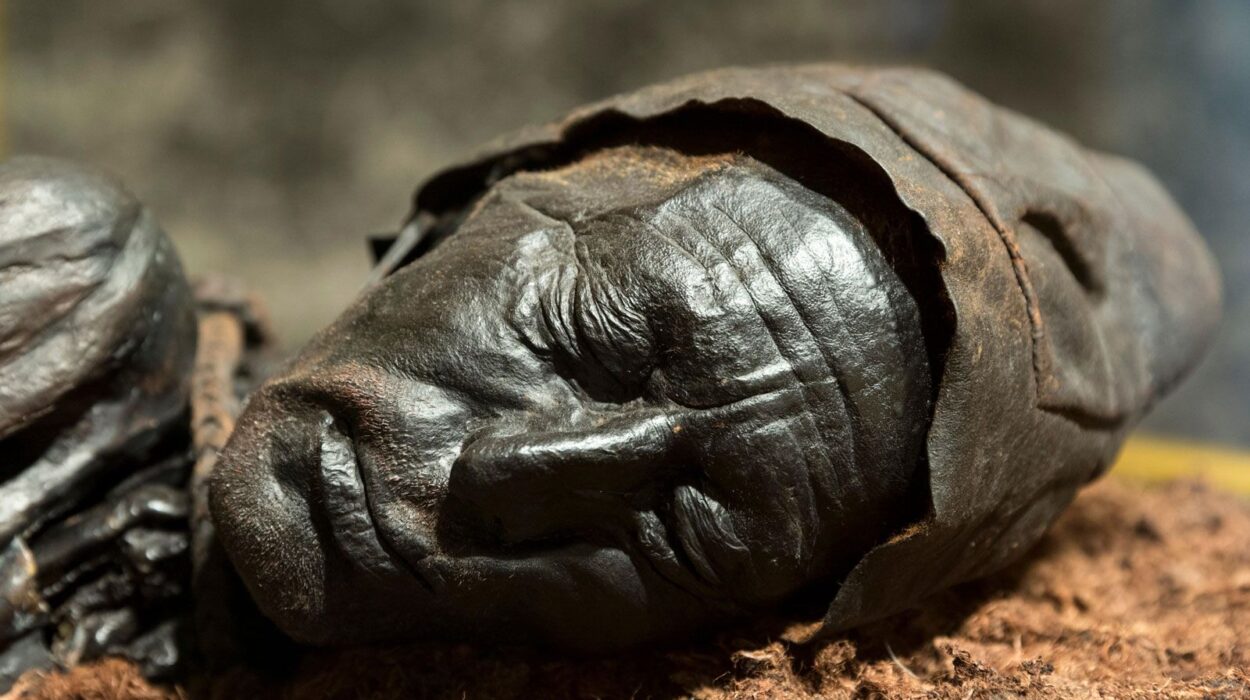
Ötzi the Iceman offers an unusually detailed look at life in prehistoric Europe because his body, clothing, tools, and other belongings survived together for more than 5,000 years. Discovered in the Alps in 1991, this naturally preserved mummy has helped scientists reconstruct what people ate, how they dressed, which technologies they used, what illnesses they experienced, and how they moved through their environment. His remains also reveal evidence of violence, providing clues about the dangers and conflicts that could shape an individual’s life during the Copper Age.
Ötzi lived around 3300 BCE, when communities across Europe were transitioning from earlier stone-based technologies toward increasingly widespread use of copper. Farming and animal husbandry were established in many regions, while hunting, gathering, and other traditional activities remained important. Although prehistoric people left behind pottery, tools, settlements, and burials, they rarely left direct evidence of their everyday experiences.
Ötzi is different. His exceptionally preserved remains provide a rare opportunity to study an actual person rather than infer an entire way of life from scattered archaeological objects. His story demonstrates how modern science can extract information from ancient biological material while also revealing the limits of what a single individual can tell us about the past.
How Ötzi was discovered and preserved
In September 1991, two hikers discovered a human body protruding from melting ice in the Ötztal Alps, near the border between Austria and Italy. Initially, the remains were mistaken for those of a relatively recent traveler. Scientific examination soon established that the body was thousands of years old.
The mummy became known as Ötzi, after the mountain region where he was found. Radiocarbon dating placed his death around 3300 BCE, making him approximately 5,300 years old. His discovery was extraordinary not simply because of his age, but because so much of his body and equipment had survived.
Most human remains decompose after death. Bacteria and fungi break down tissues, insects consume exposed material, and environmental conditions gradually destroy bones and other biological evidence. Preservation becomes much more likely when these processes are slowed by cold, dryness, limited oxygen, or other unfavorable conditions.
Ötzi’s body was preserved through natural freezing in a high-altitude environment. The cold substantially slowed decomposition, while the surrounding ice and conditions at the discovery site helped protect his remains. His body was eventually exposed as the glacier’s ice melted and shifted.
The preservation was not perfect. Parts of his body and belongings deteriorated over time, and his remains experienced environmental changes during the millennia he spent in the mountains. Nevertheless, his skin, hair, internal tissues, and numerous personal possessions survived well enough to support detailed scientific investigation.
The discovery also illustrates an important consequence of climate change. Melting ice can expose archaeological material that has remained hidden for thousands of years. Yet the same warming that reveals such discoveries can destroy them. Once ancient organic objects emerge from their frozen surroundings, they may rapidly deteriorate unless they are located, documented, and recovered.
What his body reveals about his appearance and health
Ötzi was an adult man in his mid-40s when he died. His preserved body and skeletal remains suggest that he was approximately 1.6 meters tall. His appearance was shaped by a life lived long before modern medicine, widespread sanitation, or reliable protection against many environmental hazards.
Scientific analyses of his remains have revealed evidence of several health problems. He had intestinal parasites, signs of arterial calcification, dental disease, and degenerative changes affecting parts of his skeleton. He also had evidence of previous physical injuries.
These findings challenge the idea that serious chronic disease emerged only with modern lifestyles. Arterial calcification, which involves the buildup of mineral deposits in artery walls, can occur in ancient populations as well as in people today. Its presence does not establish that Ötzi experienced the same cardiovascular disease progression seen in a modern patient, but it shows that some underlying biological risk factors existed long before industrialization.
His teeth reveal substantial wear and dental problems. The wear reflects a combination of diet, food preparation, and other activities that exposed teeth to abrasive particles. Ancient flour, for example, could contain tiny fragments of stone introduced during grinding. Over time, such particles could contribute to the wearing down of tooth surfaces.
Ötzi also suffered from intestinal parasites, including whipworm. Such infections were common in environments where human waste could contaminate soil, food, or water. The discovery provides direct evidence that parasitic disease was part of prehistoric life and helps explain why gastrointestinal infections could remain an ongoing health concern.
His skeleton shows signs of physical stress and degeneration, including damage and wear consistent with repeated activity over many years. However, skeletal changes rarely identify a specific occupation with certainty. Researchers must distinguish between evidence of physical strain and assumptions about exactly how a person spent each day.
The mummy’s skin also preserves numerous tattoos, consisting of lines and other simple markings. Many occur near areas affected by joint or back problems. One interpretation is that the markings may have been associated with therapeutic practices, perhaps involving a treatment resembling acupuncture in its broad aim of addressing pain. This remains uncertain. Their locations are intriguing, but they do not prove that Ötzi’s community understood anatomy or treated illness in the same way as later medical traditions.
Taken together, these findings show that prehistoric people experienced a familiar range of biological challenges: chronic disease, infection, injury, and age-related deterioration. Modern technology allows scientists to identify many of these problems, but it cannot always establish how painful they were, how they affected daily life, or what treatments Ötzi received.
What Ötzi ate and how he obtained food
Analysis of Ötzi’s stomach and intestinal contents has provided direct evidence of his final meals. The material indicates that he ate animal products, including meat, alongside plant foods. His diet reflected access to both domesticated and wild resources.
Among the foods identified were ibex and red deer, animals associated with the Alpine landscape. His stomach contents also included cereal material and traces of other plant foods. These findings suggest that his meals combined resources obtained through hunting or other animal-based food production with cultivated crops and gathered plants.
The presence of cereal products is particularly informative. By Ötzi’s time, agriculture had become established in many parts of Europe. Communities cultivated crops, kept livestock, and developed food-processing practices that allowed them to support more settled populations than many earlier groups could sustain.
Yet agriculture did not eliminate hunting or gathering. Prehistoric communities could combine farming with the exploitation of wild animals and plants, adapting their food supplies to local conditions and seasonal availability. Ötzi’s final meals are consistent with this flexible approach to food procurement.
Researchers have also identified microscopic and chemical evidence that helps reconstruct the composition of his diet. Stable isotopes, different forms of the same chemical element, can reveal aspects of the foods a person consumed over time. Their proportions in tissues depend partly on the isotopic composition of food and the way the body processes it.
Different tissues record different periods of life because they form and renew at different rates. Bone, for example, generally reflects dietary patterns over longer periods than the contents of a stomach. By combining these sources of evidence, scientists can distinguish between an individual’s longer-term diet and the particular foods eaten shortly before death.
His last meals do not represent a complete record of his nutritional habits. A stomach preserves only a brief snapshot, and the foods available to him may have varied with the season, his location, and the circumstances of his final journey. Even so, the remains demonstrate how biological evidence can reveal details of food consumption that ordinary archaeological objects cannot provide on their own.
What his clothing reveals about prehistoric technology
Ötzi’s clothing is among the most informative parts of his discovery. Surviving garments and fragments demonstrate that prehistoric people used several animal species and plant materials to produce clothing suited to a cold, mountainous environment.
His outfit included garments made from animal hides and skins, as well as footwear designed for difficult terrain. Different materials served different purposes, reflecting a practical understanding of insulation, flexibility, durability, and protection.
Leather and hide are not interchangeable materials. Hides can be processed in different ways depending on the intended use, and the properties of the finished material depend on the animal, preparation methods, and any additional treatments. Clothing made from animal products could provide insulation while allowing a degree of flexibility during movement.
Ötzi’s shoes are especially revealing. Their construction incorporated an outer structure, insulating plant material, and components associated with animal skin and fur. This combination would have helped protect the feet from cold ground and difficult surfaces.
The plant fibers used in footwear could trap air and provide insulation, while the outer materials offered protection against rocks, moisture, and abrasion. Although the precise performance of the footwear would have depended on its condition and the environment, its design shows that prehistoric people developed solutions to the practical challenges of travel in cold regions.
His garments also suggest that clothing was assembled from multiple materials rather than made as a single uniform covering. Different animal skins and plant products could be selected for particular functions. Producing such clothing required knowledge of raw materials, cutting, joining, and repair.
This evidence is important because organic materials usually survive poorly in archaeological sites. Stone tools can remain recognizable for thousands of years, but leather, fur, woven fibers, and wooden objects generally decompose unless unusual conditions preserve them. Without Ötzi, scientists would have a much less complete picture of how people dressed in the Copper Age.
His clothing also offers insight into the relationship between technology and the environment. People living in the Alps needed equipment suited to steep slopes, changing weather, and low temperatures. Their survival depended not only on knowing where to find food but also on designing objects that made movement and work possible under challenging conditions.
What his tools reveal about Copper Age skills
Ötzi’s belongings included a collection of tools and weapons that illustrates the range of materials and techniques available to people around 3300 BCE. His equipment included a copper-bladed axe, a flint dagger, a bow, unfinished arrows, and a quiver, along with other useful objects.
These items demonstrate that prehistoric technology was not defined by a single material. Copper was valuable for certain tools, but stone, wood, bone, animal products, and plant fibers continued to play essential roles.
The copper axe is especially significant because it represents a technological development that changed how some communities produced and used tools. Copper could be shaped into implements that had different properties from those made of stone. Its adoption required knowledge of metalworking, access to suitable raw materials, and participation in networks through which metals or finished objects could circulate.
Copper was not automatically superior to every alternative. Its usefulness depended on the task, the quality of the metal, and the design of the tool. Stone remained effective for many cutting and scraping purposes, while wood and plant fibers were indispensable for handles, shafts, bindings, and other components.
The axe’s copper blade was attached to a wooden handle, illustrating how different materials could be combined into a single functional object. The production of such a tool required several distinct skills: obtaining or acquiring the metal, shaping the blade, preparing the handle, and securing the components so they could withstand use.
His flint dagger provides another example of the continued importance of stone technology. Flint can be fractured to create sharp edges, making it useful for cutting and other tasks. Producing an effective stone tool requires control over how the material breaks, along with an understanding of the properties of the raw stone.
Ötzi’s bow and arrows reveal additional expertise in woodworking and toolmaking. A bow depends on the properties of the wood and the way it stores and releases elastic energy. Drawing the bow bends its limbs, storing energy that is transferred to the arrow when the string is released. The arrow’s shaft, point, and other components must work together for the weapon to function effectively.
His equipment also included a fire-making kit. Fire was essential in cold environments because it provided warmth, helped prepare food, and could make some materials easier to process. Producing fire reliably required suitable materials, preparation, and practical experience.
The collection shows that prehistoric technological knowledge was sophisticated even without modern machinery or written manuals. Such expertise was built through observation, practice, experimentation, and the transmission of skills between people. Objects like Ötzi’s tools preserve evidence of that knowledge long after the people who developed and used it are gone.
What his equipment reveals about movement and trade
Ötzi’s belongings also raise questions about how people traveled through the Alps and obtained the materials they needed. His equipment included substances and objects whose raw materials originated in different environments, suggesting that he had access to resources beyond those immediately available at the place where he died.
Some materials could have been obtained through exchange, travel, or contact between neighboring communities. Others may have been collected directly by Ötzi or acquired through local networks. Archaeologists can compare the chemical composition and geological characteristics of materials with known sources to investigate these possibilities.
Such evidence matters because prehistoric communities were not isolated simply because they lacked modern transportation. People moved across landscapes to hunt, herd animals, visit relatives, exchange goods, and maintain social relationships. Mountains could create significant obstacles, but they could also serve as routes connecting valleys and regions.
The presence of copper does not, by itself, reveal exactly where Ötzi obtained his axe or whether he acquired it through trade. Establishing an object’s origin requires more specific evidence, and determining how it changed hands is harder still. An object might have been exchanged many times, passed between generations, or carried over a long distance by its owner.
Nevertheless, his belongings demonstrate that the technology available to an individual could incorporate knowledge and materials drawn from a wider world. The history of a tool is not always limited to the place where it was found.
Ötzi’s equipment also suggests that he was prepared for travel or work in demanding terrain. His clothing, footwear, weapons, and other supplies served complementary purposes. Their combination offers a more complete picture of practical life than any single artifact could provide.
What remains uncertain is the precise purpose of his journey. His belongings do not provide a diary, a map, or a clear account of his intentions. Archaeologists can identify what he carried and investigate how those objects were made, but they must be cautious about turning this evidence into a detailed narrative of his final days.
How scientists reconstructed his final hours
Ötzi’s death is one of the most striking aspects of his story. Examination of his body revealed evidence that he had suffered a serious injury shortly before he died. A flint arrowhead was found lodged in his left shoulder, and the injury was associated with damage to blood vessels.
The wound indicates that he was shot with an arrow. The resulting bleeding was likely severe and may have contributed directly to his death. Additional injuries and traces of blood associated with his remains have prompted further investigation into the circumstances surrounding the event.
Scientists have also examined the position of his body and the distribution of his belongings. These observations can help reconstruct the sequence of events, but the evidence does not establish every detail of what happened. His death could have involved a confrontation, an ambush, or another form of violence, yet the exact circumstances remain uncertain.
The arrow wound is important because it provides direct physical evidence of lethal violence in the Copper Age. It shows that interpersonal conflict could be fatal and that weapons were used against other people, not just for hunting.
However, one violent death cannot establish how common warfare or homicide was in Ötzi’s society. Archaeological evidence must be interpreted in proportion to its scope. A single individual can reveal that an event occurred, but estimating its frequency requires a much larger body of evidence.
The contents of his digestive tract have also helped researchers investigate the timing of his last meals. Because food moves through the digestive system at different rates, the contents of different sections can provide clues about the sequence and approximate timing of eating. These clues are informative but do not function as a precise clock.
The broader lesson is that reconstructing an ancient death involves combining multiple forms of evidence: wounds, body position, clothing, equipment, environmental conditions, and biological material. Each source answers different questions, and the strongest interpretations are those that remain consistent with the evidence as a whole.
What ancient DNA reveals about Ötzi’s ancestry
DNA preserved in Ötzi’s remains has helped scientists investigate his genetic ancestry and certain aspects of his biology. Ancient DNA is genetic material recovered from archaeological remains, often after thousands of years of chemical damage and environmental exposure.
DNA carries inherited information, but it does not survive indefinitely under all conditions. Heat, moisture, microorganisms, and other environmental factors break it into fragments. Cold environments can slow some of these processes, increasing the chance that useful genetic material will remain.
Researchers extract ancient DNA under carefully controlled conditions because modern human DNA can contaminate ancient samples. Even a small amount of contamination can complicate the interpretation of results. Scientists therefore use specialized laboratory methods and computational comparisons to distinguish ancient genetic sequences from more recent material.
Ötzi’s genome has provided information about his ancestry and biological traits. Comparisons with genetic data from other ancient and modern populations help researchers investigate how populations moved, mixed, and changed over time.
His ancestry reflects the complex demographic history of prehistoric Europe, where farming populations expanded and interacted with groups whose ancestors had lived in Europe earlier. These movements did not occur as a single event or affect every region in the same way. They involved many communities over extended periods.
Genetic evidence can also reveal inherited characteristics, although predictions are not equally reliable for every trait. Some characteristics are strongly influenced by particular genetic variants, while others depend on many genes and environmental factors. A DNA sequence therefore does not provide a complete description of a person’s appearance, health, or behavior.
Ancient genomes also have important limitations. Ötzi represents one individual from a particular time and place. His ancestry cannot be treated as a complete genetic portrait of all people who lived in the Alps, much less of everyone living in Europe during the Copper Age.
The most useful insights emerge when genetic evidence is combined with archaeology, skeletal analysis, and environmental research. DNA can illuminate biological relationships and population history, while artifacts and other remains provide information about technology, diet, settlement, and daily activities.
What the landscape tells us about prehistoric life
Ötzi’s remains were preserved in a high mountain environment, and that setting is essential to understanding both his life and his discovery. Alpine landscapes can change dramatically over short distances, with differences in elevation producing sharp changes in temperature, vegetation, and the length of the growing season.
For prehistoric people, such variation created opportunities and challenges. Valleys could support agriculture and livestock, while higher elevations offered access to wild animals, plants, grazing areas, and routes across the mountains. The resources available at any particular location depended on the season and local conditions.
Travel through mountainous terrain required knowledge of the landscape. People needed to recognize safe routes, anticipate weather changes, and carry equipment suitable for cold and uneven ground. The risks included exposure, injury, falls, and becoming stranded far from shelter.
Ötzi’s survival in the archaeological record also reflects the unusual preservation conditions of the place where he died. Most people who lived during the Copper Age left no comparable collection of biological remains and personal possessions. Their clothing decomposed, their wooden equipment decayed, and their bodies were subject to the ordinary processes of decomposition.
This creates a challenge for archaeologists. The objects that survive are not necessarily representative of everything people used. Stone and metal may remain for millennia, while baskets, leather garments, wooden handles, and food residues often disappear. The resulting archaeological record can make prehistoric societies appear more dependent on durable materials than they actually were.
Ötzi provides a partial correction to that imbalance. His remains preserve organic objects that would ordinarily be missing from an archaeological site. By studying them, researchers can reconstruct a broader range of prehistoric activities and better understand how people adapted to their surroundings.
His discovery also demonstrates how environmental change affects the historical record. Glaciers and other frozen environments can preserve objects that would otherwise disappear, but they can also transport, expose, or damage them. Understanding the conditions surrounding a discovery is therefore essential to interpreting the evidence correctly.
What Ötzi can and cannot tell us about prehistoric society
Ötzi’s remains offer a remarkable amount of information, but they cannot answer every question about life in the Copper Age. His body reveals aspects of health and diet, his clothing demonstrates practical knowledge, and his tools preserve evidence of technological skill. Yet many elements of his social world remain difficult to reconstruct.
We do not know with certainty what he did for a living, what languages he spoke, what beliefs he held, or how he understood the events that led to his death. His belongings may suggest particular activities, but they do not provide a complete account of his occupation or social status.
Nor can his experience stand for every person who lived during the same period. Differences in geography, wealth, age, gender, occupation, and access to resources shaped prehistoric lives just as they shape human lives today. A person living in an agricultural settlement might have had a very different daily routine from someone traveling through the mountains.
Archaeologists address these limitations by comparing evidence from many sites and individuals. Settlements can reveal how houses were built and how communities organized space. Burials provide information about mortuary practices and, sometimes, social differences. Plant remains and animal bones help reconstruct agriculture, herding, hunting, and food preparation.
Ötzi’s importance lies partly in the way he complements these other sources. Instead of presenting a broad pattern across an entire population, he offers a detailed record of one person’s body and possessions. Other archaeological evidence helps researchers determine which of his characteristics were common and which may have been unusual.
This distinction between individual evidence and population-level conclusions is central to sound scientific reasoning. A well-preserved specimen can reveal details that are otherwise inaccessible, but conclusions about an entire society require comparison, context, and careful evaluation.
Why Ötzi remains important to science
More than five millennia after his death, Ötzi continues to provide insights because different scientific disciplines can investigate the same set of remains in complementary ways. Archaeology examines his tools and clothing, biological anthropology studies his body and skeletal changes, genetics investigates his ancestry, and chemical analyses help reconstruct his diet and movements.
These methods also show how scientific understanding develops. New analytical techniques can reveal information that earlier researchers could not detect, while reexamination may refine or challenge existing interpretations. The physical evidence remains the same, but the questions scientists can ask of it change as their methods improve.
Ötzi’s discovery has transformed the study of prehistoric life by preserving an unusually complete combination of human remains and everyday equipment. His body reveals that chronic disease and parasitic infections existed in the distant past. His food remains provide a direct glimpse of his diet. His garments and tools demonstrate practical ingenuity, while the arrow wound offers evidence of a violent death.
At the same time, his story reminds us that ancient people should not be reduced to either primitive stereotypes or romantic images of life in harmony with nature. They possessed substantial technical knowledge and adapted to difficult environments, yet they also experienced illness, injury, and violence.
Ötzi was one person who lived, ate, worked, traveled, and died in a world very different from our own. His remains cannot tell us everything about that world, but they allow us to examine parts of it with unusual precision. Through the careful study of his body and belongings, prehistoric life becomes more than an abstract period in a timeline: it becomes a tangible human experience, preserved in the ice and reconstructed through science.