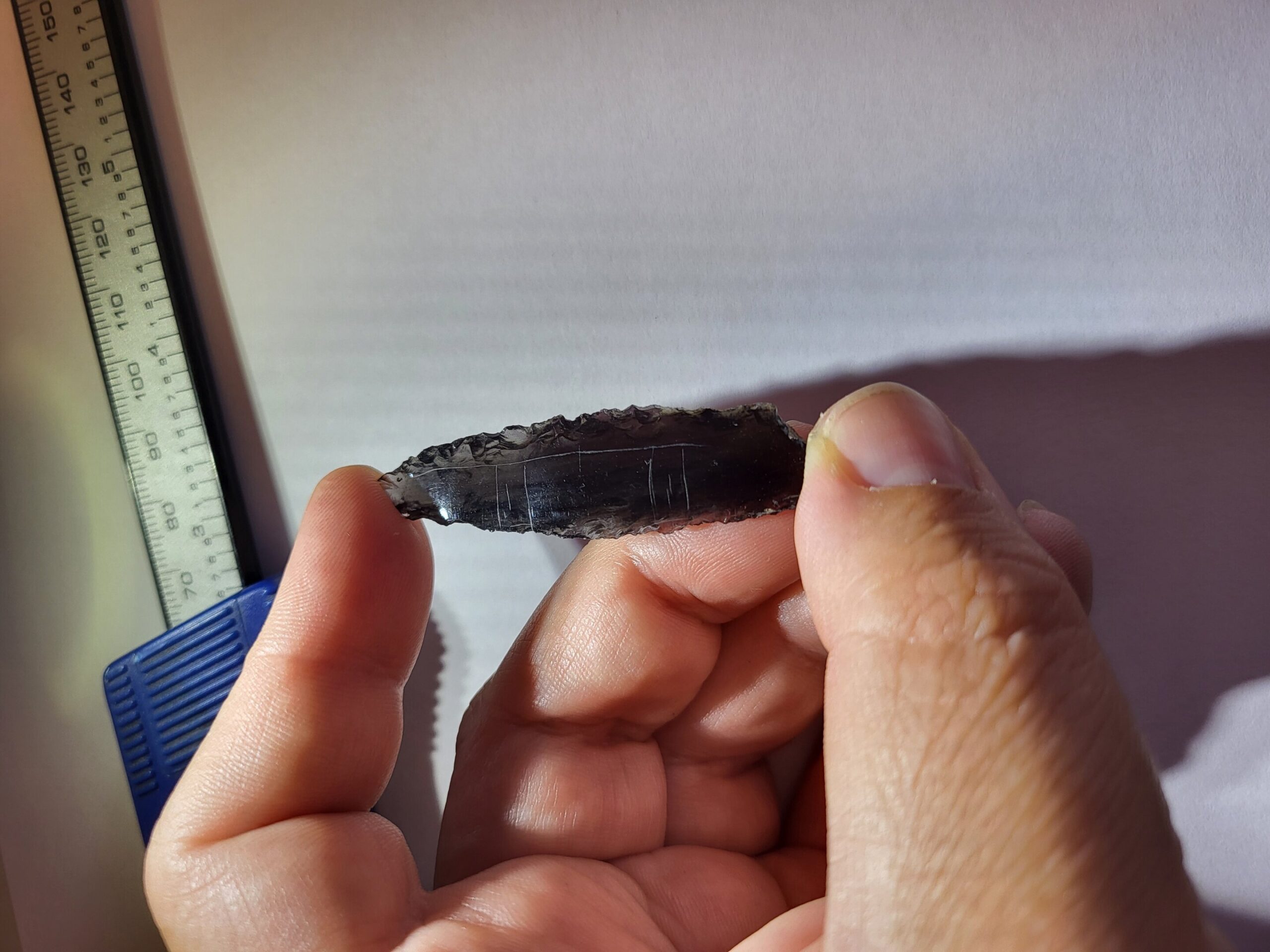
Twelve obsidian arrowheads from a Neolithic settlement in central Anatolia bear deliberately made lines and geometric designs, adding to evidence that people in the region repeatedly marked projectile points in a practice that lasted for more than a millennium but remained uncommon and has no clear meaning.
The arrowheads were found at Tepecik-Çiftlik, an archaeological settlement in Cappadocia in central Anatolia, in what is now Türkiye. Researchers examined 12 arrowheads with incisions, including 11 newly identified specimens and one previously reported from the site.
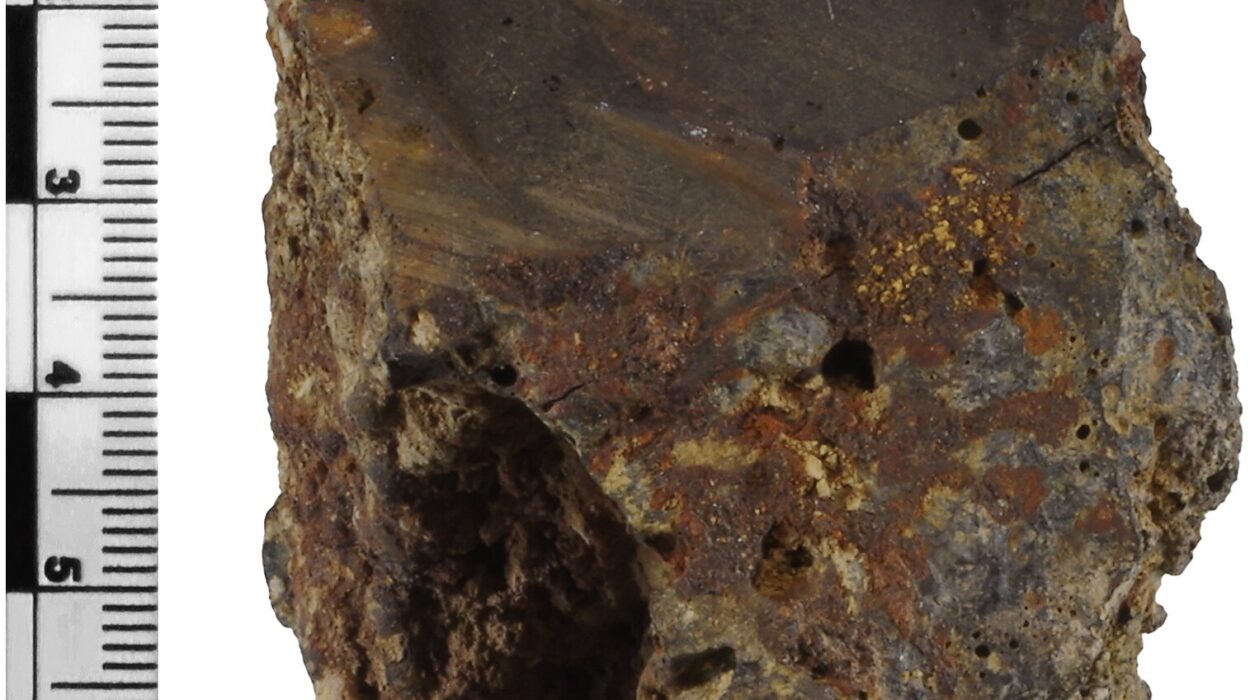
The markings range from single lines to much more elaborate designs. One arrowhead carries two repeated V-shaped lines. Another has three square-shaped groups made with 20 individual incisions. Other examples contain crosses, chevrons, wavy lines, parallel lines and roughly rectangular patterns.
The researchers distinguished deliberate incisions from ordinary scratches using three criteria. The marks had to be visible to the naked eye, involve actual removal of material rather than being superficial scratches, and show evidence of deliberate execution.
Repeated strokes were especially important. Several lines were made two or three times, sometimes along nearly the same path. The repeated gestures indicate controlled actions rather than random damage.
Two specimens did not meet all of the criteria. On one arrowhead, five parallel lines may have been intentional, but surface disturbance makes that uncertain. Another has a single vertical line whose isolated nature makes its intentionality difficult to establish.
The markings were unusually varied
The 12 arrowheads do not share a single design system.
Some markings are centered on the lower face of an arrowhead, while others are shifted to one side or spread across much of the surface. Some designs are simple, while the most elaborate contains 20 individual incisions.
No design can be confidently identified as an animal, human figure, plant or other recognizable image. The markings also do not correspond to known decorative or symbolic motifs found elsewhere at Tepecik-Çiftlik, including motifs seen on pottery and stamp seals.
There is also no repeated design that appears in exactly the same form across the Tepecik-Çiftlik group.
That variability matters because it argues against a clearly standardized system of signs. At the same time, comparisons with arrowheads from other central Anatolian sites reveal some formal similarities. A cross on one Tepecik-Çiftlik arrowhead resembles a design from Çatalhöyük. Two wavy lines on another resemble a marking from Can Hasan III, while an A-shaped design resembles another Can Hasan III example.
Similarities also occur among specimens from Çatalhöyük, Karabatak, Göllüdağ and Kömürcü-Kaletepe.
The result is a pattern that is neither completely standardized nor entirely unique. The researchers describe it as potentially reflecting a shared but flexible practice.
The arrowheads were made from local obsidian
The markings were found on arrowheads made from obsidian, the volcanic glass that was abundant around Tepecik-Çiftlik.
Six of the 12 incised arrowheads were made from obsidian associated with Nenezi Dağ, while the other six came from the eastern flank of Göllüdağ. Both are local Cappadocian sources.
The study used macroscopic visual characterization rather than formal laboratory provenance analysis. The researchers examined characteristics such as color, inclusions and transparency to distinguish the sources.
The result fits the broader stone-tool industry at Tepecik-Çiftlik. More than 99% of the chipped-stone assemblage is made from obsidian, primarily from Göllüdağ and Nenezi Dağ.
The incised arrowheads themselves are not technically unusual apart from their markings. Their dimensions, proportions, manufacture and retouch fall within the broader variation seen among other arrowheads at the site.
At least six of the 12 were made on blades, including four made on bidirectional blades. None was made on a unidirectional blade or flake.
The arrowheads were generally tanged and varied considerably in shape and retouch. Some were highly regular, while others were irregular.
There was no relationship between the complexity of a design and the quality or shape of the arrowhead. The most elaborate design, for example, was not placed on the most symmetrical or finely retouched point.
The markings were added at different stages
The researchers also examined when the incisions were made relative to the shaping and retouching of the arrowheads.
There was no single pattern.
In three cases, the incisions clearly came before retouching. Later retouch scars cut across parts of the incised lines. In three other cases, the incisions were made after retouching because the lines cross or overlap retouch scars.
For the remaining six arrowheads, the relationship could not be determined because the incisions and retouch scars do not overlap.
This finding is important because it means the marking was not tied to one fixed stage of arrowhead production.
The researchers also found evidence that the markings involved deliberate sequences of gestures. On one arrowhead, three squares were made first and a vertical line was added afterward. On another, vertical lines were made before horizontal ones.
An experiment provided further information about how the markings could have been produced.
The researchers made two crossed incisions on an unretouched obsidian bladelet using the proximal end of an unretouched flint blade. The flint produced precise, well-defined marks on the obsidian. Attempts to make comparable incisions using another obsidian tool were unsuccessful.
The experiment therefore supports the possibility that a flint tool was used to make the archaeological markings, although the researchers could not identify the exact type of tool used.
Flint was rare at Tepecik-Çiftlik. Fewer than 1% of the chipped-stone artifacts were made from materials other than obsidian, and the site’s flint assemblage consisted mainly of flakes and blades that could potentially have been used for making the incisions.
Most were not clearly used as projectiles
The function of the marked arrowheads remains difficult to establish.
Only one of the 12 specimens, arrowhead #11, has a large burin-like fracture at its distal end that is diagnostic of projectile impact. Another arrowhead, #6, has wear traces consistent with a transverse motion on an abrasive material, although the researchers could not establish that its single incision was intentional.
Most of the other arrowheads lack diagnostic impact fractures.
The absence of such fractures does not by itself demonstrate that the points were never used as projectiles. The study notes that experimental research has shown that diagnostic impact fractures do not form on every projectile point during use.
Evidence from other sites also indicates that at least some incised arrowheads were used as projectiles. An incised point from Kömürcü-Kaletepe has a diagnostic impact fracture, while earlier work at Can Hasan III concluded that the incised arrowheads there had been used as projectiles based on breakage and microscopic wear.
Taken together, the researchers say the functional evidence supports the interpretation that incised points were integrated into Neolithic hunting or armed conflict rather than being exclusively symbolic or ceremonial.
But the evidence does not establish that every marked arrowhead was used in the same way.
The practice was rare but lasted for a long time
The 12 marked arrowheads represent only a small fraction of the 740 arrowheads documented at Tepecik-Çiftlik.
Incisions were identified on 1.6% of the total arrowhead assemblage. Because many arrowheads have damaged or heavily retouched central surfaces where markings would be difficult to see, the proportion rises to about 3% when only specimens with preserved central sections and little or no ventral retouch are considered.
The marked examples occur through much of the site’s Neolithic sequence.
One comes from Level 10, dated to about 7100–7000 BCE. Six come from Levels 4–6, dated to about 6800–6400 BCE, and three come from Level 3, dated to about 6400–6100 BCE. Two additional examples came from surface or cleaning contexts.
No incised arrowheads were identified in Levels 7–9, although the researchers note that those levels were excavated only to a limited extent. None was found in the Chalcolithic levels.
The broader regional record now contains 54 recorded incised arrowheads. They come from a small number of sites in central Anatolia, including Can Hasan III, Çatalhöyük, Karabatak, Göllüdağ, Kömürcü-Kaletepe, Sırçalıtepe and Tepecik-Çiftlik.
At Can Hasan III, 31 incised arrowheads make up about 3% of a corpus of 1,049 arrowheads. At Çatalhöyük, five account for about 0.4% of 1,218 arrowheads. Tepecik-Çiftlik’s approximately 1.6% lies between those figures.
Despite these differences, the practice remained marginal at all of the sites.
The markings were restricted to central Anatolia
The geographical pattern is another important part of the finding.
Incised obsidian arrowheads are currently known only from central Anatolia, particularly the Konya Plain and Cappadocia. They have not been found in neighboring regions during the period considered in the study.
This restriction cannot simply be explained by a lack of access to the right raw material. Cappadocian obsidian was transported over much larger areas, including regions as far away as the southern Levant, where no incised arrowheads are known.
The researchers therefore argue that the distribution likely reflects a particular cultural practice among some Neolithic communities in central Anatolia.
The practice also persisted through substantial changes in the region’s culture and ways of life. Incised arrowheads occur in both Aceramic and Pottery Neolithic contexts, including examples from the 8th and 7th millennia BCE.
The authors conclude that the evidence shows a recurring but infrequent practice that continued for more than a millennium without becoming widespread.
Earlier explanations remain possible
One earlier interpretation proposed that the incisions were “hunter marks.” Under that idea, individual hunters could have marked projectile points to identify themselves or their equipment.
The hypothesis was partly based on ethnographic examples in which hunters marked arrows or hunting equipment. But the researchers emphasize the limitations of such comparisons.
The Tepecik-Çiftlik markings do not form a standardized system. The arrowheads also appear in varied contexts and are not concentrated in particular buildings, burials or other specialized areas.
Across central Anatolia, almost all of the 54 known examples come from settlements with domestic occupations. They are generally mixed with the rest of the chipped-stone industry rather than concentrated in particular structures or areas.
No incised arrowhead has been securely associated with a burial or a non-funerary deposit.
The study also considered archaeological and ethnographic examples of marked projectile points from other periods and regions. These include decorated points from prehistoric Europe, engraved projectile points from Alaska, marked metal spearheads from the royal tomb at Ur, and inscribed arrowheads from later societies.
None provides a close parallel for the central Anatolian material. The examples come from very different cultures, periods and social settings, and the researchers describe the comparisons as exploratory rather than direct analogies.
The purpose of the markings is still unresolved
The evidence does not establish whether the Anatolian incisions were decorations, identification marks, hunting-related markings, or something else.
The researchers do not find decisive evidence favoring one explanation. Different interpretations may also have existed at the same time.
The apparently random occurrence of the marked points within archaeological assemblages does not support a clear ritual interpretation. At the same time, the similarities between some markings from different sites suggest that the practice may not have been entirely individual or idiosyncratic.
The evidence instead points toward a practice that was shared across parts of central Anatolia but remained flexible in its execution.
The markings were technically straightforward to make, but they still required deliberate gestures and, in some cases, more than 20 individual strokes. They were also placed directly on the arrowhead rather than on the shaft, even though other parts of an arrow could have provided surfaces for marking.
Why this particular practice appeared in central Anatolia and persisted there while remaining absent from neighboring regions is still unresolved.
The researchers conclude that the available evidence is not sufficient to determine the precise nature or significance of the markings. Further discoveries will be needed to clarify why Neolithic communities repeatedly incised these otherwise ordinary obsidian arrowheads.
The study was published in PLOS One.