Lost ancient civilizations are not simply vanished cities buried beneath the earth. They are societies whose histories, political systems, technologies, and everyday lives have been partly or entirely forgotten, often surviving only in ruins, artifacts, environmental traces, and fragments of written records. Archaeology reveals how these societies developed, how they adapted to changing conditions, and why some declined or transformed. It also shows that civilizations rarely disappear in a single dramatic event. More often, their institutions change, their populations move, and their cultural traditions persist long after familiar centers of power have been abandoned.
From the cities of the Indus Valley to the monumental settlements of the Maya and the trading centers of ancient Mesopotamia, archaeological discoveries have transformed our understanding of the human past. They demonstrate that complex societies emerged independently in different parts of the world, followed diverse paths of development, and possessed sophisticated knowledge long before modern industrial technology.
What makes an ancient civilization lost?
The term lost civilization describes a society whose existence, location, or historical significance was forgotten or misunderstood by later generations. It does not necessarily mean that the society vanished completely or that its descendants disappeared.
A city might be abandoned while people continue living in the surrounding region. A political system might collapse while its language, farming practices, religious traditions, and artistic styles survive. In other cases, a civilization may be well documented in the records of neighboring societies but remain poorly understood until archaeologists investigate its physical remains.
Several processes can contribute to this apparent disappearance. Political instability can weaken governments, trade disruptions can undermine urban economies, and environmental changes can make established settlements harder to sustain. Warfare, disease, migration, and shifts in rivers or coastlines can also reshape communities. Sometimes, later societies build over earlier settlements, gradually obscuring their remains.
The word civilization itself requires care. It is often associated with cities, specialized occupations, political institutions, extensive trade, and monumental architecture. However, these characteristics do not establish that one society was inherently more intelligent or culturally advanced than another. Communities that left few large buildings or written records could possess extensive ecological knowledge, sophisticated social networks, and complex cultural traditions.
Archaeologists therefore investigate more than the rise and fall of cities. They examine how people organized their lives, distributed resources, managed their environments, and understood their place in the world.
How archaeology reconstructs forgotten societies
Archaeology is the study of past human life through material evidence. Unlike historians who primarily analyze written documents, archaeologists can investigate societies that left no surviving texts. Their evidence includes buildings, pottery, tools, burials, food remains, agricultural fields, roads, and traces of ancient manufacturing.
The process begins with locating and documenting sites. Researchers may identify buried structures through field surveys, aerial photographs, satellite imagery, or remote sensing technologies. Ground-penetrating radar can detect certain buried features without excavation, while lidar, a method that uses laser pulses to measure the landscape, can reveal subtle terrain patterns hidden beneath vegetation.
These methods do not directly reveal an entire civilization. They help researchers identify places where evidence may survive. Excavation then exposes archaeological layers, allowing scientists to examine the relationships among objects, buildings, and deposits.
The position of an artifact matters as much as the object itself. A stone tool found beside a hearth has a different significance from an identical tool recovered from a grave or a workshop. Researchers record the precise location and surrounding material because this context helps establish how an object was used and when it was deposited.
Dating techniques provide another essential piece of the puzzle. Radiocarbon dating estimates the age of once-living material, such as charcoal, wood, seeds, or bone, by measuring the remaining radioactive carbon-14 and accounting for its known rate of decay. It cannot directly date most stone structures, but organic materials associated with a building may help establish when it was constructed or occupied.
Other techniques include dendrochronology, which uses patterns of tree rings to date wooden material, and luminescence dating, which can estimate when certain minerals were last exposed to sunlight or intense heat. Archaeologists combine these methods with stratigraphy, the study of the order of archaeological layers, to develop chronologies.
No single method answers every question. Dating results have uncertainties, objects can be moved from their original locations, and ancient deposits may have been disturbed. Reliable interpretations emerge when multiple lines of evidence support the same explanation.
The Indus Valley civilization and the mystery of urban decline
The Indus Valley civilization, also known as the Harappan civilization, flourished across parts of what are now Pakistan and northwestern India during the third millennium BCE and the surrounding periods of its development and transformation. Its major urban centers included Harappa and Mohenjo-daro, settlements that reveal a remarkable capacity for planning, construction, and economic coordination.
Archaeologists have uncovered streets arranged in organized patterns, brick buildings, wells, drainage systems, craft workshops, and standardized weights. These remains suggest that many communities shared conventions for construction and trade. Evidence of exchange with regions beyond the Indus Valley also indicates that the civilization participated in extensive commercial networks.
One of its most intriguing features is its writing system. Short inscriptions appear on seals and other objects, but the script has not been convincingly deciphered. Without a reliable reading of these inscriptions, researchers cannot directly reconstruct many aspects of Harappan political organization, religious beliefs, or the names its people used for themselves.
The civilization’s later transformation presents another major puzzle. Many large urban centers declined or were abandoned, while settlement patterns shifted toward smaller communities and different regions. This was not necessarily a sudden collapse shared by every settlement.
Environmental change appears to have played an important role. Changes in monsoon rainfall and river systems likely affected water availability and agricultural productivity in some areas. The precise influence of particular rivers remains debated, and environmental conditions varied across the civilization’s extensive territory. Trade changes and shifting settlement patterns may also have contributed.
The evidence supports a gradual transformation rather than a single universal catastrophe. People continued living in the region, maintaining and adapting cultural practices even as the earlier urban system changed. The Indus Valley example shows how a civilization can lose its distinctive urban form without its population disappearing.
The Maya and the transformation of great cities
The ancient Maya developed one of the most sophisticated cultural traditions in the Americas. Their societies occupied parts of present-day southern Mexico, Guatemala, Belize, and neighboring regions of Central America. Over many centuries, Maya communities built cities, developed writing and mathematical systems, tracked celestial movements, and maintained complex political and religious institutions.
Maya civilization was not a single empire governed by one central authority. It consisted of numerous cities and kingdoms whose relationships included trade, diplomacy, rivalry, warfare, and shifting alliances. Their political fortunes differed from one region and period to another.
Archaeological remains reveal monumental temples, palaces, ceremonial spaces, residential neighborhoods, reservoirs, and agricultural landscapes. Maya inscriptions, many of which can now be read, provide information about rulers, political events, warfare, and dynastic histories. These records can be compared with archaeological evidence to investigate how power operated within individual cities.
One of the most discussed episodes in Maya history is the decline of many major cities in the southern lowlands during the ninth century CE. Monumental construction and the recording of royal inscriptions diminished in numerous centers, and some cities lost much of their former population. However, this was not the end of Maya civilization.
Maya people continued living throughout the region. Northern centers remained important, communities developed along other parts of the peninsula, and Maya languages and cultural traditions survived. Maya populations remain present across Mesoamerica today.
The decline of many southern lowland centers likely resulted from several interacting pressures. Warfare could disrupt agriculture and trade, while political instability weakened ruling dynasties. Droughts and changing rainfall patterns may have placed additional stress on communities that depended on reliable water supplies and intensive farming. Population pressures and land-use practices could have intensified these difficulties in some places.
The importance of each factor remains a subject of research. Environmental evidence can establish that drought occurred, but it cannot by itself prove that drought caused a particular city to decline. Archaeologists must also consider political events, settlement patterns, food production, and regional differences.
The Maya case illustrates a central lesson of archaeology: the abandonment of monumental centers is not equivalent to the disappearance of a people. A political system can fragment while a civilization’s cultural identity and knowledge endure.
Mesopotamia and the changing landscapes of early cities
Mesopotamia, located largely between the Tigris and Euphrates rivers in what is now Iraq and surrounding areas, was one of the major centers of early urban development. Its cities supported specialized crafts, long-distance trade, organized religious institutions, and increasingly complex forms of government.
The Sumerian city-states of southern Mesopotamia helped develop early systems of writing during the late fourth millennium BCE. Writing initially served important administrative and economic purposes, including recording goods and transactions. Over time, it was used for literature, law, royal inscriptions, scholarly works, and other forms of communication.
Unlike many ancient societies whose histories remain difficult to reconstruct, Mesopotamian communities left enormous quantities of inscribed clay tablets. When clay was baked accidentally in fires or deliberately hardened, some tablets survived for thousands of years. These records reveal details about taxation, agricultural management, labor, education, trade, family relationships, and political conflict.
Yet written records do not tell the whole story. Royal inscriptions could exaggerate military victories, and administrative documents often emphasized the concerns of institutions rather than ordinary people. Archaeological evidence from homes, workshops, graves, and settlements helps balance these perspectives.
Mesopotamian cities also demonstrate how environmental conditions shape urban life. Irrigation supported agriculture in areas where rainfall was insufficient for dependable crop production. Maintaining canals required coordinated labor, and water management influenced settlement patterns and economic organization.
Over time, changes in river courses, political boundaries, irrigation practices, and regional economies affected individual cities. In some irrigated areas, salt accumulation in agricultural soils may have reduced productivity, although the effects varied across locations and periods. Warfare and political upheaval also contributed to the decline of particular urban centers.
Mesopotamia was never a single civilization that vanished at one moment. Sumerian, Akkadian, Babylonian, Assyrian, and other political and cultural traditions emerged, interacted, and changed over thousands of years. Some cities lost their prominence while others grew. Languages and institutions evolved, and later societies inherited and transformed earlier knowledge.
The region’s history demonstrates that civilization is a dynamic process. Urban centers rise and decline within broader networks of cultural continuity, political competition, and environmental adaptation.
Göbekli Tepe and the origins of monumental architecture
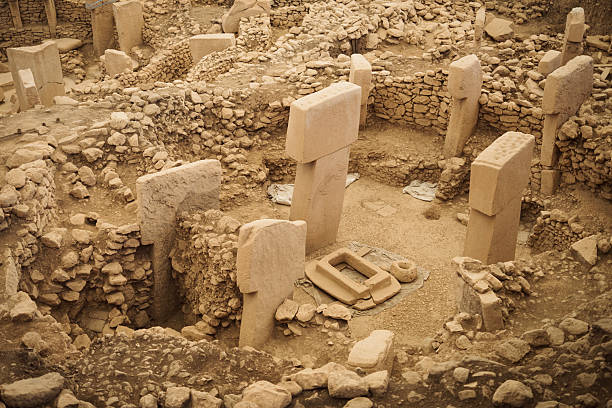
Göbekli Tepe, in southeastern present-day Turkey, has reshaped debates about the development of early complex societies. Its monumental stone structures were built by communities living roughly 11,000 years ago, during the early Neolithic period, when human groups in the region were transitioning toward new forms of settlement and subsistence.
The site contains large carved stone pillars arranged in circular or oval enclosures. Some pillars feature images of animals and abstract symbols. Their size and craftsmanship demonstrate that people could organize substantial building projects before the widespread emergence of cities and established farming economies.
For many years, explanations of monumental architecture emphasized the ability of settled agricultural societies to produce food surpluses and support specialists. Göbekli Tepe complicates that picture. Its builders belonged to a period when hunting, gathering, and early food production were central to life in the region.
This does not mean that agriculture played no role in the site’s development or that the builders lacked social organization. Rather, it suggests that communal projects, ritual activities, and cooperation may have contributed to the social conditions from which more settled communities developed.
The exact purpose of the structures remains uncertain. Their architecture and imagery support interpretations involving communal or ceremonial activities, but researchers cannot confidently reconstruct every belief or ritual associated with them. Nor is it established that the site served a single purpose throughout its history.
Göbekli Tepe also challenges the assumption that monumental architecture necessarily indicates a state, a king, or a centralized bureaucracy. Groups of people can coordinate complex activities through shared traditions, social obligations, leadership, and collective decision-making.
Its significance lies not in proving one simple theory about civilization’s origins, but in revealing that the relationship between farming, settlement, religion, and social complexity was more varied than previously assumed.
Angkor and the challenge of sustaining a vast urban landscape
The Khmer Empire of mainland Southeast Asia developed one of the region’s most influential political and cultural systems. Its major center at Angkor, in present-day Cambodia, became famous for monumental architecture, including Angkor Wat, but the surrounding settlement was far more extensive than its stone temples suggest.
Archaeological research has revealed a large urban landscape containing residential areas, reservoirs, canals, embankments, roads, and agricultural infrastructure. These features demonstrate that Angkor depended on the coordinated management of water across a broad territory.
The region experiences strong seasonal differences in rainfall. Water infrastructure helped store, transport, and manage water for domestic use and agriculture, while also supporting the broader economic and political system. Such infrastructure could provide substantial benefits, but its effectiveness depended on maintenance and changing environmental conditions.
Evidence indicates that Angkor experienced periods of climatic stress, including severe droughts and episodes of intense rainfall. These conditions may have placed pressure on parts of its water-management network. Research has also identified damage and changes within the infrastructure that could have affected how water moved through the landscape.
However, climate alone does not explain Angkor’s political transformation. Shifts in trade, warfare, religious practices, and regional power relationships also mattered. The rise of new political centers and the changing importance of maritime commerce may have reduced the prominence of the older inland capital.
The traditional picture of Angkor as a city simply swallowed by jungle is misleading. People continued living in the region, and Angkor remained important as a religious and cultural landscape. The Khmer Empire’s political center changed, but its cultural legacy persisted.
Angkor shows why archaeological research must consider an entire landscape rather than only its most impressive monuments. The temples reveal artistic and religious ambitions; canals, reservoirs, and settlement remains show the practical systems that supported urban life.
Why civilizations decline or disappear from the historical record
Although each ancient society had its own history, archaeology identifies recurring processes that can weaken complex political systems. These processes rarely operate independently, and their effects depend on the society’s geography, economy, institutions, and ability to adapt.
Environmental change can undermine familiar ways of life. Drought, flooding, shifts in river courses, changing temperatures, and soil degradation can affect food production and access to water. Communities that depend heavily on a narrow range of crops or a particular water source may be especially vulnerable. Yet environmental change does not automatically cause collapse. People can respond by changing crops, modifying infrastructure, moving settlements, or developing new economic relationships.
Political instability can weaken coordination. Governments and other institutions help organize labor, collect resources, resolve disputes, and maintain infrastructure. When political authority fragments, the systems that support large settlements may become harder to sustain. However, centralized government is not the only way to organize complex societies, and decentralization can sometimes allow communities to adapt more effectively.
Trade disruptions can spread economic difficulties. Long-distance exchange connects communities to materials, food, markets, and specialized skills. The loss of a major trading partner or route can affect producers and institutions that depend on external goods. The consequences vary: some societies decline, while others reorganize their economies or establish new connections.
Conflict can damage settlements and displace populations. Warfare may destroy buildings, disrupt farming, reduce trade, and undermine political legitimacy. Archaeological evidence of burned structures, fortifications, weapons, or injuries can help researchers investigate violence. Such evidence must be interpreted carefully because fires can have accidental causes and damaged buildings may have been rebuilt or reused.
Disease and demographic change can reshape communities. Epidemics can reduce populations and disrupt social organization, while migration can alter the distribution of people and labor. Identifying specific ancient diseases is often difficult, and researchers need appropriate biological or contextual evidence before attributing a settlement’s decline to an epidemic.
Cultural and economic changes can make old centers less important. A city may lose its political role because trade moves elsewhere, a new capital emerges, religious practices change, or communities adopt different settlement strategies. Such transitions may occur without widespread violence or a catastrophic environmental event.
These processes often interact. A drought may reduce agricultural output, intensify competition over resources, weaken political authority, and encourage migration. Political conflict may then interfere with the maintenance of irrigation systems, making environmental stress more damaging. Understanding the sequence and relative importance of these factors is one of archaeology’s most challenging tasks.
What ancient ruins reveal about everyday life
Monumental architecture attracts attention, but much of archaeology’s most informative evidence comes from ordinary objects and modest structures. The remains of kitchens, storage rooms, workshops, wells, and homes help reconstruct how people ate, worked, raised children, traded goods, and organized households.
Plant remains can reveal which crops people cultivated and how their diets changed. Charred seeds and grains sometimes survive when fires destroy buildings. Animal bones can provide evidence of livestock management, hunting, butchery, and food consumption. Microscopic plant remains, including pollen and phytoliths—tiny mineral structures formed in plant tissues—can help researchers reconstruct past vegetation and land use.
Pottery offers information about cooking, storage, trade, and craft production. Differences in clay composition can help identify where vessels were manufactured, while wear patterns and residues may reveal how containers were used. Stone tools can show how people processed food, shaped materials, and adapted to local resources.
Human remains, when available and studied ethically, can provide evidence about health, diet, physical activity, injuries, and patterns of relatedness. Skeletal changes may reflect nutritional stress or particular diseases, although many conditions leave no distinctive traces in bone. Ancient DNA can sometimes reveal biological relationships and population movements, but genetic evidence does not independently establish a person’s language, cultural identity, or political affiliation.
Archaeologists also study inequality. Differences in housing, burial practices, access to imported goods, and nutrition may indicate social distinctions. Yet wealth, status, occupation, age, and religious role can overlap, making simple interpretations unreliable.
Evidence from ordinary life often corrects assumptions based on royal monuments. A society that built magnificent temples may still have contained households with unequal access to food and resources. Conversely, a settlement without monumental architecture may have supported sophisticated exchange networks and complex community relationships.
The aim is not merely to reconstruct what ancient people built, but to understand how they lived and how their experiences differed across social groups.
How archaeologists distinguish evidence from speculation
Ancient societies invite imaginative stories because their ruins leave gaps in the historical record. Some gaps can be filled through careful research; others remain unresolved. Responsible archaeology distinguishes what the evidence demonstrates from what it merely permits researchers to consider.
A collapsed building, for example, does not establish that an earthquake destroyed a city. Researchers would look for characteristic structural damage, geological evidence, the chronology of the destruction, and signs of rebuilding or continued occupation. Likewise, a period of drought does not prove that drought caused political collapse unless the timing and other evidence support that connection.
The principle of multiple working hypotheses helps researchers avoid becoming attached to a single explanation. If a settlement was abandoned, possible explanations might include migration, economic reorganization, warfare, environmental change, or a combination of factors. Researchers compare these possibilities against the available evidence and revise their interpretations as new discoveries emerge.
Absence of evidence must also be handled carefully. The failure to find a particular kind of artifact does not necessarily mean that an activity never occurred. Buildings decay at different rates, organic materials often disappear, and archaeological surveys may overlook sites. Excavation exposes only a small portion of most ancient landscapes.
Written sources present their own problems. Surviving texts may reflect the priorities of rulers, priests, merchants, or administrators rather than the experiences of the entire population. A king’s claim to have defeated every enemy, for instance, should not be treated as a neutral account of historical events.
Archaeological interpretations are therefore provisional in the scientific sense: they remain open to revision when better evidence becomes available. This does not mean that all explanations are equally plausible. A hypothesis supported by several independent forms of evidence is stronger than one that relies on a single ambiguous object or an unsupported assumption.
The distinction between uncertainty and ignorance is important. Researchers may know that a city declined during a particular period while remaining uncertain about the precise balance of causes. They may identify a writing system without being able to decipher it. Such limits are part of the evidence, not failures to tell a compelling story.
The role of climate science, genetics, and other disciplines
Modern archaeology increasingly combines evidence from several scientific fields. This interdisciplinary approach allows researchers to investigate ancient societies at scales that would be difficult to achieve through excavation alone.
Paleoclimatology reconstructs past climates using evidence such as lake sediments, ice cores, cave deposits, tree rings, and other natural records. These archives can reveal changes in rainfall, temperature, and environmental conditions over time. When researchers compare climate records with archaeological chronologies, they can investigate whether environmental stress coincided with changes in settlement or agriculture.
Geology helps explain how landscapes evolved. Rivers migrate, coastlines shift, and sediment accumulates, sometimes burying ancient settlements or changing access to water and transport routes. A site that now appears far from a river may once have stood beside a channel that later moved elsewhere.
Bioarchaeology examines human and animal remains to investigate health, diet, activity, and social conditions. Isotope analysis can sometimes reveal aspects of diet and the geographic origins of people, depending on the isotope measured and the available environmental baseline. These results require careful interpretation because similar isotope signatures may occur in different places or dietary settings.
Ancient DNA analysis can help reconstruct population relationships and movements. It has clarified many aspects of human prehistory, but genetic ancestry is not the same as cultural identity. Languages and traditions can spread between populations without requiring large-scale replacement, and people with similar genetic ancestry can belong to different cultural communities.
Digital mapping and computer modeling also help archaeologists study settlement patterns, water systems, transport routes, and agricultural landscapes. Models can test how different assumptions might affect a system, but their results depend on the quality of the input data. A sophisticated simulation cannot compensate for an unreliable chronology or missing evidence.
The greatest advances often occur when independent methods converge. Climate records may establish a period of environmental stress, settlement data may show changes in population distribution, and archaeological deposits may reveal shifts in food production. Together, these findings can support a stronger explanation than any one line of evidence could provide.
Why some civilizations remain difficult to understand
Not every ancient society leaves the same kind of archaeological record. Preservation depends on climate, geology, construction materials, burial practices, later land use, and the passage of time.
Stone monuments can survive for millennia, while buildings made from wood, reeds, mud, or other perishable materials may disappear almost completely. In tropical environments, biological activity can rapidly destroy organic remains. In other regions, erosion, flooding, farming, construction, and looting can damage archaeological deposits.
Some ancient settlements lie beneath modern cities, where excavation is difficult or impossible in occupied areas. Others are submerged beneath lakes, rivers, or the sea because coastlines and water levels have changed. Still others remain undiscovered because dense vegetation, remote terrain, or limited research resources make investigation challenging.
Writing systems create another barrier. Even when inscriptions survive, researchers may lack a bilingual text, a sufficiently large collection of inscriptions, or knowledge of the language in which the script was used. The Indus script remains undeciphered, limiting what can be learned directly from its inscriptions.
Archaeological evidence is also shaped by research history. Many early investigations concentrated on monumental buildings, elite burials, and objects considered valuable or visually impressive. As a result, some earlier interpretations underrepresented women, children, workers, rural communities, and other groups whose lives left less conspicuous traces.
Contemporary archaeology increasingly examines these overlooked perspectives. Researchers ask whose activities are represented in the surviving evidence, which parts of a settlement remain unexcavated, and how earlier assumptions may have influenced the questions being asked.
No archaeological record is a complete account of the past. It is a surviving sample shaped by preservation, discovery, and interpretation.
What lost civilizations teach us about the present
The study of ancient societies offers more than a record of vanished cities. It helps explain how human communities respond to uncertainty, manage shared resources, organize political authority, and maintain complex systems across generations.
Ancient water-management systems demonstrate the benefits and risks of large infrastructure networks. Reservoirs, canals, and irrigation channels could support dense populations, but they also required maintenance and adaptation as environmental conditions changed. Similar principles apply to modern systems that depend on interconnected infrastructure.
Agricultural evidence shows that food security depends on more than total production. Crop diversity, storage, transport, access to land, and the distribution of resources all influence a community’s ability to withstand difficult conditions. The past also demonstrates that environmental stress does not produce identical outcomes everywhere. Institutions, social relationships, technology, and local knowledge influence how communities respond.
The archaeological record cautions against treating collapse as inevitable. Some societies reorganized their settlements, diversified their economies, or shifted political centers. Others experienced severe disruption. Even within a single civilization, neighboring communities could respond differently to similar pressures.
It also warns against simplistic comparisons between ancient and modern societies. Present-day technologies, political systems, and global connections differ substantially from those of the ancient world. Historical cases cannot predict modern outcomes with certainty, and an ancient drought should not automatically be equated with a contemporary climate crisis. The useful comparisons concern mechanisms, vulnerabilities, and adaptation rather than exact repetition.
Perhaps the most important lesson is that social change rarely fits a simple story of progress followed by disaster. Societies develop through experimentation, cooperation, competition, and adaptation. Institutions that once supported growth can become difficult to maintain under new conditions, while practices that appear modest in the archaeological record may help communities endure.
The past is not as lost as it seems
Archaeology continually changes the picture of ancient history because discoveries can reveal settlements, technologies, and social relationships that earlier researchers could not recognize. A buried neighborhood, a fragment of pottery, a group of seeds, or a newly understood inscription may transform interpretations of an entire region.
Yet the evidence also reminds us to be cautious about claims of disappearance. The abandonment of a capital does not prove that a people vanished, and the decline of a political system does not erase every tradition associated with it. Cultural continuity can persist through migration, adaptation, intermarriage, language, religion, and everyday practices.
The societies described as lost are therefore not merely vanished worlds waiting to be rediscovered. They are parts of a continuing human story, preserved unevenly in landscapes, objects, biological remains, and living cultural traditions.
By combining careful excavation with scientific dating, environmental reconstruction, and critical interpretation, archaeologists can recover much of what time has obscured. Their work reveals not only how ancient societies flourished or declined, but also how diverse human communities have repeatedly found ways to build, organize, adapt, and endure.