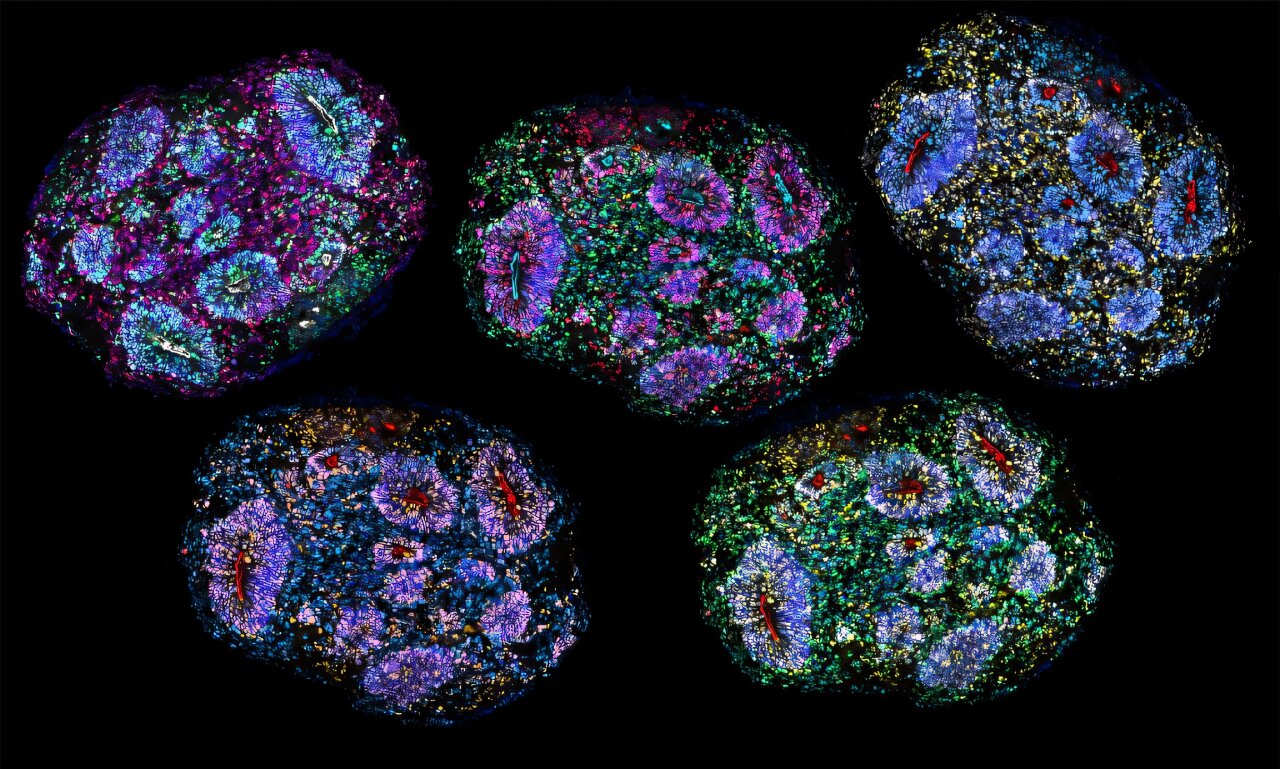
Tiny clumps of human brain cells grown in the lab for about seven years continued to mature in ways that resembled aging brain cells, suggesting that the cells retained a cellular record of their developmental history even outside a human body.
These lab-grown structures, known as brain organoids, are made from stem cells and are used as simplified models of human brain cells. Scientists use them to study how the brain develops and to investigate disorders and potential medicines.
Most brain organoids survive for only a few months. That limits how much they can tell researchers about later stages of human brain development, which takes nearly 20 years to fully unfold.
A U.S.-led research team pushed that limit much further. The researchers kept brain organoids alive for around seven years, making them the oldest brain organoids reported so far, according to Paola Arlotta, a Harvard University professor and senior author of the study.
The organoids continued to mature
The organoids changed and matured throughout the seven-year period even though they had never developed inside an embryo or a human body.
The researchers examined the aging organoids using three recently developed genetic clocks. These tools can roughly estimate the biological age of cells by tracking changes in their genetic material.
All three clocks indicated that the organoids changed over time in ways similar to normal brain cells.
The findings led the researchers to describe the organoids as having “recorded the passage of time” and retained a memory of developmental steps they had already completed.
That does not mean the organoids formed memories in the everyday sense of remembering childhood experiences or other events. Instead, Arlotta said their developmental history was effectively “engraved” at the cellular level.
The organoids remain much simpler than an actual human brain. They are biological models of human brain cells and do not receive sensory input. Scientists widely agree that brain organoids are not capable of consciousness or other higher-order brain functions.
Older cells kept their developmental history
The researchers then tested whether the cells’ developmental age could affect how they behaved when placed alongside much younger cells.
They combined cells that had been developing for about a year with cells that were only two weeks old, creating what the researchers called a “chimera.”
The younger cells behaved normally. The older cells, however, moved ahead in development and began producing neurons that normally take about four months to appear.
Arlotta described the result as effectively “warping time” for brain development.
The researchers suggested that, in the future, a similar approach could potentially be used to speed up the development of particular types of brain cells. That possibility remains an idea for future work rather than a demonstrated application of the experiment.
The organoids outlasted the previous record
The previous record for the oldest brain organoids grown in the laboratory was a little under two years, according to the study.
The researchers hope that keeping organoids alive for much longer could help scientists study how conditions such as autism and schizophrenia first emerge and later progress.
The experiment also raises a more basic question about how long these lab-grown brain structures can survive.
Unlike a human brain, an organoid does not have a body that can become sick and die. Arlotta said nobody really knows whether such organoids could eventually outlive humans, although she suspected they might hypothetically survive somewhat longer.
The organoids used in the study, however, will not provide an answer. They were recently destroyed.
The study was published in Nature.