Intermittent fasting reduced pain sensitivity and improved some measures of memory and anxiety-like behavior in mice with chronic pain, while also changing their gut bacteria and related biological signals. The findings point to a specific gut–brain pathway that may help explain how fasting produced these effects in the animals.
How the mice responded to fasting
Researchers at Zhengzhou University and its First Affiliated Hospital studied several mouse models of chronic pain, including animals experiencing pain caused by injury, inflammation, or other controlled experimental conditions.
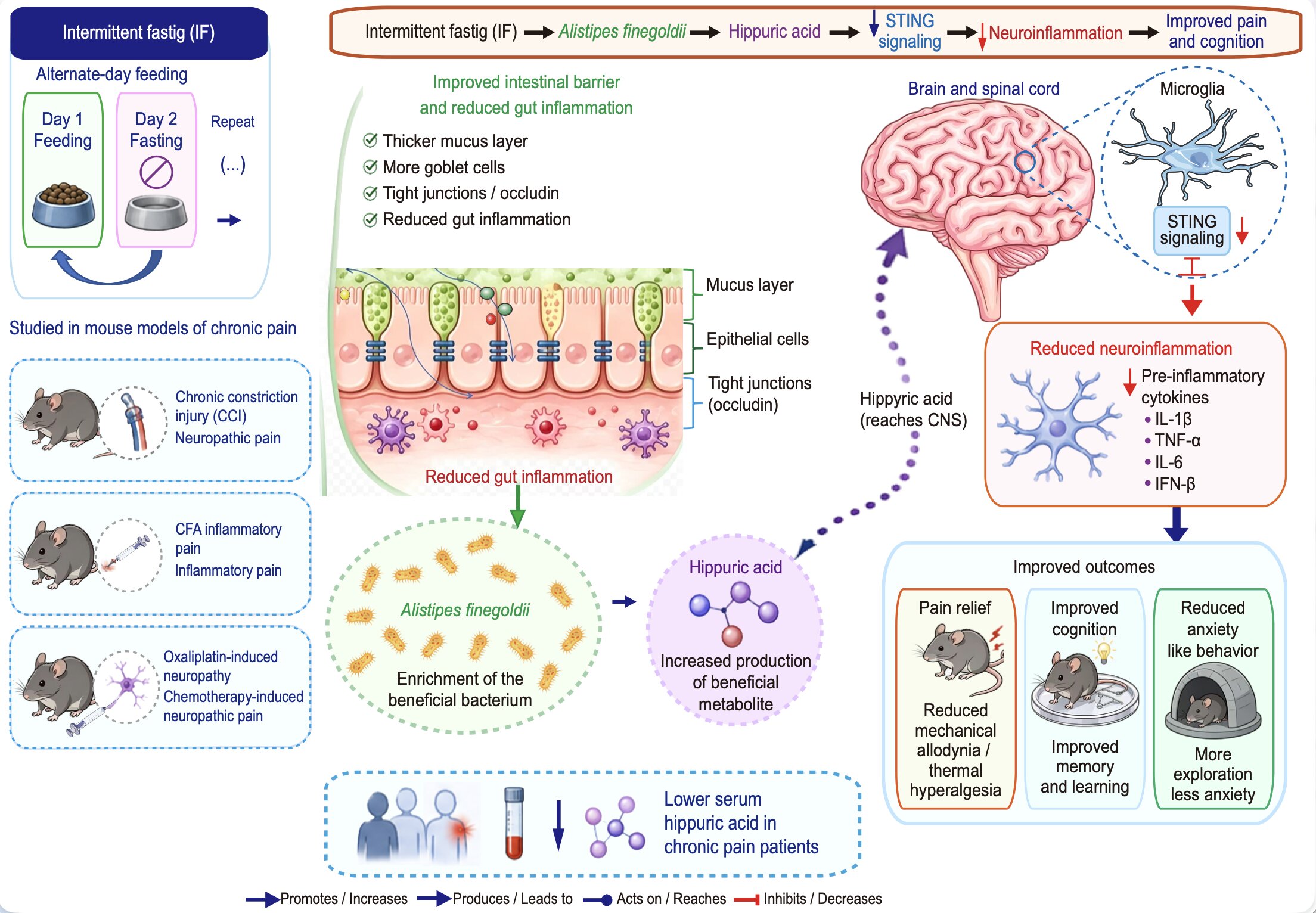
For 38 days, one group followed an alternating fasting schedule. The mice went without food for 24 hours and then had unrestricted access to food for the next 24 hours. A comparison group had unlimited access to food throughout the study.
The researchers measured several outcomes, including pain sensitivity, memory, anxiety-like behavior, the condition of the intestinal barrier, neuroinflammation, gut microbiota, and substances circulating in the blood.
The fasting mice with chronic pain became less sensitive to normally harmless touch and to heat. They also performed better on simple tasks used to assess cognitive function and showed fewer anxiety-like behaviors.
Fasting changed the gut and brain-related signals
The researchers found several biological changes alongside the behavioral effects.
Fasting appeared to strengthen the mice’s intestinal barrier and reduce neuroinflammation. It also changed the composition of the animals’ gut microbiota.
One bacterial species, Alistipes finegoldii, consistently increased in the mice following the intermittent fasting regimen.
The researchers then examined whether this bacterium might be connected to the effects of fasting rather than simply changing at the same time.
Their analysis pointed to a pathway involving Alistipes finegoldii, the metabolite hippuric acid, and STING signaling, a part of the immune system. The researchers described this as an intermittent fasting–Alistipes finegoldii–hippuric acid–STING neuroimmune pathway associated with changes in pain, cognition, and anxiety-like behavior.
Adding the bacterium reproduced some of the effects
The researchers next supplemented mice with Alistipes finegoldii. The bacterial supplementation reproduced the pain-relieving effects and cognitive improvements seen in the fasting mice.
They also used pharmacological manipulation of STING signaling to investigate whether this pathway mediated the effects observed with intermittent fasting.
Together, these experiments led the researchers to propose that the effects of fasting were linked not only to general metabolic changes but also to specific changes in gut bacteria and bacterial metabolites that influence neuroinflammation.
What the researchers want to investigate next
The findings come from mouse models, and the researchers plan further studies to examine the biological pathway in greater detail.
Their next work will investigate which specific cell types are involved in changes to STING signaling. They also plan to examine possible sex differences and whether other microbial species and metabolites contribute to the effects associated with intermittent fasting.
The researchers also intend to test the findings in larger longitudinal clinical studies to determine whether microbiota- or metabolite-based approaches could eventually be developed into safe and effective treatments for chronic pain and its associated cognitive and affective problems.
The study was published in Brain, Behavior, and Immunity.