For millions of years after the dinosaurs disappeared, two major groups of meat-eating mammals lived alongside each other in Europe. New evidence from 155 fossil species suggests that climate shifts, rather than a simple struggle for dominance, tracked the changes in body size and diversity that eventually reshaped these ancient predator communities.
Modern cats, dogs, bears and walruses belong to a larger group called Carnivoramorpha. During the Paleogene, their ancestors lived alongside other large predatory mammals that later disappeared.
Among the most important of these rivals were hyaenodonts. They became large early in the Paleogene and occupied the role of top predators in their ecosystems. Over the following tens of millions of years, hyaenodonts disappeared in stages, while carnivoramorphans expanded into many different body sizes and ecological roles.
One long-standing explanation for this change has been competition. The idea is that carnivoramorphans eventually displaced hyaenodonts because their teeth were more versatile, giving them an advantage over their rivals.
But most of the evidence behind that explanation comes from fossils found in North America.
Researchers from Belgium, France, Switzerland, Spain and the United States wanted to see whether the same pattern appeared elsewhere. They turned to Europe’s fossil record and focused on changes in body mass through the Paleogene.
Fossil teeth can reveal body size
Body mass can provide clues about the ecological role of ancient land predators. The researchers used measurements of important features in fossil teeth to estimate the body mass of extinct predators.
Their dataset included 155 fossil species and covered nearly the entire Paleogene period.
The results did not match the expected pattern of a simple competitive takeover.
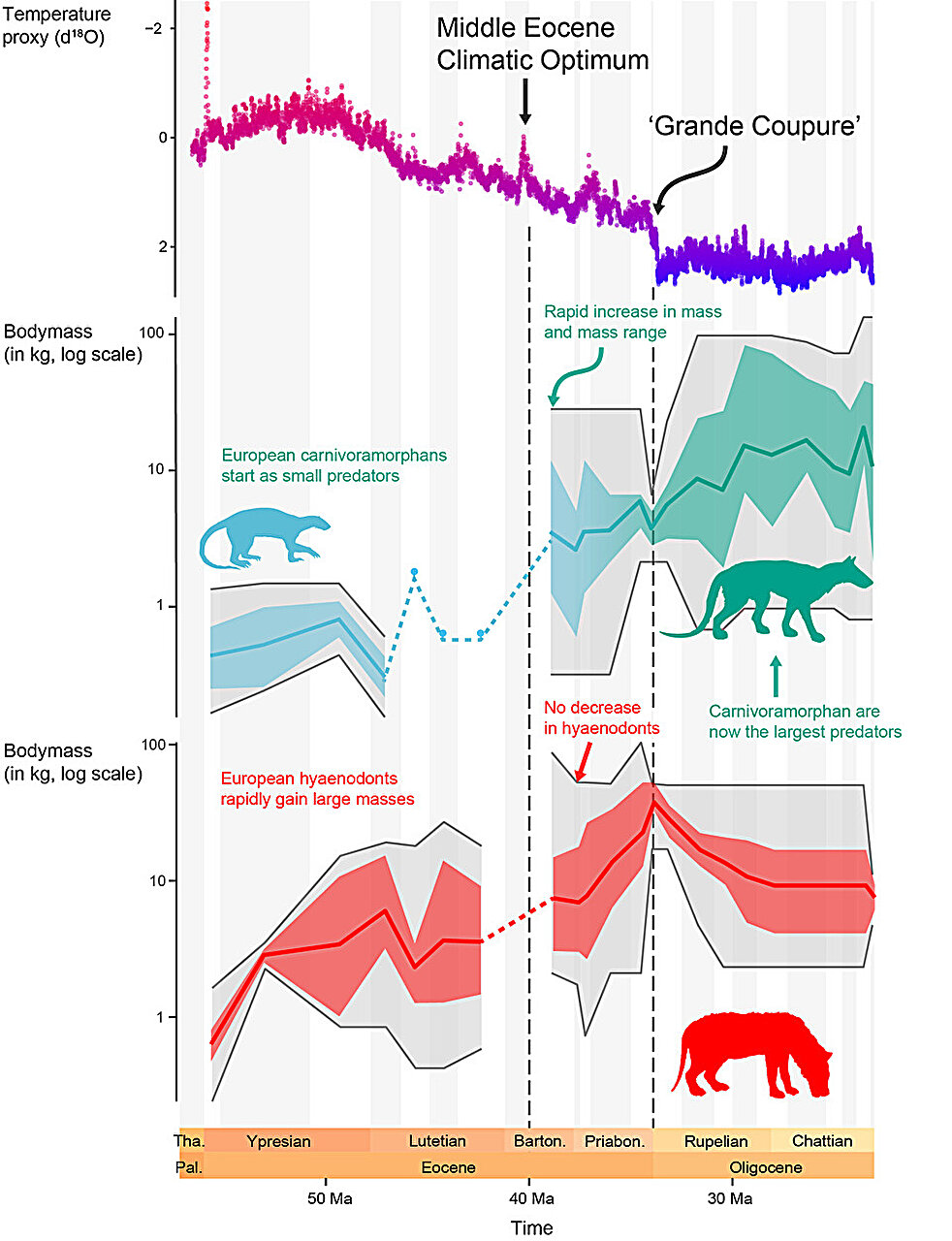
Carnivoramorphans became larger and developed a much wider range of body masses shortly after an abrupt period of global warming about 40 million years ago. This warming event is known as the Middle Eocene Climatic Optimum.
If competition alone had driven the decline of their rivals, the researchers would expect the expansion of carnivoramorphans to be associated with a decline in hyaenodont diversity. Instead, Europe’s hyaenodonts remained diverse for millions of years after the warming event.
A later cooling event changed the pattern
The major decline of European hyaenodonts came later, after a substantial cooling event about 34 million years ago known as the Grande Coupure.
This timing is important because it places the major changes in predator communities alongside major climate shifts rather than showing a consistent pattern of one predator group replacing another through competition.
The European evidence therefore differs from the pattern seen in North America.
The researchers found that carnivoramorphans and hyaenodonts coexisted for a long period. Changes in body size also followed climate events more closely than changes in diversity.
Based on these patterns, the study suggests that regional climate played a major role in determining which lineages occupied the position of top predator, rather than a universal competitive advantage allowing carnivoramorphans to replace their rivals everywhere in the same way.
The researchers also found strong differences in the timing of these changes between continents.
The carnivorous mammal lineages that eventually gave rise to today’s lions, wolves, grizzlies and raccoons were therefore shaped by climate changes that occurred deep in their evolutionary history.
The study was published in Biology Letters.