Far beyond the bright central glow of IC 1101, ghostly streams and diffuse stellar structures stretch across hundreds of thousands of light-years, refusing to form a clean, finished boundary. By pushing observations to some of the faintest levels ever achieved for this galaxy, astronomers have traced its main stellar body to an immense radius of about 260 kiloparsecs—roughly 520 kiloparsecs across—while finding that even beyond that enormous extent, the outskirts still bear the marks of an ongoing process of growth.
How large can a galaxy become?
That deceptively straightforward question has remained difficult to answer because the outermost regions of massive galaxies are extraordinarily faint. Even when a galaxy appears to end, its dim stellar envelope may continue far beyond what ordinary observations can detect. In the most massive galaxy clusters, those outer stars also blend into diffuse light spread throughout the cluster itself, making it even harder to determine where a galaxy truly ends.
IC 1101 has long stood out as an ideal object for exploring that limit.
Located at the center of the galaxy cluster Abell 2029, IC 1101 is already known as one of the most massive and extended galaxies ever observed. Earlier deep imaging established that it stretched to remarkable distances, but those observations could not determine whether the galaxy actually possessed a physical edge or whether its light simply faded indefinitely into the surrounding cluster.
The new study set out to answer that question using the deepest optical images yet obtained of IC 1101.
Looking deeper than previous observations
To expose the galaxy’s faintest structures, the team observed IC 1101 with the Wide Field Camera on the 2.5-meter Isaac Newton Telescope.
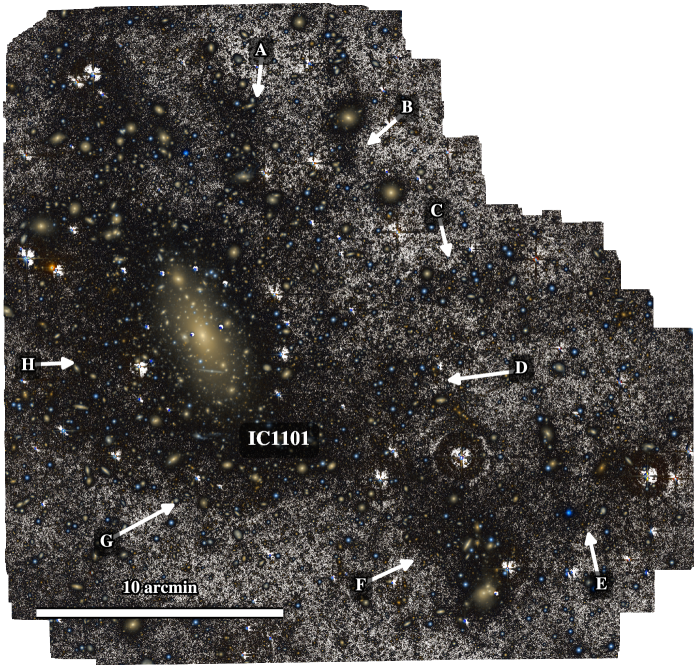
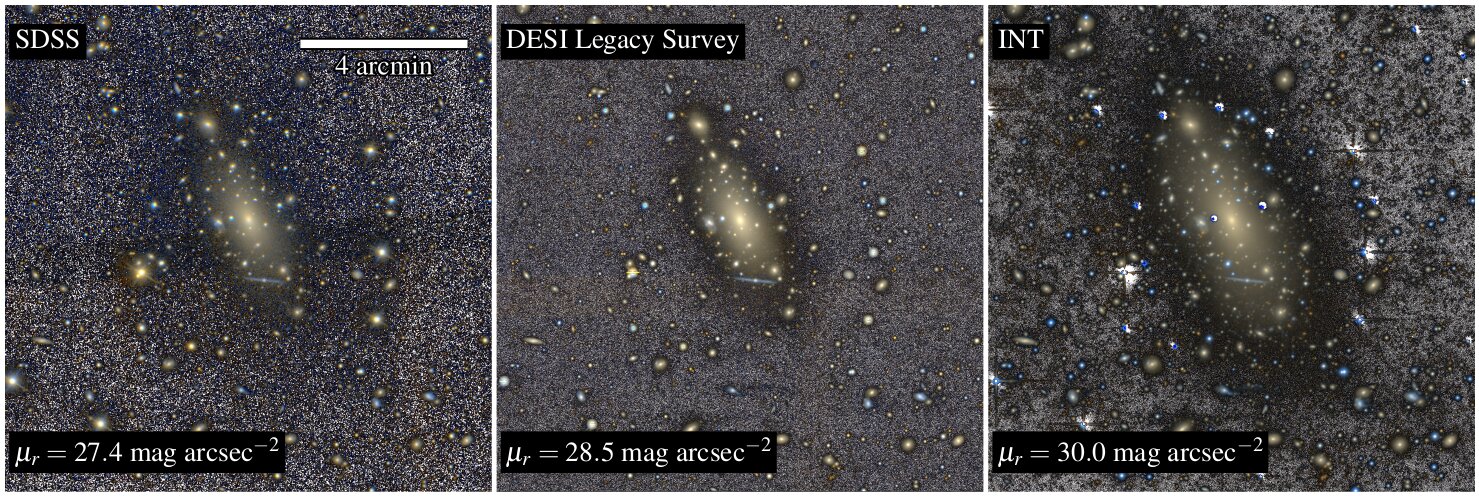
The observations combined nearly four hours of imaging in the Sloan g band and more than four hours in the r band. After processing, the images reached surface-brightness limits of about 30.5 magnitudes per square arcsecond in the g band and 30 magnitudes per square arcsecond in the r band.
The paper illustrates how much additional detail this depth revealed by comparing the new images with earlier data from the Sloan Digital Sky Survey and the DESI Legacy Imaging Surveys. Structures that were barely visible—or entirely absent—in previous datasets emerged in the new observations.
But simply taking deeper images was not enough.
Removing light that did not belong to the galaxy
The greatest obstacle was scattered light.
Bright foreground stars can produce extended halos through the telescope’s optics, spreading light across large portions of an image. The galaxy itself also contributes scattered light through the telescope’s point spread function, potentially making faint structures appear brighter or even creating misleading features.
To address this, the researchers carefully modeled the telescope’s point spread function across a wide range of brightness levels, combining observations of many stars and supplementing them with an especially bright calibration star to characterize the faintest outer wings.
They then modeled and subtracted the scattered light from 250 foreground stars in both observed filters.
Afterward, they applied a wavelet-based technique designed to reduce scattered light from IC 1101 itself and neighboring galaxies while minimizing damage to genuine low-surface-brightness structures.
Only after those corrections did the faint outer regions become suitable for detailed analysis.
A distinct transition appears hundreds of thousands of light-years from the center
Rather than looking only at brightness, the researchers examined several properties simultaneously as they moved outward from the galaxy’s center.
They measured surface brightness, color, stellar mass surface density, ellipticity, and position angle.
One modest transition appeared at roughly 146 kiloparsecs from the center. At that distance, changes in the galaxy’s shape and color profile suggested what the authors interpret as an internal structural transition rather than the galaxy’s outer boundary.
A much stronger change emerged farther out.
At approximately 260 kiloparsecs, several independent measurements shifted together. The galaxy became rounder, its orientation changed, its color profile varied, and both the surface-brightness and stellar-mass-density profiles changed slope.
Because all of these changes occurred together, the authors interpret this radius as the boundary of the main stellar body of IC 1101.
Instead of ending abruptly, the galaxy transitions into a more diffuse outer envelope, matching expectations for massive elliptical galaxies whose outskirts have grown through repeated mergers and accretion over cosmic time.
Using this definition, the study places the galaxy’s edge at approximately 260 ± 38 kiloparsecs from the center, corresponding to a diameter of roughly 520 kiloparsecs.
The stellar mass enclosed within that boundary is estimated at about 3.36 × 10¹² solar masses.
The galaxy does not simply stop there
Although the main body appears to end near 260 kiloparsecs, the observations reveal that stellar material continues much farther outward.
The wedge-shaped profiles aligned with the galaxy’s major axis identified another transition around 475 kiloparsecs.
At this distance, the orderly elliptical appearance seen closer to the center begins dissolving into a more irregular, diffuse structure.
The authors interpret this region not as the edge of the galaxy alone but as part of an extended system that combines the brightest cluster galaxy with intracluster light—the diffuse population of stars spread throughout the surrounding galaxy cluster.
Farther still, around 620 kiloparsecs, the coherent low-surface-brightness emission largely disappears.
Beyond that distance, the measurements become increasingly irregular and dominated by low signal-to-noise fluctuations.
The researchers interpret this outermost boundary as marking the transition between material that has already been incorporated into the central system and material that has not yet become fully mixed into it.
Maps reveal the same story in two dimensions
The team’s two-dimensional maps reinforce what the radial measurements suggested.
Inside the adopted edge radius, IC 1101 maintains a relatively regular elliptical appearance.
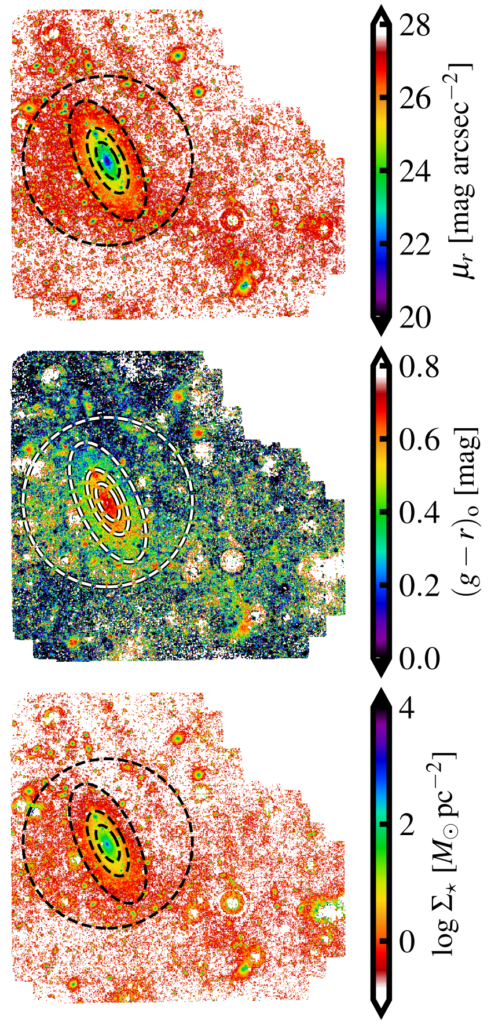
Beyond that point, the stellar distribution becomes progressively more diffuse and asymmetric.
Maps of stellar mass density show a broader, flatter outer distribution, while color maps reveal spatial variations occurring over the same general radial range identified by the profile analysis.
Together, these independent measurements support the interpretation that the galaxy’s outer regions are structurally different from its main stellar body.
The largest known galaxy still appears to be assembling
One of the study’s most striking results is not simply IC 1101’s enormous size but the condition of its outskirts.
The newly revealed low-surface-brightness features include elongated filaments, diffuse overdensities, asymmetric stellar envelopes, and other irregular structures surrounding the galaxy.
These features are not distributed randomly.
The authors note that their locations are spatially consistent with large-scale disturbances previously observed in the hot gas of the Abell 2029 cluster through X-ray observations.
Earlier X-ray studies identified extensive spiral-like residual structures that have been interpreted as the aftermath of an off-axis merger involving a smaller cluster or group several billion years ago.
The optical structures uncovered in the new images occupy comparable regions, although the paper emphasizes that a strict one-to-one correspondence is not expected.
Instead, the similar large-scale morphology suggests that the diffuse stars and the disturbed hot gas may represent different components responding to the same cluster-scale dynamical history.
The researchers also examined whether the newly detected faint structures could instead be foreground Galactic cirrus—diffuse dust within the Milky Way.
Based on the observed colors of the features and their lack of correspondence with Galactic extinction maps, the study concludes that a Galactic-cirrus origin is not supported.
Measuring just how exceptional IC 1101 is
The researchers compared IC 1101 with established galaxy size relations using several different measures.
The effective radius of the galaxy was measured as 73 ± 2 kiloparsecs.
Another commonly used size indicator, known as R1—defined where stellar mass surface density falls to one solar mass per square parsec—was measured at 362 ± 38 kiloparsecs.
Regardless of which size measurement was used, IC 1101 consistently occupied the extreme upper end of the mass-size relations examined in the study.
Using the same stellar-mass definition adopted in earlier comparison studies, the researchers estimated a total stellar mass of approximately 4.2 × 10¹² solar masses within the radius where the g-band surface brightness reaches 29 magnitudes per square arcsecond.
The enclosed stellar mass also increases steadily with radius, from about 2.66 × 10¹² solar masses within the inner transition near 146 kiloparsecs to approximately 3.69 × 10¹² solar masses within R1, reaching roughly 3.91 × 10¹² solar masses within 475 kiloparsecs and about 4.2 × 10¹² solar masses within 620 kiloparsecs, where diffuse intracluster light contributes increasingly to the total.
A remarkably large galaxy with no sign of being finished
The study argues that IC 1101 now represents the largest known galaxy based on its measured edge radius, corresponding to a projected diameter of about 520 kiloparsecs.
Yet the observations also point to an important distinction between measuring a galaxy’s present size and concluding that its growth has ended.
Beyond the main stellar body, the newly uncovered diffuse structures indicate that material continues to accumulate in the galaxy’s outer regions. The combination of faint stellar features and their consistency with large-scale disturbances already known in the surrounding galaxy cluster suggests that IC 1101 remains embedded in an environment where mass assembly is still underway.
Rather than presenting a neatly bounded giant, the deepest images of IC 1101 instead portray an enormous galaxy whose visible limits can finally be measured even as its outskirts continue evolving.
Publication details
Carlos Marrero-de la Rosa et al, How large can galaxies be? Ultra-deep imaging of IC 1101, the most extended known galaxy, arXiv (2026). DOI: 10.48550/arxiv.2607.15340