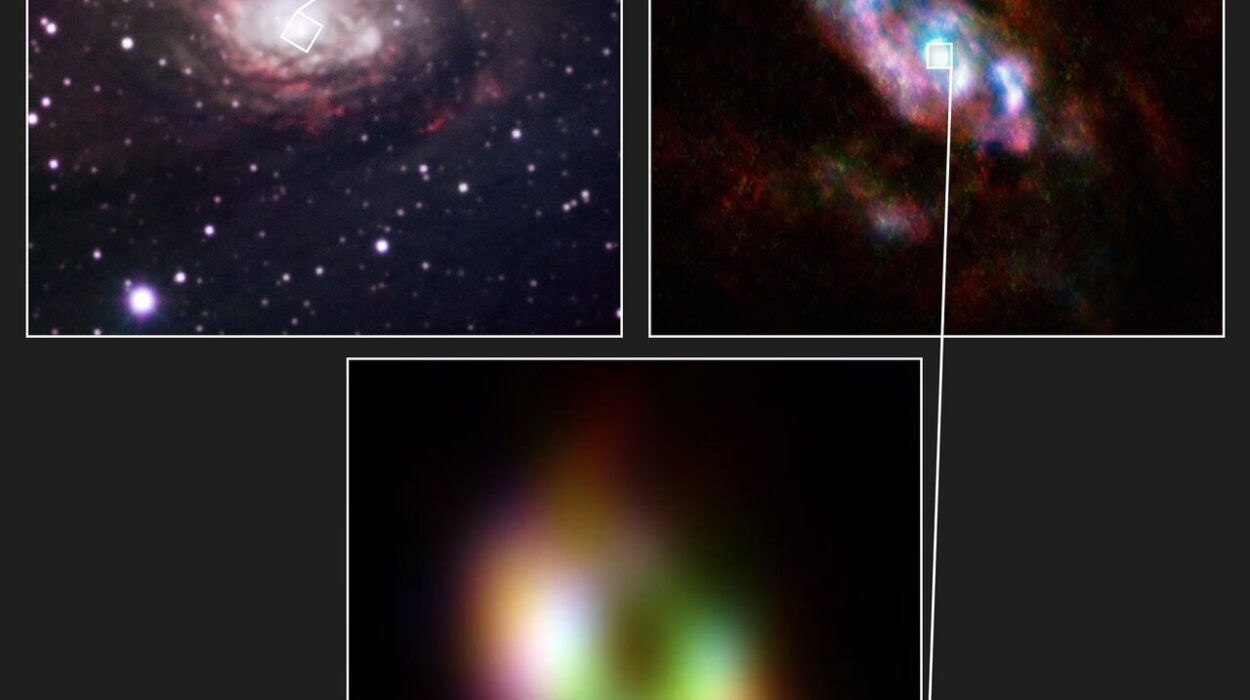
Astronomers have taken an exceptionally deep look at Cloud-9, a candidate “dark galaxy” near the spiral galaxy M94, and found no evidence of stars. The observations limit the amount of stars in its central region to just 16,000 solar masses, compared with about 1 million solar masses of hydrogen gas.
Cloud-9 lies about 4.66 megaparsecs, or roughly 15 million light-years, away. Earlier surveys found a gas cloud containing an estimated 1 million solar masses of hydrogen but no obvious stars. Those observations, however, could not completely exclude the possibility of an extremely faint stellar population.
That distinction matters because Cloud-9 could fit a prediction of the widely accepted Lambda Cold Dark Matter model of the universe. The model predicts many small dark matter clumps containing gas that never becomes dense enough to form stars.
In these small halos, gravity pulls gas inward while gas cooling and heating from the ultraviolet background can work against the collapse needed for star formation. A system that contains gas and dark matter but has failed to produce stars would therefore be consistent with that prediction.
But a gas cloud without stars can have other explanations. Possible alternatives include tidal debris, high-velocity clouds and temporary gaseous structures. Some of those objects could contain very faint stars, making sufficiently deep imaging necessary to distinguish between them.
The deepest look yet
A team led by Ignacio Trujillo of the Institute of Astrophysics of the Canary Islands used HiPERCAM, a high-speed camera mounted on the Gran Telescopio Canarias, to search Cloud-9 for faint starlight.
The researchers observed the cloud over two nights in June 2026. HiPERCAM recorded the object simultaneously through five filters.
The team also used an observing and image-processing strategy designed to preserve very faint, spread-out light. The telescope pointing was shifted systematically between exposures, and the region around Cloud-9 was masked before the background was subtracted. This was intended to prevent genuine stellar emission from being removed along with the background.
The resulting observations reached a limiting surface brightness of 31.4 magnitudes per square arcsecond in the g-band, allowing the team to search for stellar populations too faint for previous surveys.
They found no starlight across the central region of Cloud-9.
Very little room for stars
The non-detection puts an upper limit of 16,000 solar masses on the amount of stars in a region about 4,200 light-years across.
That limit is much smaller than the roughly 1 million solar masses of hydrogen gas estimated to be present in Cloud-9. In other words, even if stars are present within that region, the observations allow for at least 60 times more gas than stars.
The result does not by itself establish that Cloud-9 contains absolutely no stars. Instead, it places a stringent limit on how much stellar material could be there and strengthens the case that the object is genuinely starless.
The researchers describe Cloud-9 as an “excellent candidate for a starless galaxy.”
Earlier searches left the question open
The new result falls between two earlier estimates. One previous survey produced a less restrictive limit because its observations were not designed to preserve very faint, diffuse light. A deeper estimate based on star counts from the Hubble Space Telescope depended heavily on a comparison galaxy that may have been too compact.
The new observations provide an independent test and strengthen the earlier evidence that Cloud-9 could be a rare system dominated by gas and dark matter that has not formed stars.
The study was posted on the arXiv preprint server.