The interstellar comet 3I/ATLAS appears to have formed in conditions colder than -240°C (-400°F), far from the star of the planetary system where it originated. The finding comes from measurements of gases released as the object traveled away from the Sun, giving astronomers new evidence about the environment in which this rare visitor formed.
3I/ATLAS is only the third known object observed to have come from beyond our solar system. It was discovered in July 2025 as it passed the Sun and headed back into deep space.
Because the object formed around another star, its material offers an opportunity to study a comet from a different planetary system. Dr. Lea Ferellec, a research fellow at Northumbria University’s School of Engineering, Physics and Mathematics, led a study that examined the gases flowing away from 3I/ATLAS.
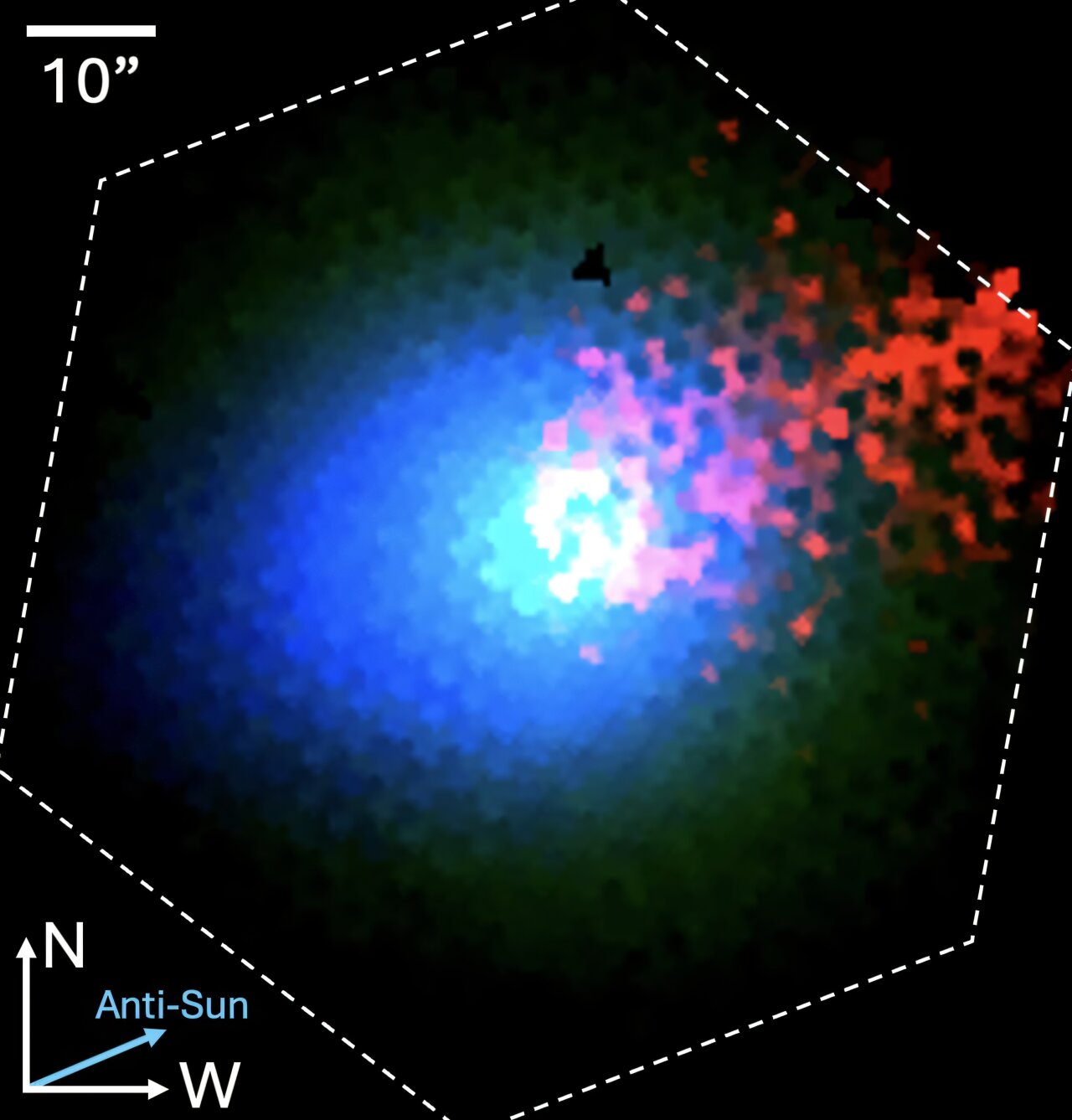
The observations were made with the Large Integral Field Unit, or LIFU, on the WEAVE instrument at the 4.2-meter William Herschel Telescope. By combining LIFU’s imaging spectroscopy with the telescope’s non-sidereal guiding system, the researchers detected five different ions in the comet’s stream at the same time.
The team then compared the amount of dinitrogen gas with carbon monoxide in the material coming from the comet. That ratio pointed to a formation environment that was extremely cold, likely below -240°C (-400°F).
The researchers interpret the result as evidence that 3I/ATLAS formed far from its home star, in the outer, icy region of the system where it originated.
The tail also changes with distance
The observations provided more than a chemical measurement of where the comet may have formed. The researchers also tracked how the ions changed at different distances along 3I/ATLAS’s tail.
A comet’s tail forms as plasma streaming from the Sun sweeps charged particles from the object behind it. The team was able to examine changes along that tail in a level of detail not previously captured for an interstellar object of this kind.
Researchers from the University of Edinburgh were also involved in the work.
Ferellec said the object’s nitrogen-rich material points to formation in extremely cold conditions far from its home star. She described 3I/ATLAS as an opportunity to examine material formed somewhere different from our solar system and to learn more about how planets form around other stars.
The observations were made possible with WEAVE-LIFU, a large-format instrument designed to collect sensitive data in the blue optical part of the spectrum. The researchers said its capabilities are opening new opportunities for studying comets and other solar system objects.
The study was published in Monthly Notices of the Royal Astronomical Society.