Gas around a faint object outside the main disk of the dwarf galaxy UGCA 320 is moving in a pattern that fits a predicted way for a wandering black hole to gather fuel. The object, estimated to contain about 35,000 solar masses, is surrounded by a low-density upstream flow, a much denser downstream wake and inner absorbing gas that changes the appearance of its broad emission lines over just a few years. Taken together, the observations provide evidence that an intermediate-mass black hole can accrete gas through the gravitational wake it creates while moving through its host galaxy.
UGCA 320, also known as DDO 161, is a nearby edge-on dwarf irregular galaxy at a distance of Mpc. It has a stellar mass of and an H I mass of . The galaxy forms a pair with the nearby dwarf UGCA 319 and has a faint optical distortion toward its companion. H I observations have also revealed a galaxy-scale outflow along the galaxy’s minor axis.
The black-hole candidate, designated UGCA320-IMBH, is not in the galaxy’s center. Its position is outside the main star-forming disk, where contamination from emission in the host is relatively limited. Its spectroscopic redshift is consistent with that of UGCA 320, establishing an association with the galaxy.
The first major clue came from observations with the Multi Unit Spectroscopic Explorer, or MUSE, on the Very Large Telescope in 2021. The spectrum contains broad Balmer emission, a characteristic associated with gas moving rapidly around an accreting massive black hole. The broad H-alpha line has a full width at half maximum of km/s. Under the black-hole interpretation, that corresponds to a mass of .
Other observations make a normal stellar source difficult to explain.
The peak of the broad H-alpha emission is spatially coincident with an unresolved continuum source in an HST ACS F814W image. Its compact appearance argues against a Balmer-dominated supernova remnant. The source also has a relatively low [S II]/H-alpha ratio compared with the host galaxy, which is inconsistent with a shock-dominated supernova remnant. Its emission-line ratios place it in the star-forming region of BPT diagnostic diagrams rather than the usual AGN regions, but the authors note that the unusually low ratios can result from low ionization, low metallicity and attenuation of ultraviolet photons.
The object also varies in brightness. Optical monitoring over about 14 years shows stochastic variability. After a brighter period more than a decade ago, it faded to a minimum around 2019 and then gradually brightened. The observed variability amplitude is about 0.15 magnitude, and Gaia Data Release 3 independently identified the source as variable.
Its ultraviolet-to-optical spectrum adds another piece of evidence. The observed spectral energy distribution can be described by an AGN-like power-law continuum affected by optically thick gas and modest dust extinction. Stellar-atmosphere models cannot reproduce the ultraviolet and optical continua simultaneously. The inferred bolometric luminosity exceeds the empirical upper luminosity limit of known massive Milky Way stars, even when the source is modeled as a binary system. The spectrum also lacks a detectable 4,000-angstrom break expected from stellar atmospheres and contains high-order Balmer absorption lines with nearly identical equivalent widths, indicating saturated absorption that the authors argue cannot be produced by a stellar atmosphere.
Three kinds of gas surround the object
The unusual part of the discovery comes from spectroscopy that resolves the motions and physical conditions of gas around the black hole.
A wandering black hole has a different problem from one sitting at the center of a galaxy. Central black holes can be supplied through several processes that bring gas toward the galactic nucleus. An off-nuclear black hole does not have the same access to those fuel sources.
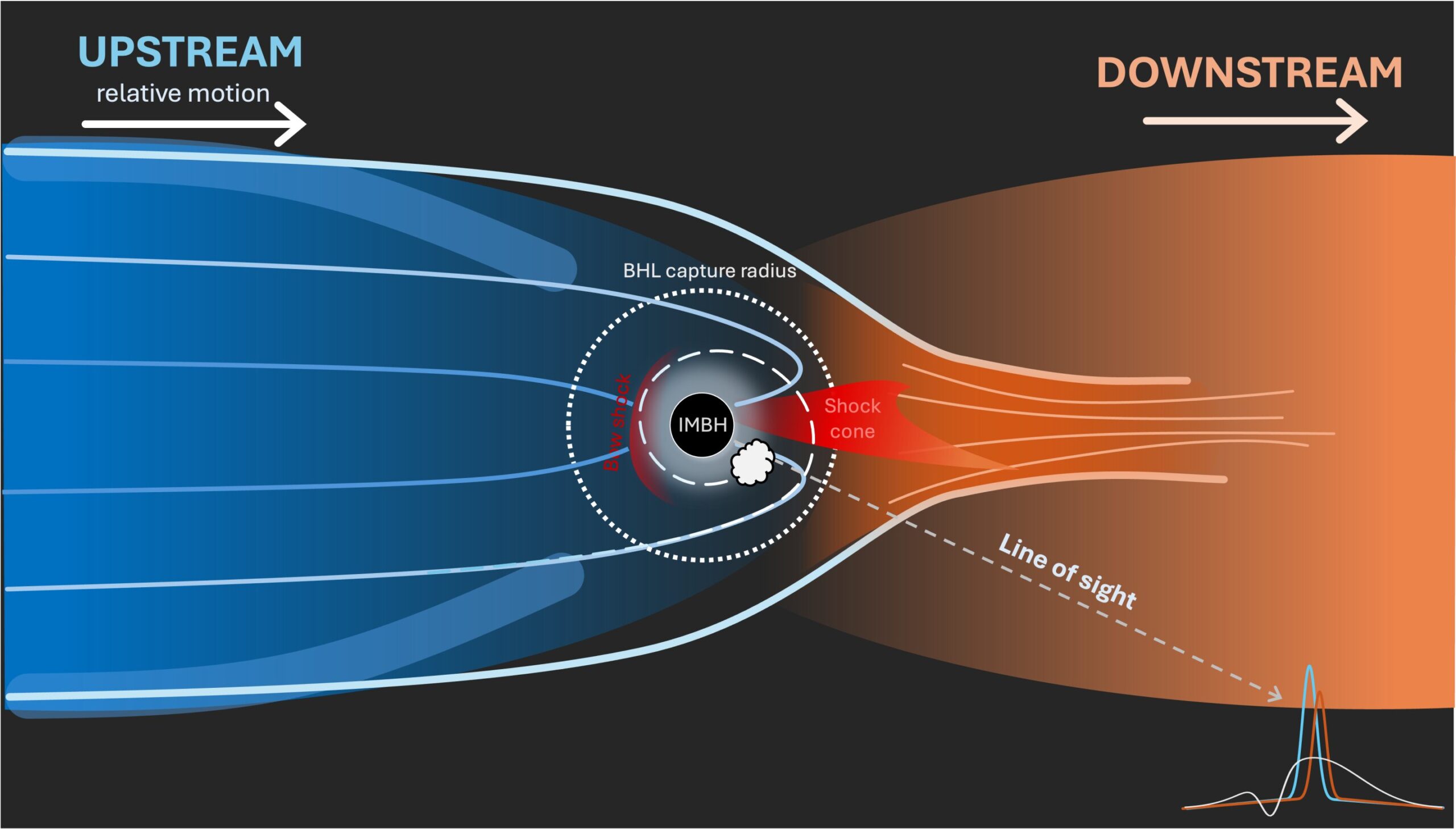
One proposed alternative is Bondi-Hoyle-Lyttleton accretion. As a massive object moves through interstellar gas, its gravity can focus gas toward its path. In the predicted configuration, relatively low-density gas lies upstream, a compressed and denser wake develops downstream, and gas captured from that wake forms an inner accretion flow.
The observations reveal the three components expected in that picture.
The first is a relatively diffuse upstream component. In the X-shooter spectrum, forbidden [O III] and [S II] emission lines are blueshifted by 27 km/s relative to the local systemic velocity. The [S II] doublet gives an electron density of about , consistent with typical interstellar-medium conditions. The researchers interpret this blueshifted component as low-density gas flowing toward the black hole from upstream.
The second component is moving in the opposite direction. Narrow emission lines at a redshifted velocity of 27 km/s include permitted Fe II and Ca II transitions. These lines indicate partially ionized gas. The exact density is difficult to constrain, but the coexistence of strong Fe II and Ca II emission requires a density orders of magnitude above that of the ambient interstellar medium, likely exceeding . The researchers interpret this dense, redshifted component as the gravitationally focused downstream wake.
MUSE observations provide a broader view of the same kinematic structure. Despite a spatial resolution of about 28 pc, the data show a velocity gradient in [O III] emission around the object, indicating blueshifted and redshifted gas components. The higher-resolution X-shooter spectrum then reveals the different components in greater detail.
Dense gas periodically blocks the inner source
The third component appears in absorption rather than emission.
The X-shooter spectrum contains absorption from the Balmer series, extending from H-alpha toward the Balmer break, as well as Fe I, Fe II and Ca II. These absorption features share a blueshift of about 50 km/s. Reproducing the Balmer break and Balmer equivalent widths requires a hydrogen column density exceeding .
A deep Chandra observation obtained close to the X-shooter observations detected no significant X-ray signal. The X-ray nondetection independently implies a hydrogen column density of at least .
The absorbing material appears to change the source’s observed behavior on a remarkably short timescale. Broad H-alpha and H-beta were prominent in April 2021. They had nearly disappeared by April and June 2025, partially returned in July 2025 and faded again by April 2026.
The researchers use the approximately 50 km/s line-of-sight velocity of the absorbing material to place an order-of-magnitude constraint on its location. If that velocity is comparable to the absorber’s orbital velocity, the corresponding Keplerian radius for a black hole is about 0.06 pc. The authors stress that the radius would be smaller if the absorber has a substantial velocity component perpendicular to the line of sight.
That estimated location is inside the approximately 0.3-pc BHL capture radius adopted in the study, assuming a sound speed of 10 km/s and a black-hole relative velocity of 30 km/s. The researchers therefore interpret the absorbing clumps as part of the accretion flow toward the black hole. The rapid changes in the broad-line emission also favor an absorber located close to the central source.
The absorber is extremely dense
The researchers used the photoionization code CLOUDY to model the absorbing gas. With complete coverage of the continuum source, the observed Balmer break and H-gamma absorption are consistent with a hydrogen density of roughly to and a hydrogen column density of about .
But the authors do not treat those values as final measurements. Both the spectral energy distribution and the presence of Balmer emission indicate that the absorber only partially covers the emitting region. For the same observed absorption, partial coverage requires stronger intrinsic absorption and therefore larger values of both density and column density. The complete-coverage results are consequently regarded as conservative lower limits. The modeling also does not include internal dust extinction, and emission components can contaminate the H-gamma absorption measurement.
The observations were assembled over several years. MUSE data were obtained in April 2021, followed by WiFeS observations in 2025 and 2026 and X-shooter observations in July 2025. The study also uses HST imaging and photometry from several ultraviolet and optical facilities, along with Chandra X-ray observations.
The multi-epoch spectra show that the broad-line source, the blueshifted low-density gas, the redshifted dense gas and the rapidly changing absorber can be observed together in the same system. In the authors’ interpretation, they correspond to different parts of the flow expected when a wandering intermediate-mass black hole gravitationally focuses surrounding gas into a wake.
The authors conclude that UGCA320-IMBH provides observational evidence that wandering intermediate-mass black holes can actively accrete through gravitational wakes. They propose that this mobile accretion channel may contribute to the growth of intermediate-mass black holes while they remain away from galactic centers.
The study was posted on the arXiv preprint server.