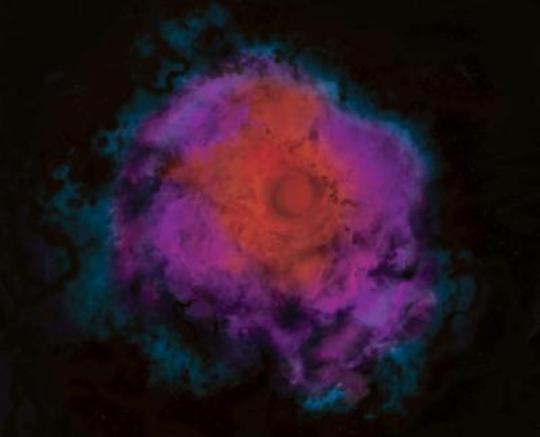
The universe began in fire.
Nearly 13.8 billion years ago, in a hot, dense state we call the Big Bang, space itself expanded, matter condensed, stars ignited, galaxies formed, and over vast stretches of time, consciousness arose to contemplate the cosmos. The atoms in your body were forged in ancient stars. The light in your eyes was born in nuclear furnaces. The story of the universe is not separate from you—you are one of its chapters.
But every story has an ending.
Physics does not merely tell us how the universe began or how it evolves. It also dares to ask the ultimate question: how will it end? Will it fade quietly into darkness? Tear itself apart? Collapse in a cosmic inferno? Or vanish in a quantum tremor beyond imagination?
Modern cosmology, built upon the foundations laid by Albert Einstein and expanded through quantum theory and astronomical observation, offers several scientifically grounded possibilities. None are certain. All are awe-inspiring.
Here are nine ways the universe might actually end—according to physics.
1. Heat Death: The Long, Slow Fade into Darkness
The most widely accepted scenario for the universe’s fate is known as heat death, sometimes called the Big Freeze.
To understand it, we must turn to thermodynamics—the physics of heat and energy. The second law of thermodynamics states that entropy, a measure of disorder, tends to increase over time in a closed system. The universe, on the largest scale we can observe, appears to behave like such a system.
Today, the universe is expanding at an accelerating rate due to dark energy. Galaxies are drifting farther apart. Over trillions of years, star formation will cease. Existing stars will burn out, becoming white dwarfs, neutron stars, or black holes.
Eventually, even black holes may evaporate via Hawking radiation, a quantum process first described by Stephen Hawking. This evaporation takes unimaginably long times—far beyond the current age of the universe—but it is finite.
As expansion continues, galaxies beyond our local group will recede beyond the cosmic horizon. The night sky will grow emptier. Cosmic microwave background radiation will redshift to near undetectability.
In the far future, the universe becomes cold, dark, and dilute. Matter decays. Energy spreads evenly across space. No temperature differences remain to drive processes. No stars shine. No structure evolves.
It is not an explosion or a collapse. It is exhaustion.
Heat death is the triumph of entropy—the quiet settling of all things into equilibrium. It is the universe whispering itself into stillness.
2. The Big Rip: When Space Tears Itself Apart
What if dark energy is not constant?
Observations show that the expansion of the universe is accelerating. If this acceleration is driven by a cosmological constant—a steady energy density of empty space—then expansion will continue smoothly. But if dark energy grows stronger over time, something far more violent could occur.
This scenario is called the Big Rip.
If the energy driving cosmic acceleration increases without bound, it could eventually overwhelm all other forces. First, galaxies would be torn apart. Then star systems would be ripped from their gravitational bonds. Planets would be flung into isolation. Eventually, the very fabric of atoms would be pulled apart.
In the final moments, even atomic nuclei could be shredded.
The timeline depends on the precise properties of dark energy, which remain uncertain. Current measurements are consistent with a cosmological constant, but they do not rule out more exotic possibilities such as “phantom energy,” where the equation of state parameter is less than minus one.
In a Big Rip universe, space does not merely expand—it accelerates toward destruction. Distances grow faster and faster, until structure itself cannot survive.
It would be a dramatic ending: the universe unbinding itself at every scale, leaving no remnant but a runaway expansion into emptiness.
3. The Big Crunch: A Cosmic Reversal
Before the discovery of accelerated expansion, many cosmologists believed the universe might eventually stop expanding and reverse course.
In the Big Crunch scenario, gravity eventually overcomes expansion. The outward motion slows, halts, and turns inward. Galaxies move toward one another. The cosmos contracts. Temperatures rise as matter compresses.
In the final stages, the universe collapses into a dense, hot state—possibly resembling the conditions at the Big Bang.
This possibility depends on the total density of matter and energy in the universe. If density were high enough, gravity would dominate. However, current measurements indicate that dark energy is causing accelerated expansion, making a Big Crunch unlikely under present models.
Yet if dark energy were to change behavior in the distant future—perhaps decaying or reversing sign—collapse could become possible again.
A Big Crunch would be a cosmic mirror image of the beginning: a return to fire and compression. Whether it would lead to a new expansion—a bounce into another universe—remains speculative.
Still, the idea lingers. The universe that began in heat could end in heat once more.
4. The Big Bounce: An Eternal Cycle
What if the universe does not end, but transforms?
The Big Bounce hypothesis proposes that the Big Bang was not the absolute beginning. Instead, it may have been the result of a previous universe collapsing in a Big Crunch.
In this scenario, cosmic contraction reaches extreme densities, but quantum gravitational effects prevent a true singularity. Instead of infinite compression, spacetime rebounds, launching a new expansion phase.
Some versions of loop quantum gravity suggest such a bounce is mathematically possible. In these models, spacetime has a discrete structure at the smallest scales, which can halt collapse and trigger expansion.
If correct, the universe may be cyclic: expansion followed by contraction, endlessly repeating.
Each cycle could erase much of the previous universe’s structure, but perhaps subtle imprints remain. Physicists search for hints in cosmic microwave background radiation—tiny anomalies that might reflect pre-Big Bang physics.
The Big Bounce is not yet supported by definitive evidence. But it offers a profound possibility: that endings are not final, but transitional.
In such a universe, death becomes rebirth on a cosmic scale.
5. Vacuum Decay: A Quantum Catastrophe
This scenario is among the most unsettling.
Quantum field theory describes our universe as existing in a vacuum state—the lowest-energy configuration of fields. But what if our vacuum is not truly stable? What if it is only metastable, like a ball resting in a shallow valley that could roll into a deeper one?
If so, a quantum fluctuation could trigger vacuum decay.
In this event, a bubble of “true vacuum” would form somewhere in spacetime. This bubble would expand at nearly the speed of light. Inside it, the laws of physics could differ—fundamental constants might change, atomic structures might become impossible, matter might disintegrate.
The bubble would engulf everything, rewriting reality.
We would not see it coming. The bubble’s boundary would move at light speed, meaning no warning could arrive before destruction.
Current measurements of the Higgs boson mass suggest that our vacuum might indeed be metastable, though uncertainties remain. The stability depends on precise values of particle masses and interactions.
Vacuum decay does not require cosmic timescales. It could occur tomorrow—or trillions of years from now—or never.
It is a reminder that even the emptiness of space may not be eternal.
6. Proton Decay and the Dissolution of Matter
Many grand unified theories in particle physics predict that protons—the building blocks of atomic nuclei—are not absolutely stable. They may eventually decay into lighter particles over extremely long timescales.
Experiments have searched for proton decay but have not yet observed it. Current lower limits on proton lifetime exceed 10^34 years.
If protons do decay, then over vast periods, all ordinary matter would gradually disintegrate. Stars, planets, and even black holes (after evaporation) would leave behind only radiation and elementary particles.
Combined with cosmic expansion, proton decay would accelerate the approach to heat death.
This scenario does not involve dramatic explosions or cosmic tearing. It is subtler: the quiet disassembly of matter itself.
The atoms that once formed galaxies would dissolve into fundamental particles drifting through an ever-expanding void.
Matter, once structured into worlds and minds, would become memory.
7. Black Hole Dominance and the Black Hole Era
Even without proton decay, the universe may pass through a prolonged Black Hole Era.
After trillions of years, star formation will end. White dwarfs cool. Neutron stars merge or decay. Black holes become the dominant massive objects in the cosmos.
Galaxies may disintegrate through gravitational interactions, with black holes either merging or being ejected.
For unimaginably long periods—far longer than the current age of the universe—black holes will remain as the last structured remnants.
Yet even they are not eternal.
Through Hawking radiation, black holes slowly lose mass. The larger the black hole, the slower the evaporation. Supermassive black holes may take up to 10^100 years or more to vanish.
In the final moments of evaporation, black holes release a burst of radiation.
The Black Hole Era would end not with a bang, but with the final whisper of evaporating singularities.
After that, only dilute radiation remains.
8. A Cosmological Phase Transition
Just as water can freeze or boil when temperature changes, the universe might undergo a large-scale phase transition.
If dark energy is associated with a dynamic field rather than a simple cosmological constant, that field could evolve. A shift in its configuration might alter the expansion rate of the universe.
Such a transition could change the vacuum energy, perhaps triggering collapse, runaway expansion, or other unforeseen behavior.
This possibility is related to vacuum decay but could occur through gradual evolution rather than sudden catastrophe.
Phase transitions occurred in the early universe—for example, when fundamental forces separated as temperatures dropped. Similar transitions in the distant future cannot be ruled out.
Physics does not guarantee that the current state of cosmic acceleration is permanent.
The universe may yet surprise us with a transformation of its underlying fields.
9. The Multiverse Collision
Some theories of cosmic inflation suggest that our universe is just one bubble in a vast multiverse.
In eternal inflation models, different regions of spacetime inflate at different rates, forming separate “bubble universes” with potentially different physical constants.
If another bubble universe were to collide with ours, the consequences could be dramatic. The collision might create immense energy release, distort spacetime, or alter fundamental properties within affected regions.
Searches for unusual patterns in the cosmic microwave background have looked for evidence of past collisions. So far, none have been confirmed.
Still, if we inhabit a multiverse, interactions may not be impossible.
The end of our universe might not come from internal evolution, but from contact with a neighboring cosmic domain.
In that case, the sky itself could become the frontier of collision between realities.
The Cosmic Perspective
These nine scenarios span a vast range of possibilities—from slow fading to explosive rupture, from quantum instability to cyclic rebirth.
Some are more probable than others based on current data. Heat death appears most consistent with observations of accelerated expansion driven by dark energy resembling a cosmological constant.
Yet cosmology is a science in progress. Dark energy’s nature remains unknown. Quantum gravity is incomplete. Particle physics may reveal new phenomena.
The ultimate fate of the universe is not merely a theoretical curiosity. It is the grand context of existence. It frames our understanding of time, meaning, and impermanence.
Will the cosmos end in silence or violence? Will it collapse into fire or dissolve into cold emptiness? Will it reset in a bounce or vanish in a quantum flicker?
Physics does not offer certainty—only models constrained by evidence and guided by mathematics.
But perhaps there is comfort in this uncertainty.
The universe that may one day freeze, rip, collapse, or transform is the same universe that produced galaxies, oceans, music, and thought. Its laws gave rise to consciousness capable of asking how it will end.
And that may be the most extraordinary fact of all.
Whatever the ending, the story of the universe is already magnificent.