Chemistry has a reputation for being abstract, technical, and hidden behind equations and lab glassware. Yet some chemical reactions defy that stereotype so completely that they appear, at first glance, indistinguishable from magic. Liquids suddenly change color as if responding to a spell. Solids grow into branching crystals that resemble living organisms. Flames burn in impossible hues, and invisible substances reveal themselves in dramatic ways. These reactions captivate not because they break the laws of nature, but because they reveal those laws in their most theatrical form.
What makes these reactions feel magical is the speed, clarity, and visual drama with which chemical principles manifest. Beneath every transformation lies rigorous science: electron transfer, molecular rearrangement, energy exchange, and thermodynamics. Understanding these reactions does not diminish their wonder. On the contrary, it deepens it. When we see how precise, predictable laws give rise to such astonishing effects, chemistry becomes not a cold science, but a creative force shaping the material world.
The following five reactions are celebrated not for danger or spectacle alone, but for how vividly they translate invisible molecular events into visible reality. Each one looks like magic, yet each one obeys chemistry with perfect discipline.
1. The Color-Changing “Chemical Chameleon” Reaction
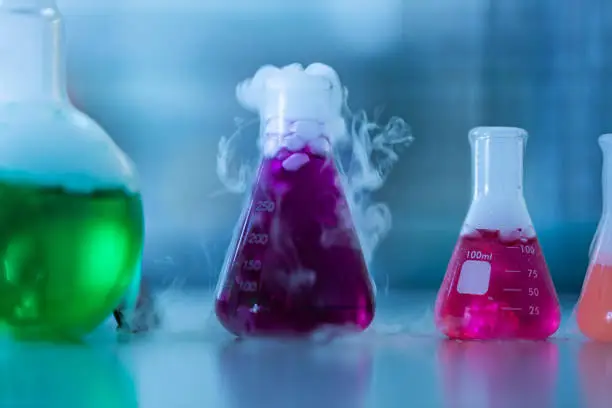
Few reactions capture the imagination as powerfully as a solution that shifts through multiple colors before your eyes, as if cycling through moods or identities. The so-called chemical chameleon reaction does exactly this, transforming from one vivid color to another in a sequence that feels alive.
At the heart of this reaction is oxidation and reduction, commonly called redox chemistry. In redox reactions, electrons move from one chemical species to another. This invisible transfer of electrons changes the oxidation state of certain atoms, altering how they interact with light. The result is a dramatic shift in color.
The color changes occur because different oxidation states of the same element absorb and reflect different wavelengths of visible light. As the reaction progresses, the element passes through several oxidation states, each associated with a distinct color. What looks like magic is actually a precise molecular dance governed by electron energy levels.
Emotionally, this reaction feels uncanny because it violates our everyday expectations of stability. We assume that once a liquid has a color, it will remain that way unless something obvious is added. Here, the change seems spontaneous, as though the solution has an inner life of its own. In reality, the transformation reflects the gradual consumption of reactants and the shifting balance of chemical species in solution.
Scientifically, the chemical chameleon is a vivid lesson in kinetics and thermodynamics. The reaction does not jump instantly from one state to another. Instead, it passes through intermediate stages, each briefly dominating before giving way to the next. The eye catches these fleeting states as bursts of color, revealing the normally hidden pathway of a chemical reaction.
This reaction reminds us that chemistry is not only about what goes in and what comes out, but also about the journey in between. The magic lies in seeing that journey unfold in real time.
2. The Oscillating Reaction That Never Seems to Settle
Imagine a liquid that cannot make up its mind. One moment it is one color, the next moment another, and then it switches back again, over and over, without any apparent external influence. This is the essence of an oscillating chemical reaction, a phenomenon so counterintuitive that it challenged long-standing assumptions about chemical behavior.
For much of scientific history, it was believed that chemical reactions must move smoothly toward equilibrium, gradually settling into a final, stable state. Oscillating reactions shattered that assumption. In these systems, concentrations of reactants and products rise and fall periodically, creating rhythmic changes in observable properties such as color.
The underlying science involves a network of interconnected reactions with feedback loops. Some steps accelerate the reaction, while others inhibit it. When these opposing effects are balanced in just the right way, the system never stabilizes. Instead, it oscillates, like a pendulum swinging back and forth.
The colors seen in oscillating reactions arise because different chemical species dominate at different times. As the balance shifts, so does the color of the solution. What looks like indecision is actually a precise and deterministic cycle governed by reaction rates and molecular interactions.
Emotionally, this reaction feels alive. The regular pulsing of color evokes biological rhythms such as heartbeats or breathing. It challenges the intuition that chemistry is static or lifeless, revealing instead that even simple molecules can produce dynamic, time-dependent behavior.
From a scientific perspective, oscillating reactions are deeply important. They provide insight into non-equilibrium thermodynamics, a field that studies systems far from stability. Such principles are essential for understanding biological processes, where chemical oscillations play a role in metabolism, neural signaling, and circadian rhythms.
The apparent magic of an oscillating reaction lies in its defiance of expectation. It teaches us that nature does not always seek stillness. Sometimes, the laws of chemistry favor motion, rhythm, and perpetual change.
3. The Instant Ice Reaction That Freezes on Command
There is something profoundly unsettling about watching a liquid turn into a solid instantly, without cooling, as if responding to an invisible signal. In reactions involving supercooled liquids and crystallization, this exact effect occurs, creating the illusion that ice is forming by magic.
The key concept behind this phenomenon is metastability. A supercooled liquid is cooled below its normal freezing point without actually solidifying. Although it appears stable, it exists in a delicate state, ready to crystallize at the slightest disturbance.
When crystallization begins, it spreads rapidly through the liquid as molecules lock into an ordered structure. This sudden release of energy, known as latent heat, often makes the transformation visible and dramatic. The liquid seems to freeze from within, growing solid structures in a matter of seconds.
What makes this reaction feel magical is the disconnect between cause and effect. There is no visible cooling, no gradual thickening. One moment the substance flows freely, the next it stands rigid. The transformation is so abrupt that it appears to violate the normal pace of physical change.
Scientifically, this reaction highlights the importance of molecular organization. Liquids and solids are distinguished not by their composition, but by how their particles are arranged. The instant ice reaction reveals that the boundary between these states can be crossed suddenly when conditions align.
This phenomenon also carries emotional weight because it taps into our instinctive understanding of freezing as something slow and inevitable. To see it happen instantaneously forces a reevaluation of what we think we know about matter and phase transitions.
The magic, once again, lies not in mystery, but in precision. Chemistry shows us that dramatic transformations can occur when systems are pushed just beyond their limits.
4. The Reaction That Creates Fire Without Heat
Fire is one of humanity’s oldest and most powerful symbols, associated with warmth, danger, and transformation. Yet some chemical reactions produce flames that defy our expectations, burning with vivid colors while generating surprisingly little heat. These reactions look like sorcery, as though fire itself has been tamed.
Colored flames arise from the excitation of electrons in atoms or ions. When these electrons absorb energy, they move to higher energy levels. As they return to their original states, they emit light at specific wavelengths. Different elements emit different colors, producing flames that glow green, blue, violet, or red.
What makes these reactions appear magical is the mismatch between appearance and sensation. The eye sees flame, but the skin feels little warmth. This challenges the deep association between fire and heat that is embedded in human experience.
Scientifically, the explanation lies in energy distribution. In these reactions, much of the energy is released as light rather than as thermal motion. The total energy may be relatively low, even though the visual effect is intense.
These reactions demonstrate a fundamental principle of chemistry: energy can take many forms, and not all energetic processes are destructive or dangerous. By controlling the pathways through which energy is released, chemists can produce effects that are visually spectacular yet physically gentle.
Emotionally, this kind of fire feels almost friendly, like a trick flame from a myth or legend. It invites fascination rather than fear, reminding us that chemistry can reshape even the most primal phenomena into something new and surprising.
5. The Reaction That Builds Living-Looking Structures from Nothing
Perhaps the most astonishing chemical reactions are those that seem to create life-like forms from inert materials. In certain reactions, simple substances assemble into branching, plant-like structures that grow before the observer’s eyes. These formations resemble trees, corals, or crystals blooming underwater.
The science behind these reactions involves precipitation, diffusion, and osmosis. As chemical species move through a solution, they react and form solid structures. The shapes that emerge are governed by gradients in concentration, pressure, and chemical potential.
What makes these structures look alive is their complexity. Instead of forming simple geometric shapes, they branch, twist, and expand in ways that mimic biological growth. This resemblance is no coincidence. Both chemical and biological structures are shaped by the same physical constraints and principles.
Emotionally, these reactions provoke a sense of wonder because they blur the boundary between the living and the non-living. Watching a structure “grow” taps into deep intuitions about life, creation, and emergence.
From a scientific standpoint, these reactions offer insight into self-organization, a process by which order arises spontaneously from simpler components. Self-organization is a key concept not only in chemistry, but also in physics, biology, and complexity science.
The magic here lies in emergence. No single molecule knows the final shape of the structure, yet together they produce something intricate and beautiful. Chemistry reveals that complexity does not always require intention; sometimes it arises naturally from simple rules applied repeatedly.
Conclusion: Why Chemistry Feels Like Magic
The chemical reactions that look like magic do not do so because they are mysterious or supernatural. They feel magical because they reveal the hidden workings of nature in ways that are sudden, vivid, and emotionally resonant. They transform abstract concepts—electron transfer, energy levels, molecular organization—into experiences that can be seen and felt.
Understanding these reactions does not strip them of wonder. Instead, it adds a new layer of appreciation. The true magic of chemistry lies in its ability to turn the invisible into the visible, to show that even the most astonishing transformations obey consistent and elegant laws.
In a world increasingly shaped by technology and scientific knowledge, these reactions remind us why chemistry matters. It is not only a tool for industry or medicine, but a lens through which we can witness the beauty and drama of matter itself. When chemistry looks like magic, it is not deceiving us—it is inviting us to look deeper.