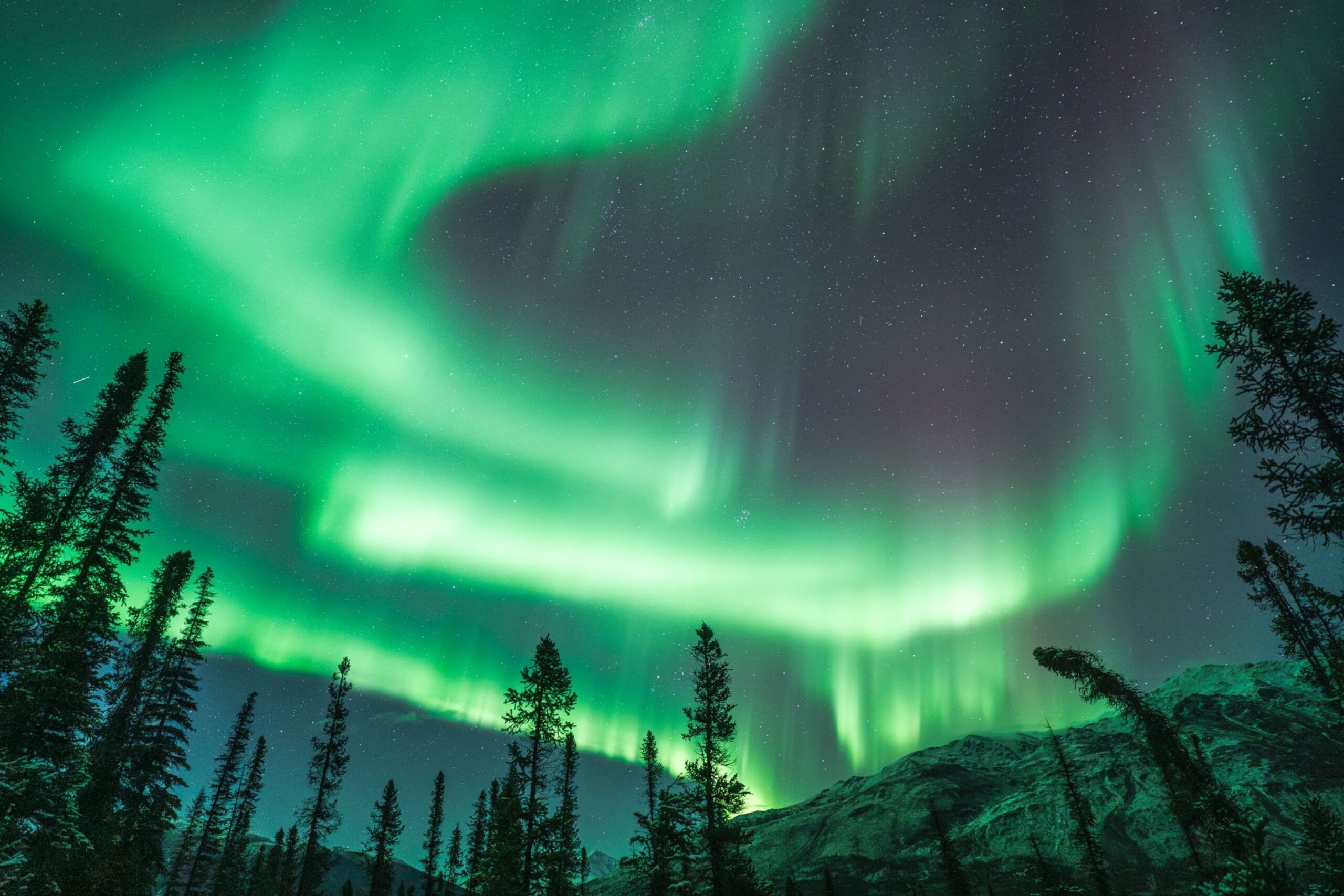
The Northern Lights are among the most spectacular natural displays on Earth. Curtains of green, red, purple, and sometimes blue light can ripple across the night sky, appearing almost to dance above the horizon. Known scientifically as the aurora borealis, the Northern Lights are produced by interactions between charged particles from the Sun and Earth’s magnetic field and upper atmosphere.
Although the aurora can look mysterious, the basic physics behind it is well understood. At the same time, every display is different. Its colors, shape, movement, brightness, and visibility depend on conditions both on the Sun and around Earth.
Here are 15 important facts that explain what the Northern Lights are, why they happen, where they appear, and what makes them so extraordinary.
1. The Northern Lights are caused by activity on the Sun
The ultimate source of most auroras is the Sun.
The Sun is constantly releasing a stream of electrically charged particles called the solar wind. These particles, primarily electrons and protons, travel outward through the solar system.
The solar wind is usually present even when the Sun appears quiet. But eruptions on the Sun can send much larger amounts of energy and charged particles toward Earth. Solar flares and coronal mass ejections can disturb Earth’s space environment and produce particularly strong auroras.
When this solar activity interacts with Earth’s magnetic field, energy can be transferred into the near-Earth environment. Some of that energy eventually accelerates charged particles downward toward the upper atmosphere, where they help produce the glowing aurora.
The Northern Lights are therefore not simply a phenomenon of Earth’s atmosphere. They are part of a much larger interaction between the Sun, Earth’s magnetic field, and Earth’s upper atmosphere.
2. The aurora happens high above Earth’s surface
The Northern Lights occur in Earth’s upper atmosphere, generally at altitudes of roughly 80 to several hundred kilometers above the ground.
For comparison, commercial airplanes typically cruise around 10 to 12 kilometers above Earth’s surface. The aurora is therefore many times higher than the altitude of an airliner.
Different parts of an auroral display can occur at different altitudes. The exact height depends on the energy of the particles entering the atmosphere and the atmospheric gases they encounter.
Because the aurora occurs so high above the surface, the phenomenon can stretch across enormous distances. A display that appears to be directly overhead in one location can be visible near the horizon from a much greater distance away.
3. Earth’s magnetic field guides the aurora
Earth’s magnetic field plays a central role in determining where auroras occur.
The magnetic field surrounds Earth and extends far into space. When the solar wind reaches Earth, it interacts with this magnetic environment. The interaction can disturb and energize the magnetosphere, the region of space dominated by Earth’s magnetic field.
Charged particles respond to magnetic fields and tend to follow magnetic field lines. Near the polar regions, those field lines connect Earth’s magnetosphere with the upper atmosphere.
As a result, auroral activity is concentrated around the magnetic poles rather than being distributed evenly across the planet.
The auroral zones are not perfect circles, however. They expand, shift, and become distorted as Earth’s magnetic environment responds to changing conditions in the solar wind.
4. The Northern Lights are not limited to the North Pole
The name “Northern Lights” can give the impression that the aurora occurs only at the North Pole. It does not.
Auroras can be seen across a broad region surrounding the Arctic, particularly during periods of strong geomagnetic activity.
The best viewing areas are generally located at high northern latitudes, including parts of Alaska, Canada, Iceland, Greenland, Scandinavia, and northern Russia.
During powerful geomagnetic storms, the auroral zone can expand toward lower latitudes. This can make the Northern Lights visible much farther south than usual.
For observers in the continental United States, especially those living farther north, strong geomagnetic storms can occasionally bring auroras into view. Visibility depends on the strength of the storm, local conditions, darkness, and how far south the auroral activity extends.
5. There is a Southern Lights counterpart
The Northern Lights have a southern counterpart called the aurora australis, or Southern Lights.
The two phenomena are produced by essentially the same physical process. Earth’s magnetic field directs energetic charged particles toward the polar regions, where they interact with gases in the upper atmosphere.
The aurora borealis occurs around the northern magnetic region, while the aurora australis occurs around the southern magnetic region.
Scientists therefore study both hemispheres to understand how Earth’s magnetosphere responds to solar activity.
The two auroras are often broadly similar, although they are not necessarily identical at every moment. Conditions in Earth’s magnetic environment and the solar wind can create differences between the two hemispheres.
6. The green color comes mainly from oxygen
The most familiar aurora color is green.
That green light is produced primarily when energetic electrons collide with oxygen atoms high in Earth’s atmosphere. The collisions leave the oxygen atoms in excited states. When the atoms return to lower-energy states, they release energy in the form of light.
The characteristic green emission is associated with oxygen at a particular range of altitudes and atmospheric conditions.
The familiar green glow is so strongly associated with the aurora that it is sometimes assumed to be the only color. In reality, auroras can display several colors.
The exact appearance depends on which atmospheric gases are involved, the altitude of the emissions, and the energy of the incoming particles.
7. Auroras can be red, purple, blue, and pink
Oxygen is also responsible for some red auroral emissions. Red light generally comes from oxygen at higher altitudes than the oxygen responsible for the familiar green emission.
Nitrogen and nitrogen molecules can contribute blue, purple, and reddish colors under suitable conditions.
An intense aurora can therefore contain several colors at once. A display might have a bright green curtain with red edges or purple and pink tones near its lower portions.
Color also depends on the sensitivity of human vision. The human eye is less sensitive to color in very dim conditions, which means a faint aurora can appear mostly grayish or white to the naked eye even when a camera records strong green or other colors.
This is one reason photographs of the Northern Lights can sometimes look dramatically more colorful than what an observer remembers seeing.
8. The aurora can appear to dance across the sky
Auroras are famous for their movement.
They can appear as arcs, ribbons, curtains, rays, patches, or rapidly changing structures. During an active display, these shapes can brighten, shift, ripple, or sweep across large portions of the sky.
The movement is caused by changing electric and magnetic conditions in near-Earth space and by the behavior of energetic charged particles entering the upper atmosphere.
An auroral curtain is not a physical sheet of glowing material waving in the wind. It is a large-scale pattern of light produced by particles interacting with the atmosphere along magnetic field structures.
The apparent motion can be remarkably fast during intense auroral activity. At other times, the aurora may remain relatively stable and slowly change shape.
9. You need darkness to see the aurora clearly
The Northern Lights can occur during daylight, but you cannot normally see them against the bright daytime sky.
Darkness provides the contrast necessary for the relatively faint auroral light to become visible.
This is why aurora viewing is generally associated with nighttime. The exact timing varies with location, season, and geomagnetic activity.
High-latitude regions also experience major seasonal differences in daylight. During parts of summer, areas within or near the Arctic Circle can experience extremely long periods of daylight or even the midnight sun. Even if auroral activity is occurring, the sky may simply be too bright for an observer to see it.
For practical viewing, a dark, clear sky away from artificial light is extremely helpful.
10. Light pollution can make the Northern Lights harder to see
Auroras compete with artificial light.
In a dark rural location, a moderately bright aurora can be visible across a large part of the sky. In a city, however, streetlights, buildings, signs, and other sources of light can wash out faint auroral features.
This does not mean an aurora can never be seen from a city. Strong displays can become bright enough to remain visible even through significant light pollution. But weaker activity may be impossible to distinguish from the glow of the urban sky.
For this reason, experienced aurora observers often travel away from cities and seek locations with unobstructed views toward the northern sky.
Clouds are another major limitation. The aurora occurs far above ordinary weather systems, but clouds close to the ground can completely block the view.
11. The aurora is connected to Earth’s magnetic storms
Strong auroras are often associated with geomagnetic storms, disturbances in Earth’s magnetic environment caused by enhanced solar activity.
A coronal mass ejection, for example, can send a large cloud of magnetized plasma toward Earth. If its magnetic field interacts favorably with Earth’s magnetic field, energy can be transferred efficiently into the magnetosphere.
This can trigger a chain of processes that energize particles and intensify auroral activity.
During a strong geomagnetic storm, the auroral oval can expand significantly toward lower latitudes. Displays can consequently become visible in regions where the Northern Lights are rarely seen.
Not every solar flare or solar disturbance produces a spectacular aurora visible from the ground. The direction, speed, magnetic properties, and interaction of solar material with Earth’s magnetic field all matter.
12. Auroras can produce sounds—but this is unusual and complicated
There are longstanding reports of people hearing faint sounds associated with exceptionally strong auroras. Descriptions have included crackling, hissing, or rustling noises.
For many years, such reports were difficult to reconcile with the physics. The aurora itself occurs at extremely high altitudes, where sound generated there could not simply travel through the atmosphere to an observer on the ground in the ordinary way.
Research has proposed mechanisms involving electrical effects near the Earth’s surface and atmospheric conditions, but the phenomenon remains much less established and much harder to observe than the visual aurora itself.
The important distinction is that the Northern Lights are not generally accompanied by audible sounds that travel directly down from the glowing structures. Most auroral displays are completely silent to observers on the ground.
13. The Northern Lights do not normally pose a direct danger to people on the ground
The aurora occurs high in the atmosphere, well above where people live and work.
The energetic particles responsible for auroras are largely guided and controlled by Earth’s magnetic field and interact with the upper atmosphere. Earth’s atmosphere also provides substantial protection from energetic particles and radiation.
So watching an aurora outdoors is not inherently dangerous.
However, the solar activity that produces strong auroras can have technological effects. Geomagnetic storms can disturb radio communications, affect navigation systems, induce currents in long electrical conductors, and create problems for satellites and electrical infrastructure.
The aurora is therefore a visible sign of space weather, while some of the associated space-weather effects can be technologically significant.
14. The aurora has been observed and described for thousands of years
People have been seeing unusual lights in the night sky for as long as humans have lived at auroral latitudes.
Historical cultures developed their own interpretations and stories about the phenomenon. Before modern physics, the cause of the lights was unknown, so auroras naturally became part of folklore, mythology, and traditional storytelling.
Scientific understanding developed gradually. As researchers learned about electricity, magnetism, the atmosphere, and the Sun, they began connecting auroras with charged particles and Earth’s magnetic field.
The scientific term aurora borealis comes from Latin: “aurora” refers to dawn, while “borealis” means northern.
The name is associated with the Roman goddess of dawn, Aurora, and the Greek personification of the north wind, Boreas.
Today, the aurora is understood through the combined fields of atmospheric physics, solar physics, magnetospheric physics, and space-weather science.
15. Cameras can capture auroras that look brighter than they do to your eyes
One of the most surprising things about photographing the Northern Lights is that a camera can reveal colors and details that are difficult to see directly.
Modern cameras can collect light over longer exposures than the human eye can effectively integrate. Digital image sensors can therefore record faint auroral emissions and produce an image with much stronger apparent color and detail.
This does not mean photographs are necessarily fake or misleading. Rather, the camera is measuring light differently from the human visual system.
A faint aurora may appear gray, pale green, or almost invisible to the naked eye while a long-exposure photograph reveals vivid green or purple structures.
During a very bright display, however, the colors can be strikingly obvious without a camera.
When is the best time to see the Northern Lights?
There is no single date or hour when the Northern Lights are guaranteed to appear.
The most important requirement is darkness, while the strength of the display depends largely on solar and geomagnetic conditions. At high latitudes, auroras can occur throughout the year, but summer daylight can prevent them from being visible.
For a person hoping to see the aurora, the most useful combination is a dark sky, clear weather, minimal light pollution, and sufficient geomagnetic activity. Locations closer to the auroral zone generally have more opportunities than locations farther south.
Auroral activity can also change quickly. A sky that appears ordinary can become active later, while a forecast of increased activity does not guarantee a visible display at a particular location.
Why are the Northern Lights different every time?
No two auroral displays are exactly alike because the conditions that create them are constantly changing.
The solar wind varies in speed and density. The Sun can release eruptions with different magnetic properties. Earth’s magnetosphere responds dynamically to those changes, and the resulting particle acceleration can vary in intensity and location.
The upper atmosphere also has its own changing conditions.
Together, these factors determine whether an observer sees a faint green glow near the horizon, a broad curtain spanning the sky, or a rapidly moving multicolored display overhead.
The Northern Lights are therefore not a fixed phenomenon that follows a single script. They are the visible expression of a constantly changing connection between the Sun and Earth.