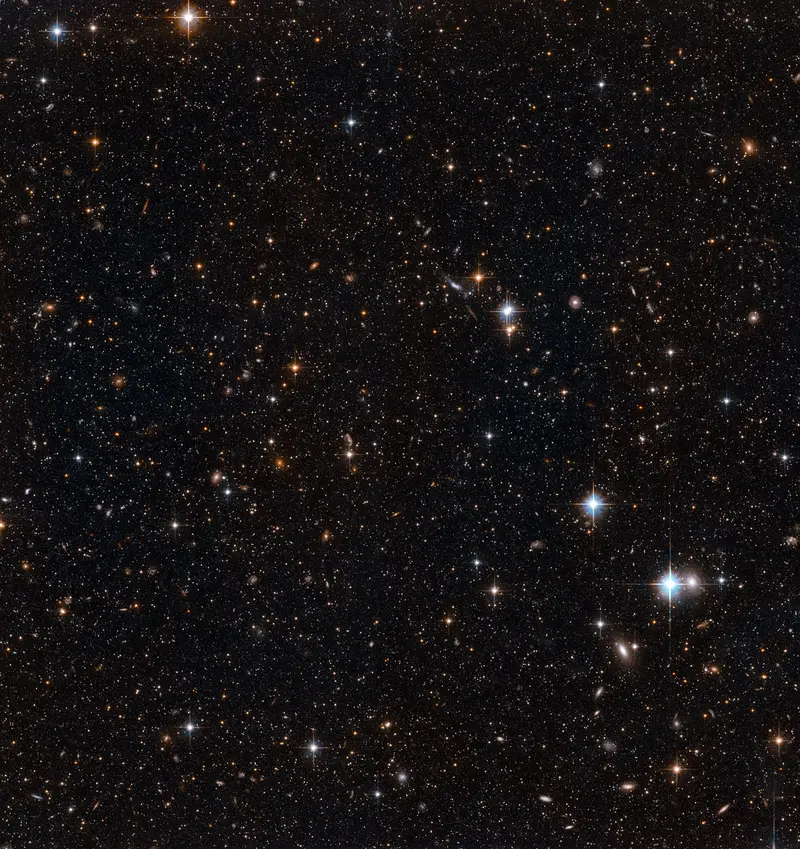
Space is beautiful. It is also terrifying. The same universe that offers glittering stars and poetic nebulae carries truths so vast, so indifferent, and so unsettling that they quietly shake our sense of meaning. Existential dread does not come from monsters or explosions—it comes from scale, time, silence, and the realization that reality owes us nothing.
The following ten space facts are not science fiction. They are not exaggerated. They are grounded in our best scientific understanding of the cosmos. And once you truly absorb them, they have a way of lingering in your thoughts long after the night sky fades from view.
1. Most of the Universe Is Completely Inaccessible to Us Forever
The observable universe is about 93 billion light-years across. That number alone feels absurd. But here is the part that unsettles scientists the most: much of the universe already lies beyond our reach, and more of it slips away every second.
Because the universe is expanding—and accelerating in that expansion—there are galaxies so distant that the space between us and them is growing faster than light can travel. This does not violate relativity because it is space itself expanding, not objects moving through space.
The consequence is haunting. Light emitted from those regions today will never reach us, no matter how long we wait. Entire galaxies, filled with stars, planets, and possibly life, are permanently cut off. They exist, but they might as well not, because no signal from them can ever arrive.
Even more unsettling, this cosmic isolation increases over time. The longer the universe lives, the smaller our observable neighborhood becomes. Far in the future, distant galaxies will fade from view entirely, leaving observers trapped in a lonely island of stars with no evidence that anything else ever existed.
Existential dread blooms here because it confronts us with permanent unknowability. There are answers we will never have, not because we lack intelligence or technology, but because reality itself has placed them beyond the horizon.
2. You Are Made of Matter That Has Already Died Many Times
Every atom in your body has a history far older than Earth. The carbon in your cells, the oxygen you breathe, the iron in your blood—none of it originated here.
These elements were forged inside stars through nuclear fusion. When those stars ran out of fuel, many of them died violently, exploding as supernovae and scattering their enriched guts across space. Later generations of stars formed from that debris, and eventually so did planets like Earth.
This means parts of you were once inside stars that no longer exist. They burned, collapsed, exploded, and vanished billions of years before humans appeared. You are not just alive; you are recycled stardust, assembled temporarily into a thinking pattern.
The existential weight comes from impermanence. If matter has been rearranged countless times before you, it will be rearranged countless times after you. “You” are not the atoms themselves, but a fleeting organization of them—a brief pattern in a universe that endlessly reshuffles its pieces.
The cosmos does not care which arrangement persists. When your pattern ends, the atoms will move on without ceremony.
3. Time Began, and It Will Almost Certainly End
Time feels eternal because it flows forward relentlessly. But according to modern cosmology, time itself had a beginning.
The Big Bang was not just the origin of matter and energy; it was the origin of space and time. Asking what happened “before” the Big Bang is meaningless in the same way asking what is north of the North Pole is meaningless. Time did not exist yet.
Equally unsettling is the fact that time may not last forever. Depending on the true nature of dark energy, the universe may expand endlessly, stretching matter thinner and thinner until stars burn out, black holes evaporate, and all structure dissolves into cold emptiness—a scenario known as heat death.
In that future, time still technically passes, but nothing meaningful happens. No complexity. No life. No change worth noticing. Eventually, even the concept of “event” becomes irrelevant.
Existential dread arises because time, which feels like the most fundamental feature of existence, may be temporary. Consciousness, memory, and meaning rely on time. If time itself fades into irrelevance, so does everything that ever mattered.
4. The Universe Is Mostly Stuff We Don’t Understand
All the stars, planets, gas, dust, and life combined make up less than 5 percent of the universe’s total content. The rest is something else entirely.
About 27 percent is dark matter, an invisible substance that does not emit or absorb light, yet exerts gravitational influence. It holds galaxies together, shapes cosmic structure, and dominates the mass of the universe. We do not know what it is made of.
About 68 percent is dark energy, an even stranger phenomenon driving the accelerated expansion of the universe. We do not know what it is, where it comes from, or why it exists.
In other words, the universe we can see and touch is a tiny fraction of what is actually there. Reality is mostly composed of things that pass through us without interaction, shaping our fate without revealing their nature.
The existential dread here is epistemic. We live inside a universe whose dominant components are fundamentally mysterious. Our theories describe their effects, not their essence. We are building meaning inside a reality whose primary ingredients are unknown to us.
5. Space Is Almost Perfectly Silent and Indifferent
In movies, space roars with explosions and dramatic sound. In reality, space is almost entirely silent.
Sound requires a medium—air, water, or solid matter—to propagate. The vacuum of space offers none. Supernovae explode in absolute silence. Stars collapse without a whisper. Galaxies collide in mute grandeur.
This silence is not just physical; it is emotional. The universe does not react to tragedy or triumph. When a star dies, nothing mourns. When a planet becomes uninhabitable, nothing notices. When an entire species goes extinct, the cosmos remains unchanged.
Existential dread emerges from this indifference. Humans seek acknowledgment, response, and meaning. Space offers none. It is vast, ancient, and unconcerned with who we are or what we feel.
Any meaning we find must be created locally, fragile and temporary, in defiance of a universe that will never confirm it.
6. There Are More Galaxies Than Humans Who Have Ever Lived
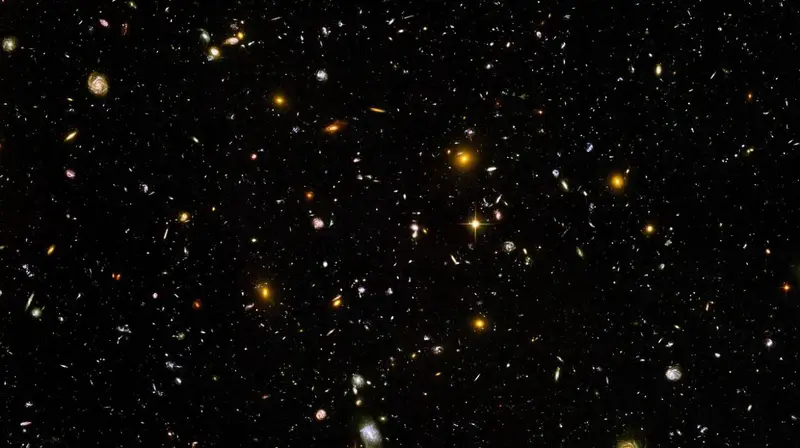
Estimates suggest there are hundreds of billions, possibly trillions, of galaxies in the observable universe. Each galaxy contains billions or trillions of stars. Around many of those stars orbit planets.
By contrast, the total number of humans who have ever lived is estimated at around 100 billion.
This means there are likely more galaxies than human lives that have ever existed, each galaxy itself an island universe of staggering complexity. Your entire species, history, wars, art, love, and suffering may be statistically insignificant in the cosmic census.
Existential dread surfaces when scale crushes significance. Human achievements feel monumental from the inside, but cosmically, they barely register. The universe is not built on human proportions, and it does not bend to our narratives.
We are not the audience. We are background noise in a story that has no central character.
7. Black Holes Erase Information—Or Maybe Reality Itself
Black holes are regions of spacetime where gravity becomes so intense that nothing, not even light, can escape once it crosses the event horizon.
According to classical physics, anything that falls into a black hole is lost forever. According to quantum mechanics, information cannot be destroyed. Reconciling these two ideas has become one of the deepest problems in modern physics.
If information truly disappears inside black holes, then reality itself may not preserve its own history. The universe could be fundamentally forgetful. Cause and effect may break down at the deepest level.
Even if information is somehow preserved, it may be smeared across the event horizon or encoded in Hawking radiation in ways that are practically irretrievable.
Existential dread lives here because memory underpins identity. If the universe itself cannot guarantee the preservation of information, then permanence is an illusion. Even reality may not remember itself.
8. The Universe Will Outlive Every Possible Form of Life
Stars will not shine forever. Eventually, all nuclear fuel will be exhausted. New stars will stop forming. Black holes will slowly evaporate over unimaginable timescales. Even protons may decay.
In the far future, trillions upon trillions of years from now, the universe may consist of nothing but thin radiation and isolated particles drifting in darkness. No chemistry. No structure. No observers.
Life, consciousness, and complexity appear to be temporary phases—brief sparks in an otherwise eternal cosmic night. The universe is not designed for life; life is a side effect of rare conditions that will not last.
Existential dread arises because this future is not dramatic. There is no final explosion, no cosmic curtain call. Just gradual fading. Meaning does not end with a scream, but with a whisper.
9. You Experience Reality in a Tiny, Biologically Filtered Slice
Your senses do not perceive reality as it is. They evolved to help you survive, not to reveal truth.
You see a narrow band of electromagnetic radiation called visible light. You hear a limited range of sound frequencies. You feel solidity where electromagnetic forces prevent atoms from passing through each other.
Space, at its deepest level, is a quantum field soup of probabilities, fluctuations, and interactions far removed from everyday experience. Time may not even be fundamental—it may emerge from deeper processes we barely understand.
Existential dread comes from the realization that what feels real is an interface, not reality itself. You are navigating a simplified projection of a universe far stranger and more alien than intuition allows.
Your certainty is a biological illusion.
10. The Universe Has No Known Purpose—and It Doesn’t Need One
Physics describes how the universe behaves, not why it exists. There is no evidence that the universe has intent, direction, or goal. Stars form because gravity allows them to. Life emerges because chemistry permits it. Consciousness arises because evolution favors complex information processing.
There is no cosmic obligation for meaning to exist.
This does not mean life is meaningless—but it does mean meaning is not built into the structure of reality. It is something humans construct locally, temporarily, against the backdrop of an indifferent cosmos.
Existential dread peaks here. If meaning is not guaranteed, then it is fragile. It can be lost, distorted, or ignored. It must be defended, nurtured, and chosen repeatedly.
The universe will not help you. It will not stop you. It will not remember you.
The Quiet After the Fear
Existential dread is not panic. It is the slow realization that the universe is vast beyond comprehension, indifferent beyond comfort, and temporary beyond denial. Space does not hate us. It simply does not notice us.
And yet, here we are—thinking, wondering, fearing, loving, and asking questions in a universe that did not promise us answers.
Perhaps the most unsettling fact of all is also the most beautiful: in a reality that does not care, caring becomes extraordinary. In a universe without built-in meaning, the act of creating meaning becomes an act of defiance.
The stars do not ask us to exist.
We do it anyway.