The natural world is far stranger and more astonishing than most of us realize. Every forest, ocean, desert, and sky is filled with creatures carrying secrets millions of years in the making. Animals have evolved abilities so extraordinary that they often seem like the products of imagination rather than biology. Some can regenerate entire body parts. Others can see colors humans cannot even conceive. A few can survive in environments that would kill most life instantly.
For centuries humans have watched animals with curiosity and admiration. But only in recent decades, with advanced technology and careful scientific research, have we begun to uncover just how remarkable many animals truly are. Behind every chirp, flutter, and splash lies an evolutionary story that stretches back through deep time.
What follows are ten mind-blowing facts about animals that reveal just how mysterious, intelligent, resilient, and surprising life on Earth can be.
1. Octopuses Have Three Hearts and Blue Blood
Among the most alien-like creatures in the ocean is the Octopus. With their eight flexible arms, incredible camouflage abilities, and startling intelligence, octopuses already seem unusual. But their internal biology is even more astonishing.
Unlike humans, who rely on a single heart to pump blood throughout the body, octopuses have three hearts. Two of these hearts pump blood specifically to the gills, where oxygen is absorbed from the water. The third heart then circulates the oxygenated blood through the rest of the body.
Even stranger, the blood of an octopus is blue rather than red. This is because it uses a copper-based molecule called hemocyanin to transport oxygen, rather than the iron-based hemoglobin found in human blood. Hemocyanin performs better in cold, low-oxygen environments, which makes it perfectly suited for life in the deep sea.
The biology of octopuses also includes a nervous system that is radically different from our own. About two-thirds of their neurons are located in their arms rather than in the central brain. Each arm can perform complex movements and even react to stimuli independently.
This means an octopus does not control its arms the way we control our hands. Instead, each arm possesses a degree of autonomy, almost like having eight semi-independent minds working together. The result is a creature capable of solving puzzles, escaping enclosures, and manipulating objects with remarkable skill.
2. Tardigrades Can Survive the Vacuum of Space
If there were an award for the toughest animal on Earth, the microscopic Tardigrade would almost certainly win.
Tardigrades, sometimes called “water bears” because of their tiny bear-like shape, are microscopic animals that live in moss, soil, and freshwater environments. At first glance they seem fragile and insignificant. Yet these tiny creatures possess one of the most extraordinary survival abilities in the entire animal kingdom.
When conditions become harsh, tardigrades can enter a state called cryptobiosis. In this state, they essentially shut down their metabolism almost completely. They lose nearly all the water in their bodies and curl into a tiny, shriveled structure known as a “tun.”
In this form, tardigrades can survive extreme temperatures ranging from near absolute zero to over 150°C. They can endure crushing pressures found deep in the ocean and intense radiation levels that would instantly kill humans.
Perhaps most astonishing of all, tardigrades have survived exposure to the vacuum of space. In experiments conducted on spacecraft, tardigrades were sent into orbit without protection from cosmic radiation or air pressure. When they returned to Earth, many of them revived and continued living normally.
This incredible resilience has fascinated scientists studying the limits of life. Tardigrades show that life can endure conditions far beyond what we once believed possible.
3. Dolphins Have Names for Each Other
The ocean is full of intelligent animals, but few are as socially sophisticated as the Bottlenose Dolphin.
For decades researchers suspected that dolphins communicated in complex ways using whistles and clicks. But a groundbreaking discovery revealed something even more remarkable: dolphins appear to have names.
Each dolphin develops a unique whistle pattern known as a “signature whistle.” This whistle functions much like a personal name. Dolphins use it to identify themselves and to call specific individuals.
Even more fascinating, dolphins can imitate the signature whistle of another dolphin to get its attention, much like humans calling someone by name across a room.
This discovery suggests that dolphin communication includes elements of identity recognition and social relationships similar to those found in human societies. Dolphins live in tightly bonded groups, cooperate while hunting, and even appear to help injured members of their pod.
Their brains are also among the largest relative to body size in the animal kingdom, with highly developed regions associated with cognition and emotion. The existence of names in dolphin communication hints at a level of social intelligence far deeper than we once imagined.
4. Some Frogs Can Freeze Solid and Come Back to Life
In the freezing forests of North America lives an extraordinary amphibian: the Wood Frog.
Every winter, temperatures in its habitat drop far below freezing. Most animals would die if their body fluids turned to ice. Yet wood frogs have evolved a survival strategy that seems almost magical.
As winter approaches, their bodies produce large amounts of glucose, which acts as a natural antifreeze. When temperatures plunge, up to 70 percent of the frog’s body water freezes.
During this frozen state, the frog’s heart stops beating. Breathing ceases. Brain activity becomes undetectable. By every ordinary definition, the frog appears dead.
But when spring arrives and temperatures rise, the ice slowly melts. The frog’s heart begins beating again. Its organs resume functioning, and within hours it hops away as if nothing had happened.
This remarkable adaptation allows wood frogs to survive harsh winters in environments where few amphibians could endure.
Scientists are studying this ability closely because it could provide insights into medical preservation techniques, including the storage of organs for transplantation.
5. Sharks Are Older Than Trees
The ancient oceans of Earth were once dominated by creatures long before forests covered the continents. Among those ancient predators were the ancestors of modern Shark.
Sharks first appeared in the fossil record around 400 million years ago. At that time, the land was largely barren of large plants. The earliest trees would not evolve until about 350 million years ago.
This means sharks existed on Earth tens of millions of years before trees began forming forests.
Over hundreds of millions of years, sharks have survived multiple mass extinction events that wiped out vast numbers of species, including the catastrophe that eliminated the dinosaurs.
Their success lies in their efficient body design. Sharks possess streamlined bodies, powerful tails, and highly developed senses. Some species can detect tiny electrical signals produced by the muscles of nearby animals, allowing them to locate prey even when it is hidden beneath sand or darkness.
While their appearance has changed somewhat through evolutionary time, the basic design of sharks has remained remarkably stable. Nature discovered an effective predator early on and saw little reason to redesign it.
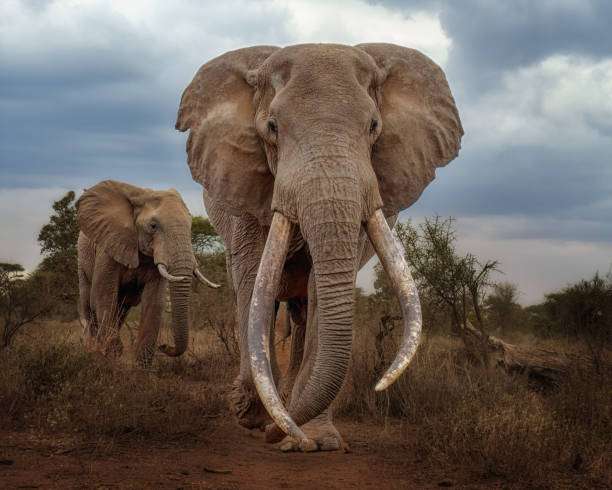
6. Elephants Can “Hear” With Their Feet
The immense African Elephant is known for its intelligence, memory, and strong social bonds. Yet one of its most surprising abilities lies in how it perceives sound.
Elephants communicate using extremely low-frequency sounds called infrasound. These sounds are too deep for human ears to detect and can travel several kilometers through the ground.
When an elephant produces these vibrations, they spread through soil and rock. Other elephants can sense these signals not only with their ears but also through specialized receptors in their feet.
By placing their feet on the ground, elephants detect vibrations transmitted through the earth. These signals travel up the bones of their legs to their inner ears, where they are interpreted as sound.
This ability allows elephants to communicate across long distances, coordinate group movements, and even detect distant storms or herds.
Their sensitivity to vibrations essentially gives them an additional sensory channel that humans lack entirely.
7. Crows Can Solve Complex Puzzles
The intelligence of birds often surprises people who assume that small brains must mean simple behavior. Few birds challenge that assumption more strongly than the New Caledonian Crow.
These crows have demonstrated remarkable problem-solving abilities in laboratory experiments. In some tests, researchers presented them with multi-step puzzles that required using tools in sequence to obtain food.
For example, a crow might first need to use a short stick to retrieve a longer stick, then use the longer stick to reach a piece of food placed beyond its beak’s reach.
Even more impressive, crows have been observed bending wires into hooks to create tools when none were available.
This level of planning and innovation suggests advanced cognitive abilities similar to those seen in some primates. Crows also show evidence of memory, social learning, and even an understanding of cause and effect.
The realization that birds can possess such sophisticated intelligence has transformed how scientists think about the evolution of cognition.
8. Some Lizards Can Squirt Blood From Their Eyes
Nature sometimes produces defense mechanisms that sound almost unbelievable. One of the strangest belongs to the Horned Lizard.
When threatened by predators such as coyotes or foxes, certain horned lizards can perform an extraordinary trick: they can shoot jets of blood from their eyes.
Specialized muscles around the lizard’s eyes constrict blood flow, increasing pressure until small vessels rupture. The resulting stream of blood can spray several feet toward an attacker.
This sudden burst of blood startles predators and often deters them from continuing the attack. Even more importantly, the blood tastes unpleasant to some predators, particularly canids.
While it may seem grotesque, this ability provides the lizard with a surprisingly effective survival strategy in harsh desert environments where escape options are limited.
9. Hummingbirds Are the Only Birds That Can Fly Backward
The tiny Hummingbird performs aerial feats unmatched by any other bird.
Unlike most birds, which generate lift primarily during the downward wing stroke, hummingbirds create lift on both the downstroke and the upstroke. Their wings rotate in a figure-eight pattern similar to the motion of insect wings.
This unique wing movement allows hummingbirds to hover in place while feeding from flowers. It also enables them to fly backward, a skill no other bird possesses.
Their wings beat astonishingly fast, sometimes more than 70 times per second. To sustain this intense activity, hummingbirds have extremely high metabolic rates. Their hearts can beat over 1,000 times per minute during flight.
Because of their energy demands, hummingbirds must feed frequently on nectar, which provides the sugar needed to power their flight muscles.
Despite their small size, hummingbirds are capable of long migrations spanning thousands of kilometers, demonstrating endurance that seems impossible for such delicate creatures.
10. Axolotls Can Regrow Entire Body Parts
Among the most extraordinary regenerative animals on Earth is the Axolotl.
Unlike most animals, which can only heal wounds with scar tissue, axolotls can regenerate entire body structures. If an axolotl loses a limb, it can grow a completely new one that includes bones, muscles, nerves, and blood vessels.
Even more astonishing, axolotls can regenerate parts of their heart, spinal cord, and brain without permanent damage.
This ability comes from specialized cells that can revert to a flexible state similar to stem cells. These cells then reorganize themselves into whatever tissues are needed to rebuild the missing structure.
Scientists study axolotls intensely because understanding their regenerative biology could one day help humans repair damaged tissues or organs.
In laboratories around the world, these small amphibians are providing clues about how regeneration might one day transform medicine.
The Endless Wonder of the Animal Kingdom
The animal kingdom is filled with abilities that stretch our imagination. From microscopic survivors that can endure space to giant mammals that listen through their feet, life on Earth constantly reminds us that evolution is an extraordinary creative force.
Each species carries the imprint of millions of years of adaptation. Every unusual ability, every bizarre behavior, and every astonishing survival strategy is a solution to a challenge faced long ago in Earth’s history.
What makes these discoveries even more exciting is the realization that we have only begun to uncover the secrets of the natural world. New species are discovered every year. New behaviors are observed. New mysteries appear.
The more we study animals, the more we realize how complex and interconnected life truly is. And with each revelation comes a renewed sense of wonder at the remarkable diversity of creatures that share our planet.