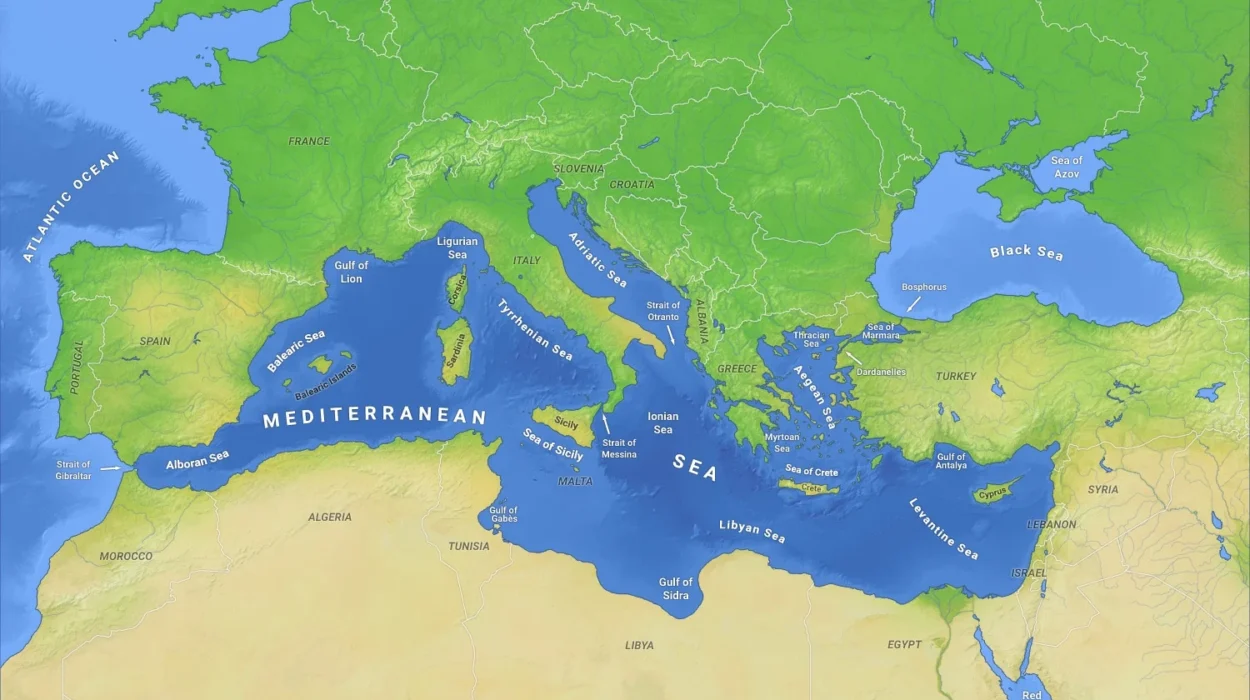
Ancient Greece did not decline because its people suddenly lost their creativity, military skill, or political influence. Instead, the Greek world changed through a combination of prolonged warfare, political fragmentation, shifting military power, and the expansion of stronger neighboring states. Macedon first brought much of mainland Greece under its control in the fourth century BCE. Centuries later, Rome absorbed the remaining independent Greek kingdoms and cities into its growing Mediterranean empire.
Yet the decline of Greek political independence was not the end of Greek civilization. Greek philosophy, science, literature, art, and political ideas continued to shape the ancient world long after Greek states lost their freedom to determine their own foreign policies. Understanding this distinction between political power and cultural influence is essential to explaining what happened to ancient Greece.
What ancient Greece actually was
Ancient Greece was not a unified country with a single government. It consisted primarily of independent city-states, known as poleis, each with its own political institutions, laws, military forces, and civic identity. Athens, Sparta, Corinth, Thebes, and other cities often competed for territory, trade, and regional influence.
Geography helped shape this political arrangement. Mountains divided much of the Greek mainland into separate valleys and coastal regions, while numerous islands and a deeply indented coastline encouraged maritime travel and local centers of power. These conditions did not make political unity impossible, but they favored the development of communities that could govern themselves independently.
The city-state system produced remarkable achievements. Citizens participated in different forms of government, philosophers debated the nature of knowledge and justice, playwrights explored human conflict, and mathematicians investigated geometry and astronomy. Greek merchants and settlers established communities throughout the Mediterranean and Black Sea regions, spreading their language and cultural practices.
However, political independence also created persistent vulnerabilities. Because no central authority could reliably settle disputes among the city-states, disagreements frequently escalated into wars. Alliances provided temporary security but could also intensify rivalries. The same political diversity that encouraged experimentation and competition made coordinated defense difficult when a powerful external state emerged.
This tension between local independence and collective security became one of the central problems in Greek history.
How the Peloponnesian War weakened the Greek city-states
The first major turning point came with the Peloponnesian War, fought from 431 to 404 BCE between Athens and Sparta and their respective allies. The conflict grew out of competing political interests, fear, and struggles for influence across the Greek world.
Athens had developed a powerful maritime empire after the Persian Wars. Its navy protected trade routes and helped defend the Aegean against Persian power, but Athens also used its influence to control allied communities and collect tribute. Sparta, a leading land power, viewed Athenian expansion with growing concern.
The resulting war lasted nearly three decades and placed enormous demands on the participating states. Athens suffered a devastating epidemic early in the conflict, killing a substantial portion of its population, including its prominent leader Pericles. Military campaigns, economic disruption, and the loss of citizens further strained the city.
Athens eventually surrendered in 404 BCE after Sparta and its allies, assisted by Persian financial support, gained the advantage at sea. The defeat ended Athenian imperial dominance and temporarily imposed a narrow oligarchic government, although democracy was subsequently restored.
Sparta emerged as the leading Greek power, but it could not create a stable political order that satisfied the other city-states. Its attempts to impose its influence generated resistance, and its own military resources were limited. Thebes defeated Sparta at the Battle of Leuctra in 371 BCE, demonstrating that Spartan supremacy could also be overturned.
The central problem was not simply that Athens had lost a war. The Greek states repeatedly exhausted their resources fighting one another without establishing a durable system for resolving their conflicts. Victories changed the balance of power, but they rarely ended the rivalries that produced the wars.
Why Greek political fragmentation became a strategic weakness
Competition among city-states had once encouraged military innovation and political experimentation. By the fourth century BCE, however, the inability to cooperate consistently had become a serious strategic disadvantage.
Each major state needed to maintain its own army, negotiate alliances, protect its territory, and finance military campaigns. When one city became powerful, its neighbors often joined forces to contain it. These coalitions could defeat a dominant state, but they were frequently held together by a shared opponent rather than a common political purpose.
This created a recurring cycle: one city gained influence, other cities resisted, warfare weakened the participants, and a new power emerged. The cycle did not mean that every Greek state was continuously impoverished or incapable of recovery. Many cities remained prosperous, culturally productive, and militarily capable. The problem was that their combined strength was difficult to mobilize under unified leadership.
Persia also played an important role. The Persian Empire remained a major power in the eastern Mediterranean and frequently intervened in Greek disputes through diplomacy, financial support, and military pressure. Greek states sometimes accepted Persian assistance against their rivals, even when doing so strengthened a foreign power’s influence over Greek affairs.
By the middle of the fourth century BCE, the Greek world was therefore politically divided, experienced in warfare, and vulnerable to a state that could organize military resources on a larger and more coordinated scale.
That state was Macedon.
How Macedon transformed warfare and regional power
Macedon lay north of the principal Greek city-states. Its monarchy, agricultural resources, and access to timber and mineral wealth gave it a different political and economic foundation from that of many southern Greek communities. Macedonian society also included powerful aristocratic families whose cooperation was important to royal authority.
Under King Philip II, who ruled from 359 to 336 BCE, Macedon underwent a major military and political transformation. Philip reorganized the army, strengthened royal control, developed alliances, and exploited divisions among the Greek states.
One of his most important innovations was the development of a highly effective infantry formation equipped with long pikes called sarissas. These weapons allowed Macedonian soldiers to project force beyond the reach of many conventional spears when the formation remained organized. The Macedonian army combined this infantry with cavalry, lighter troops, and siege capabilities, giving it flexibility in different types of warfare.
The effectiveness of this system depended on more than weapon length. Soldiers had to maintain formation, officers needed to coordinate different units, and cavalry had to exploit opportunities created by the infantry. Philip’s army was a combined military system in which different forces supported one another.
Philip also benefited from political circumstances. The Greek states were divided, and their leaders disagreed about how to respond to Macedonian expansion. Some regarded Philip as a threat to their independence, while others considered cooperation with him advantageous or necessary.
The decisive confrontation came at the Battle of Chaeronea in 338 BCE, when Philip’s forces defeated a coalition led by Athens and Thebes. The victory established Macedonian military dominance over much of mainland Greece. Philip subsequently organized many Greek states into the League of Corinth, a coalition designed to maintain a common political and military framework under Macedonian leadership.
The arrangement preserved some local institutions, but the participating states no longer possessed the same freedom to determine their collective foreign policy. Greek independence had not disappeared everywhere, yet the balance of power had fundamentally changed.
Alexander the Great expanded Macedonian power beyond Greece
Philip II was assassinated in 336 BCE, and his son Alexander III, later known as Alexander the Great, succeeded him. Alexander inherited a powerful army and a political system capable of coordinating military campaigns across extensive territories.
In 334 BCE, Alexander invaded the Persian Empire. His campaigns brought much of the eastern Mediterranean, Egypt, Mesopotamia, and territories extending into Central Asia under his control. His army won a series of major victories against Persian forces, and the Persian king Darius III was eventually defeated.
Alexander’s conquests transformed the scale of Greek and Macedonian political influence. Greek-speaking soldiers, administrators, merchants, and settlers moved into newly conquered regions. New cities were established, and existing centers became connected through networks of trade, government, education, and cultural exchange.
This period helped create the Hellenistic world. The term Hellenistic refers to the era in which Greek language and cultural traditions spread widely and interacted with the traditions of Egypt, Persia, Mesopotamia, and other societies.
Alexander did not create a stable, lasting system of succession. He died in Babylon in 323 BCE, aged 32, leaving an enormous empire without an adult heir capable of exercising effective authority. His generals and their successors fought for control of the territories, eventually producing several major kingdoms, including the Ptolemaic kingdom in Egypt and the Seleucid Empire across much of western Asia.
Macedon’s expansion had therefore weakened the political independence of the Greek city-states while simultaneously expanding the reach of Greek culture. The center of Greek-speaking intellectual and economic life was no longer confined to the traditional cities of the mainland. Alexandria in Egypt, for example, became a major center of scholarship, mathematics, medicine, and literature.
Greek civilization was changing its geographic and political form rather than simply disappearing.
Why the Hellenistic kingdoms could not stop Rome
After Alexander’s death, the Hellenistic world consisted of competing monarchies rather than a unified empire. These kingdoms possessed substantial resources, professional armies, wealthy cities, and sophisticated administrative systems. They were not inherently weak, and Rome did not defeat them all in a single campaign.
Their vulnerability arose partly from rivalry and partly from the growing power of Rome, which had expanded from a city-state in central Italy into a dominant force across the Italian peninsula.
Rome’s political and military system differed from those of the Greek city-states and Hellenistic monarchies. The Roman Republic could draw soldiers and resources from Roman citizens and allied communities across Italy. Its system of alliances often required conquered or subordinate communities to provide military support, although the obligations and privileges of these communities varied.
This network helped Rome recover from severe military defeats. Rather than collapsing after a disastrous battle, Rome could often recruit additional forces and continue fighting. Its ability to sustain prolonged wars became particularly important during its conflicts with Carthage and later with the Hellenistic kingdoms.
Rome also developed extensive experience in organizing armies, establishing fortified settlements, negotiating alliances, and maintaining control over conquered territories. Its strength did not rest on superior tactics in every battle. Roman commanders could lose engagements and still benefit from a broader system capable of replacing troops and supplying new campaigns.
The Hellenistic kingdoms, meanwhile, frequently competed with one another for territory and influence. Some rulers sought Roman support against rival monarchs or Greek opponents. These diplomatic choices sometimes produced short-term advantages but allowed Rome to become increasingly involved in eastern Mediterranean affairs.
Rome’s expansion was thus both a military process and a political one. It advanced through battles, alliances, interventions, and the gradual incorporation of territories into its sphere of control.
How Rome brought Greece under its authority
Roman involvement in the Greek world increased during the third and second centuries BCE. Conflicts involving Macedon, Greek leagues, and other Hellenistic powers created opportunities for Rome to intervene.
During the Second Macedonian War, fought from 200 to 197 BCE, Rome defeated King Philip V of Macedon. In 196 BCE, the Roman commander Titus Quinctius Flamininus proclaimed the freedom of the Greek states from Macedonian control. The proclamation was politically significant, but it did not mean that Greece had become independent of Roman influence. Rome increasingly acted as an arbiter of disputes and a decisive military power in the region.
Later conflicts exposed the limits of this nominal freedom. In 168 BCE, Roman forces defeated the Macedonian king Perseus at the Battle of Pydna. Macedon’s monarchy was dismantled, and its territory was reorganized under Roman control. Further resistance and political conflict followed.
The decisive Roman destruction of Corinth occurred in 146 BCE, when Roman forces defeated the Achaean League, a coalition of Greek states. The city was sacked, and its inhabitants suffered severe consequences. In the same year, Rome completed the defeat of Carthage, another major Mediterranean rival.
The date 146 BCE is therefore often used as a landmark in the end of Greek political autonomy, although the process was gradual and different regions experienced Roman rule in different ways. Greek cities retained varying degrees of local administration, and not every community was governed identically.
The incorporation of Greece into the Roman world continued over time. In 27 BCE, during the reign of Augustus, much of mainland Greece was organized as the Roman province of Achaea. By then, Roman power had become firmly established across the eastern Mediterranean.
The result was not the disappearance of Greek society. It was the transfer of ultimate political authority to Rome.
The economic and social consequences of prolonged conflict
Warfare affected Greek communities in ways that extended beyond changes in rulers. Military campaigns could destroy farmland, interrupt trade, displace populations, and reduce the labor available for agriculture and other economic activities. Sieges could be especially damaging because they cut off food supplies and exposed urban populations to disease and deprivation.
The effects varied by place and period. Some cities experienced serious losses, while others recovered or continued to prosper. It would be inaccurate to describe the entire Greek world as uniformly impoverished after the Peloponnesian War or to attribute every later political change to economic decline.
The relationship between warfare and political weakness was nevertheless important. Military expenditures competed with other demands on public resources, and the destruction caused by conflict could make subsequent campaigns harder to sustain. When rival states repeatedly mobilized against one another, their resources were often spent on immediate security rather than long-term cooperation.
Political institutions also mattered. Greek democracy, oligarchy, and monarchy each had different strengths and limitations, but none automatically solved the problem of coordinating independent states. Democratic governments could face pressure from popular opinion, oligarchies could struggle with internal legitimacy, and monarchies depended heavily on the authority and succession arrangements of individual rulers.
These differences contributed to the complexity of Greek politics. They did not make Greek institutions inherently inferior to Macedonian or Roman systems. Rather, the outcome depended on how institutions operated under particular military, economic, and diplomatic conditions.
Macedon succeeded partly because Philip II built a system capable of concentrating resources and making coordinated decisions. Rome succeeded partly because its political and alliance structures allowed it to sustain expansion across a large region. Neither power’s rise can be explained by military technology alone.
Why Greek culture flourished under foreign rule
The loss of political independence did not end Greek intellectual life. In many respects, the Hellenistic and Roman periods were among the most influential eras for the development and transmission of Greek learning.
Greek remained an important language of administration, education, philosophy, and commerce throughout much of the eastern Mediterranean. Cities such as Alexandria became centers of scholarship, attracting thinkers who studied mathematics, astronomy, geography, medicine, and literature.
Greek philosophical schools continued to explore questions about ethics, knowledge, nature, and human society. The traditions associated with Plato and Aristotle remained influential, while Stoicism and Epicureanism offered different approaches to living well in an uncertain world.
Scientific and mathematical inquiry also advanced. Hellenistic scholars developed sophisticated methods for studying geometry, planetary motion, geography, and anatomy. Their work drew on earlier Greek traditions while also interacting with knowledge from Egypt, Mesopotamia, and other regions.
Roman elites adopted many aspects of Greek education and culture. They studied Greek literature and philosophy, collected Greek art, and employed Greek teachers. Roman writers and thinkers frequently adapted Greek ideas to Roman political, literary, and ethical concerns.
This relationship was not simply one-way cultural transmission. Greek communities continued to develop their own traditions, while Roman patronage, infrastructure, and political networks helped circulate Greek learning across a wider area.
The contrast between political control and cultural influence is therefore crucial. Rome could govern Greek territories while relying heavily on Greek intellectual traditions. Macedonian conquest had similarly expanded the geographical reach of Greek culture even as it reduced the independence of the city-states that had originally nurtured it.
Was the decline of ancient Greece inevitable?
The rise of Macedon and Rome can appear inevitable when viewed in hindsight, but the historical outcome was not predetermined. Political decisions, military victories, diplomatic alliances, leadership changes, and local circumstances all influenced the course of events.
The Greek city-states had demonstrated their ability to resist powerful external enemies, most famously during the Persian Wars in the early fifth century BCE. They also repeatedly recovered from internal conflicts. Their later subordination was not proof that Greek society had become incapable of military or political achievement.
Instead, the circumstances of the fourth century BCE differed from those of earlier periods. Macedon developed a more coordinated military system under Philip II, while the Greek states remained divided over how to respond. Alexander then used Macedonian power to conquer the Persian Empire, transforming the political environment in which Greek communities operated.
Rome’s rise involved another set of conditions. Its ability to mobilize resources through Italian alliances, sustain long wars, and intervene in conflicts among Hellenistic states gave it advantages over time. The fragmentation of the eastern Mediterranean kingdoms helped Rome expand, but Roman success also depended on its own institutions, military organization, and strategic decisions.
Historians can debate the relative importance of individual leaders, economic conditions, military reforms, and political institutions. There is no single explanation that accounts for every region or every stage of the process. What is well established is that Greek political independence declined through a sequence of conflicts and power shifts, not through one sudden civilizational collapse.
The lasting legacy of ancient Greece
Ancient Greece declined as a system of largely independent city-states, but Greek civilization survived and continued to evolve. Macedon changed the political structure of the Greek mainland and expanded Greek influence across western Asia and Egypt. Rome later absorbed the Greek world into a much larger political system, spreading Roman authority while preserving and adopting many Greek cultural traditions.
These developments illustrate a broader pattern in history: political power and cultural influence do not always rise and fall together. A society can lose control of its territory yet continue to shape the institutions, ideas, and intellectual traditions of its conquerors.
Greek political fragmentation made collective resistance difficult, Macedonian military and administrative reforms shifted the balance of power, and Roman institutions enabled sustained expansion across the Mediterranean. Together, these forces ended the independence of much of the ancient Greek world.
But they did not erase its achievements. Greek philosophy, mathematics, literature, art, and political thought continued to influence Roman civilization and later societies. The history of ancient Greece is therefore not simply a story of decline. It is a story of transformation, in which the end of one political order helped create a new world that carried Greek ideas far beyond their original home.