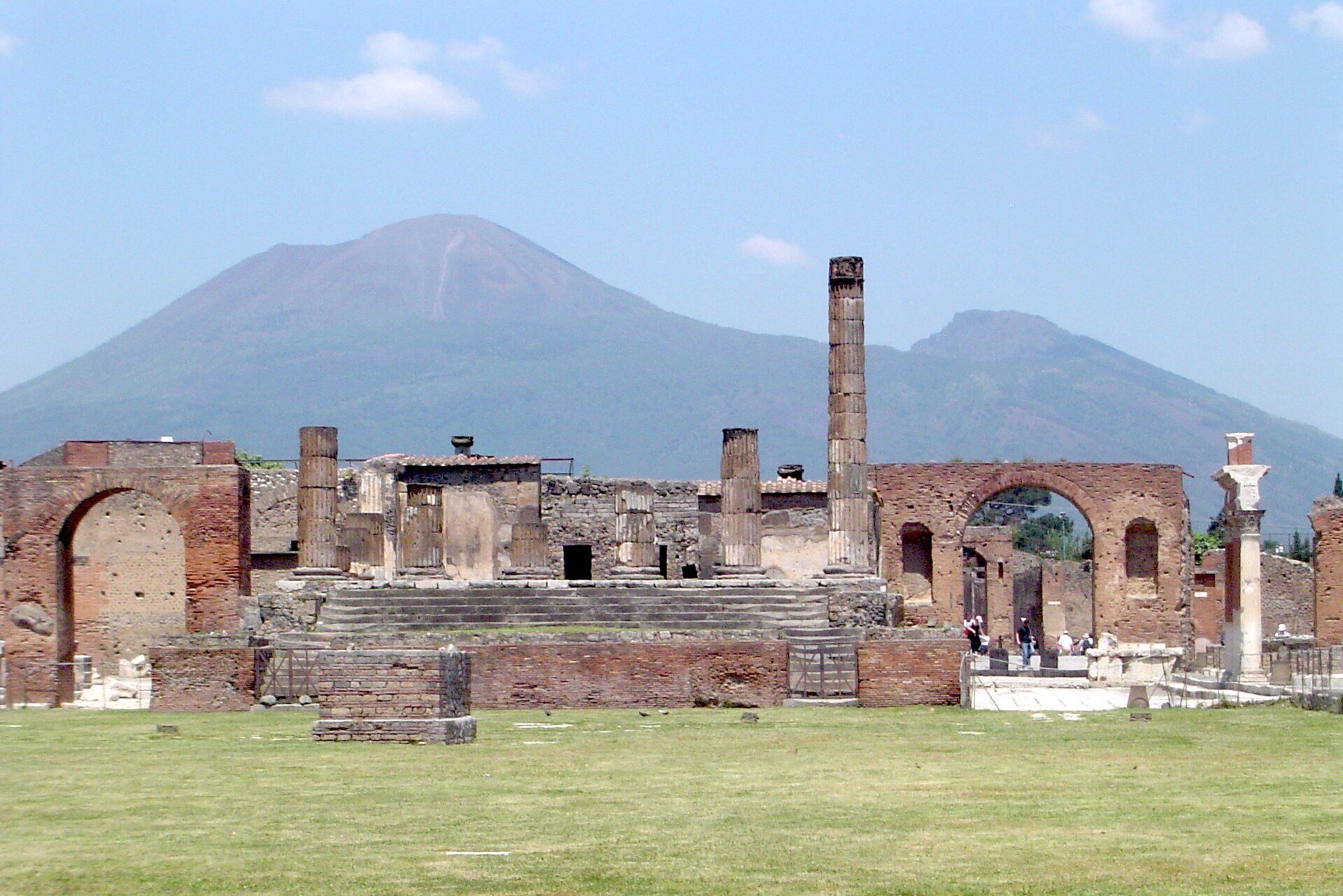
When Mount Vesuvius buried Pompeii and Herculaneum in 79 CE, the eruption left behind more than a famous archaeological record. Its volcanic minerals also preserved a tiny amount of radioactive argon that has now allowed scientists to test one of Earth science’s most important clocks at an unusually young age.
Using the argon-40/argon-39 method, researchers dated the eruption to 1938 ± 13 years before their measurement in 2025. Expressed as a calendar age, that corresponds to 87 ± 13 CE. The result is statistically indistinguishable from the historically established 79 CE date at the 1-sigma level, while achieving about 0.7% relative precision.
That level of precision at an eruption less than 2,000 years old is unprecedented for the argon-40/argon-39 method, according to the authors. The experiment also produced a more precise estimate of a radioactive decay constant used in potassium-argon geochronology.
The result came from a combination of unusually favorable volcanic material and improvements in how the measurements were made. The researchers used potassium-rich sanidine crystals from pumice deposited during the 79 CE eruption, analyzed many portions of the crystals by incremental laser heating, and measured the resulting argon isotopes with a multicollector mass spectrometer.
The experiment was designed around a rare advantage: unlike most prehistoric eruptions, Vesuvius’s 79 CE eruption has a historical age against which a radiometric measurement can be compared.
The historical date is more complicated than it sounds
The researchers first examined the historical evidence they would use as the reference point for their radiometric measurement.
Pliny the Younger witnessed the eruption and described it in two letters. Those letters give the day and month as 24 August, but they do not state the year. The year has to be established from other historical evidence.
The earliest surviving association of the eruption with a specific year comes from the Roman historian Cassius Dio, whose original work survives through later paraphrases. Dio connected the eruption with events involving the emperor Titus. In particular, he placed the eruption in the same year that Titus received his 15th title of imperator and that his father, Vespasian, died.
The researchers traced that chronology through Roman records and the conversion of ancient consular dates into the modern calendar. They conclude that the historical evidence securely places the eruption in 79 CE.
The exact day has been more controversial. Pliny’s description corresponds to 24 August, and the researchers note that Cassius Dio’s account is also compatible with an eruption at the end of summer.
Archaeological discoveries have nevertheless been used to argue for an eruption later in the year. Finds at Herculaneum included braziers, warm clothing and fruits associated with a later season. A charcoal inscription discovered at Pompeii in 2018 has also been interpreted as evidence for an October date. But experiments conducted at Pompeii showed that charcoal graffiti can survive from October until the following August, weakening that argument.
A coin from a hoard in Pompeii was also once thought to bear the inscription IMP XV, apparently referring to Titus’s 15th imperator title, which was granted after 8 September 79 CE. A later reevaluation concluded that the poorly preserved coin instead reads IMP XIII.
The researchers therefore use 24 August 79 CE as their historical reference date, while acknowledging uncertainty in the historical record.
That distinction becomes important later, because the radiometric experiment does not need the historical date to be exact to the day to provide a useful calibration.
The volcanic crystals preserve the signal
The researchers collected about 2 kilograms of pumice lapilli from Villa Poppea at Oplontis, about 1.8 kilometers west-northwest of Pompeii. The material came from the EU2 white pumice fall layer, which contains a particularly high concentration of sanidine and some of the most potassium-rich sanidine in the stratigraphic sequence of the eruption.
Sanidine is a potassium-rich mineral that can be used for argon-argon dating. Radioactive potassium-40 decays over time, producing argon-40 among its decay products. By measuring the relevant isotopes and comparing them with a standard of known age, scientists can determine how much time has passed since the mineral formed or, in this case, since the eruption deposited it.
The researchers crushed and cleaned the pumice, separated a particular grain-size fraction and handpicked pure sanidine crystals without visible inclusions or attached material.
They analyzed 50 grains with scanning electron microscopy. The grains appeared unzoned, meaning the researchers did not observe compositional zoning that might complicate the dating. The bright curved features visible in backscattered-electron images were interpreted as cracks and voids rather than chemical anomalies.
The experiment ultimately used about 700 milligrams of sanidine from the Vesuvius material for the age determination.
Hundreds of measurements converged on one age
The sanidine was divided among irradiation wells and analyzed alongside Alder Creek sanidine, a 1.18-million-year-old standard used to calibrate the measurements.
Two irradiation wells containing Vesuvius material were excluded because they had been contaminated by older material. Their apparent ages ranged from values consistent with 79 CE to more than 20,000 years ago. The similar potassium-to-calcium ratios of the contaminated and uncontaminated material led the researchers to suggest that dust or fine grains from the nearby Alder Creek standard may have caused the contamination during sample loading or unloading.
The remaining material produced a much more coherent result.
The researchers analyzed 153 incremental-heating steps from the uncontaminated material. Those measurements formed a single line on an inverse isochron diagram, a relationship that allows the researchers to determine both the age and the amount of argon that was trapped in the material independently of the atmospheric component.
Together, the measurements yielded an age of 1938 ± 10 years before the measurement date, with a mean squared weighted deviation, or MSWD, of 1.5.
Because the MSWD was greater than 1, indicating more scatter than expected from the individual analytical uncertainties alone, the researchers expanded the uncertainty by the square root of the MSWD. That produced the final uncertainty of ±13 years.
Using their 2025 measurement date, the result corresponds to 87 ± 13 CE.
The historical 79 CE date therefore falls within the radiometric age’s 1-sigma uncertainty range.
Another feature of the measurements helped make the result possible. In individual heating steps, radiogenic argon accounted for as much as 43.9% of the measured argon. A larger radiogenic signal makes it easier to establish the relationship needed for the isochron calculation.
The isochron also produced a trapped argon-40 to argon-36 ratio of 299.64 ± 0.24. That is distinguishable at the 95% confidence level from the atmospheric value of 298.56 ± 0.31.
The difference suggests that the samples contained a small component of magmatic excess argon. Rather than simply assuming the atmospheric ratio, the researchers incorporated the measured trapped-argon relationship into the dating calculation.
Several technical changes pushed the precision further
The authors identify several features of the experiment that together allowed argon-argon dating to reach such a young age with relatively small uncertainty.
The first was the mineral itself. The Vesuvius deposit contains abundant sanidine, and the particular sanidine analyzed from the lower white pumice unit has extremely homogeneous potassium-to-calcium compositions. The researchers say this composition is plausibly consistent with equilibrium with the erupted magma, making the crystals unlikely to contain older xenocrysts or antecrysts that could distort the age.
The second was incremental laser heating.
Instead of simply melting each sample at once, the researchers progressively heated the Vesuvius sanidine. The technique allows nonradiogenic trapped argon to be released efficiently while keeping atmospheric backgrounds relatively low. At higher laser powers, the researchers were able to measure radiogenic argon exceeding 40% of the total signal.
That produced enough spread and enough measurements to identify the slightly elevated trapped argon-40 to argon-36 ratio rather than forcing the analysis to assume a standard atmospheric value.
The third improvement was the mass spectrometer. The researchers used an Isotopx NGX instrument with multiple Faraday detectors equipped with ATONA amplifiers. Multicollector measurements allow isotope beams to be measured simultaneously rather than repeatedly switching between masses, reducing uncertainties associated with comparing measurements made at different times. The ATONA detectors also provided stable measurements of low-intensity ion beams.
The irradiation itself was tightly controlled. The samples were exposed for only six minutes in a cadmium-lined irradiation tube at the Oregon State University TRIGA reactor.
That short irradiation time, together with cadmium shielding and measurements of neutron-induced argon production, reduced the correction required for one interfering reaction involving potassium-40 to about 20 years, with an uncertainty of about one year. Measurements of potassium-derived argon-36 also improved the correction for nonradiogenic argon-40.
Finally, the researchers accounted for spatial changes in neutron fluence across the irradiation discs. Rather than treating the irradiation as uniform, they determined the neutron-fluence parameter for individual sample wells by using nearby standard wells that bracketed each unknown. The resulting average relative precision of the relevant correction was 0.07%.
The same measurement constrains potassium-40 decay
The Vesuvius experiment was also used for a second purpose.
Because the eruption’s approximate age is independently known from historical evidence, the amount of radiogenic argon accumulated in the sanidine can be used to estimate the partial decay constant for potassium-40’s production of radiogenic argon.
The researchers describe the experiment as a controlled radioactive ingrowth measurement. For an eruption roughly 2,000 years old, the amount of potassium-40 that has decayed is so small relative to the isotope’s half-life that the relevant radioactive-growth equation can be simplified to a form that relates the measured radiogenic argon-to-potassium ratio directly to the decay constant and elapsed time.
To determine the radiogenic argon-to-potassium ratio in the Vesuvius sanidine, the researchers linked their measurements to several potassium-argon standards. They used the Vesuvius sanidine’s measured argon-40/argon-39 ratio relative to the Alder Creek standard and an existing calibration connecting Alder Creek to Fish Canyon sanidine.
The resulting radiogenic argon-40 to potassium-40 ratio for the Vesuvius material was (1.1195 ± 0.0081) × 10⁻⁷.
For the elapsed time, the researchers used the midpoint of their analytical session, 1 June 2025, and assigned a one-month uncertainty to encompass the measurement period. They used 24 August 79 CE as the eruption date and assigned a two-month uncertainty to account for uncertainty in the historical record. The resulting total ingrowth interval was 1945.77 ± 0.12 years.
From those values, they calculated a partial decay constant of
5.7551 ± 0.0422 × 10⁻¹¹.
The value is statistically indistinguishable from a previous experimental determination based on liquid scintillation counting, but the uncertainty is nearly twice as small, according to the authors.
The researchers also tested the result with a parallelized Markov chain Monte Carlo analysis of the full posterior distribution. They report that this approach converged on the same result.
The result reaches beyond Vesuvius
The immediate experiment establishes a high-precision argon-argon age for a historically dated eruption. But the authors also use it as a calibration point for the broader potassium-argon dating system.
They note that the current experimental determination of the potassium-40 decay branch that produces radiogenic argon has a relative uncertainty of about 1.4%. Their Vesuvius-based estimate has a smaller uncertainty.
The authors connect this measurement to recent efforts to calibrate the potassium-argon system jointly with other radioisotope systems, including uranium-lead dating. They also discuss the potential role of high-precision argon-argon ages in calibrating radiocarbon dating for volcanic events within the roughly 55,000-year range of radiocarbon dating.
One reason is that radiocarbon ages are calibrated against independently established records because atmospheric carbon-14 levels have varied through time. Volcanic deposits can sometimes contain both minerals suitable for argon-argon dating and charred organic material suitable for radiocarbon dating, creating opportunities to compare the systems.
The authors point specifically to the Millennium Eruption of Changbaishan, on the China-North Korea border, as a case where the dating methods have not yet agreed cleanly. A previous argon-argon study produced an age of 1240 ± 205 years, corresponding to 864 ± 205 CE, while radiocarbon and other proxy records led to an inferred date of 946 CE without a reported uncertainty. The earlier argon-argon measurements also contained many anomalously old apparent-age steps that were attributed to excess argon, and another study attributed anomalous results to contamination by older crystals.
The Vesuvius experiment does not resolve the Changbaishan chronology. The authors instead say that further work could conceivably produce useful argon-argon results for that eruption.
The Vesuvius measurements also provide a new datum for comparing argon-argon dating with other geochronological systems.
For very young eruptions, the central difficulty is that only a small amount of radioactive decay has occurred. That makes the radiogenic signal small relative to sources of uncertainty. The Vesuvius experiment shows that, under favorable conditions, the method can nevertheless resolve an age on a scale of decades for an eruption only about two millennia old.
The final age, 87 ± 13 CE, does not replace the historical date of 79 CE. Rather, it independently reproduces that historically established age within the stated uncertainty while demonstrating the precision that the improved measurement strategy can achieve.
The study was published in Science Advances.