The stars in the night sky have long held humanity in awe, their distant light igniting our curiosity about the vast universe. Yet, despite centuries of study, some of the most intriguing objects in the cosmos remain hidden in the glare of brighter stars. But now, thanks to an innovative collaboration between space-based and ground-based technologies, astronomers have made two groundbreaking discoveries that bring us closer to unveiling these hidden worlds.
A team of astronomers using the Subaru Telescope in Hawaiʻi recently made a stunning discovery: a massive planet and a mysterious brown dwarf orbiting distant stars. These discoveries, published in The Astronomical Journal, mark the first major results from OASIS (Observing Accelerators with SCExAO Imaging Survey), a program designed to hunt for invisible companions that may be lurking around distant stars. For the first time, astronomers have captured direct images of objects that, until now, were nearly impossible to detect.
The Quest for Hidden Worlds
At first glance, the process behind these discoveries may seem simple: find a planet, take a picture, and reveal its secrets to the world. However, the reality is far more complex. In fact, astronomers have long faced a daunting challenge when it comes to spotting massive planets and brown dwarfs. These objects are often faint and difficult to detect because they are overshadowed by the glare of their parent stars. Even young planets, still glowing from the energy of their formation, are barely visible compared to the brightness of their host stars.
Only about 1% of stars host massive planets or brown dwarfs that can be directly imaged with current technology. To locate these elusive objects, astronomers need to know where to look. That’s where OASIS comes in, combining the precision of space-based star-tracking systems like Hipparcos and Gaia with the advanced imaging capabilities of the Subaru Telescope.
With the power of OASIS, the team is able to identify stars that appear to be moving in strange ways, possibly due to the gravitational pull of unseen companions. From there, the Subaru Telescope’s SCExAO system—a powerful tool that uses adaptive optics to block out starlight and capture the faint light of nearby objects—steps in to capture these hidden worlds in stunning detail.
Discovering the Hidden Planet
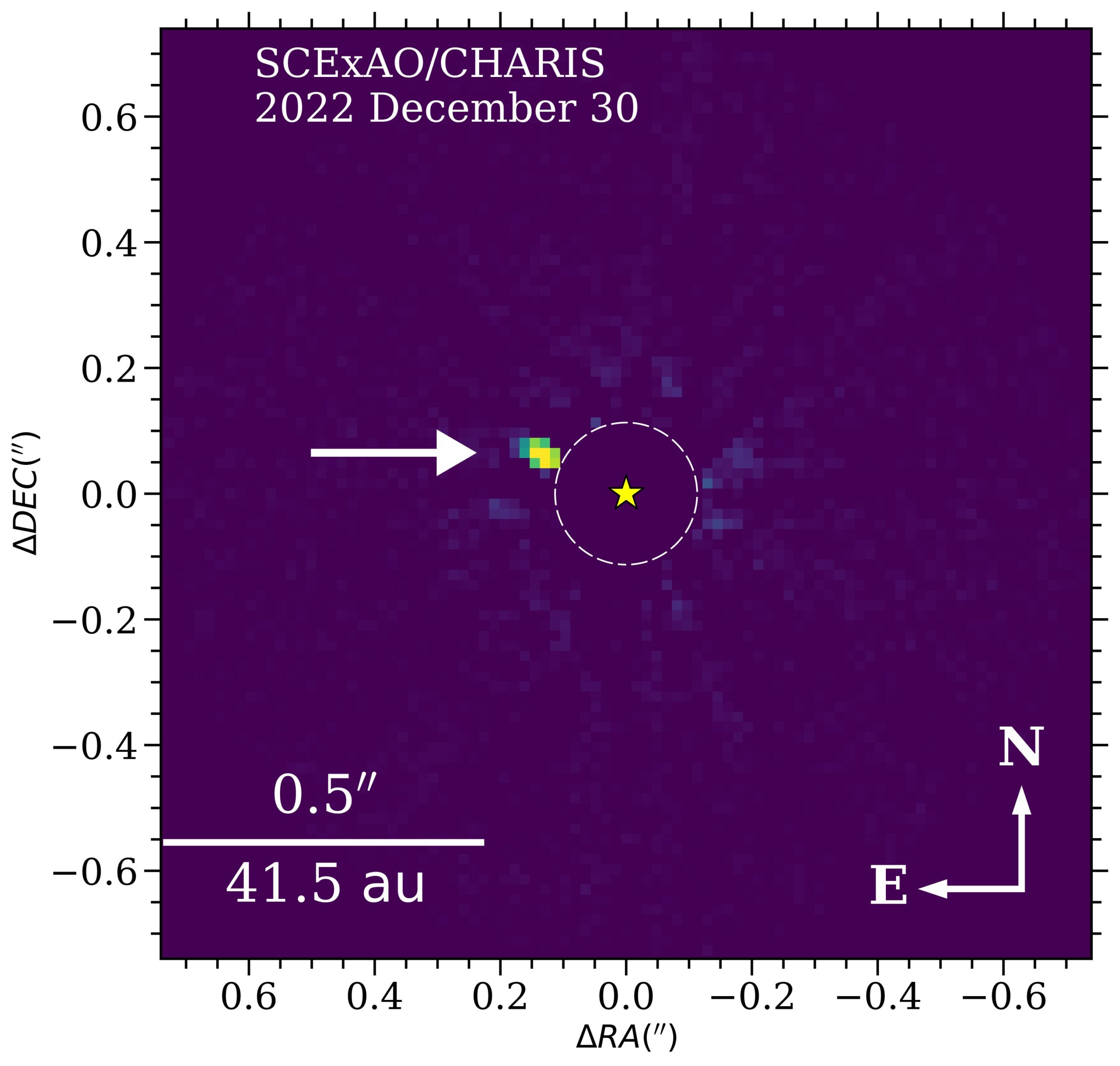
The first of these new discoveries is a massive planet known as HIP 54515 b, located 271 light-years away in the constellation Leo. This planet is nearly 18 times the mass of Jupiter and orbits its star at a distance similar to that of Neptune from our Sun. Despite its enormous size, the planet itself appears surprisingly small when viewed from Earth. It is about as large in the sky as a baseball would appear if seen from 100 kilometers away.
What makes this discovery so remarkable is the clarity with which it was imaged. Using SCExAO’s advanced imaging technology, the astronomers were able to produce incredibly sharp images of HIP 54515 b, revealing a planet that would otherwise have been lost in the glare of its parent star. This breakthrough in imaging technology not only gives us a closer look at distant worlds but also helps set the stage for future explorations of exoplanets.
The Mysterious Brown Dwarf
The second discovery, HIP 71618 B, is a brown dwarf located 169 light-years away in the constellation Bootes. Brown dwarfs are fascinating objects because they form in much the same way as stars, but never accumulate enough mass to sustain nuclear fusion. In other words, they are “failed stars,” not quite big enough to shine like our Sun, but still intriguing objects in their own right.
HIP 71618 B, with a mass 60 times that of Jupiter, is an ideal target for a different kind of mission. This brown dwarf is perfectly suited for observations with NASA’s upcoming Roman Space Telescope. The Roman Telescope, which will test groundbreaking coronagraph technologies designed to capture images of faint Earth-like planets around distant stars, has struggled to find an appropriate target for its demonstrations—until now.
A Perfect Match for Future Missions
What makes HIP 71618 B so special is its unique properties, which make it an ideal candidate for the Roman Space Telescope’s technology demonstration. This brown dwarf meets all the strict requirements needed to test the coronagraph system—a vital tool for future space telescopes to capture faint images of planets that are ten billion times dimmer than their stars. The brightness of HIP 71618 B’s star and the location of the brown dwarf make it a perfect match for validating the new technologies that will one day allow us to directly image Earth-like planets around distant stars.
Before this discovery, astronomers lacked a confirmed target that met all the necessary conditions for these types of observations. HIP 71618 B now checks all the boxes, providing scientists with a rare opportunity to test and refine the technology that will play a crucial role in the search for habitable worlds beyond our solar system.
Looking Toward the Future of Planet Discovery
The discoveries made by the OASIS program showcase the power of combining space-based precision with ground-based imaging to reveal hidden worlds in the cosmos. By leveraging the strengths of both, astronomers are now able to spot planets and brown dwarfs that were previously beyond our reach. These discoveries are not just a technological triumph; they also signal a new era in planet exploration, where distant worlds that once seemed invisible are now coming into focus.
As new space telescopes like the Roman Space Telescope begin to test their cutting-edge technologies, these discoveries from OASIS provide valuable insights that will help guide future missions. The Subaru Telescope, with its world-leading capabilities, will continue to be at the forefront of this exciting field, even as new observatories come online.
Why This Research Matters
This research is not just about capturing beautiful images of distant planets and brown dwarfs; it is about paving the way for the future of space exploration. The ability to detect and photograph exoplanets—particularly those that could resemble Earth—is one of the holy grails of modern astronomy. The technologies being tested today, such as those demonstrated by OASIS and the upcoming Roman Space Telescope, will be critical in the search for life beyond our solar system.
The discoveries of HIP 54515 b and HIP 71618 B represent a monumental step forward in our ability to explore the universe. They bring us closer to understanding how planets form, how stars and their companions interact, and how we might one day find planets that could host life. In a very real sense, these discoveries help us answer one of the most profound questions humanity has ever asked: Are we alone in the universe?
The work of astronomers using the Subaru Telescope shows that, as technology evolves, our ability to uncover the secrets of the cosmos will only grow stronger. And with every new discovery, we get one step closer to understanding our place in the vast expanse of space.
More information: Thayne Currie et al, SCExAO/CHARIS and Gaia Direct Imaging and Astrometric Discovery of a Superjovian Planet 3–4λ/D from the Accelerating Star HIP 54515*, The Astronomical Journal (2025). DOI: 10.3847/1538-3881/ae1a82