Spaghettification is a physical effect in which an object is stretched lengthwise and compressed sideways by differences in gravitational strength across its body. It is most famously associated with black holes, whose intense gravitational fields can pull an object apart as it approaches the event horizon or moves deeper into the black hole.
The name comes from the appearance of an object being elongated into a long, thin strand, resembling a piece of spaghetti. Although the term sounds playful, the underlying physics is serious: spaghettification is a consequence of tidal forces, the same type of gravitational effect responsible for ocean tides on Earth.
Understanding this phenomenon requires looking beyond the idea that gravity simply pulls objects toward massive bodies. Gravity also varies with distance. When one part of an object experiences a stronger gravitational pull than another, the resulting difference can stretch, deform, or eventually destroy it.
What causes spaghettification?
Spaghettification is caused by tidal forces, which arise when gravity acts with different strengths across an extended object.
Every object with mass experiences gravitational attraction from other masses. However, the strength of that attraction depends on distance. In the gravitational field of a compact object such as a black hole, the difference in gravitational acceleration between two nearby points can become enormous.
Imagine an astronaut falling feet-first toward a black hole. The astronaut’s feet are closer to the black hole than the head, so they experience stronger gravitational acceleration. The feet are therefore pulled more strongly toward the black hole than the head.
At the same time, gravity pulls different parts of the astronaut toward the black hole’s center. This produces stretching along the direction of the fall.
There is also a sideways effect. Parts of the body separated in directions perpendicular to the fall tend to move toward one another. This creates compression across the body’s width.
Together, these effects produce the characteristic deformation: stretching in one direction and compression in the other two.
The important point is that spaghettification does not happen simply because gravity is strong. It happens because gravity changes significantly over the size of an object.
An astronaut could experience a strong but nearly uniform gravitational acceleration without being torn apart by tidal forces. Conversely, a sufficiently steep gravitational gradient can produce destructive tidal forces even when the overall gravitational acceleration is not extraordinarily large.
How tidal forces work
Tidal forces are familiar on Earth because of their role in producing ocean tides.
The Moon’s gravitational attraction is slightly stronger on the side of Earth facing it than on the opposite side. This difference contributes to the formation of tidal bulges in Earth’s oceans.
The effect is relatively small because the Moon is far away compared with Earth’s diameter. Nevertheless, it is measurable and has significant consequences for the oceans.
The same principle applies to objects near black holes, but the differences in gravitational strength can become vastly greater.
In a simplified description, the gravitational attraction of a spherical mass decreases with the square of the distance from its center. This means that moving closer to the mass increases the gravitational acceleration, and the rate of increase becomes especially important near compact objects.
For a small object falling toward a black hole, the gravitational field may be substantially stronger at its near end than at its far end.
The resulting difference in acceleration is what produces tidal deformation.
An important distinction is that tidal forces are not a separate kind of gravity. They are the physical consequences of spatial variations in a gravitational field. In general relativity, the more complete theory of gravity, these variations are associated with spacetime curvature.
Why black holes can stretch objects so dramatically
Black holes are particularly effective at producing spaghettification because they concentrate enormous amounts of mass into extremely small regions.
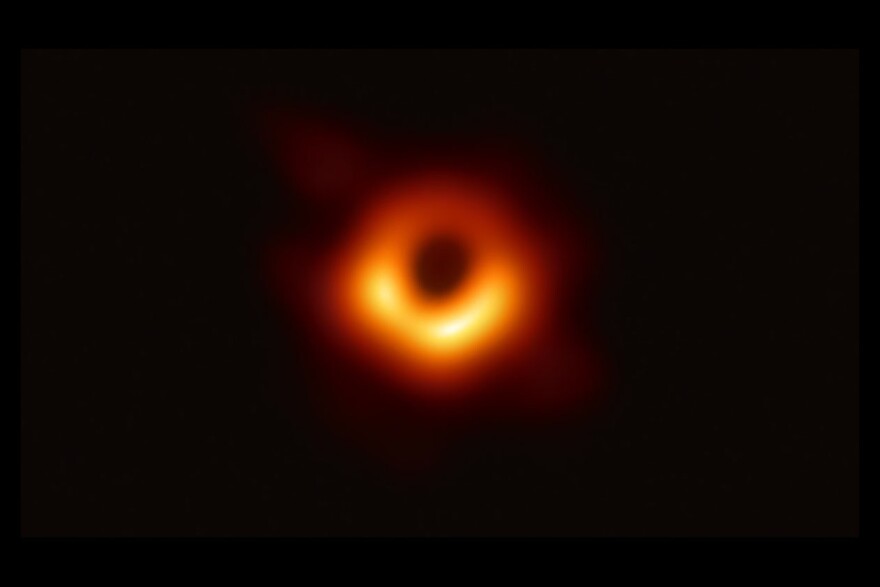
A black hole forms when enough mass becomes concentrated within a sufficiently small volume that an event horizon develops. The event horizon is the boundary beyond which nothing, including light, can escape to the outside universe.
The region inside this boundary is not simply an extremely dense surface. In the standard description, it is a boundary in spacetime that separates events capable of communicating with the distant outside universe from those that cannot.
The gravitational field around a black hole becomes increasingly intense toward its center. More importantly for spaghettification, the gravitational field can change very rapidly over relatively short distances.
An object approaching a black hole may therefore experience increasingly strong differences in gravitational acceleration between its nearer and farther parts.
These differences can overwhelm the forces holding the object together.
For a human body, those binding forces include the strength of bones, muscles, connective tissues, and other biological structures. For spacecraft, they include the mechanical strength of their materials and structural components.
Once tidal stresses exceed an object’s ability to resist deformation, it begins to stretch and break apart.
The process does not require the object to touch anything. A black hole’s gravitational field can destroy an object from a distance through tidal forces alone.
Why the size of a black hole matters
One of the most surprising aspects of spaghettification is that smaller black holes can produce stronger tidal forces near their event horizons than much larger black holes.
This seems counterintuitive because larger black holes contain more mass. However, the relevant factor is not mass alone. It is how rapidly the gravitational field changes across the object.
For a nonrotating, uncharged black hole, the radius of the event horizon increases directly with the black hole’s mass. A more massive black hole therefore has a larger event horizon.
At that larger radius, the gravitational field changes less sharply over a given distance than it does near the event horizon of a smaller black hole.
As a result, the tidal forces at the event horizon decrease as black hole mass increases.
Consider two examples.
A stellar-mass black hole, formed from the collapse of a massive star, may have a mass several times that of the Sun. Its event horizon is relatively small, so tidal forces near the horizon can be strong enough to destroy an approaching human-sized object.
A supermassive black hole, by contrast, can contain millions or billions of solar masses. Its event horizon is enormously larger. Although its overall gravitational influence is immense, the difference in gravitational acceleration across a human body at the horizon can be comparatively modest.
Under idealized conditions, an astronaut approaching a sufficiently massive supermassive black hole could cross its event horizon without immediately noticing any extraordinary tidal stretching.
This does not mean the astronaut would survive indefinitely. Once inside the event horizon, the astronaut could not return to the outside universe, and the tidal forces would eventually become destructive during continued inward motion.
The distinction is important: the event horizon is not necessarily where spaghettification becomes fatal.
What happens when an object approaches a black hole?
Spaghettification is not necessarily an instantaneous event. Depending on the black hole’s mass, the object’s structure, and its trajectory, tidal deformation may develop gradually or become destructive over a relatively short period.
As an object approaches a black hole, several physical effects become increasingly important.
First, the difference in gravitational acceleration between its near and far ends grows. This produces longitudinal stretching and transverse compression.
Second, the object develops internal stresses. Different parts are effectively being accelerated at different rates, while the materials and structures connecting them attempt to hold them together.
Third, if the tidal stresses become greater than the object’s structural strength, it begins to deform permanently. Materials may fracture, tissues may tear, and a spacecraft may lose its structural integrity.
Eventually, the object can be pulled apart into smaller pieces. Those fragments continue moving through the black hole’s gravitational environment and may undergo further deformation.
For sufficiently large tidal forces, even individual pieces of matter can be affected. The exact behavior depends on the physical properties of the material and the strength of the gravitational field.
Spaghettification is therefore better understood as a progressive physical process than as a single dramatic moment.
Does spaghettification happen at the event horizon?
No. Spaghettification does not have to begin at the event horizon, and crossing that boundary does not automatically mean an object will be torn apart.
The event horizon marks the point beyond which escape to the distant outside universe is impossible. It does not mark a physical surface where gravity suddenly becomes stronger or where matter must immediately be destroyed.
Whether an object experiences destructive tidal forces before crossing the horizon depends largely on the black hole’s mass.
Near a small black hole, tidal forces can become fatal well outside the event horizon. An object approaching feet-first could be stretched apart before it reaches the boundary.
Near a sufficiently massive black hole, the tidal forces at the horizon can be weak enough that an object crosses without immediate damage from gravity’s differential effects.
However, crossing the event horizon has an irreversible consequence. Once inside, every future-directed path leads deeper into the black hole rather than back to the outside universe.
For a simple, nonrotating black hole described by classical general relativity, an infalling object eventually encounters the region where tidal forces become extremely large.
Thus, the location of destructive spaghettification and the location of the event horizon are two different things.
What would an astronaut experience?
An astronaut falling toward a black hole would experience spaghettification differently depending on the black hole’s mass and the astronaut’s distance from its center.
Near a stellar-mass black hole, the difference in gravitational acceleration between the astronaut’s feet and head could become enormous. The lower body would be accelerated more strongly than the upper body, producing severe stretching.
At the same time, the body would be compressed sideways. The resulting tidal stresses would eventually overwhelm biological structures.
Near a sufficiently massive supermassive black hole, the astronaut might cross the event horizon before experiencing destructive tidal forces.
For the astronaut, crossing the horizon would not necessarily produce a sudden physical sensation. In a sufficiently large black hole, the local environment at that boundary could be relatively uneventful, assuming no other dangerous matter or radiation was present.
This is an important consequence of general relativity: an event horizon is not necessarily a locally detectable physical barrier.
The experience also differs from what a distant observer would describe.
An astronaut falling freely toward a nonrotating black hole would cross the event horizon in a finite amount of their own proper time. Proper time is the time measured by a clock traveling with the astronaut.
A distant observer using the usual coordinates of a stationary observer outside the black hole would describe the astronaut as appearing increasingly slowed and redshifted as they approach the horizon. The light received from the astronaut would become progressively fainter and more stretched toward longer wavelengths.
The distant observer would not receive a signal showing the astronaut crossing the horizon. This does not mean the astronaut physically freezes at the boundary. It reflects the way time and light propagation behave in curved spacetime.
How general relativity explains spaghettification
Spaghettification is closely connected to Albert Einstein’s general theory of relativity, which describes gravity as the curvature of spacetime.
In Newtonian physics, gravity is treated as a force acting between objects with mass. This description works extremely well for many everyday situations, including planetary motion and falling objects.
General relativity provides a deeper explanation. Massive objects curve spacetime, and freely falling objects follow paths through this curved geometry called geodesics.
A geodesic is the natural path followed by an object moving under gravity alone, without additional forces such as air resistance or engine thrust.
If two nearby objects fall freely toward the same massive body, their paths may gradually move closer together or farther apart. This relative acceleration is the relativistic description of tidal effects.
The phenomenon is especially important near black holes because spacetime curvature becomes increasingly pronounced toward the center.
A freely falling astronaut does not feel ordinary gravitational force in the same way a person standing on Earth’s surface does. In free fall, the astronaut experiences local weightlessness.
However, different parts of the astronaut’s body follow slightly different free-fall paths. The resulting relative acceleration between those parts creates tidal stresses.
This explains an apparent paradox: an astronaut can feel weightless while simultaneously being stretched by a black hole.
Weightlessness concerns the absence of a supporting force acting on the astronaut as a whole. Spaghettification concerns differences in gravitational acceleration across the astronaut’s body.
These are distinct physical effects and can occur together.
Can spaghettification happen outside black holes?
Yes. Although black holes provide the most famous examples, spaghettification is not exclusive to them.
Any sufficiently strong gravitational gradient can produce tidal stretching and compression.
For example, a spacecraft passing extremely close to a planet or another massive astronomical body experiences tidal forces. These forces may be too weak to cause noticeable damage, but they can affect the spacecraft’s orbit, orientation, and structural stresses.
Natural satellites also experience tidal deformation. Jupiter’s moon Io is a particularly striking example.
Io experiences strong tidal forces because of Jupiter’s enormous mass and the gravitational influence of other large moons, which help maintain variations in its orbit. These effects contribute to internal heating and extraordinary volcanic activity.
Io is not being pulled apart like a strand of spaghetti. Its internal structure and gravitational binding allow it to respond through deformation and heating rather than complete disruption.
A more extreme example is a star passing close to a supermassive black hole.
If the star approaches sufficiently closely, the black hole’s tidal forces can exceed the star’s self-gravity, pulling it apart. This event is called a tidal disruption event.
The stellar material becomes stretched into long streams, and some of it may form a hot accretion flow around the black hole. An accretion flow is matter moving inward under gravity while redistributing angular momentum and releasing energy.
These events can produce bright electromagnetic signals, making them valuable opportunities for astronomers to study otherwise difficult-to-observe black holes.
What happens when a star is torn apart?
A star is held together primarily by its own gravity. Its internal pressure, generated largely by hot gas and radiation, helps support it against gravitational collapse.
When a star passes sufficiently close to a black hole, the gravitational acceleration on its near side can differ greatly from that on its far side.
If the tidal forces become stronger than the star’s ability to remain gravitationally bound, the star can be disrupted.
Its material is stretched into elongated streams, often described as tidal debris. Some of this material may escape, while some remains gravitationally bound to the black hole.
The bound material can return toward the black hole and collide with other debris streams. These interactions can produce shocks, heating the gas and helping it lose energy and angular momentum.
Some of the material may eventually settle into an accretion disk or another type of accretion flow.
An accretion disk is a rotating structure of gas and other matter that gradually moves inward toward a compact object. Friction-like processes and magnetic interactions redistribute angular momentum, allowing some material to move closer to the black hole.
As the material heats up, it can emit radiation across different parts of the electromagnetic spectrum.
Astronomers can detect some tidal disruption events through their changing brightness and radiation. These observations help scientists investigate the properties of black holes and the behavior of matter under extreme gravitational conditions.
Not every close encounter produces an observable tidal disruption event. If a star crosses the event horizon before being disrupted outside it, its destruction may not generate the same visible signal for distant observers.
How scientists study spaghettification
Scientists cannot send spacecraft into black holes to directly observe what happens inside an event horizon. Instead, they investigate spaghettification through mathematical models, computer simulations, and astronomical observations.
General relativity provides the theoretical framework for calculating how spacetime curvature affects objects near black holes.
Researchers can use these calculations to estimate tidal forces at different distances and determine whether an object is likely to remain intact, deform, or become disrupted.
Computer simulations are particularly useful for studying complicated events such as stars being torn apart. These models can follow the motion of stellar material, the development of tidal streams, the formation of shocks, and the evolution of accretion flows.
Astronomical observations provide another important source of evidence.
When a star is disrupted by a black hole, the resulting hot material may produce a temporary increase in brightness. By examining how the radiation changes over time, scientists can test models of tidal disruption and infer properties of the black hole and the disrupted star.
These observations do not provide a direct view of spaghettification at every stage. Instead, they allow researchers to compare predicted physical behavior with the radiation actually detected.
Scientists also study tidal effects in other environments, including planetary systems and binary stars. These systems provide opportunities to test gravitational physics under conditions that are less extreme than those near black holes.
What spaghettification reveals about gravity
Spaghettification demonstrates that gravity is not simply about how strongly one object attracts another. The way gravitational strength changes across space can be just as important.
This distinction explains why an enormous black hole can have relatively weak tidal forces at its event horizon while a smaller black hole can produce destructive stretching much farther outside its boundary.
It also illustrates one of the central insights of general relativity: gravity affects not only the motion of objects but also the geometry of spacetime through which they move.
From the gradual deformation of astronomical bodies to the dramatic destruction of stars, tidal forces reveal how objects respond to differences in gravitational acceleration.
Spaghettification is therefore more than an unusual consequence of black holes. It is a vivid demonstration of tidal gravity, one of the fundamental features of the universe’s gravitational structure.