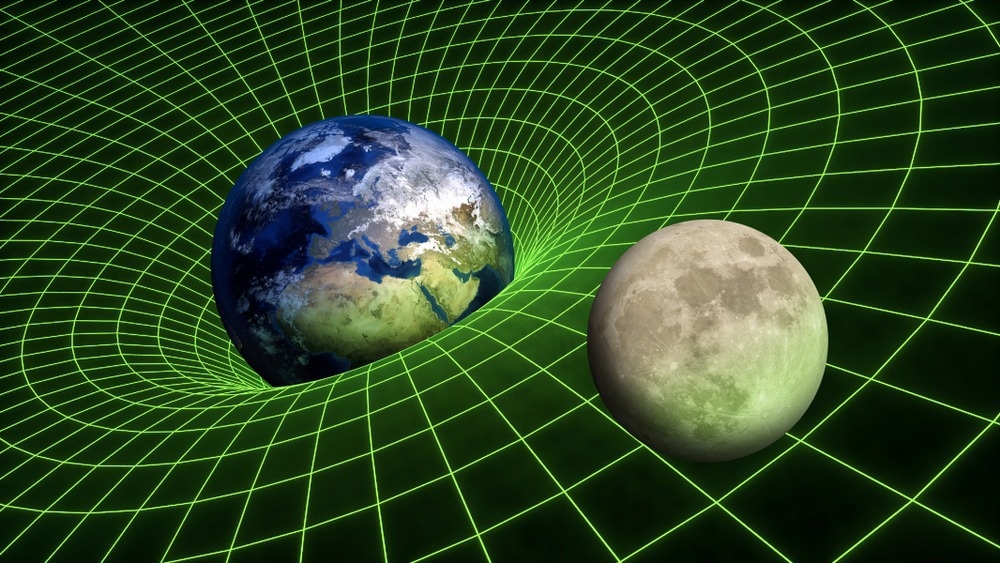
General relativity is Albert Einstein’s theory of gravity, published in its completed form in 1915. It describes gravity not as an invisible force pulling objects together, but as a consequence of the curvature of space and time. According to the theory, matter and energy shape the geometry of spacetime, and objects move through that geometry along paths determined by its curvature.
This idea transformed our understanding of the universe. It explained why planets orbit the Sun, predicted the existence of black holes and gravitational waves, and revealed that time passes at different rates depending on gravity and motion. Today, general relativity is essential to modern astronomy, cosmology, and technologies such as the Global Positioning System (GPS).
The theory is also remarkable for its reach. A framework developed to explain gravity under extreme conditions describes phenomena ranging from the motion of satellites around Earth to the behavior of matter near black holes and the evolution of the universe itself.
Understanding how Einstein arrived at this picture requires reexamining some familiar assumptions about space, time, motion, and the meaning of gravity.
Why Einstein needed a new theory of gravity
For more than two centuries, scientists relied on Isaac Newton’s theory of universal gravitation to explain how objects attract one another. Published in 1687, Newton’s theory described gravity as a force acting between objects with mass. The strength of the attraction depends on their masses and the distance separating them.
Newton’s framework explained the falling of objects, the orbits of planets, the paths of comets, and the motion of moons with extraordinary accuracy. It provided a mathematical foundation for predicting celestial events and remains useful for countless practical calculations.
Yet Newton’s theory left a fundamental question unanswered: How does gravity act across empty space?
In Newton’s mathematical description, the gravitational influence of one object appears to affect another instantaneously, regardless of the distance between them. That assumption was difficult to reconcile with a developing understanding of space, time, and the speed at which physical influences can travel.
By the early 20th century, another challenge had emerged. Einstein’s special theory of relativity, published in 1905, established that the laws of physics are the same for observers moving at constant velocities relative to one another and that the speed of light in a vacuum is the same for all such observers. It also showed that space and time are interconnected and that no physical signal can travel faster than light.
Newtonian gravity did not fit naturally into this framework because its instantaneous action implied that changes in a gravitational field could propagate without delay.
There were also observational clues that Newton’s theory was not the complete story. Mercury, the planet closest to the Sun, follows an orbit whose orientation slowly changes over time. Most of this change can be explained by the gravitational influence of other planets, but a small portion remained unexplained by Newtonian calculations.
The discrepancy was subtle, yet it pointed toward a deeper problem. Einstein sought a theory of gravity consistent with relativity that could also account for the observed motion of Mercury.
His solution required changing more than the mathematical description of gravity. It required rethinking the nature of space and time themselves.
What spacetime means
To understand general relativity, it helps to begin with a distinction between space and spacetime.
In everyday experience, space describes where an object is, while time describes when an event occurs. We tend to think of them as separate backgrounds against which physical events unfold.
Special relativity showed that this separation is not absolute. Measurements of distance and duration depend on the relative motion of observers. Two observers moving relative to each other can disagree about whether two distant events happened at the same time, even though they agree on the underlying physical events and the speed of light.
Space and time are therefore best understood as interconnected aspects of a four-dimensional structure called spacetime. It has three spatial dimensions and one time dimension.
An event is something that happens at a particular place and time. The complete history of an object can be represented as a path through spacetime, called its worldline.
Spacetime is not simply an ordinary three-dimensional space with time added as another interchangeable direction. Time has a different mathematical role from spatial dimensions, and the relationships between spatial and temporal measurements are constrained by the speed of light.
This distinction matters because gravity, in general relativity, affects both spatial geometry and the passage of time.
Massive objects such as Earth and the Sun alter the geometry of the spacetime around them. Other objects then move through that geometry, following paths that may look curved when described using ordinary spatial coordinates.
Gravity is thus not merely about where objects are in space. It is also about how their motion and the passage of time are related to the structure of spacetime.
How gravity becomes the curvature of spacetime
Einstein’s central insight was that gravity can be understood as a change in spacetime geometry rather than as a conventional force acting across a fixed background.
In general relativity, matter and energy influence the curvature of spacetime. That curvature, in turn, determines how matter and light move.
This relationship is summarized by Einstein’s field equations, which connect the geometry of spacetime to the distribution of matter, energy, momentum, and pressure. The equations are complex, but their central message is straightforward: The physical contents of the universe and the geometry of spacetime are linked.
A familiar analogy is a heavy ball placed on a stretched rubber sheet. The ball depresses the sheet, and a smaller ball rolling nearby may follow a curved path because of the altered surface.
The analogy can help illustrate how an object’s presence changes the geometry around it, but it has important limitations. A rubber sheet is a two-dimensional surface that bends into an additional dimension, and gravity causes the balls to roll partly because of Earth’s own gravitational pull. General relativity does not require spacetime to bend into some external dimension. Its curvature is an intrinsic geometric property that can be described by measurements made within spacetime itself.
Nor does the analogy fully capture time, which plays a central role in gravity. In many situations, differences in the rate at which time passes are more important to understanding gravitational effects than the picture of curved space alone.
Consider Earth orbiting the Sun. In Newtonian physics, the Sun continually pulls Earth inward through gravity, keeping it in orbit rather than allowing it to travel in a straight line away from the solar system.
In general relativity, the Sun changes the geometry of the surrounding spacetime. Earth, moving through that geometry, follows a natural path called a geodesic. A geodesic is the closest equivalent in curved spacetime to a straight line in flat space, generalized to account for the geometry involved.
Earth’s orbital path is not a straight line when viewed in ordinary space, but its motion can be understood as the natural continuation of its movement through curved spacetime.
This does not mean that gravity is imaginary or that objects somehow ignore physical influences. The theory provides a different and more comprehensive account of what gravity is and how it operates.
In weak gravitational fields, such as those around Earth or in much of the solar system, general relativity produces results that are extremely close to Newton’s predictions. Newton’s theory remains an excellent approximation for many everyday applications. Einstein’s theory becomes especially important when precision is high, gravitational fields are strong, or the structure of spacetime changes significantly.
The equivalence principle: Einstein’s crucial insight
One of the ideas that guided Einstein toward general relativity was the equivalence principle. In its simplest form, it concerns the close relationship between gravity and acceleration.
Imagine standing inside a closed elevator with no windows. If the elevator is resting on Earth’s surface, you feel pressed against the floor. Your feet experience an upward force from the floor, preventing you from falling freely toward Earth.
Now imagine the elevator floating far from planets and stars but accelerating upward at approximately 9.8 meters per second squared. You would feel pressed against the floor in much the same way.
If the elevator were sufficiently small and the experiment sufficiently limited, you could not distinguish the effects of Earth’s gravity from those of the elevator’s acceleration using purely local mechanical experiments.
Einstein recognized that this equivalence was more than a curious similarity. It offered a way to understand gravity as connected to the geometry of spacetime and the behavior of freely falling objects.
The principle also helps explain why objects of different masses fall at the same rate in a vacuum, provided they start under equivalent conditions and other forces are negligible. A heavy object and a light object experience the same gravitational acceleration, even though Newtonian gravity describes the gravitational force on the heavier object as greater.
In general relativity, a freely falling object follows a geodesic. It is not being pushed away from that path by a separate gravitational force. Instead, its motion reflects the geometry of spacetime.
This leads to an initially surprising conclusion: A person falling freely under gravity does not feel their own weight. Astronauts aboard the International Space Station experience apparent weightlessness because they and the station are continually falling around Earth together, not because Earth’s gravity has disappeared.
By contrast, a person standing on the ground feels weight because the surface prevents them from following their natural free-fall path. The ground pushes upward on the person.
The equivalence principle is not an assertion that gravity and acceleration are identical in every circumstance. Gravitational fields can vary from place to place, producing tidal effects that an accelerating elevator in otherwise empty, flat spacetime cannot fully reproduce. Such differences are essential to understanding the deeper geometry of gravity.
Why gravity changes the passage of time
One of the most consequential predictions of general relativity is gravitational time dilation: Clocks at different gravitational potentials can tick at different rates.
In the weak gravitational field around Earth, a clock closer to Earth’s surface ticks slightly more slowly than a comparable clock farther away, assuming other effects such as relative motion are accounted for.
This is not a defect in a clock or an illusion caused by observing it from a distance. The difference is a physical feature of spacetime. When clocks follow different paths through spacetime, they can accumulate different amounts of elapsed time between events.
Imagine two highly accurate clocks. One remains at sea level, while the other is placed high on a mountain. After their readings are compared under carefully controlled conditions, the mountain clock will have accumulated slightly more time because it sits in a weaker gravitational field.
The difference is tiny for ordinary elevations, but modern atomic clocks can measure it.
Motion also affects the passage of time. According to special relativity, a clock moving relative to an observer generally accumulates less elapsed time than a clock at rest in that observer’s reference frame, when the clocks’ paths are compared appropriately.
In practical situations, gravitational and motion-related effects can act in opposite directions. Predicting the total difference requires accounting for both.
The importance of time dilation extends beyond laboratory experiments. GPS satellites orbit Earth at high altitudes, where gravity is weaker than at Earth’s surface. Their motion also causes a relativistic timing effect. The gravitational effect makes their clocks tick faster relative to ground clocks, while the motion-related effect makes them tick more slowly.
The gravitational contribution is larger, so the net effect is that satellite clocks gain roughly 38 microseconds per day relative to clocks on Earth’s surface before the relevant corrections are applied. That difference may seem insignificant, but light travels about 300 meters in a microsecond. Without relativistic corrections, navigation errors would accumulate rapidly.
GPS is a practical demonstration that relativity is not merely an abstract theory about distant stars or exotic cosmic objects. Its predictions are necessary for precise technologies used in everyday life.
How Einstein’s theory passed its early tests
A scientific theory becomes compelling when it makes predictions that can be checked against observations. General relativity succeeded because it explained existing puzzles and predicted measurable effects that could be tested independently.
One of its early successes concerned Mercury’s orbit.
Planets do not trace perfectly repeating ellipses around the Sun. Their orbital paths slowly shift because of gravitational interactions with other planets and additional effects. After known planetary influences were calculated, Mercury still exhibited a small unexplained advance in the orientation of its orbit.
General relativity accounted for the remaining discrepancy, approximately 43 arcseconds per century. An arcsecond is one-sixtieth of an arcminute, and an arcminute is one-sixtieth of a degree. The effect is extremely small, but Einstein’s theory explained it without requiring an unknown planet or another adjustment to Newtonian gravity.
Another important prediction was the bending of light by gravity.
In Newtonian physics, gravity is conventionally described as acting on mass, which raises the question of how light, with no rest mass, could be affected. General relativity provides a different answer: Light follows paths determined by spacetime geometry. When light passes near a massive object, its path can be deflected.
During a total solar eclipse in 1919, astronomical observations of stars near the apparent position of the Sun were used to test the predicted bending of starlight. The observations supported Einstein’s prediction, although the early measurements had significant uncertainties and were not, by themselves, the final word on the theory.
Subsequent observations and increasingly precise experiments have strengthened the evidence for gravitational light bending.
Today, astronomers use this effect in gravitational lensing. When a massive galaxy or cluster lies between Earth and a more distant source of light, its gravitational field can bend and magnify the background light. In some arrangements, the result is multiple images of the same object, arcs of light, or nearly complete rings called Einstein rings.
Gravitational lensing helps scientists study distant galaxies, estimate the distribution of mass in galaxy clusters, and investigate dark matter, which does not emit or reflect light in the ordinary way but reveals its presence through gravitational effects.
The theory has also been tested through increasingly precise measurements of planetary motion, atomic clocks, spacecraft trajectories, and the behavior of compact astronomical objects. Its predictions have repeatedly agreed with observations within the accuracy of the experiments.
Black holes and the limits of ordinary intuition
General relativity predicts that spacetime can become so strongly curved that a region forms from which nothing, not even light, can escape to distant observers. This region is associated with a boundary called the event horizon, which defines a black hole’s point of no return.
Black holes are not simply cosmic vacuum cleaners that pull in everything nearby. At a sufficient distance, an isolated black hole produces the same external gravitational field as another object with the same mass and angular momentum, under the conditions described by the standard idealized models. If the Sun could somehow be replaced by a black hole of exactly the same mass, Earth would not suddenly be pulled inward. It would continue along approximately the same orbit, although the solar system would lose the sunlight and heat supplied by the Sun.
The defining difference appears near the black hole, where gravity can become extraordinarily strong and the event horizon determines which signals can reach distant observers.
Black holes can form when sufficiently massive stellar cores collapse under their own gravity. As matter compresses into a smaller region, the gravitational field becomes increasingly intense. If the collapse produces an event horizon, no signal originating inside that boundary can escape to the outside universe.
General relativity describes the spacetime around black holes with remarkable precision in many circumstances. It also predicts that the theory’s classical equations lead to a singularity under certain idealized conditions, including the simplest mathematical description of a black hole. A singularity is a breakdown of the classical description, associated with quantities such as spacetime curvature becoming unbounded.
It would be misleading to treat this mathematical prediction as a complete physical explanation of what happens at the deepest interior. Most physicists expect quantum effects to become important under such extreme conditions, but a fully established theory combining quantum physics with gravity is not yet available.
Black holes are now supported by multiple lines of observational evidence. Astronomers have measured the motions of stars orbiting unseen compact objects, detected radiation from hot matter around black holes, and observed the gravitational waves produced when black holes merge. The Event Horizon Telescope collaboration has also produced images of the bright emission surrounding the shadows of supermassive black holes.
These observations do not mean that every detail of black hole interiors is understood. They do show that objects matching general relativity’s black hole predictions exist in nature.
Gravitational waves: When spacetime moves
General relativity predicts that changes in the distribution and motion of mass and energy can produce disturbances in spacetime that propagate outward at the speed of light. These disturbances are called gravitational waves.
A useful, though limited, analogy is a ripple spreading across the surface of water after a disturbance. Gravitational waves are not ripples in a material substance or a medium surrounding spacetime. They are changes in spacetime geometry itself.
Most ordinary objects produce gravitational waves too weak to detect with current instruments. The strongest observable signals come from extreme events involving massive objects undergoing rapid acceleration, particularly compact systems such as merging black holes or neutron stars.
A neutron star is the extremely dense remnant of a massive star that has undergone a supernova explosion. When two neutron stars orbit one another, they lose energy by emitting gravitational waves. As their orbit shrinks, they move closer together and eventually collide or merge, producing a stronger signal.
In September 2015, the Laser Interferometer Gravitational-Wave Observatory, or LIGO, made the first direct detection of gravitational waves, generated by the merger of two black holes. The signal matched the general pattern predicted by relativity for such a system.
The detection was a major achievement because gravitational waves carry information that is difficult or impossible to obtain from light alone. They allow scientists to study the motion and properties of massive objects, including black holes that emit little or no light themselves.
In 2017, detectors observed gravitational waves from a neutron-star merger, alongside electromagnetic signals from the same event. The combined observations helped scientists investigate the origin of some heavy elements and test aspects of gravitational physics.
Gravitational-wave astronomy has since developed into a new way of exploring the universe. Rather than relying only on electromagnetic radiation, astronomers can measure the distortions produced when spacetime itself carries energy across cosmic distances.
General relativity and the expanding universe
General relativity also provides the framework for modern cosmology, the scientific study of the universe as a whole.
When Einstein applied his equations to the universe, he found that they naturally allowed cosmological models in which space expands or contracts. This was a major conceptual shift. The universe no longer had to be treated as a static, unchanging stage.
Observations subsequently established that the universe is expanding: On sufficiently large scales, distant galaxies generally recede from one another, and more distant galaxies tend to show greater recession speeds in the standard description of cosmic expansion.
This expansion does not mean that galaxies are all flying away from a single central point through preexisting empty space. Instead, the distances between widely separated, gravitationally unbound regions of space increase as the universe expands.
The distinction is important. On small scales, gravity can hold systems together. Atoms, people, planets, solar systems, and galaxies do not expand in step with the universe in the simple way that distant cosmic regions do. Their internal structure is governed by local physical processes and gravitational or other binding forces.
General relativity also underlies the standard account of the universe’s early evolution. When the equations are applied to a universe filled with matter and radiation, they describe how its expansion changes over time. Combined with observations of cosmic expansion, the cosmic microwave background, and the abundance of light elements, the framework supports the broad picture of a universe that evolved from an earlier hot, dense state.
However, general relativity alone does not settle every question about cosmic history.
Observations indicate that the expansion of the universe is accelerating. In the standard cosmological model, this acceleration is attributed to dark energy, a term for whatever is driving the observed effect. The simplest mathematical representation is a cosmological constant, which can be interpreted as a constant energy density associated with space itself.
The physical nature of dark energy remains unknown. It may be adequately described by a cosmological constant, or it may point toward more complicated physics. Current observations do not conclusively establish its underlying nature.
Similarly, dark matter is inferred from its gravitational effects on galaxies, galaxy clusters, and the large-scale structure of the universe. General relativity helps scientists calculate how this unseen mass affects cosmic motion and light, but the identity of dark matter remains an open question.
The theory is therefore central to cosmology without being a complete answer to every cosmological mystery.
Where general relativity works—and where it may be incomplete
General relativity has passed a wide range of tests, from the solar system to black-hole mergers. Its success is one of the strongest reasons physicists regard it as the best established classical theory of gravity.
Yet the theory has important limits.
One difficulty arises when scientists try to describe gravity at extremely small scales. Quantum mechanics, the framework used to understand atoms, elementary particles, and other microscopic systems, describes nature in terms of quantum states and probabilistic outcomes. General relativity, by contrast, describes gravity through the geometry of spacetime in a classical framework.
Both theories work remarkably well in their respective domains. The challenge is that they do not yet form a single, experimentally confirmed framework that consistently describes every situation in which quantum effects and strong gravity are simultaneously important.
This issue becomes especially significant near the classical singularities associated with black holes and in attempts to describe the earliest moments of the universe. Under those conditions, physicists expect a theory of quantum gravity to be necessary.
Several approaches to quantum gravity have been developed, including string theory and loop quantum gravity, but no approach has yet achieved decisive experimental confirmation as a complete description of nature.
It is also important to distinguish a mathematical limitation from evidence that a theory is wrong in the situations where it has been tested. A theory can be extraordinarily accurate within a defined range of conditions and still be incomplete at extremes it cannot adequately describe.
Newtonian mechanics illustrates this point. It remains useful for calculating the motion of many everyday objects even though it is not the most complete description of motion. General relativity similarly reproduces Newtonian gravity under appropriate weak-field and low-speed conditions while extending the theory to phenomena Newton’s framework cannot fully explain.
Future observations may reveal additional limits to general relativity, particularly through precise gravitational measurements, cosmological observations, and studies of extreme environments. So far, however, its central predictions have survived a remarkable range of experimental and observational tests.
Why Einstein’s change in perspective matters
General relativity changed the meaning of gravity by connecting it to the structure of space and time. Rather than treating gravity as a force acting instantaneously between separated objects, Einstein described it as an effect of spacetime geometry, shaped by matter and energy and followed by freely moving objects and light.
That shift explains why planets orbit stars, why light bends near massive bodies, why clocks run at different rates in different gravitational fields, and why accelerating masses can produce gravitational waves. It also provides the mathematical foundation for understanding black holes and the evolution of the universe.
The theory does not eliminate every mystery. Its compatibility with quantum mechanics remains an unresolved challenge, and the physical nature of dark matter and dark energy is still uncertain. Those open questions are part of the continuing scientific effort to understand how the universe works.
Einstein’s achievement was not simply to replace one formula for gravity with another. It was to show that a familiar feature of everyday life reflects a deeper relationship between matter, energy, space, and time—a relationship that becomes visible whenever measurements are precise enough or the universe pushes physical conditions to their limits.