Earthquakes occur when built-up stress inside Earth causes rocks to break or suddenly slip along a fracture in the crust, releasing energy that travels through the ground as seismic waves. Most earthquakes happen along faults, where large sections of Earth’s crust move relative to one another. Although the ground may shake for only a few seconds, the forces responsible can accumulate over decades, centuries, or even longer.
The movement of Earth’s tectonic plates provides the main driving force behind most earthquakes. These enormous slabs of rock are constantly shifting, colliding, separating, and sliding past one another. Their motion gradually loads stress onto faults. When the stress exceeds the strength of the rocks or the friction holding them together, the fault slips, releasing stored energy and setting the surrounding ground in motion.
Understanding earthquakes means looking beneath Earth’s surface, where slow geological processes can produce sudden and sometimes destructive changes at the surface.
How Earth’s moving plates cause earthquakes
Earth’s outermost rigid layer consists of the crust and the uppermost part of the mantle. Together, these form the lithosphere, which is divided into large pieces called tectonic plates. These plates move slowly over the hotter, weaker rock beneath them, generally at rates comparable to how quickly fingernails grow.
The plates move because of several interacting forces, including the sinking of cold, dense oceanic plates into the mantle and the gravitational pull that helps drive plates away from elevated ocean ridges. Heat escaping from Earth’s interior also contributes to the movement of material within the mantle.
Although plate motion is gradual, the boundaries between plates are often sites of intense stress. The plates do not always slide smoothly past one another. Their rough surfaces and the rocks within them create friction that can temporarily lock sections of a fault in place.
As the plates continue moving, the surrounding rocks deform. They bend, compress, stretch, or twist while the fault remains locked. Eventually, the stress may overcome the resistance to movement, causing the rocks to slip abruptly. That sudden release of energy produces an earthquake.
Most earthquakes are associated with tectonic plate boundaries, but earthquakes can also occur within plates, far from their edges. These intraplate earthquakes may result from ancient faults being reactivated by stresses transmitted through the crust.
What happens along a fault
A fault is a fracture or zone of fractures in Earth’s crust along which rocks have moved relative to each other. Faults can extend for considerable distances and may reach deep into the crust. They provide the surfaces along which many earthquakes occur.
The relationship between stress, friction, and rock deformation explains why earthquakes often happen suddenly rather than through continuous movement.
When a fault is locked, tectonic forces continue pushing or pulling on the surrounding rocks. The rocks deform elastically, meaning they can temporarily change shape and return toward their original form if the stress is removed. However, as stress builds, the rocks store elastic energy.
If the stress becomes sufficient to overcome friction or break the surrounding rock, the fault begins to slip. The movement may spread rapidly along part of the fault, releasing accumulated energy as seismic waves. The rocks on either side of the fault shift into a new position, relieving some of the stress.
This process is commonly described by the elastic rebound theory. After an earthquake, the rocks are generally less deformed near the portion of the fault that slipped, although substantial stress may remain elsewhere.
Not every part of a fault behaves the same way. Some sections remain locked for long periods, while others move gradually in a process called fault creep. Certain faults experience both slow movement and sudden earthquakes. The balance depends on factors such as rock type, temperature, pressure, friction, and the presence of fluids.
The three main types of tectonic plate boundaries
Earthquakes occur in different settings because tectonic plates interact in different ways. The type of movement helps determine the kind of fault involved, the depth of the earthquake, and the potential for damage.
Convergent boundaries
At convergent boundaries, two plates move toward each other. When an oceanic plate meets another plate, the denser oceanic plate may descend beneath it in a process called subduction.
Subduction zones can generate some of Earth’s largest earthquakes. Friction may lock extensive sections of the boundary between the descending plate and the overriding plate. As the plates continue moving, stress accumulates until a large section slips.
These earthquakes can occur at shallow depths near the plate boundary and much deeper within the descending slab. Powerful shallow earthquakes beneath the ocean can displace the seafloor and generate tsunamis.
When two continental plates collide, neither plate readily sinks beneath the other. Instead, the crust can buckle, thicken, and break along faults. This process helps build mountain ranges and produces earthquakes in regions such as the Himalayas.
Divergent boundaries
At divergent boundaries, tectonic plates move apart. As the crust stretches, it becomes thinner and fractures. Magma may rise from below to fill the opening and create new crust.
Earthquakes in these settings are generally shallow because the hot, stretched crust is relatively thin and can fracture near the surface. Many occur along mid-ocean ridges, where new oceanic crust forms, and along continental rifts, where a continent is gradually pulling apart.
Although some divergent-boundary earthquakes can cause damage, many occur beneath the ocean or in sparsely populated areas.
Transform boundaries
At transform boundaries, two plates slide horizontally past each other. The San Andreas Fault in California is a well-known example.
Even when the overall plate motion is sideways, sections of a transform fault can become locked by friction. Stress accumulates until the rocks suddenly slip, producing an earthquake.
The direction of movement along a fault influences the pattern of ground displacement. Along a strike-slip fault, the blocks on opposite sides move mainly horizontally relative to each other. Other faults involve predominantly vertical movement or a combination of vertical and horizontal displacement.
Earthquakes can occur wherever the rocks experience sufficient stress and are capable of brittle failure, not only at the boundaries between major plates.
How seismic waves make the ground shake
An earthquake releases energy at a point or region within Earth called the hypocenter, also known as the focus. The point directly above it on Earth’s surface is the epicenter.
The released energy travels outward in the form of seismic waves. These waves carry the motion produced by the sudden fault slip through the surrounding rocks and, eventually, to the surface.
There are two main categories of seismic waves: body waves, which travel through Earth’s interior, and surface waves, which travel along or near the surface.
Primary waves, or P waves, are compressional waves. They move particles back and forth in the same general direction as the wave travels, alternately compressing and expanding the material. P waves can travel through solids, liquids, and gases, and they are generally the fastest seismic waves.
Secondary waves, or S waves, move particles perpendicular to the direction in which the wave travels. These shear waves can pass through solid rock but not through liquids. They generally arrive after P waves because they travel more slowly.
When body waves reach Earth’s surface, they can generate surface waves. Love waves produce primarily horizontal side-to-side motion, while Rayleigh waves create a rolling motion involving both vertical and horizontal displacement. Surface waves can cause substantial damage because they often produce strong shaking near the ground surface.
The different waves arrive at different times because they travel at different speeds and along different paths. Seismometers record these motions, allowing scientists to identify earthquakes, estimate their locations, and study Earth’s internal structure.
Why some earthquakes are stronger than others
Earthquakes vary greatly in size. Some release so little energy that people never notice them, while others rupture extensive sections of a fault and produce destructive shaking over large areas.
One important factor is the size of the fault area that slips. A larger rupture can involve more rock and release more energy. The amount of movement along the fault and the stiffness of the surrounding rock also influence how much energy is released.
Earthquake size is commonly expressed using moment magnitude, a measure based on the physical characteristics of the rupture. These include the area of the fault that slipped, the average amount of displacement, and the rigidity of the rocks.
The magnitude scale is logarithmic. An earthquake of magnitude 6 releases about 32 times as much seismic energy as one of magnitude 5, while a magnitude 7 earthquake releases about 1,000 times as much energy as a magnitude 5 earthquake.
Magnitude is different from intensity. Magnitude describes the overall size of an earthquake, whereas intensity describes how strongly the shaking is felt and what effects it produces at a particular location. One earthquake has a single estimated magnitude, but its intensity can vary substantially from place to place.
Several factors determine how strongly an earthquake affects a community. These include the distance from the rupture, the depth of the earthquake, the direction in which the rupture propagates, and the local geology. Soft sediments can amplify certain seismic waves, sometimes producing stronger shaking than nearby areas built on solid bedrock.
Buildings also respond differently to ground motion. Their height, structural design, construction quality, and ability to withstand sideways forces can influence whether they remain standing or suffer serious damage.
Why earthquake depth matters
Earthquakes occur at a range of depths, and that depth influences how their effects reach the surface.
Shallow earthquakes occur relatively close to the ground surface and can produce intense shaking near the fault, especially when the rupture is large. Because seismic waves have less distance to travel before reaching nearby communities, their energy may remain concentrated enough to cause significant damage.
Intermediate-depth and deep earthquakes occur farther below the surface, particularly within descending tectonic plates at subduction zones. Deep earthquakes can be felt over wide regions, but they often cause less intense surface shaking directly above them than a comparable shallow earthquake would, although the actual effects depend on magnitude, depth, and local conditions.
The deepest earthquakes occur within cold, sinking slabs of oceanic lithosphere. Scientists understand many aspects of these events, but the exact mechanisms that allow rocks to fail under the extreme pressures and temperatures found at great depths remain an active area of research.
Unlike shallow earthquakes, which commonly result from frictional sliding along faults, deep earthquakes cannot always be explained by ordinary brittle fracture alone. Processes involving changes in mineral structure, localized deformation, and other mechanisms may contribute.
Earthquakes that do not originate from plate movement
Although tectonic forces cause most earthquakes, other processes can also produce ground shaking.
Volcanic earthquakes occur when magma moves, gases expand, or pressure changes fracture rocks around a volcanic system. These earthquakes can accompany volcanic unrest, but not every volcanic earthquake leads to an eruption. Scientists examine earthquake patterns alongside other observations to assess what may be happening beneath a volcano.
Some earthquakes are associated with human activities. Reservoirs created by large dams can alter stresses in the crust as water adds weight and seeps into fractures. Mining can disturb the balance of stress around excavated rock. Certain industrial operations, including the underground injection of wastewater or fluids used in some energy-related activities, can increase pressure within existing fractures and faults.
When fluid pressure rises inside a fault, it can reduce the effective force pressing the rock surfaces together. This reduction can make slipping easier, allowing a fault already under stress to move.
Human-induced earthquakes vary in size, and not every activity that changes underground pressure produces a noticeable event. The outcome depends on the geology, the preexisting stress state, the properties of the fault, and the nature of the activity.
Explosions, landslides, and other sudden events can also generate seismic signals. Scientists distinguish these from tectonic earthquakes by analyzing waveform characteristics, event locations, depth estimates, and other evidence.
Why earthquakes cause damage
Ground shaking is the most familiar earthquake hazard, but the consequences depend on more than the magnitude alone.
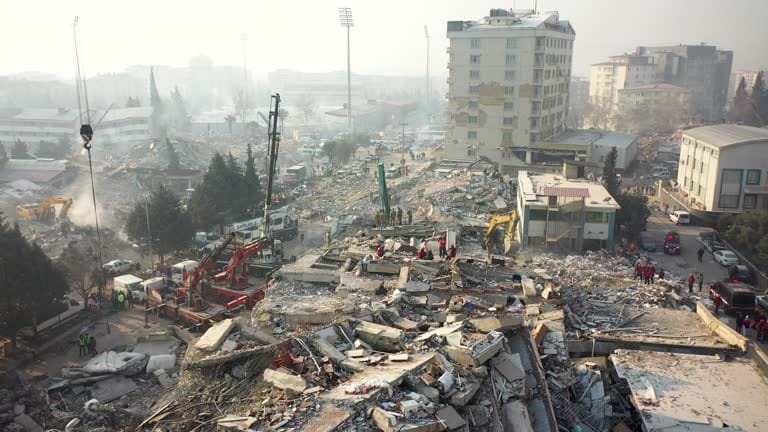
As seismic waves pass through a building, they push its foundation in different directions. The structure must resist these changing forces without losing stability. If the shaking exceeds the building’s capacity, walls can crack, structural connections can fail, and floors or roofs may collapse.
The duration of strong shaking matters, too. A long earthquake can subject a structure to repeated cycles of stress, increasing the likelihood of damage. A building may also be affected by the frequency of the shaking, which depends on the seismic waves and the characteristics of the ground.
Local soil conditions can significantly alter the effects. Loose sediments and soft soils may amplify certain frequencies of ground motion. In some water-saturated sediments, intense shaking can cause liquefaction, a process in which the soil temporarily loses much of its strength and behaves more like a fluid. Buildings may settle or tilt, and buried pipes may shift or break.
Earthquakes can trigger landslides on steep slopes, damage dams and roads, and disrupt water, electricity, transportation, and communication systems. In coastal regions, a large undersea earthquake can generate a tsunami if it causes substantial vertical displacement of the seafloor.
Fires may follow when gas lines or electrical systems are damaged. In mountainous regions, landslides can block rivers and create temporary lakes that may later flood downstream areas if the barriers fail.
These secondary hazards help explain why an earthquake’s total impact can extend well beyond the area of strongest shaking.
Can scientists predict when an earthquake will happen?
Scientists can identify regions where earthquakes are more likely over long periods, estimate the likelihood of future events, and assess the expected range of earthquake sizes. However, reliably predicting the exact time, location, and magnitude of an individual earthquake remains beyond current scientific capabilities.
One reason is that faults form complex systems. Their behavior depends on irregular surfaces, changing friction, fluid pressure, accumulated stress, and interactions with nearby faults. Scientists can study these factors, but they cannot measure every relevant condition throughout an entire fault system.
Small earthquakes, unusual animal behavior, changes in groundwater, and other proposed warning signs do not provide a dependable basis for predicting a specific earthquake. A smaller earthquake may precede a larger event, but scientists generally cannot know that it was a foreshock until the larger earthquake occurs.
Earthquake early-warning systems address a different problem. They detect the first seismic waves from an earthquake that has already begun and use that information to estimate the shaking that may follow. Because some waves travel more slowly than electronic signals, an alert can sometimes reach people or automated systems before the strongest shaking arrives.
The warning may provide only seconds, and locations close to the rupture may receive little or no advance notice. Even so, a brief alert can give people time to take protective action or allow systems to slow trains, open firehouse doors, or shut down vulnerable equipment.
Long-term hazard assessment remains essential. Mapping faults, studying past earthquakes, measuring ground deformation, monitoring seismic activity, and applying earthquake-resistant building standards can all help communities prepare for future events.
How scientists study earthquakes
Scientists called seismologists use instruments known as seismometers to detect and record ground motion. Networks of these instruments help determine where an earthquake occurred, how large it was, and how its waves traveled through Earth.
The difference in arrival times between P waves and S waves helps establish an earthquake’s distance from a station. Measurements from several stations can then be combined to estimate the event’s location and depth.
Researchers also study faults directly, examine geological evidence of ancient earthquakes, and use satellite measurements to detect subtle changes in Earth’s surface. These observations reveal how the ground deforms before and after fault movement and help scientists estimate how stress is distributed across a region.
Earthquake records also provide a way to investigate Earth’s interior. Seismic waves change speed, bend, reflect, and refract as they pass through materials with different properties. By studying these patterns, scientists have established that Earth has a layered interior, including a solid inner core and a liquid outer core.
No single measurement explains every aspect of an earthquake. Seismologists combine instrument records, geological observations, physical models, and computer simulations to build a more complete understanding of how faults behave.
Why earthquakes will continue to shape Earth’s surface
Earthquakes are a natural consequence of a planet whose outer shell is continually moving and deforming. The same tectonic processes that generate earthquakes also help create mountain ranges, ocean basins, volcanic arcs, and deep ocean trenches.
The suddenness of an earthquake contrasts with the slow movement that usually drives it. Stress may accumulate over long periods while a fault remains locked, then be released in seconds as the rocks shift and seismic waves spread through the ground.
Scientists have made substantial progress in explaining these processes, measuring earthquake size, mapping hazards, and improving early warning and structural safety. Yet the detailed behavior of individual faults remains difficult to anticipate, and some mechanisms—particularly those involved in deep earthquakes—are not fully understood.
Earthquakes cannot be prevented, but their consequences can be reduced. Better knowledge of local hazards, strong building standards, reliable warning systems, and practical emergency preparation can make communities more resilient.
The essential science is clear: Earth’s sudden shaking is the surface expression of forces acting deep within a dynamic planet. Understanding how stress builds, how faults slip, and how seismic waves travel helps explain both why earthquakes occur and how people can better prepare for them.