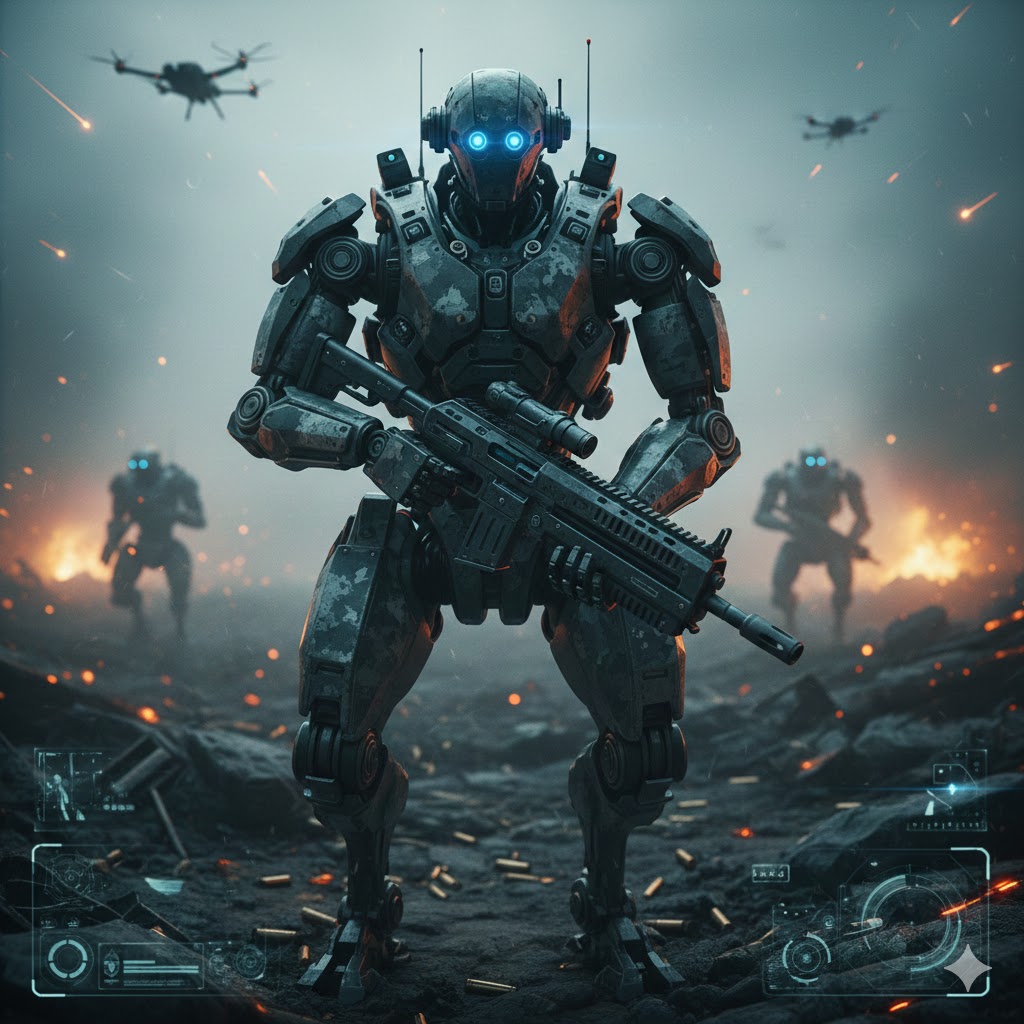
War has always been a mirror of human ingenuity and fear. From sharpened stones to gunpowder, from trenches to nuclear arsenals, each technological leap has altered not only how wars are fought but also how societies think about violence, responsibility, and survival. In the early twenty-first century, a new transformation is unfolding—one driven not by stronger explosives or faster aircraft, but by artificial intelligence. Autonomous weapons, often described as “AI soldiers,” are reshaping the nature of warfare in ways that challenge long-standing assumptions about human control, ethical responsibility, and the limits of machines.
These systems do not merely extend human reach; they introduce the possibility that machines could select and engage targets without direct human intervention. This shift is more than a technical upgrade. It represents a fundamental change in the relationship between humans and the use of force. To understand the rise of AI soldiers, it is necessary to examine the science behind autonomous weapons, their historical roots, their military advantages and risks, and the ethical and geopolitical questions they raise. The story of autonomous warfare is not just about algorithms and sensors; it is about the future of conflict and the values that will govern it.
From Automation to Autonomy in Warfare
Military technology has always incorporated elements of automation. Even the earliest mechanical devices, such as catapults or clockwork triggers, reduced the need for constant human input. In the modern era, automation became increasingly sophisticated. Radar-guided anti-aircraft systems, missile defense platforms, and automated navigation tools demonstrated that machines could perform specific tasks faster and more reliably than humans in high-pressure environments.
However, automation and autonomy are not the same. Automated systems follow predefined rules and respond to specific inputs in predictable ways. An automated missile defense system, for example, may track incoming threats and calculate interception trajectories, but it typically operates within tightly constrained parameters set by human designers. Autonomy, by contrast, implies a system’s ability to make decisions in complex, uncertain environments with minimal or no human oversight.
The rise of artificial intelligence, particularly machine learning, has made autonomy increasingly feasible. AI systems can analyze vast amounts of data, identify patterns, and adapt their behavior based on experience. In military contexts, this means that machines can potentially recognize targets, assess threats, and choose actions dynamically. The transition from automated weapons to autonomous weapons marks a qualitative shift in how force can be applied.
The Technological Foundations of AI Soldiers
At the core of autonomous weapons lie several interlocking technologies. Machine learning algorithms enable systems to process sensor data and make probabilistic judgments. Computer vision allows machines to interpret visual information from cameras and infrared sensors, distinguishing objects, vehicles, and human forms. Sensor fusion combines inputs from radar, lidar, acoustic sensors, and satellite data to create a coherent picture of the battlefield.
Equally important is the role of decision-making architectures. Autonomous systems rely on models that evaluate possible actions and their likely outcomes. These models may be trained using simulations that expose the AI to millions of hypothetical scenarios, allowing it to refine its responses. Advances in edge computing have made it possible for these calculations to occur directly on the platform, reducing dependence on remote communication links that could be disrupted.
Robotics provides the physical embodiment of AI soldiers. Unmanned aerial vehicles, ground robots, and maritime drones serve as platforms for autonomous capabilities. These machines can operate in environments that are dangerous or inaccessible to humans, such as contaminated zones, deep seas, or contested airspace. Together, AI, sensors, and robotics form the technological backbone of autonomous warfare.
Early Examples and Emerging Capabilities
Autonomous features are already present in many modern weapons systems. Defensive platforms designed to intercept rockets or incoming projectiles often operate at speeds beyond human reaction time, requiring automated decision-making. Unmanned drones can navigate complex terrain, avoid obstacles, and maintain formation with minimal human input. Naval systems can patrol vast areas, detecting and tracking potential threats over long durations.
More controversial are systems designed with offensive autonomy. Experimental drones have demonstrated the ability to identify and pursue targets independently under certain conditions. Loitering munitions, sometimes described as “kamikaze drones,” can search for targets and strike once identified. While many of these systems still involve human authorization at key stages, the trajectory of development points toward increasing independence.
These early examples illustrate both the promise and the peril of AI soldiers. On one hand, they offer precision, speed, and endurance beyond human capabilities. On the other hand, they raise concerns about reliability, accountability, and unintended escalation. As autonomy increases, so too does the importance of understanding its implications.
Speed, Scale, and the Changing Tempo of War
One of the most profound effects of autonomous weapons is the acceleration of warfare. Human decision-making, constrained by cognitive limits and emotional stress, operates on timescales of seconds to minutes. Machines, by contrast, can process information and act in milliseconds. In a conflict involving autonomous systems on both sides, engagements could unfold at speeds that leave little room for human intervention.
This acceleration has strategic consequences. Rapid decision cycles may favor those with superior algorithms and computing power, potentially destabilizing traditional deterrence relationships. The risk of unintended escalation increases when automated systems interact in unpredictable ways. A misinterpreted signal or an unforeseen interaction between autonomous platforms could trigger responses faster than humans can intervene.
Scale is another factor. Autonomous systems can be produced and deployed in large numbers, creating swarms that overwhelm defenses through sheer quantity. Coordinated by AI, such swarms could adapt collectively to changing conditions, redistributing tasks and compensating for losses. This capability challenges conventional military planning, which has traditionally focused on individual platforms and hierarchical command structures.
Precision and the Promise of Reduced Harm
Proponents of autonomous weapons often argue that AI soldiers could make warfare more precise and potentially less harmful to civilians. Machines do not experience fear, fatigue, or anger, factors that can impair human judgment in combat. In theory, an AI system trained to follow international humanitarian law could apply force more consistently than a human under stress.
Advanced sensors and data analysis could allow autonomous weapons to identify targets with greater accuracy, reducing collateral damage. Real-time assessments of the environment might enable systems to delay or abort attacks when civilians are detected. From this perspective, autonomy is seen as a tool for ethical improvement, not moral erosion.
However, this promise depends critically on the quality of data, the robustness of algorithms, and the clarity of ethical constraints encoded into the system. Real-world environments are messy and ambiguous. Distinguishing combatants from non-combatants often requires contextual understanding that goes beyond pattern recognition. The gap between theoretical precision and practical performance remains a central concern.
The Problem of Accountability
As machines take on greater decision-making roles, questions of responsibility become increasingly complex. In traditional warfare, accountability is relatively clear. Human commanders and soldiers can be held responsible for their actions under military law and international conventions. Autonomous weapons blur this clarity.
If an AI soldier makes a lethal decision that violates the laws of war, who is responsible? The programmer who wrote the code, the engineer who designed the hardware, the commander who deployed the system, or the political authority that authorized its use? This diffusion of responsibility challenges existing legal frameworks, which are built around human agency and intent.
Efforts to address this issue often emphasize the concept of “meaningful human control.” This principle asserts that humans must retain sufficient oversight to be accountable for the use of force. Yet defining what counts as meaningful control is difficult. Is it enough for a human to approve a mission in advance, or must they be able to intervene in real time? As autonomy increases, maintaining genuine human control becomes technically and operationally challenging.
Ethical Dimensions of Machine Decision-Making
Beyond legal accountability lies a deeper ethical question: should machines be allowed to make life-and-death decisions at all? For many critics, the idea of delegating lethal authority to algorithms crosses a moral boundary. They argue that killing requires moral judgment, empathy, and responsibility—qualities that machines do not possess.
Supporters counter that warfare has always involved technological mediation and that autonomy is a matter of degree rather than kind. They note that human decision-making is not inherently ethical and that machines could be designed to adhere strictly to ethical rules. The debate reflects broader tensions about artificial intelligence and the nature of moral agency.
Philosophical perspectives diverge sharply on this issue. Some emphasize the intrinsic value of human judgment, while others focus on outcomes, arguing that if autonomous systems reduce overall harm, their use may be justified. This ethical debate is unlikely to be resolved easily, as it touches on fundamental beliefs about human dignity and the role of technology in society.
Bias, Data, and the Risk of Error
AI systems learn from data, and the quality of that data shapes their behavior. In civilian contexts, biased or incomplete data can lead to unfair outcomes. In military contexts, such biases can have deadly consequences. If training data does not adequately represent the diversity of real-world scenarios, an autonomous weapon may misidentify targets or behave unpredictably.
Environmental factors such as weather, terrain, and lighting can also affect sensor performance. Adversaries may deliberately attempt to deceive or confuse AI systems through camouflage, decoys, or electronic interference. While humans are also vulnerable to deception, they can often draw on contextual understanding and intuition in ways that machines cannot easily replicate.
Robust testing and validation are essential, but they cannot cover every possible scenario. The unpredictability of warfare means that autonomous systems will inevitably encounter situations beyond their training. How they respond in such moments remains an open and troubling question.
Strategic Stability and the Risk of Arms Races
The development of AI soldiers has significant implications for global security. States that perceive themselves as lagging in autonomous capabilities may feel pressure to accelerate development, fearing strategic disadvantage. This dynamic risks triggering an arms race, where speed of deployment becomes more important than careful evaluation.
Autonomous weapons could also lower the threshold for conflict. If the political and human costs of deploying force are reduced, leaders may be more willing to engage in military actions. The use of machines instead of soldiers can make war feel more distant and abstract, potentially weakening public restraint.
At the same time, the opacity of AI systems complicates deterrence. Traditional deterrence relies on clear signaling of capabilities and intentions. When decision-making is partially delegated to algorithms, predicting an adversary’s response becomes more difficult. Miscalculations could lead to unintended escalation, particularly in crises involving multiple autonomous systems interacting in real time.
International Law and Emerging Norms
International humanitarian law, including the Geneva Conventions, was developed in an era when humans were the primary agents of warfare. Applying these frameworks to autonomous weapons presents significant challenges. Concepts such as intention, proportionality, and distinction are central to the law of armed conflict, yet they are difficult to translate into algorithmic terms.
In response, there have been calls for new international agreements to regulate or prohibit fully autonomous weapons. Some advocate for a preemptive ban, arguing that the risks are too great to allow widespread deployment. Others support regulation and transparency, emphasizing the potential benefits of autonomy if properly constrained.
International discussions have highlighted the diversity of perspectives among states. Technological leaders may favor flexible guidelines that preserve innovation, while others seek stronger restrictions to prevent destabilization. The outcome of these debates will shape the future trajectory of autonomous warfare.
Human–Machine Teaming on the Battlefield
Rather than replacing human soldiers entirely, many military planners envision a future of human–machine teaming. In this model, AI systems augment human capabilities, handling tasks such as reconnaissance, logistics, and threat detection, while humans retain ultimate control over critical decisions.
Human–machine teams could combine the strengths of both. Machines offer speed, endurance, and data processing, while humans provide judgment, creativity, and ethical reasoning. Effective collaboration requires interfaces that allow humans to understand and trust AI recommendations without becoming overly dependent on them.
This balance is delicate. Overreliance on automation can lead to skill degradation, where human operators lose the ability to intervene effectively. Designing systems that support, rather than undermine, human agency is a central challenge in the development of AI soldiers.
Psychological and Social Impacts of Autonomous Warfare
The introduction of AI soldiers affects not only military strategy but also the psychological experience of war. For human soldiers, fighting alongside autonomous systems may alter perceptions of risk, responsibility, and camaraderie. Trust in machines becomes a critical factor, particularly when lives depend on their performance.
For societies, the distancing effect of autonomous warfare raises concerns about democratic accountability. When wars are fought with fewer human casualties on one’s own side, public scrutiny may diminish. The moral weight of war could be obscured by technological abstraction, making it easier to sustain prolonged conflicts.
At the same time, the use of AI soldiers may influence how adversaries and civilians perceive military power. The presence of autonomous systems can evoke fear and uncertainty, particularly when their behavior is difficult to predict. Managing these psychological dimensions is as important as addressing technical performance.
The Science of Control and Predictability
Ensuring that autonomous weapons behave predictably is a scientific and engineering challenge. Complex AI systems, particularly those based on deep learning, can be difficult to interpret. Their internal decision processes may not be easily explained, even by their creators. This opacity complicates efforts to verify compliance with ethical and legal constraints.
Research into explainable artificial intelligence seeks to address this issue by making AI decisions more transparent. In military contexts, explainability is not merely an academic concern; it is essential for trust, accountability, and effective command. Commanders must be able to understand why a system recommends or takes a particular action.
Control mechanisms, such as fail-safes and override capabilities, are also crucial. These features aim to ensure that humans can intervene if an autonomous system behaves unexpectedly. However, as systems operate at higher speeds and greater levels of complexity, maintaining effective control becomes increasingly challenging.
The Future Battlefield and the Role of Humans
Looking ahead, it is clear that autonomous weapons will continue to evolve. Advances in AI, robotics, and materials science will expand their capabilities and reduce their limitations. The question is not whether AI soldiers will exist, but how they will be integrated into military and political decision-making.
Some envision a future where human soldiers are largely removed from direct combat, with machines bearing the physical risks. Others warn that this vision underestimates the enduring importance of human judgment and the unpredictability of conflict. War is not merely a technical problem to be optimized; it is a social and political phenomenon shaped by human values and choices.
The role of humans may shift from direct action to oversight, strategy, and ethical governance. This transition requires not only technological adaptation but also cultural and institutional change. Training, doctrine, and leadership must evolve to address the realities of human–machine warfare.
Moral Responsibility in an Automated Age
The rise of AI soldiers forces societies to confront fundamental questions about moral responsibility. Technology does not exist in a vacuum; it reflects the priorities and values of those who develop and deploy it. Decisions about autonomy in warfare are ultimately decisions about how much control humans are willing to relinquish and under what conditions.
Maintaining moral responsibility in an automated age requires deliberate choices. It involves setting clear boundaries, investing in oversight, and fostering international dialogue. It also requires humility, recognizing that no system is infallible and that the consequences of error in warfare are profound.
The debate over autonomous weapons is not solely about machines; it is about humanity’s relationship with violence and power. How societies navigate this debate will shape not only the future of warfare but also the broader trajectory of artificial intelligence.
Conclusion: A Turning Point in the History of War
The rise of AI soldiers marks a turning point in the long history of warfare. Autonomous weapons embody extraordinary scientific achievement, drawing on advances in artificial intelligence, robotics, and data science. They promise speed, precision, and new forms of military capability. At the same time, they introduce risks that challenge existing ethical, legal, and strategic frameworks.
Understanding how autonomous weapons change warfare requires more than technical analysis. It demands reflection on accountability, morality, and human agency. The choices made today—by scientists, military leaders, policymakers, and citizens—will determine whether AI soldiers become tools for restraint and protection or catalysts for instability and harm.
Physics and engineering have given humanity unprecedented power over the material world. Artificial intelligence extends that power into the realm of decision-making itself. In the context of war, this extension carries immense responsibility. The rise of AI soldiers is not merely a technological evolution; it is a test of how wisely humanity can wield its own creations.