An abandoned SpaceX Falcon 9 upper stage is expected to strike the moon on Aug. 5, 2026, creating a fresh crater and a towering cloud of lunar dust that astronomers may be able to observe from Earth. Researchers say the impact offers an unusual chance to study an artificial lunar collision in real time while testing a new way to determine exactly where objects hit the moon.
An abandoned rocket stage is on a direct path toward the moon, and astronomers are preparing for what could become one of the most closely watched artificial impacts ever recorded.
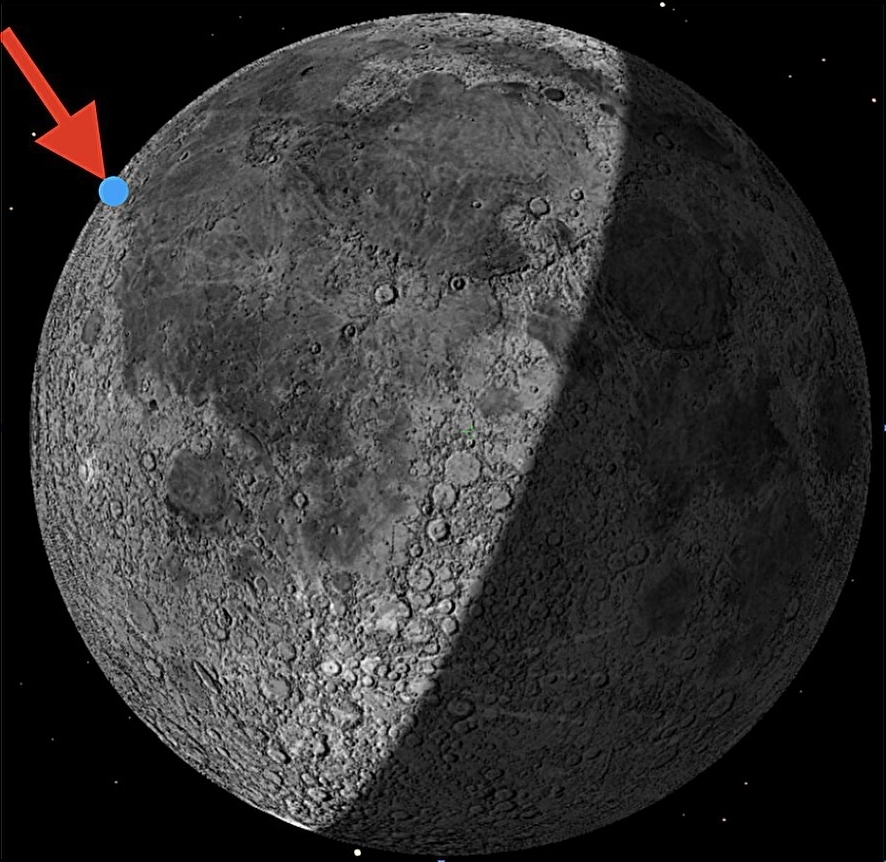
According to a new paper posted on the arXiv preprint server, the collision is expected to occur on Aug. 5, 2026, near Einstein Crater on the moon’s visible side. Because the impact may produce both a bright flash and a large plume of dust, researchers are encouraging observatories and amateur skywatchers alike to record the event.
The authors describe the impact as more than a striking celestial spectacle. It also provides a valuable opportunity to test a new technique for determining the precise location of lunar impacts, an approach that could support future lunar seismic experiments.
A Rocket Stage Left Drifting After Its Mission
The object heading toward the moon is the upper stage of a SpaceX Falcon 9 rocket, cataloged as 2025-010D.
Its journey began in January 2025, when it successfully launched two private robotic lunar landers. After delivering the spacecraft onto their paths toward the moon, the upper stage exhausted its fuel.
Without enough propellant to steer itself into deep space or guide a controlled return to Earth for atmospheric burn-up, the rocket stage remained in space, drifting until its orbit placed it on a collision course with the moon.
The abandoned hardware measures roughly 12 meters (39 feet) long, 4 meters (13 feet) wide, and has a mass of approximately 4,000 kilograms. Researchers estimate it will strike the lunar surface at about 8,750 kilometers per hour (5,400 mph).
Simulations Reveal How the Impact Could Unfold
To predict the consequences of the collision, the study’s authors used orbital tracking data calculated by astronomer Bill Grey and incorporated it into an advanced physics simulation.
Their models indicate that the rocket stage should behave differently from a natural asteroid because of its construction.
Unlike a dense, solid rock, the rocket stage is largely a hollow metal structure. Rather than driving deeply into the lunar surface, the vehicle is expected to collapse under the force of impact.
The simulations suggest the collision will excavate a new crater measuring approximately 20 to 30 meters (66 to 98 feet) across while ejecting a substantial cloud of lunar dust several kilometers above the surface.
That expanding cloud of debris is one of the event’s most important scientific targets.
As the researchers explain in their paper, “Potential observables from this event include the flash at the time of impact … and the ejecta plume.“
A Rare Opportunity for Lunar Observations
Artificial impacts on the moon are uncommon, making this event particularly valuable for researchers.
Because astronomers know both the incoming object’s trajectory and its expected arrival time, they can prepare telescopes and cameras in advance. Capturing the collision and comparing it with predictions could help scientists refine methods for identifying exactly where impacts occur on the lunar surface.
Improving that capability could prove useful when planning future experiments designed to study seismic activity on the moon.
The paper therefore calls on the broader scientific community to participate in observing the event. Both professional observatories and experienced amateur astronomers may be able to contribute useful data if conditions allow.
Timing Will Be Critical
Researchers emphasize that success will depend heavily on precise timing.
Current calculations predict the rocket stage will hit the moon at approximately 06:35 UTC on Aug. 5, 2026. Because the collision will occur on the moon’s visible side, observers on Earth could have an opportunity to detect the impact.
The authors note that cameras capable of recording very high-speed video will be needed to capture the brief flash produced at the moment of impact and the rapidly developing dust plume that follows.
If those observations are successful, the event could provide an unusually detailed record of an artificial object striking the moon—offering scientists a rare chance to compare real observations with computer simulations while testing new techniques for locating lunar impacts with greater precision.