More than two decades after a rare stellar explosion vanished behind its own dust, astronomers have finally identified the unusual binary star system that caused it. The observations also uncovered mysterious, possibly oxygen-rich gas clumps racing through space at up to 20 million miles per hour, a phenomenon never before seen in any other known nova.
For more than 20 years, one of the Milky Way’s strangest stellar explosions kept its secrets hidden behind a dense cloud of dust. Now, as that veil has finally begun to clear, astronomers have identified the remarkable star system responsible for the galaxy’s only confirmed helium nova—and discovered an unexpected mystery embedded within its expanding debris.
The findings come from observations collected over two decades and are being presented this week at the Royal Astronomical Society’s National Astronomy Meeting in Birmingham. The work provides the clearest picture yet of V445 Puppis, an exceptionally rare stellar system that has challenged astronomers since its dramatic eruption in late 2000.
Even more surprising, the researchers detected high-speed clumps of gas—described as “bullets”—traveling through the nova’s debris at extraordinary speeds. Their origin remains unknown.
Dust Finally Uncovers the Hidden Star System
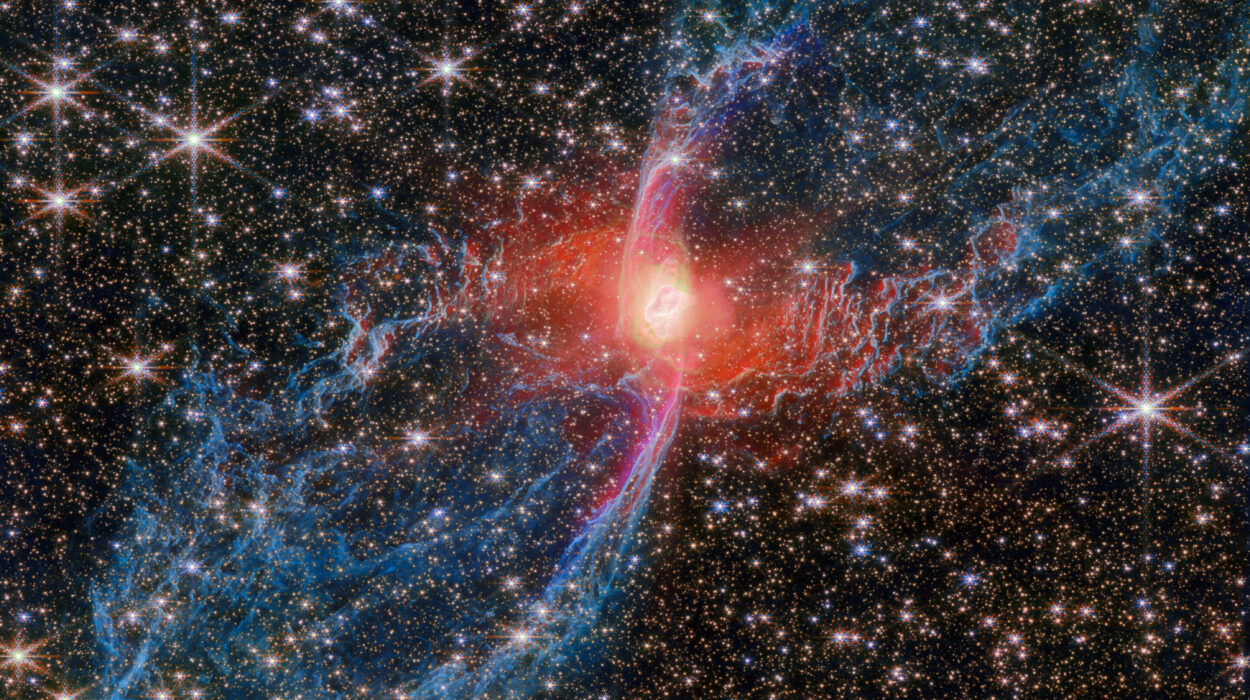
When V445 Puppis erupted at the end of 2000, it expelled an enormous bipolar outflow that stretched more than a trillion miles across space. The explosion also created a thick disk of dust that completely obscured the stars at its center.
Although astronomers could continue tracking the expanding debris cloud, the dust prevented them from determining exactly what kind of stellar system had produced such an unusual explosion.
That obstacle has finally disappeared.
Using infrared observations from the European Southern Observatory’s Very Large Telescope, optical images from the Hubble Space Telescope, long-term spectroscopy from the Southern African Large Telescope, and photometric data from NASA’s TESS mission, University of Warwick doctoral researcher John Mills reconstructed the hidden binary system in unprecedented detail.
“The explosion’s outflow has now faded sufficiently for us to probe its origin, so we can confirm that the star system does indeed consist of a white dwarf grabbing material from an extremely rare type of star called a helium star,” Mills said.
Why This Nova Is Different
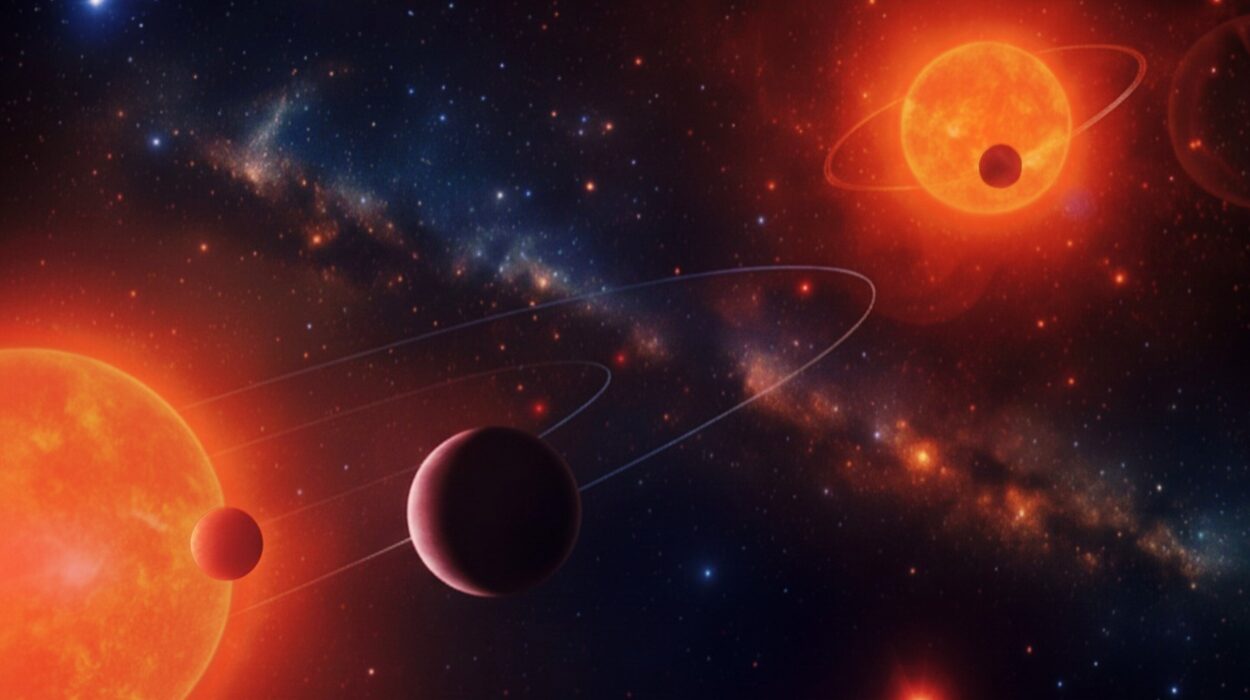
A nova occurs when a white dwarf—the dense remnant of a Sun-like star—pulls material from a nearby companion. As gas accumulates on the white dwarf’s surface, temperatures and pressures eventually become high enough to trigger a runaway thermonuclear explosion.
Nearly all known novae feed on hydrogen-rich material.
V445 Puppis is fundamentally different.
Instead of collecting hydrogen, the white dwarf is drawing in helium-rich, hydrogen-poor material from its companion, making it a helium nova, one of the rarest known varieties of stellar explosion.
“V445 Puppis has long stood out among novae for its complete lack of hydrogen. How could such an event be completely devoid of the most abundant element in the universe?” Mills said.
The new observations answer that question by identifying the companion as a helium star—a star that has already lost its outer hydrogen envelope, likely through earlier interactions with the white dwarf.
Helium stars themselves are exceptionally uncommon. Astronomers estimate that only a few thousand stripped helium stars exist among the Milky Way’s hundreds of billions of stars.
Because V445 Puppis is currently the only confirmed helium nova in the galaxy, it offers researchers a unique opportunity to investigate this rare type of stellar eruption.
Strange “Bullets” Race Through the Debris
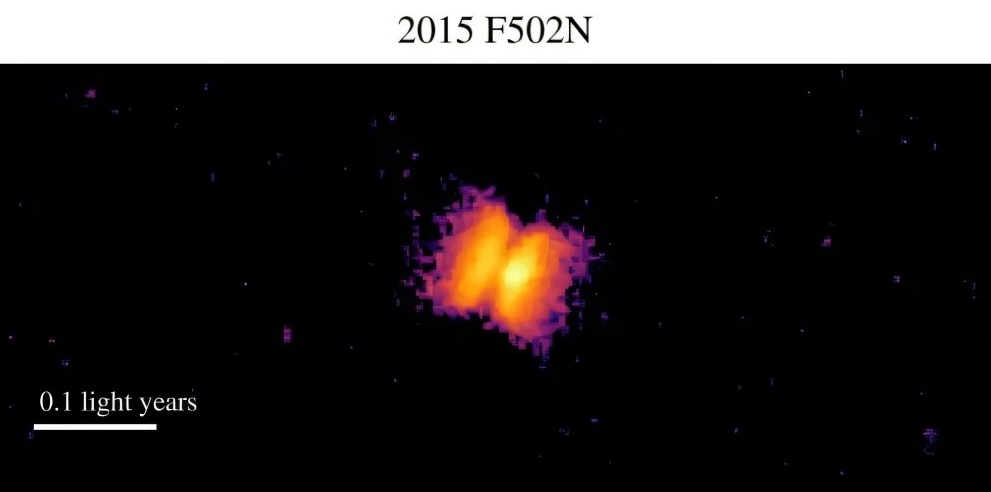
Among the most unexpected discoveries were compact, fast-moving clumps of gas embedded within the expanding debris cloud.
These “bullets,” thought to be possibly rich in oxygen, are traveling at speeds reaching 20 million miles per hour.
No similar structures have been observed in any other known nova.
“The origin of these ‘bullets’ is a mystery. We suspect that these originated post-outburst, but ‘bullets’ of this kind have not been observed in any other nova,” Mills said.
Because the phenomenon has never been documented elsewhere, astronomers do not yet know what process created these rapidly moving gas clumps or why they appear only in this unusual system.
The Binary System Has Become Active Again
The observations also revealed that the stellar pair has resumed transferring material.
That means the white dwarf is once again accreting helium-rich gas from its companion—the same process that ultimately produced the original eruption more than two decades ago.
The researchers also determined that the two stars complete one orbit every 3.7 days, approximately twice as long as previous estimates suggested.
These measurements provide a more accurate picture of the system’s dynamics and establish a stronger foundation for future observations as the binary continues evolving.
A Rare Window Into Explosive Stellar Evolution
Understanding helium novae may have implications that extend well beyond this single object.
Astronomers have proposed that repeated helium-rich eruptions could represent one possible evolutionary pathway toward producing Type Ia supernovae, some of the brightest explosions observed in the universe.
These supernovae are especially important because they exhibit remarkably consistent brightness.
“Because these supernovae shine with remarkably consistent brightness, they are special in their use as ‘standard candles,’ used to measure distances to galaxies,” Mills explained.
Type Ia supernovae have played a central role in measuring the expansion of the universe and were instrumental in Nobel Prize-winning research showing that cosmic expansion is accelerating.
Whether helium novae like V445 Puppis eventually evolve into Type Ia supernovae remains uncertain. However, confirming the nature of this binary system provides an important opportunity to investigate that possibility.
“The culprits behind this galactic eruption have been an enduring mystery over the past 25 years, which is why it is very exciting to confirm that this helium nova was the result of a helium star accreting onto a white dwarf,” Mills said. “I look forward to seeing how this result may help us uncover what powers other similar hydrogen-poor astronomical explosions, such as the famous Type Ia supernovae.”
Although major questions remain, V445 Puppis has become the clearest natural laboratory available for studying one of astronomy’s rarest stellar explosions. Its newly revealed binary system—and its unexplained, ultra-fast gas “bullets”—offer fresh clues about how some of the universe’s most unusual and powerful eruptions unfold.