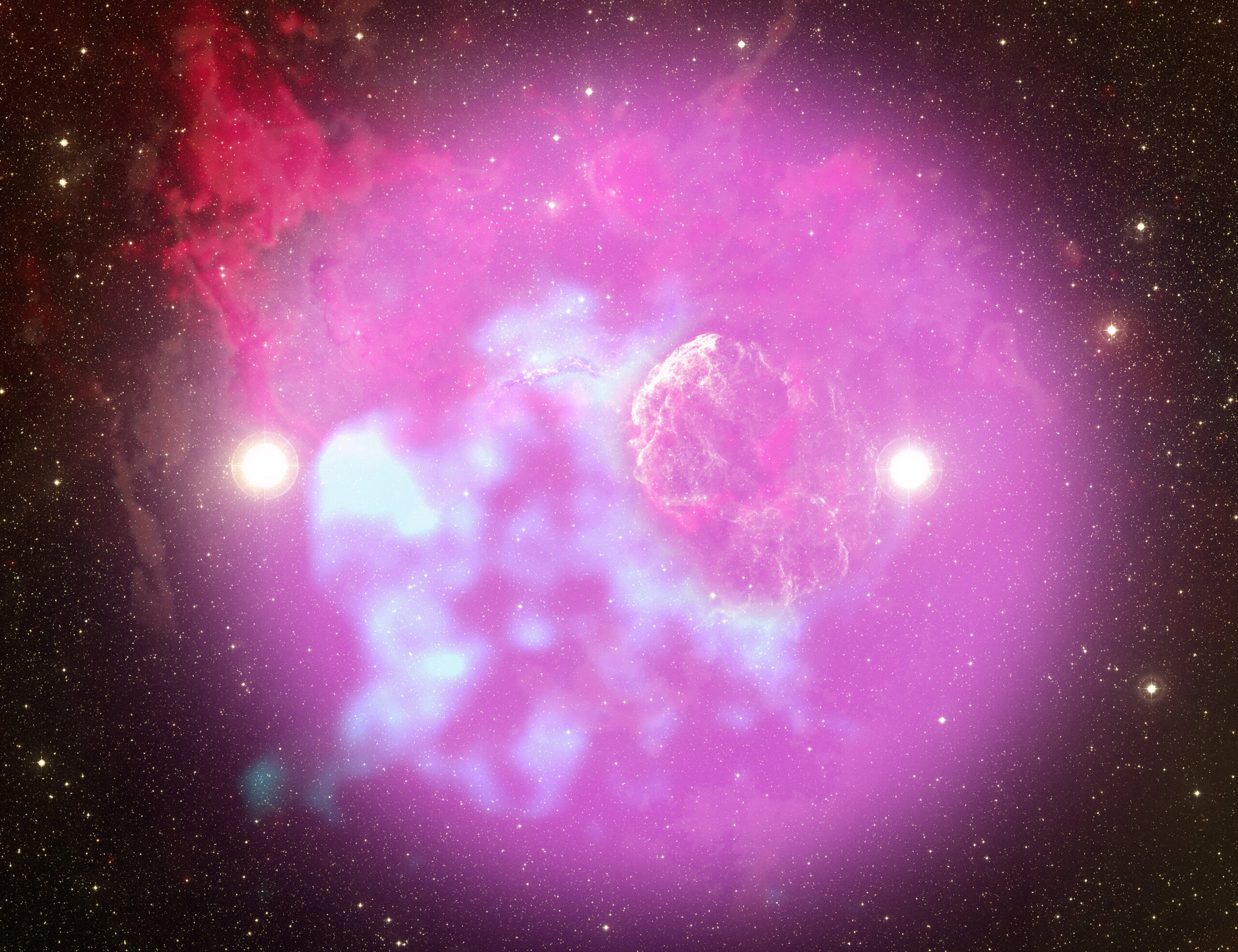
Two neighboring supernova remnants appear to be the remains of a long-lost pair of massive stars, with evidence suggesting one star exploded up to 100,000 years before its companion. The finding could represent the first known binary star system in which both stars ended their lives as supernovae, offering a rare glimpse into how massive stellar pairs evolve.
Astronomers have uncovered evidence that the Jellyfish Nebula, one of the Milky Way’s best-known supernova remnants, may have a remarkable history. Rather than marking the death of an isolated star, the nebula appears to share its surroundings with another supernova remnant that likely originated from its former stellar companion.
The discovery points to what researchers say could be the first identified case of a binary star system in which both stars eventually exploded as supernovae. Their findings have been published in Nature Communications.
Two stellar explosions in the same neighborhood
The Jellyfish Nebula, also known as IC 443, is the expanding cloud of debris left behind after a massive star exploded. Located in the constellation Gemini about 6,000 light-years from Earth, it has long been recognized as a striking example of a supernova remnant.
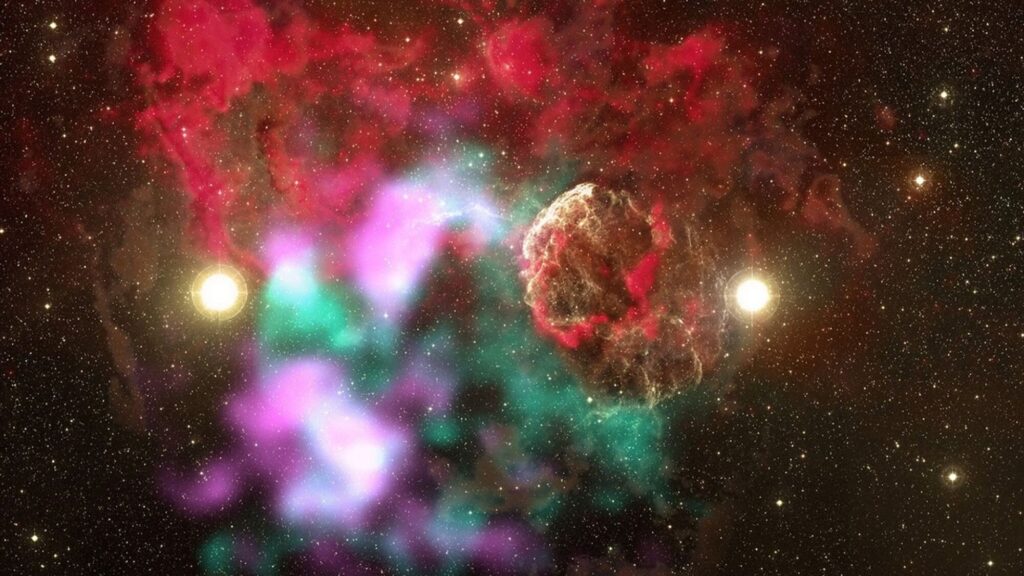
Researchers have now shown that IC 443 shares the same physical environment as another supernova remnant known as G189.6+3.3. Rather than being unrelated objects that merely appear close together in the sky, the evidence indicates they occupy nearly the same region of space and lie at approximately the same distance from Earth.
That connection prompted scientists to ask whether the two remnants could share an even deeper history.
Untangling a crowded region of the Milky Way
Finding relationships between supernova remnants is far from straightforward. Although astronomers have identified hundreds of these expanding debris clouds throughout the Milky Way, determining whether any are physically related is especially challenging in regions crowded with gas, dust, and overlapping astronomical structures.
IC 443 sits within one such complex environment, making its surroundings difficult to interpret using any single type of observation.
To overcome this challenge, Miltiadis Michailidis and colleagues combined 16 years of observations from the Fermi Large Area Telescope with X-ray data from eROSITA and additional observations collected across multiple wavelengths.
By bringing together these different datasets, the researchers were able to establish that G189.6+3.3 and IC 443 occupy the same physical environment rather than simply lining up by chance along Earth’s line of sight.
A timeline that points to a shared origin
The ages of the two remnants provide the strongest clue that they are connected.
According to the researchers’ estimates, the star that created G189.6+3.3 exploded roughly 20,000 to 100,000 years before the explosion that produced IC 443.
That sequence is consistent with two massive stars that formed together but reached the ends of their lives at different times.
To test whether the pairing might simply be a coincidence, the team performed statistical analyses and simulations. Those tests showed that such an arrangement is highly unlikely to result from a random alignment of unrelated supernova remnants.
Instead, the evidence supports the idea that the two progenitor stars were born together as members of the same binary star system before each eventually exploded.
A rare glimpse into stellar evolution
If confirmed, the discovery would mark the first known example of a binary system in which both stars survived long enough to become supernovae and left behind identifiable remnants that can still be observed together.
Such a system offers an unusual opportunity to study how massive stellar companions evolve over time and how their individual explosions unfold within a shared cosmic environment.
Because the remnants remain close to one another, they preserve a record of two stellar deaths separated by tens of thousands of years rather than occurring simultaneously. That makes the pair an especially valuable laboratory for investigating the life cycles of massive stars.
Looking beyond a single supernova
The findings also highlight the value of combining observations across different parts of the electromagnetic spectrum. Gamma-ray data, X-ray observations, and complementary measurements together allowed researchers to distinguish a genuine physical association from what could otherwise appear to be an accidental overlap in a crowded region of the galaxy.
As the authors note, the discovery has the potential to provide new insights into both supernovae and binary star systems. By revealing that the Jellyfish Nebula may be only one half of a much older stellar story, the study reshapes how astronomers view one of the Milky Way’s most recognizable supernova remnants—not as the isolated aftermath of a single explosion, but as evidence of two stars whose shared journey ended in separate cosmic blasts.