Previously overlooked bones embedded in a mosasaur fossil block collected more than 30 years ago have revealed the first confirmed premaxilla ever identified from a Japanese mosasaur specimen. The newly recognized fossils also display unusual anatomical features that could indicate the remains belong to a previously unknown mosasaur species, researchers reported.
Fossils stored in museum collections can continue to yield important scientific discoveries decades after they are first collected. That has now been demonstrated by researchers from Okayama University of Science, Tokyo City University, the Natural History Museum, Kishiwada City, and collaborating institutions, who uncovered four previously unrecognized fossil bones during a fresh examination of a rock containing mosasaur remains from Osaka Prefecture.
The fossils were originally collected between 1990 and 1992 in Sobura, Kaizuka City, Osaka Prefecture. Although the rock had long been preserved at the Natural History Museum, Kishiwada City, several bones remained hidden inside the surrounding rock matrix and were not recognized during the initial study.
Their rediscovery has produced one of the most significant Japanese mosasaur fossil findings in recent years, including the country’s first confirmed example of a premaxilla, the bone forming the frontmost portion of the upper jaw.
Hidden fossils revealed after decades
Rather than discovering a new fossil site, the researchers turned their attention to specimens that had already spent decades in museum collections.
During a reexamination of unprepared rock specimens, the team recovered four previously unrecognized fossil bones that had remained embedded within the matrix. Advances in preparation techniques and, more importantly, the dramatic growth of scientific knowledge about mosasaur anatomy over the past several decades allowed researchers to recognize features that had gone unnoticed when the fossils were first collected.
When the specimens were originally discovered more than 30 years ago, scientists had relatively few mosasaur fossils available for comparison. That limited their ability to identify the bones with confidence.
Today, however, decades of additional discoveries from around the world have greatly expanded the available comparative material and anatomical knowledge. Those advances enabled the team to determine that one of the newly exposed bones is a premaxilla.
First confirmed premaxilla from a Japanese mosasaur
The identification of the premaxilla represents the study’s most notable discovery.
Located at the very front of the upper jaw, the premaxilla is an important skeletal element for understanding the anatomy and classification of extinct reptiles. According to the researchers, this is the first confirmed occurrence of this particular bone in a Japanese mosasaur fossil.
The discovery fills an important gap in the fossil record preserved in Japan and provides researchers with new anatomical information that was previously unavailable from Japanese mosasaur remains.
The finding also illustrates how older museum collections can produce new scientific insights without requiring additional field excavations.
Unusual skull features raise the possibility of a new species
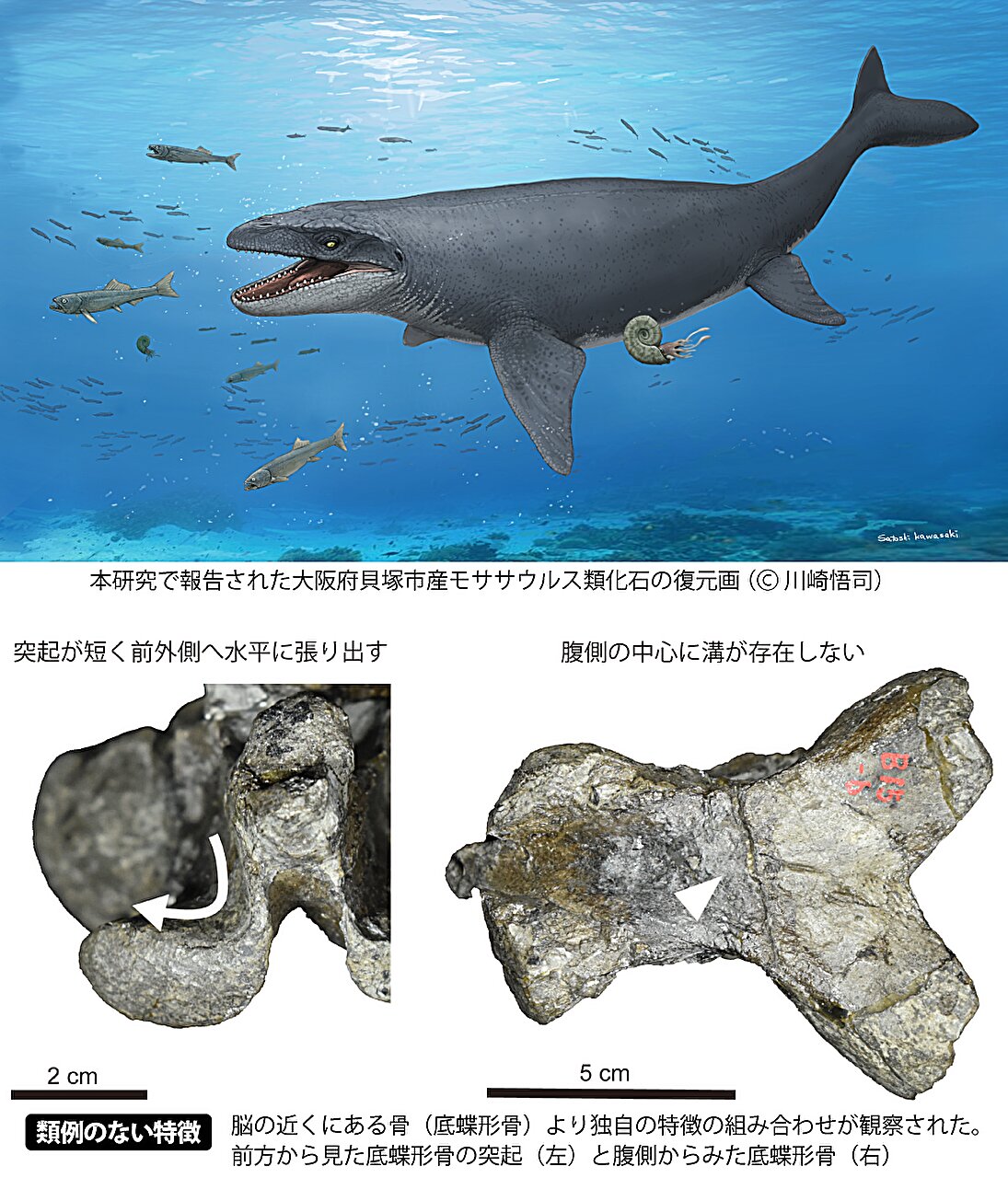
Beyond the newly identified jaw bone, the researchers also examined another part of the skull known as the basisphenoid, a bone positioned near the braincase.
The basisphenoid displayed several features that differ from those documented in previously described mosasaurs. Among them were short horn-like projections extending sideways and the absence of a ventral median groove, an anatomical combination not seen in known species.
These distinctive characteristics suggest the fossil may represent a previously unknown species of mosasaur. However, the researchers emphasize that additional investigation will be needed before such a conclusion can be confirmed.
Future research will focus on determining whether the unusual anatomical features are sufficient to establish the specimen as a new species.
A reminder of the value of museum collections
The discovery highlights the scientific importance of revisiting fossils that have already entered museum collections.
Specimens collected years or even decades earlier may still contain hidden information that becomes recognizable only after scientific understanding improves or additional comparative material becomes available. In this case, bones that remained concealed inside rock for more than three decades ultimately revealed new details about Japanese mosasaurs.
The researchers say the findings demonstrate the value of carefully reexamining unprepared specimens housed in museums and research institutions, where overlooked fossils may continue to await discovery.
Expanding knowledge of ancient Pacific marine ecosystems
Mosasaurs were large marine reptiles that lived throughout the world’s oceans during the Late Cretaceous, approximately 98 to 66 million years ago.
Although the new fossils primarily improve understanding of Japanese mosasaur anatomy, they also contribute to a broader picture of marine ecosystems that existed along the northwestern Pacific during the Cretaceous Period.
By identifying previously hidden skeletal elements and recognizing anatomical features that differ from known mosasaurs, the study adds another piece to the fossil record of these ancient marine reptiles and provides new material for future comparisons.
The research team presented the findings at the 177th Annual Meeting of the Palaeontological Society of Japan, held at Osaka Metropolitan University on June 27, 2026, where the fossils were introduced as evidence that long-curated museum collections can continue to reshape scientific understanding decades after the original discoveries.